
Independent News
Reproductive rights protests erupt nationwide in wake of leaked SCOTUS opinion
This post was originally published on this site
Protests began Monday night in the wake of Politico publishing a leaked Supreme Court draft opinion from Justice Samuel Alito that would essentially overturn Roe v. Wade and bodes terribly for reproductive rights. With Alito’s lengthy opinion threatening a host of rights, including marriage equality, people have taken to the streets to fight against such a damaging potential ruling. Demonstrations in front of the Supreme Court saw hundreds of people coming together in a show of solidarity. Shortly after, protests were planned across the country. Multiple demonstrations will take place in New York, with Amazon Labor Union organizer Christian Smalls among countless others tweeting times and locations for events. Smalls’ tweet shows how intrinsically linked reproductive rights are to labor rights, as workers have been battling for decades for equality in health care and access to necessary services like abortions.
Countless unions have voiced their support of preserving Roe, as have activists in other organizing spaces. It only makes sense that their calls for reproductive justice would include taking to the streets on Tuesday. In Michigan, where abortion restrictions preceding Roe were never eliminated, Planned Parenthood is asking folks to take to the state capitol Tuesday evening. Organizers with the Women’s March have urged people across the country to demonstrate in front of courthouses, federal buildings, town halls, and squares. And groups like the Party for Socialism and Liberation also have protests planned around the country on Tuesday and Wednesday.
More and more scenes from protests are popping up on social media, with demonstrators gathering in Georgia, Nebraska, Missouri, Michigan, Pennsylvania, and Texas.
Demonstrators in Florida are rightfully targeting Gov. Ron DeSantis, who is not only aggressively anti-abortion but has made a concerted effort to enact laws that target reproductive health care access for pregnant people and the LGBTQ community.
My state is showing out, y’all! Reproductive rights are especially essential for communities in Louisiana, which is one of 13 states that have trigger laws on the books that would automatically ban abortions were Roe to be reversed. Louisiana also faces some of the most severe weather threats due to climate change, which further threatens access to reproductive health care. As I wrote earlier, reproductive justice is an essential component of seeking environmental justice.
Hundreds took to Kerry Park in Seattle to protest Alito’s draft opinion and the potential elimination of Roe v. Wade. Though the state of Washington has relatively progressive laws protecting the right to choose, many who live there have had to travel more than 25 miles for abortion access — a particularly barrier for more vulnerable communities.
We Testify provided space outside the Supreme Court for those who’ve had an abortion to share their stories. The organization has done powerful work to center reproductive health care in its fight for equality while also supporting the LGBTQ community.
New Yorkers are out in full force to protest Alito’s draft opinion and advocate for reproductive rights. Multiple demonstrations are taking place across New York City, including at Barclays Center and Foley Square.
So far, the amount of pro-choice demonstrators have far exceeded the amount of counter-protesters near the Supreme Court.
A crowd has gathered in Portland, Maine in front of the U.S. District court. Planned Parenthood shared a tweet of the scene:
Demonstrations are taking shape in the nation’s capital, with Politico’s Nicholas Wu noting the presence of dump trucks meant to “block 1st St. and the SCOTUS protests.” Additional on-the-ground footage shows the steps to the Supreme Court completely blocked off.
I’ll be following the protests as they unfold throughout the evening so please comment if you’re attending any actions in your community. And sign the petition urging Congress to codify Roe v. Wade.
Cartoon: Leak
If SCOTUS kills Roe, many states are poised to swiftly enforce abortion bans, sweeping restrictions
This post was originally published on this site
Abortion is still legal in the United States. The recently-leaked draft Supreme Court opinion does not yet change that. But should the high court opt to ignore the bodily autonomy of people who can become pregnant everywhere in America and overturn Roe v. Wade—a nearly 50-year-old federal law—that decision could spark dire consequences and likely at neck-breaking speed.
In mid-April, the Guttmacher Institute updated its 2021 analysis on states that are “certain or likely” to ban abortion without Roe in place. It found that 22 states had laws on the books or constitutional amendments ready to usher in the bans.
Disturbingly, of those 22 states, 13 have existing “trigger” laws that are meant to go into effect if Roe falls. A breakdown of those states is provided below—but it is critical to note that these are states with existing trigger bans on the books.
States like Florida, Indiana, Montana, or Nebraska might not have trigger laws yet, but they are considered regions teetering on abortion access as-is. Other states, like Alabama, South Carolina, Ohio, Iowa, and Georgia have already attempted to strike down access to abortion in the courts. Guttmacher expects those efforts will resume if the high court abandons Roe.
Fifty-three Democratic state party organizations responded to the leak with a statement Tuesday, noting that the “shockwaves” of former President Donald Trump’s presidency—and his impact on the judiciary—are “neither gone nor forgotten.”
But that shouldn’t serve as a deterrent, they argue:
“Many of us live in states where abortion access has been overturned or torn apart by extremist Republicans who have no business interfering in personal health decisions. Abortion bans are not favored by a majority of Americans, and they never will be. They are, however, supported by an extremist group of right wing primary voters and donors—and that’s why the GOP continues to fight to restrict abortion access nationally and in our legislatures.
“In the wake of this decision, the Supreme Court’s anticipated opinion will signal a return of power to the elected representatives of each state and territory. Therefore, it is important now, more than ever, that we protect and exercise those rights that remain intact—our First Amendment rights to associate and to vote representatives into office who will stand firm and protect their constituents from the threats and whims of conservatives.
“Across America, our State Democratic Parties will work tirelessly to recruit, train, and support Democratic candidates for state and federal office who will fight for the right to abortion. We encourage our federal legislators to codify Roe immediately. We cannot and will not wait.”
Related story: From contraception to LGBTQ rights—Alito’s draft opinion on Roe opens the floodgates
The following states each have a trigger ban in place. Many on this list also already have other prohibitions in place—think a six-week or eight-week abortion ban or a “near-total” ban:
- Arkansas
- Idaho
- Kentucky
- Louisiana
- Mississippi
- Missouri
- North Dakota
- Oklahoma
- South Dakota
- Tennessee
- Texas
- Utah
- Wyoming
Arkansas
In Arkansas, it is currently illegal to get an abortion if you are more than 30 weeks pregnant. Arkansas Governor Asa Hutchinson took that a step further in 2019 when he approved a trigger law proposing to automatically ban abortion in the state if Roe was overturned.
Some medical emergencies are allowed as an exception, for now.
Arkansas abortion providers face up to 10 years in prison if caught breaking the law and could also be forced to pay a fine of up to $100,000.
A federal judge last July blocked an attempt by the state to enforce a “near-total” abortion ban there, meaning that regardless of nearly all circumstances, a person would be unable to obtain an abortion.
Idaho
in Idaho, state legislators and Governor Brad Little have a trigger law in place that would make it a felony for health care providers to perform an abortion if “fetal cardiac activity” is detected. The trigger law recommends up to five years in prison for violators.
Another law in Idaho that passed this spring bans abortion at roughly six weeks—or just when fetal cardiac activity, i.e. a heartbeat, can first be detected. At this early stage, a pregnancy is often still unnoticed by the pregnant individual.
And if there are family members of the pregnant person who wish to sue the abortion provider, they could do that under the bill until just recently.
The law was momentarily stopped by the Idaho Supreme Court on April 8.
Kentucky
Senate Minority Leader Mitch McConnell’s home state passed legislation this March that bans abortion after 15 weeks if Roe is overturned and only makes exceptions in cases where the pregnancy could be complicated and abortion is required to stop serious or fatal injury to the mother. There are zero exceptions for rape or incest.
Louisiana
For more than a decade, anti-abortion activists have prepared the way for this moment and in 2006, first passed a trigger law to flatly ban abortions once Roe is overturned. There would be no exceptions for rape or incest once the trigger law is implemented.
In 2019, legislators approved legislation that would stop abortions once cardiac activity was detected, mirroring other red states that lurched even further right on abortion of late.
According to New Orleans Public Radio, the existing trigger law in the books in Louisiana also promises to close the state’s three remaining abortion clinics. According to Guttmacher, of every state in the nation, those pregnant in Louisiana must travel the most distance to get to a state that would allow them to have a safe, legal abortion.
Mississippi
Mississippi is at the center of Monday’s leaked draft opinion from the Supreme Court. Should Roe be overturned, existing trigger laws there would make it so that abortions can be stopped locally within just 10 days.
In 2018, Mississippi passed a law barring abortions at 15 weeks except in the case of severe medical emergencies or fetal abnormalities. The leaked opinion penned by Justice Samuel Alito aligns itself completely with Mississippi and the rights of states to make that determination, not the individuals who are pregnant.
A final decision has not yet been issued but is expected before the end of June.
Missouri
If Roe is overturned, the state’s “Right to Life of the Unborn Child Act” would go into effect with speed. The law, once enacted, makes it a felony to perform an abortion unless there is a medical emergency.
In 2019, the state passed a law that barred abortions after eight weeks, but that is currently under legal review. With the end of Roe, however, the eight-week ban would become enforceable.
In neighboring Kansas, it is important to point that out Republican legislators there have already introduced an anti-abortion amendment to its state constitution that would overturn a Kansas Supreme Court decision that found access to an abortion is a “fundamental” right.
North Dakota
The anti-abortion stranglehold in North Dakota has been flourishing for years. In 2007, the state passed a trigger law that plans to make abortion illegal within 30 days of Roe being struck down.
It provides exceptions for mothers whose lives would be imperiled and those pregnant people who perform an abortion on themselves. Cases of rape and incest are also an exception to the state’s trigger law.
Violators could face up to five years in prison and up to a $10,000 fine.
Oklahoma
For those who become pregnant in Oklahoma, legal abortions are only available in order to save the life of the person giving birth.
There is a “near-total” ban on abortion in the state.
Last month, the Oklahoma Senate passed legislation that barred abortions after six weeks while simultaneously asking the private citizenry to report those individuals they think are providing abortions to pregnant people.
Republican Governor Kevin Stitt also signed a bill into law recently that gives $10,000 as a reward to the person who helped land the successful conviction of an abortion provider.
Last month, state lawmakers also passed legislation that revised language in the trigger law. The revision made it so that Oklahoma could kill access to abortions whether the Supreme Court overrules Roe “in whole or in part.”
South Dakota
Like its neighbor to the north, an abortion trigger law has been in place for more than a decade in South Dakota.
The trigger law would make it a felony to administer or prescribe any “medicine, drug, or substance” or tools used to have an abortion. There is only an exception when trying to preserve the life of the “pregnant female,” the law states.
If enacted through Roe’s reversal, abortion providers could be sentenced to up to two years in prison and face a fine of up to $4,000 or both.
Vocal anti-abortion advocate and South Dakota Governor Kristi Noem said Monday she would hold a “special session” to protect the “right to life” if Roe is in fact overturned later this summer.
Speaking to her haste, under South Dakota’s trigger law, once Roe is declared dead, the new, stricter prohibitions would automatically go into effect.
Tennessee
People seeking an abortion in Tennessee would have just 30 days after Roe is overturned before the state plans to implement its trigger law. Legislators there made all abortions illegal except when the health care would stop the death of the person giving birth.
Tennessee passed the “Human Life Protection Act” in 2019. If Roe was reversed, doctors could face a felony charge for performing an abortion. The person receiving the abortion, however, would be exempt from prosecution.
Texas
Texas has some of the most medieval restrictions and penalties on its books when it comes to abortion access.
The Texas trigger law was passed in June 2021 and makes abortions illegal unless the person giving birth faces serious injury or could die. It would be enforceable 30 days after Roe is overturned and would also make it a felony for health care providers to provide abortions.
Violators of the Texas trigger law could face life in prison and fines of up to $100,000 if convicted.
Last month, prosecutors dropped murder charges against Lizelle Herrera of Texas after she miscarried and attempted a self-induced abortion. Staff at a Texas hospital reported her after she made the private health disclosure. Prosecutors ultimately conceded Herrera did not commit a crime.
Utah
This month two years ago, Utah passed a trigger law that would ban abortions in the state if and when Roe is overturned. Exceptions are made for individuals who are raped or are subject to incest. Pregnant people who might die due to complications from the pregnancy are also excepted. There can also be an exception if the pregnant person has two doctors who state that there are lethal birth defects.
Abortion providers in Utah could face felony charges with the trigger law’s implementation and conservative legislators in the state are already pushing to introduce another new amendment that would strike exceptions, including those exceptions made to preserve the life of the mother and in cases of rape or incest.
Wyoming
In March, the state’s governor Mark Gordon signed a trigger law that would ban abortions within five days of Roe being struck down by the Supreme Court. There are exceptions in place for rape and incest and severe injury.
Trump has no idea who is actually in Ohio's primary, but we do. Here's what to watch on Tuesday
This post was originally published on this site
After a two-month break, the 2022 primary season picks back up Tuesday in Ohio and Indiana, and we have plenty to watch. The main event is Ohio’s massively expensive Republican primary for the state’s open Senate seat, where venture capitalist J.D. Vance is hoping that a late endorsement from Donald Trump will put him over the top (even if Trump himself hasn’t bothered to remember Vance’s name), but it’s far from the only primary on tap.
Below you’ll find our guide to the key primaries to watch in both states. When it’s available, we’ll tell you about any reliable polling that exists for each race, but if we don’t mention any numbers, it means no recent surveys have been made public. And of course, because this is a redistricting year, both states on the docket have brand-new congressional maps. To help you follow along, you can find interactive maps from Dave’s Redistricting App for both Indiana and Ohio.
Polls close at 6 PM ET in the portion of Indiana located in the Eastern Time Zone, while the rest of the state follows an hour later. Voting concludes in Ohio at 7:30 PM ET, and our live coverage will begin then at Daily Kos Elections. You can also follow us on Twitter for blow-by-blow updates, and you’ll want to bookmark our primary calendar, which includes the dates for primaries in all 50 states.
● OH-Sen (R & D) (53-45 Trump): Republican Sen. Rob Portman’s retirement set off a crowded and extremely expensive GOP primary that features five serious contenders, though only one earned Donald Trump’s coveted endorsement in the final weeks of the contest. That candidate is venture capitalist J.D. Vance, the Hillbilly Elegy author and one-time vociferous Trump critic who has reinvented himself as a MAGA diehard. (Trump excused his old disloyalty at a recent rally, saying that while Vance “said some bad shit about me,” each of his rivals “did also.”) A super PAC largely funded by conservative megadonor Peter Thiel has also spent heavily to support Vance and has run ads touting Trump’s seal of approval.
The other hopefuls and their allies, though, are still hoping that voters won’t be so forgiving of Vance’s past impieties. Former state Treasurer Josh Mandel, who lost the 2012 Senate race to Democrat Sherrod Brown, and his backers at the Club for Growth have continued airing ads highlighting Vance’s old anti-Trump comments. Wealthy businessman Mike Gibbons, who took second in the 2018 Senate primary, has also spent heavily on his own commercials, though he’s continued to focus on bashing Mandel.
Another candidate to watch is Portman’s choice, former State Party Chair Jane Timken, though her decision to stop airing ads on broadcast TV late in the race is an ominous sign for her chances. Finally, there’s state Sen. Matt Dolan, who co-owns Cleveland’s Major League Baseball team. Dolan, who is the one major candidate to condemn the Big Lie, has used his personal resources to run commercials touting himself as a more traditional conservative. Trump, meanwhile, has repeatedly attacked him for changing his team’s name to the Guardians last year, a decision the state senator says he wasn’t involved in.
We’ve seen a few polls since Vance won Trump’s endorsement, and they indicate he still doesn’t have the nod locked up. A Fox News survey found Vance leading Mandel by a small 23-18 margin, though Vance’s super PAC allies see him defeating the former treasurer 31-19. The Democratic firm Blueprint Polling, meanwhile, shows Dolan edging out Vance 18-17, with Gibbons and Mandel at 13% and 12%, respectively.
Things are far less chaotic on the Democratic side, where Rep. Tim Ryan enjoys a huge financial edge over Morgan Harper, a former adviser to the Consumer Financial Protection Bureau who unsuccessfully challenged Rep. Joyce Beatty for renomination in 2020, as well as two little-known candidates.
The previews that follow are ordered by poll closing times and then race, with statewide contests first.
● IN-01 (R) (53-45 Biden): Seven Republicans are competing to take on freshman Democratic Rep. Frank Mrvan in this constituency in the northwestern corner of the state that changed minimally in redistricting, though the only two who have spent serious sums are former LaPorte Mayor Blair Milo and Air Force veteran Jennifer-Ruth Green. Milo, who went on to serve in Gov. Eric Holcomb’s administration, entered the primary as the frontrunner, but Green has aired ads arguing that the former mayor is a “Never Trump liberal” who refused to back Trump in 2016.
● IN-09 (R) (63-35 Trump): Nine Republicans are running to succeed GOP Rep. Trey Hollingsworth, who unexpectedly announced in January that he would retire after just three terms, in this south-central Indiana seat that shifted eastward but remains a conservative bastion. Of the four most notable contenders, perhaps the most familiar name is former Rep. Mike Sodrel, who lost his bid for a second term in a far-more competitive version of the 9th in 2006 and waged failed campaigns to reclaim it over the following two cycles. Sodrel has mostly been self-funding his latest comeback bid, which has allowed him to outspend his many rivals.
Former state Sen. Erin Houchin, who took second to Hollingsworth in 2016, is also trying again, and she’s benefited from almost $500,000 in aid from the cryptocurrency-aligned PAC American Dream Federal Action. Another name to watch is Army veteran Stu Barnes-Israel, who has also received over $900,000 in support from a group called Hoosier Values. (This post has been updated to reflect that PAC’s spending.) Rounding out the field is state Rep. J. Michael Davisson, who was appointed to the legislature last fall to succeed his late father, but he’s spent almost nothing.
● OH-Gov (R & D) (53-45 Trump): Republican Gov. Mike DeWine faces three intra-party foes, with former Rep. Jim Renacci looking like the most serious of the bunch—but that might be giving the ex-congressman too much credit. Renacci, who lost the 2018 Senate race to Democratic incumbent Sherrod Brown, has spent his time trashing DeWine’s handling of the pandemic, and he’s used his personal resources to self-fund most of his race. (“Why waste time trying to raise money when you’re running against an incumbent?” the former congressman recently mused.) However, DeWine and his allies have still enjoyed a massive financial edge.
The contest also includes farmer Joe Blystone and former state Rep. Ron Hood, who badly lost last year’s special election primary for the 15th Congressional District, and a recent poll indicates that they’re costing Renacci some vital anti-incumbent votes. A Fox News survey released in the final week of the primary gave DeWine a 43-24 advantage over the former congressman, with Blystone at 19%.
The Democratic primary is a duel between two former mayors who each left office at the start of the year: Cincinnati’s John Cranley and Dayton’s Nan Whaley. Cranley has enjoyed a modest spending edge, while Whaley has the support of Brown, who is Ohio’s most prominent Democrat. Cranley went negative about two weeks ahead of Election Day with an attention-grabbing ad in which he compared the performance of Cincinnati with Dayton’s during the two ex-mayors’ time in office.
● OH-09 (R) (51-48 Trump): GOP mapmakers sought to weaken 20-term Democratic Rep. Marcy Kaptur, who has served in the House longer than any woman in history, by gerrymandering her Toledo-area seat, which under the old lines voted 59-40 for Biden. Two Republican state legislators are now running to take her on. State Sen. Theresa Gavarone enjoys the support of 5th District Rep. Bob Latta, who currently represents just over half the new 9th. State Rep. Craig Riedel, meanwhile, is backed by the infamous Jim Jordan, and he’s run ads pledging to join Jordan’s Freedom Caucus.
Riedel has dominated the airwaves, with AdImpact reporting that he’d outspent Gavarone $290,000 to $43,000 on commercials going into the final week. J.R. Majewski, a conservative activist who has links to the QAnon conspiracy cult, has also generated some attention, but he has significantly fewer resources than either of his two rivals.
● OH-11 (D) (78-21 Biden): Rep. Shontel Brown faces a Democratic primary rematch against former state Sen. Nina Turner, a prominent Bernie Sanders supporter whom she defeated in last year’s special election in a 50-45 upset. Turner is hoping that she’ll gain ground now that the district has been redrawn to include all of her old base in Cleveland, but this time, she’s at a huge financial disadvantage as she goes up against the incumbent. Democratic Majority for Israel PAC, AIPAC, and the crypto industry-aligned Protect Our Future PAC have been airing ads in support of Brown, while Turner hasn’t benefited from any major outside spending. The congresswoman also earned an endorsement on Friday from President Biden.
● OH-13 (R) (51-48 Biden): This seat in the southern suburbs of Akron and Cleveland, which is a radically reconfigured mashup of five old districts, is open thanks to some unusual circumstances: Two incumbents might’ve sought reelection here, but one, Democrat Tim Ryan, is running for Senate while another, Republican Anthony Gonzalez, opted to retire after voting to impeach Trump.
That’s left us with a seven-way GOP primary, though Trump-endorsed attorney Madison Gesiotto Gilbert has decisively outspent her intraparty rivals. The field also includes former congressional aide Shay Hawkins, who lost a close 2020 race for the state House and whom The New York Times says is the one contender to air any TV ads. The winner will take on state Rep. Emilia Sykes, who faces no opposition in the Democratic primary.
Tuesday will be an exciting night, so we hope you’ll join us for our liveblog at Daily Kos Elections!
Ukraine update: The incredible shrinking Russian army
This post was originally published on this site
It’s fair to say that at this point in Vladimir Putin’s unprovoked invasion of Ukraine, the reputation of the Russian military has shrunk by, if not 100%, something like 99%. Every film that made Russian forces seem like an unbroken mass of Dolph Lundgren clones marching perfectly along in their smartly tailored coats needs to be updated to represent the combination of sniveling incompetence and thoughtless brutality that seems closer to the truth.
In a purely physical sense, the U.S. Defense Department estimates that Russia has lost about 25% of the force it sent across the Ukraine border. On top of that, the U.K. Ministry of Defense estimates that about 25% of the Battalion Tactical Groups (BTG) that remain are “combat ineffective” due to lacking either personnel or equipment. In recent days, there have been reports of assaults from Russian forces that were far below the supposed scale of a BTG, and there have been translations like this one showing that a BTG with just two remaining tanks deliberately sabotaged one of them to keep from being sent into battle.
“Our tank, we broke it ourselves in the morning as to not go. BTRs went with out us and they have a lot of 200s [killed] and 300s [wounded] in critical condition.”
But losses on the battlefield and a withering loss of reputation aren’t the only ways the Russian military is shrinking. Based on some analysis from the Ukrainian Ministry of Defense, it seems like the standard BTG was literally not what it was cracked up to be.
Kos has written several times about the nature of Russia’s BTGs and what they’re meant to do.
A brigade combat team (BCT) is the U.S. Army’s basic maneuver unit. That is, the smallest deployable unit able to stand on its own (with intelligence, artillery, support, and other assets). Russia is organized around the much smaller BTG, which is what we see in Ukraine. Problem is, as that report states, it doesn’t take a lot of casualties to knock a BTG out of commission.
Exactly what constitutes a BTG has always been something of a question, but in general it’s supposed to be a somewhat self-sufficient army in the field, like a U.S. brigade combat team (BTC) . Only a BTC includes around 4,500 soldiers. A BTG contains something like 800 soldiers. Or maybe just 700. Or maybe it’s 600.
As it turns out, that last number turns out to be closer to correct, even if it’s still a smidge too high. The Ukrainian military has had a chance to see multiple BTGs in the field, and they’ve now issued a document describing a typical BTG. The document can be a little confusing because it includes numbers from a series of specialist BTGs, and the columns don’t all add up (Russia apparently does not play by U.S. spreadsheet rules). But the numbers at the bottom of the chart give away the game: 588 soldiers and officers. That’s what they’re seeing.
This helps to explain the high degree of BTGs that seem to have been easily knocked off kilter. As kos explained back at the beginning of the fight, the small size of the BTGs means that a single skirmish that takes out a few key elements can render the entire BTG unable to continue as a self-sufficient force—something that’s much less likely to happen with a larger, more robust U.S. BTC.
With that in mind, here’s a map put together by military analyst Henry Schlottman. Using the published positions of Russian BTGs that have been made available by U.S. and Ukrainian intelligence, Schlottman made an estimate of where each of those groups is focused, how much “front” each of them is addressing, and came up ultimately with a “kilometers per BTG” rating that shows where Russia is really putting in the effort. (I recommend that you click on this tweet, then on the map to see the image in its full size).
The results of looking at it this way show an order of magnitude of difference between the areas Russia seems to be beefing up for a push and those that seem more like efforts to secure any previous gains. For example, the area northeast of Kharkiv, where Ukrainian forces seem to be taking back towns and villages by the day, has a “density” of 20 km/BTG. Meanwhile, next door in the Izyum area, Russia’s big stack of men and material results in a 2.7 km/BTG figure. Poor little Popasnya is similar. Seven BTGs are focused on a very small area there, resulting in 2.9 km/BTG.
The “least dense” area on this map is down by Kherson, where the number goes up to 22 km/BTG. However, that one is a bit deceptive. Schlottman calculated that based on an extensive potential line of combat, but most of that line is actually the wide Dnipro river. Both Russia and Ukraine have their forces there concentrated within a much smaller area.
Looking at the map this way does seem to provide some kind of information. After all, those least-dense areas are the ones where villages have been changing hands. However, the other end of the scale doesn’t seem to be true so far. Neither Izyum nor Popasna has been the scene of big Russian advances in spite of incredible numbers of BTGs shoved together in a small space.
Why not? Well, that goes back to the other thing kos has written about on a number of occasions: the inability of Russia to coordinate their forces and conduct large-scale combined arms operations. As long as Russia can only send forces down the line one or two BTGs at a time, it doesn’t matter that they have 20 more in theater. In some ways, all those additional forces are more of a problem than a help because they put a strain on—say it with me—logistics, logistics, logistics.
Looking at the kilometer per BTG doesn’t give a very good idea of where Russia is going to be effective. However, it probably is a pretty good idea of where they want to be effective. That alone makes the map worth studying.
Oh, and don’t be too concerned if the Ukrainian forces on the other side of those lines seem puny in comparison. Those Ukrainian numbers are in brigades. Here are the components of a typical Ukrainian brigade—in this case the 24th, which is based in western Ukraine.
- Headquarters and Headquarters Company
- 1st Mechanized Battalion
- 2nd Mechanized Battalion
- 3rd Mechanized Battalion
- Tank Battalion
- 3rd Motorized Infantry Battalion, “Volya”
- Brigade Artillery Group
- Headquarters and Target Acquisition Battery
- Self-propelled Artillery Battalion (2S3 Akatsiya)
- Self-propelled Artillery Battalion (2S1 Gvozdika)
- Rocket Artillery Battalion (BM-21 Grad)
- Anti-tank Artillery Battalion (MT-12 Rapira)
- Anti-aircraft Missile Artillery Battalion
- Engineer Battalion
- Maintenance Battalion
- Logistic Battalion
- Reconnaissance Company
- Sniper Company
- Electronic Warfare Company
- Signal Company
- Radar Company
- CBRN-defense Company
- Medical Company
Each one of those battalions within the brigade is itself about 400 soldiers and 40 to 50 vehicles. In other words, this is a much larger structure than a BTG. And one that’s much harder to take out.
Just as with Russian forces, some of these brigades are going to be patched up and pieced together, with companies and battalions that have suffered heavy losses. Even so, none of them are likely to be “combat incapacitated.”
Abortion will be a 2022 issue, so how do we best talk about it?
This post was originally published on this site
The political world was turned upside down yesterday, as the illegitimate Supreme Court is poised to destroy abortion rights protected by Roe v Wade. A leaked draft decision by Justice Samuel Alito directly sinks abortion rights, puts gay rights on the firing line, and undermines the foundations of decisions dealing with interracial marriage, contraception, and other key privacy rights.
Christine Pelosi has decades of experience training House candidates and is the author of Campaign Boot Camp 2.0. She’ll talk about the importance of abortion rights in the 2022 election, and how she is advising candidates to talk about the issue.
You can watch the show live right here on Tuesdays at 1:30 PM PT/4:30 PM ET, while the podcast version goes live Wednesday mornings at all the usual places, including Apple Podcasts and Spotify. A full list of places to download the show is available here.
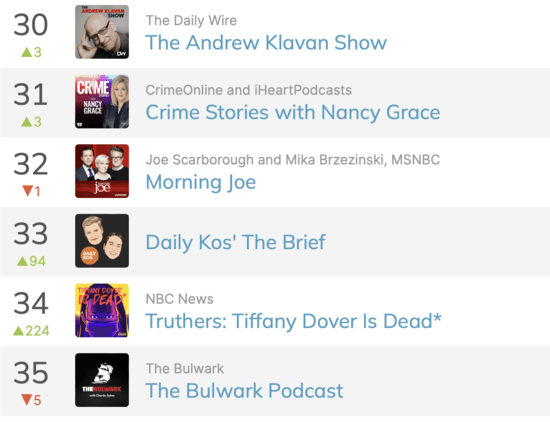
The Brief now averages around a quarter-million downloads per week and is moving up the charts:
Please like, follow, and review wherever you get your podcasts, so that we don’t have to sit one step below fucking Joe Scarborough. That’s not too much to ask, is it?
Elizabeth Warren and others react with rage to SCOTUS draft reversing Roe v. Wade
This post was originally published on this site
Americans across the country are reacting with rage after a leak of a draft opinion by Supreme Court Justice Samuel Alito was published by Politico Monday. In it, the highest court defended their decision to reverse Roe v. Wade and rule in favor of Mississippi’s abortion ban—ultimately allowing for several states to pass anti-abortion laws of their own, as reproductive rights will no longer be protected at the federal level.
Within hours of the report being published protestors and demonstrators gathered outside the Supreme Court, demanding that the 1973 law be preserved. The country is rightfully angry and we can only hope this anger contributes to change and allows for the justices to rethink their decision, as the leaked opinion was just a draft and not their final decision.
Here’s a roundup of how Americans across the country feel including legislators in various states and what they plan to do. Feel free to drop a comment with your thoughts. Right now, we feel; tomorrow, we act.
Starting it off is fan-favorite Sen. Elizabeth Warren, who has always been at the center of the fight. Warren is rightfully expressing the rage most Americans are feeling right now.
Of course, Warren isn’t alone. Democratic governors across the country also reacted, and reiterated their dedication to preserving reproductive rights.
“In light of the reported decision of the Supreme Court to overturn Roe v. Wade, [Colorado] remains a state where freedom is respected and where any person has the ability to live, work, thrive, and raise a family on their own terms,” said Democratic Colorado Gov. Jared Polis.
“While states like Texas, Florida, and Arizona are engaging in the unwelcome intrusion of government into deeply personal and religious decisions, Colorado remains a refuge where any person has the ability to live, work, thrive, and raise a family on their own terms.”
Some people were more concerned about the document being leaked than the decision shared. Republicans across the country expressed their concern despite being glad to hear SCOTUS supported their anti-abortion policies.
“This unprecedented leak is concerning, outrageous, and a blatant attempt to manipulate the sacred procedures of the U.S. Supreme Court. Those responsible should be held accountable. My prayer is that Roe v. Wade is overturned and that life prevails,” said Alabama Gov. Kay Ivey, a Republican.
Others hopped on the trend, too.
“I have advocated for the reversal of Roe v. Wade all my political career. The leak from someone within the court is reprehensible and should lead to an investigation, but I do hope the court returns authority to the states,” said Republican Arkansas Gov. Asa Hutchinson.
And, of course, some were excited that they may be able to advance their agenda sooner than later.
“If this report is true and Roe v. Wade is overturned, I will immediately call for a special session to save lives and guarantee that every unborn child has a right to life in South Dakota,” said Republican South Dakota Gov. Kristi Noem.
One good thing coming from this leak is the unity in us all coming together for this fight to protect bodily autonomy and access to safe, legal abortion. We cannot go back. As Minnesota Gov. Tim Walz tweeted: “Not on my watch.”
November’s elections matter. We need to elect pro-abortion rights officials at the federal level to help Democrats pass legislation protecting abortion rights.
From contraception to LGBTQ rights—Alito's draft opinion on Roe opens the floodgates
This post was originally published on this site
Ever since oral arguments in the Dobbs v. Jackson case against abortion rights, anyone paying attention knew the U.S. Supreme Court was poised to gut the landmark Roe v. Wade decision ensuring Americans access to abortion as a constitutional right.
But the leaked draft opinion penned for the high court majority by Justice Samuel Alito isn’t just a blow to Roe, it’s “a maximalist assault on progressive constitutionalism” that opens the floodgates to any rights Americans enjoy that are not explicitly enumerated in the Constitution.
As Slate’s Mark Joseph Stern notes, the opinion fails to treat abortion rights as unique or distinct in any way from other unenumerated rights the Supreme Court has conferred on Americans, such as the right to privacy, raise children, use contraception, or marry the person of their choosing regardless of the color of their skin or their gender.
Toppling Roe is just the beginning of a series of previous Supreme Court rulings in the crosshairs of the right-wing majority. In fact, during the recent confirmation hearings Ketanji Brown Jackson, Sen. John Cornyn of Texas delivered a diatribe about the 2015 Obergefell v. Hodges decision granting same-sex couples the constitutional right to marry.
Indeed, Alito went out of his way to harshly dismiss both Obergefell and the court’s landmark 2003 Lawrence v. Texas ruling, which established the right of same-sex couples to be intimate (i.e., privacy) without government interference. That decision is broadly considered to be the first major win for gay and lesbian activists at the Supreme Court and became foundational to nearly every other ruling establishing fundamental constitutional rights for LGBTQ Americans.
So what else is on the chopping block after Roe? It doesn’t take a genius to get a sense of where conservatives are heading.
In Michigan, the Republicans running to be the state’s next attorney general all agreed in a February debate that the 1965 ruling striking down state bans on the sale of contraception had been wrongly decided. Griswold v. Connecticut is foundational to privacy rights and the precursor to decisions like Lawrence and Obergefell.
Or how about sitting GOP Sen. Mike Braun of Indiana telling a reporter that he would be perfectly fine with the issue of interracial marriage reverting back to a states’ rights issue.
Question: “You would be okay with the Supreme Court leaving the issue of interracial marriage to the states?”
Braun: “Yes. If you are not wanting the Supreme Court to weigh in on issues like that, you are not going to be able to have your cake and eat it too.”
Braun later tried to walk it back because it’s nothing short of a radical reversal of fundamental civil rights law in modern America.
But basically the repeal of any Supreme Court ruling safeguarding the rights of Americans as we know them today is potentially in the offing. Buckle up!
Collins and Murkowski are shocked—SHOCKED!—that Supreme Court nominees lied to them
This post was originally published on this site
“Pro-choice Republican” senators Lisa Murkowski and Susan Collins would have you believe that they didn’t see the immediate end of abortion rights coming. That they had absolutely no clue the Trump justices they were trading votes on (both voted yes on Gorsuch; Murkowski was “present” on Kavanaugh, yes on Barrett; Collins was yes on Kavanaugh, no on Barrett) would do something so radical. Never mind that the guy who nominated them promised as a Republican hopeful that the best way to end abortion in the U.S. was “by electing me president.”
Trump repeated that as the Republicans’ nominee. He promised in a debate that overturning abortion rights would “happen, automatically in my opinion” because of the Supreme Court candidates he would nominate.
There weren’t any secrets here about what he was doing, and what the people he was promising a very cushy job for the rest of their lives would do for him in return. (By the way, Collins refuses to say, even now, that she won’t support him in 2024.)
Nonetheless, both Collins and Murkowski are playing disingenuous today, following the leak of Alito’s draft opinion in the Mississippi case that will end national abortion rights. Collins released a statement expressing her total surprise. “If this leaked draft opinion is the final decision and this reporting is accurate, it would be completely inconsistent with what Justice Gorsuch and Justice Kavanaugh said in their hearings and in our meetings in my office,” Collins said.
Never mind that Kavanaugh had already shown his stripes on overturning precedent on abortion and lots else—two full years ago! “Obviously,” Collins added, “we won’t know each justice’s decision and reasoning until the Supreme Court officially announces its opinion in this case.” Right. We’re totally in the dark about what the extremists on the court really intend to do, never mind that Alito put it all out there on paper.
Murkowski was little better. The leaked decision draft “rocks my confidence in the court right now,” she told reporters. Again, she and Collins are possibly the only two people in the abortion-rights community who did not see this coming. Or, that’s what she’d have us believe, anyway.
“Roe is still the law of the land,” she added, which is a good point. “We don’t know the direction that this decision may ultimately take,” Murkowski also said, resorting to remarkably obtuse again. “Sen. Collins and I in February introduced a bill that would codify Roe v. Wade. I thought it made sense then and I think it makes perhaps more sense now.”
About that bill. Yes, it’s better than what the Supreme Court is going to do, but it most certainly doesn’t not compare to the Women’s Health Protection Act, which they say “goes too far.” See, as far as these two “pro-choice” Republicans are concerned, pregnant people shouldn’t have a choice if someone in power decides that their abortion would infringe on someone else’s “religious liberty.”
They don’t believe a pregnant person should be able to get an abortion without being subject to laws forcing them to see anti-abortion propaganda before their procedure. They don’t believe pregnant minors should be able to conceal their abortions from parents or guardians, despite the potential risk to their personal safety at home.
That’s the substance of their supposed effort to preserve abortion rights. Swiss cheese. The context of this is that they know they can’t break a Republican filibuster on it. Their favorite partners in obstruction, Democrats Kyrsten Sinema and Joe Manchin, have already made that clear. Their statements in response to the leaked decision reiterate how important the filibuster is to “protect” reproductive health rights. Uh, huh.
None of this is to say that the extremist five who will overturn Roe and who knows what else in the coming months aren’t flat out liars. Because they are. But that character trait runs in Republicans, because Collins and Murkowski lied just as fervently when they said they believed this:
Which takes us back to this: the Supreme Court as it stands is illegitimate. It is full of liars, people who lied to the Senate under oath. Not to mention insurrectionists. It needs to be dealt with. It needs to be expanded.
And Collins and Murkowski either need to wake up to reality, or stop lying to their constituents.
Following major loss last fall, California's ban on private prisons will get a new day in court
This post was originally published on this site
California Attorney General Rob Bonta said last fall that he would seek a rehearing after the conservatives from a three-judge appeals panel ruled against historic state law banning private, for-profit prisons. This includes detention facilities that imprison immigrants.
In a significant step forward for California—and the immigrant communities that passionately fought for the law’s passage in 2019—the state will get a new hearing in front of an 11-judge appeals panel. The three-judge panel’s Oct. 2021 ruling has also been thrown out, San Francisco Chronicle reported.
RELATED STORY: California attorney general seeks rehearing following ruling against state’s ban on private prisons
Bonta as a state assemblyman authored AB 32, which would block the state from entering into new private prison contracts, or renewing existing ones. “We are sending a powerful message that we vehemently oppose the practice of profiteering off the backs of Californians in custody,” Bonta said at the time. “We are committed to humane treatment for all.”
The bill targeted a deadly immigration detention facility operated by notorious private prison profiteer GEO Group, which, predictably, sued. While a George W. Bush-appointed judge initially ruled against GEO Group, the private prison profiteer appealed. Two of the judges were appointed by the previous administration. The third and lone dissenting judge was appointed by the Obama administration.
This rehearing means that California will now face off against the Biden administration. When the previous administration lost its coup attempt and left office on January 20, 2021, the new administration took over in urging the courts to block AB 32. “Biden’s Justice Department has backed the Trump administration’s position and argued that federal law does not authorize state regulation,” the Chronicle reported.
The Biden administration’s defense of GEO Group and its abhorrent facility is at odds with the president’s executive order directing the Justice Department to not renew private prison contracts, and his campaign pledge “that the federal government should not use private facilities for any detention, including detention of undocumented immigrants.” The Dignity Not Detention Coalition said last fall that a ruling in favor of GEO Group “would allow these detention centers, which have a long track record of serious abuse, to remain open.”
GEO Group also has the backing of the federal government as a court last fall ordered the company to pay $23 million in damages for violating minimum wage laws in Washington state. The Northwest ICE Processing Center facility had been forcing detained immigrants to work for $1 a day, and sometimes nothing at all. Rather than having to pay immigrants beyond what the court had required, the multi-billion company instead shut down this “Voluntary Work Program.”
In seeking a rehearing last fall, Bonta said that “for-profit, private prisons and detention facilities that treat people like commodities pose an unacceptable risk to the health and welfare of Californians. AB 32 puts people over profits.”
RELATED STORIES: Conservative judges overturn California’s ban on private prisons—with an assist from the Biden admin
‘A model for the nation’: California bans private prisons, private immigration detention facilities
Inspectors report nooses in cells, medical neglect in surprise visit to private immigration prison