
Bisexual Brigham Young University student protests school's anti-queer policies on graduation stage
This post was originally published on this site
Depending on where you live and your upbringing, hearing people reference Bringham Young University (BYU), the private, religious university operated by the Church of Jesus Christ of Latter-day Saints, might bring up a number of connotations for you. Here at Daily Kos, for example, we’ve covered the institution’s frustrating and disappointing stance on LGBTQ+ issues, including the brave forms of protest coming from current and past students.
One form of protest has gotten a lot of attention in recent days as graduate Jillian Orr went viral on social media for revealing an LGBTQ+ Pride flag stitched into her graduation gown while receiving her diploma. At some universities, this wouldn’t be a huge deal; after all, some schools let students wear Pride pins and related memorabilia as part of the ceremony. But BYU explicitly bans students from being in same-sex relationships under the school’s Honor Code.
Orr, who is bisexual and had to hide her relationship with another woman as a student, decided she wasn’t going to end her time at BYU in silence. Thus the hidden Pride flag and the big reveal on stage, which was reportedly shown on live TV.
RELATED: First openly trans lawmaker in Kansas faces explicit transphobia from Republican colleague
Orr, who graduated with a degree in psychology, told the Salt Lake Tribune in an interview that she knew she wanted to “protest” her time at the university after feeling like she had to hide for so many years. She explained to the outlet that she worried about being disciplined or even expelled from the university if anyone found out about her same-sex relationship while she was a student.
And according to Orr, it wasn’t just social norms among her peers—the issue came up in her actual classes. For example, Orr told the outlet she was once assigned a paper on why it’s God’s “plan” that marriage should be between a man and a woman. Orr said she ultimately refused to write it and got a lower grade because of her decision.
With the help of her sisters, Hope and Rachel Orr, the graduate explained she decided to incorporate rainbow imagery into her graduation gown but felt she had to be a bit “sneaky” to pull it off without the administration catching on before she walked across the stage. In the end, her sister stitched the rainbow colors inside her traditional graduation gown, not to be revealed until she was on stage.
In an additional video shared on TikTok, Orr said she actually received her diploma in January. She said she’s not sure if the school can revoke it based on what she did at the ceremony. In an interview with Good Morning America, she said she has not yet heard from the school about it either way.
Orr has shared that she still identifies with the church and that the whole reason she initially attended the school was because of her religious beliefs and the less expensive tuition options there for church members. But she doesn’t feel that her faith and sexuality are inherently at odds with one another, and wants to see more acceptance and inclusivity for religious LGBTQ+ people at the school.
And Orr is certainly not alone in this experience. As she shared in an Instagram post, for example, she recalled that while moving through the crowd after the ceremony, another graduate thanked her for doing what she did she said her girlfriend saw her on live TV and was proud of her.
You can catch a brief interview with Orr via local outlet FOX 13 below.
Far-right attacks on local politics drive off ordinary folks, but there’s a blueprint to fight back
This post was originally published on this site
The ongoing far-right strategy of targeting local politics—school boards and city councils and public health boards—to gain traction for their politics of bigotry and menace is clearly a daunting concern. Adam Harris has a good piece in The Atlantic this week about how it’s so effective at driving ordinary civic-minded people away from democratic institutions and replacing them with conspiracist ideologues that it’s a chilling exploration of what democracy’s defenders are all up against.
However, there really is still hope. There are increasing signs, as BlueMonday recently reported, that these tactics are beginning to backfire. Moreover, there already is a blueprint for fighting back successfully: One small town in the Pacific Northwest has demonstrated the power of local community organizing to stand up to the right’s bullying politics, as it did in last fall’s elections.
Harris’ piece focuses on the Michigan town of Grand Blanc, a reasonable stand-in for the ordinary rural towns across the country that have suddenly faced this bewildering barrage from the far right. The school board’s monthly meetings—once the most mundane and boring of affairs, typical for communities everywhere—have become battlegrounds for conspiracists who pack the seats with people who take over the open-question sessions and dominate the gatherings with talk about critical race theory and grooming.
In the case of Grand Blanc, the problem is aggravated by the presence of a QAnon-quoting extremist already on the board—one who now claims no connection to the conspiracist cult. “I’m a victim of cancel culture,” says Amy Facchinello. “I think they’re using the QAnon narrative to cancel conservatives … If you question their narrative, they label you a QAnon conspiracy theorist.”
Local residents say it’s less her beliefs in QAnon theories and more “the division and the chaos that she brings” that concerns them. And that’s not just a concern in Grand Blanc.
The same fate is befalling places like Eatonville, Washington, and Shasta County, California, as well. Around the nation, as more and more local political entities are confronted with this organized onslaught, the people who traditionally have held those jobs and run for those seats are backing away, as Harris observes:
[W]ith the increasing hostilities of the job, many school-board members have seen resignation or retirement as their only way forward. In Wisconsin, a board member resigned after receiving threats and seeing a car idling outside his house while his children were home; in Tennessee, members were called child abusers and harassed for supporting mask mandates. “My most recent time on the board has impacted who I am as a person and my inability to have peace and joy in my life,” one school-board member in Indiana wrote in a resignation letter last year. “If the past two years have taught me anything, it is that life is precious and that time is short.”
This spate of departures will leave seats open, seats for which only the loudest voices in the room might be willing to run. Who else would want to?
But after the past two years, researchers worry that the temperature around this vital institution has been raised irreversibly. They worry that, even as districts sunset mask mandates and vaccines become standard, the battles at school-board meetings will rage on. And they worry that too few reasonable people will want to devote themselves to ever getting things back on course.
This concern was recently front and center in the Shasta County elections in which longtime establishment Republicans were driven from office by “Patriot” movement ideologues. Militiaman Carlos Zapatas—fond of threatening county supervisors that “it’s not going to be peaceful much longer,” and “good citizens are going to turn to real concerned and revolutionary citizens real soon”—led a successful recall against Supervisor Leonard Moty.
“Their agenda is, ‘If you don’t agree with us then we have to get rid of you,’” Moty told the Los Angeles Times. He added: “I am concerned for individuals in our community.”
Extremists likewise have largely taken over the machinery of Oregon’s Republican Party, particularly on the local level. In Idaho, they’re attempting to take over local Democratic Party apparatuses as well.
One such small town—Sequim, Washington, located on the northern rim of the Olympic Peninsula, a retirement-oriented community where the QAnon-loving mayor and his bullyboys on the city council took over local politics—fought back, however, and succeeded.
After the mayor forced out the city’s popular manager and began issuing dubious health directions during the COVID pandemic—and the subsequent coverage of Sequim’s takeover by QAnon, which embarrassed many longtime locals—concerned residents organized the Sequim Good Governance League (SGGL), which lined up a slate of candidates to run in last fall’s elections.
As Sasha Abramsky reported for The Nation:
When the votes were counted, they showed that the SGGL-backed candidates had ridden a wave of genuine popular fury against the faux populists aligned with Armacost. In Sequim, the five SGGL candidates for city council—[Lowell] Rathbun, [Brandon] Janisse, Vicki Lowe, Kathy Downer, and Rachel Anderson—all got between 65 and 70 percent of the vote. Both hospital commissioners’ positions in the county went to SGGL candidates, as did the fire commission and school district posts up for election last year.
“Our community has spoken and they want a change,” said Lowe, who had 68% of the vote against the incumbent. “Now we can take the focus back from everything else that doesn’t have to do with Sequim City Council, and start talking about housing and sidewalks and how our recycling is really getting recycled,” she added.
Those kind of results could point to a blueprint for pushing back against extremists at the local level, Devin Burghart of the Institute for Research and Education on Human Rights told CityLabs’ Laura Bliss. He noted that the candidates’ success began with repeatedly calling attention to their opponents’ affiliations with QAnon, as well as their excessive devotion to non-local issues, and was sealed by their strategic and energetic combined organizing and door-knocking during the campaign.
“That combination is going to be a key for defeating far-right efforts to take over local government around the country,” he said.
“It does have a national ramification,” Bruce Cowan, a politically active Port Townsend retiree, told Bliss. “Folks who don’t believe in government—populists, people who don’t have faith in the institutions of governance—shouldn’t be in charge of the government. One of the things that happened in Sequim is that people were not engaged enough to see how important it was to find candidates for city council. Now they understand the importance.”
As Blue Monday notes, the right’s politics of menace and intimidation directed at local school boards is beginning to run into organized opposition, with encouraging results so far in places like Missouri and New Hampshire, and mixed results in others, like Wisconsin.
The key critical factor in all of them is simple: Recognizing that you have a radical-right problem. Once communities can be persuaded out of being in denial about what they are up against and what they are dealing with—and that the only effective answer is to out-organize them—there is a very good chance of success.
Ukraine update: Russia is crawling forward, buying 'victory' at tremendous cost of men and materiel
This post was originally published on this site
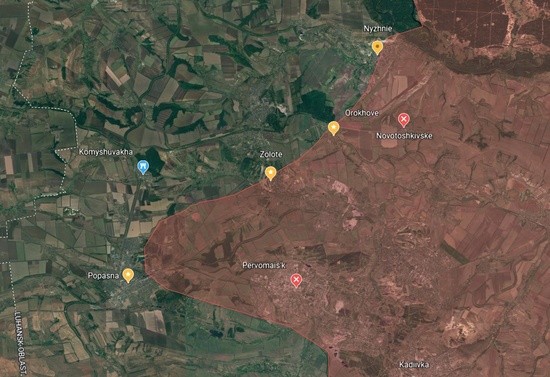
When I described the two miles between Popasna and Pervomaisk as “the center of the world” two weeks ago, what I missed was that those two miles are also apparently much larger than any other miles on the planet. How else to account for Russia reporting “steady progress” in Popasna for 12 days in a row, without actually taking Popasna?
As of Thursday, more of the town appears to have come under Russian control, and there are Chechen forces in the eastern part of the town performing what seems to be the specialty of Kadyrov’s forces: making propaganda videos. Those videos are supposed to show Ukrainian forces running away from Popasna as the Chechen fighters laugh. Shockingly, they seem to be fakes.
So far as can be discerned at this point, the center of Popasna remains under Ukrainian control, but the fighting there has devolved to a horrendous street-by-street nightmare. Russian artillery is continuing to fire into the heavily damaged town, and 10 more houses were reportedly taken out. But if Russia took more ground in the past 24 hours, it could be measured with a yardstick. And that’s in spite of hitting the small town with everything, including reportedly using cluster bombs, phosphorus, and something similar to napalm.
The tactic being used at Popasna is the tactic Russia is using everywhere, as well as the tactic Russia deployed in Chechnya, Georgia, and Syria: Fire artillery until everything ahead is dust. Then advance across the dust.
This is why getting the artillery sent to Ukraine by the U.S. and other Western nations to the front lines is so vital. The 110 U.S. M777 howitzers (over half of which are now in Ukraine, with trained crews) have a range up to 24 miles, and they are closely coupled to anti-artillery radar systems that are specifically designed to trace back the source of incoming fire so that it can be destroyed. Artillery that is outranged by modern opposing artillery fires once. Then it’s gone.
Loitering munitions like the Switchblade and still-mysterious Phoenix Ghost can also help take out Russian artillery, but it’s not clear that these systems have been effective at this task to this point.
In any case, Russia’s grind with an artillery-and-then-advance system isn’t just slow; it’s costly for Russia. As kos noted earlier, Russia’s “tactical successes” gained by days of shelling have come at a cost of high levels of casualties and significant losses of equipment. Quoting former DNR separatist leader Igor Girkin:
“…after a certain time, in this area, the same situation will repeat as in Rubezhnoe-Severodonetsk, Popasnaya, Avdeevka and Maryanka, where united forces are advancing extremely slowly and with huge losses (especially among the infantry), or not moving at all (Avdeevka).”
When Russia advances over that dust, troops are not just crossing the rubble of Ukrainian cities. They’re walking on the bodies of their own troops and the wreckage of their own gear.
There is an axiom that moving forward against an enemy in defensive position requires a 3 to 1 force advantage, all other things being equal. Considering the training and unit cohesiveness of Russian forces, they have historically moved forward by employing a 7 to 1 advantage. They don’t have 7:1. They don’t have 3:1. That doesn’t mean they can’t advance. It means they can advance, but only at a very high rate of attrition.
Some of the numbers that are coming out of the Ukrainian ministry of defense, like those that suggest Russia has lost 100 tanks in the past four days, are certainly exaggerated. But considering the proven losses Russia has already seen, they may not be that exaggerated.
Russia is crawling toward Popasna, and a dozen other towns and cities, behind a screen of artillery, losing men and machines all the way, because they’ve been told to advance despite having insufficient forces to overwhelm defenders. Ukraine can’t allow that advance to continue forever. On the other hand, Russian forces can’t survive this rate of attrition forever.
If it sometimes seems that sites like CNN are wringing their hands over the idea that Russia is winning everywhere while Daily Kos continues to be optimistic about the chances for Ukraine, it’s because CNN is looking only at what Russia bought. Meanwhile, we’re looking at the price.
U.S. Postal Service sued over massive gas-guzzling mail truck order
This post was originally published on this site
EarthJustice and the Center for Biological Diversity have teamed up to sue the U.S. Postal Service over its Next Generation Delivery Vehicle (NGDV) order of 50,000 mail trucks, just 10,019 of which will be electric. The order has been controversial since it was initially announced, though the USPS initially requested that just 10% of its NGDVs be EVs and has since ordered a slightly larger amount amid public outcry. That still isn’t good enough, given the Biden administration’s vow to purchase only zero-emissions vehicles for the federal government starting in 2035 and overall goal of the government hitting net-zero by 2050. The lawsuit contends that the way the USPS went about seeking to replace 165,000 vehicles was entirely unlawful because the agency failed to first conduct an environmental review.
“The Postal Service performed its NEPA [environmental review] analysis too late, and the analysis it did finally prepare was incomplete, misleading, and biased against cleaner vehicles,” the lawsuit notes. It’s easy to see how the Postal Service, which only began its NEPA process after it selected a contractor for its vehicle order, prioritized gas-guzzling vehicles over EVs. Per the lawsuit, the final EIS (Environmental Impact Statement) included high costs for batteries but suspiciously low assumptions for gas prices, as well as misleading data about EV capabilities that fail to take into account “expected advancements in battery technology over the next decade.” Because the agency was so worried about what it believed to be high upfront costs for EVs, it now appears as if it’ll be stuck with a majority of NGDVs hitting the road, and getting just 8.6 miles per gallon.
“We’re taking the Postal Service to court over its failure to electrify its vehicle fleet,” Katherine García, director of Sierra Club’s Clean Transportation for All campaign, said in a statement. “Instead of moving forward with common-sense and available technology to mitigate the climate crisis, clean up our air, and create good union jobs, USPS has decided to keep polluting communities at a time when federal agencies should be leading the way on electrification. It’s an unacceptable decision, and we won’t let it slide.” Sierra Club is a named plaintiff in the lawsuit, along with groups like CleanAirNow KC. The groups are hoping that a judge vacates the USPS’s final EIS and Record of Decision and forces the agency to comply with what’s required of the National Environmental Policy Act, which would likely call for more—if not a majority—of the NGDVs ordered by the USPS to be electric.
EarthJustice and the Center for Biological Diversity aren’t the only organizations looking to sue the USPS over its NGDV order. Also on Thursday, the Natural Resources Defense Council filed a joint lawsuit with United Auto Workers, contending that the NGDV order is essentially “based on an unlawfully deficient environmental analysis conducted after the Postal Service had already decided on a course of action.” “If allowed to stand, it would lock in decades of fossil fuel consumption and pollution in communities across the United States, resulting in higher maintenance and fuel costs, worse air quality, and increased climate impacts,” the suit continues. “If the Postal Service undertook a supplemental environmental analysis, it could reach a different conclusion and instead invest in much-needed EVs that would reduce air pollution, mitigate the causes of climate change, provide union jobs, and save the Postal Service money.”
Attorneys general from California, Connecticut, Delaware, Illinois, Maine, Maryland, Michigan, New Jersey, New Mexico, New York, North Carolina, Oregon, Pennsylvania, Rhode Island, Vermont, Washington, and Washington, D.C. have also come together to file a petition against the USPS, similarly claiming that the agency “failed to comply with even the most basic requirements of NEPA.”
Latino workers and older workers face shocking workplace fatality rates
This post was originally published on this site
April 28 is Workers Memorial Day, a day to honor workers killed or injured on the job. There are a lot of them.
In 2020, according to the AFL-CIO’s 2022 Death on the Job report, 4,764 workers were killed at work in the United States, and an estimated 120,000 died from diseases related to their occupations. Nearly 3.2 million work-related illnesses and injuries were reported, despite significant underreporting. The true number is likely between 5.4 million and 8.1 million.
RELATED STORY: Amazon is crushing Walmart in one metric: The rate of serious injuries in its warehouses
This year, we at least have a president who observes the day. “Ensuring worker safety is a national priority and a moral imperative,” President Joe Biden tweeted. “On Workers Memorial Day, we honor and remember those who lost their lives on the job and reaffirm every worker’s basic right to a safe and healthy workplace.” Reducing the number of deaths, injuries, and illnesses would take significant investment, though, and we don’t have a Congress that’s going to appropriate the money needed.
At the federal and state levels combined, there are just 1,719 workplace safety inspectors in the United States. That’s one for every 81,427 workers. There are 10.8 million workplaces in the nation. And in addition to the low level of federal investment in protecting workers on the job—the Occupational Safety and Health Administration (OSHA) has just $4.37 per worker—penalties to employers that endanger, injure, or even kill workers are appallingly low. The median federal penalty for a worker’s death was $9,753, and of course median means that half of the penalties were lower. State OSHA penalties for a worker’s death on the job were much lower: a median of just $5,825. For someone’s life.
Workplace dangers aren’t equally distributed. Latino and Black workers face greater risks. While the national average job fatality rate is 3.4 per 100,000 workers, for Black workers it’s 3.5 per 100,000 and for Latino workers it’s 4.5, and rising. Immigrants are particularly at risk: 65% of the Latino workers who died on the job in 2020 were immigrants.
Older workers also face a shocking level of risk, at 8.6 job fatalities per 100,000 workers 65 and older.
Where and in what industry you work also makes a big difference. In 2020, the least safe states to work in were Wyoming (13.0 per 100,000 workers), Alaska (10.7 per 100,000 workers), South Dakota (7.8 per 100,000 workers), North Dakota (7.4 per 100,000 workers), and West Virginia (6.6 per 100,000 workers). The least safe industries were agriculture, forestry, and fishing and hunting (21.5 per 100,000 workers); transportation and warehousing (13.4 per 100,000 workers); mining, quarrying, and oil and gas extraction (10.5 per 100,000 workers); construction (10.2 per 100,000 workers); and wholesale trade (4.6 per 100,000 workers).
There are some obvious fixes here: Fund workplace safety inspections, and focus them on the groups and industries at particular risk. Increase penalties to a high enough level that they might serve as a deterrent to the kind of scumbag employer who won’t worry about workers’ lives unless it hits them in the bank account. Put into place new policies on things like emergency response, heat illness and injury, combustible dust, musculoskeletal disorders.
And unions. At the Economic Policy Institute, Jennifer Sherer highlights the importance of workplace safety as an issue in the biggest union win in years, at Amazon’s JFK8 warehouse. Christian Smalls was fired after he protested for better COVID-19 safety measures. He went on to organize the historic union at a company that has workplace safety problems predating COVID-19, with serious injury rates in its warehouses coming in at nearly double that of other retail warehouses and more than double that of Walmart.
When workers come together to build power and make changes in the workplace, safety can be a major issue at the bargaining table. It remains to be seen what gains the Amazon union will be able to make—as of now, the company is refusing to even recognize the union—but the fact that this organizing win started with a workplace safety concern shows the power of the reality behind Workers Memorial Day.
'Well, hallelujah': University of California to offer free tuition for Native American students
This post was originally published on this site
In a state with more than 100 federally recognized tribes, the University of California system announced earlier this month that it will be offering Native American students free tuition and fees. The students must be in-state residents and belong to federally recognized Native American, American Indian, or Alaska Native tribes, according to a letter system President Michael Drake wrote chancellors of the University of California campuses.
“The University of California is committed to recognizing and acknowledging historical wrongs endured by Native Americans,” Drake wrote. “I am proud of the efforts the University has made to support the Native American community, including the creation of the UC Native American Opportunity Plan, and appreciate our conversations to date on all the ways in which we can better support Native American students.”
RELATED STORY: 13 recommended books about and by American Indians
The free tuition offering will be funded through a combination of state and university financial aid programs, and it will launch this upcoming fall, Drake wrote.
There are about 500 undergraduate students and 160 graduate students who meet the funding requirement of being California residents and members of federally recognized tribes, according to The Los Angeles Times.
But there are also more than 50 tribes that are not federally recognized. For those students, the Federated Indians of Graton Rancheria (FIGR) announced that it would be providing the University of California system with a $2.5-million scholarship.
“In the spirit of our ancestors we are driven to take care of our environment and our people,” FIGR Tribal Chairman Greg Sarris said in a statement the Times obtained. “Inclusivity is our responsibility and we’re pleased to extend scholarships to California Native Americans from non-federally recognized tribes.”
Clyde Hodge, a former president of the California Indian Education Association from the Muscogee (Creek) Nation of Oklahoma, praised the system funding decision. “Well, hallelujah,” he told NBC-affiliated KCRA. “We’ve been thinking that was a good idea for California natives for a long, long time. To open that up to all the federally recognized tribes is a long-needed thing.”
Greg Abbott's redundant inspections that cost Texas billions in losses find nothing, zero, nada
This post was originally published on this site
It is simply untrue to say that right-wing Texas Gov. Greg Abbott’s political stunt that forced commercial vehicles to undergo redundant inspections and cost his state $4 billion in losses turned up nothing. The Texas Tribune reports that state inspectors cited a couple of hundred drivers for minor infractions that included under-inflated tires and oil leaks. So there, naysayers!
Oh, you want to know if Abbott’s political operation turned up any migrants or drugs, which was supposed to be the whole point of this disastrous scheme? The short answer: No. Zero, per official state data.
RELATED STORY: Angry over Mexico’s remarks, Abbott threatens to reinstate stunt that cost state $4 billion
The Texas Tribune reports that in addition to those minor citations, officials “took 850 trucks off the road for various violations related to their equipment.” But no migrants, or drugs. The Texas Department of Public Safety director tried to claim that this is proof that the scheme actually worked, and that cartels were scared away by their checks.
Listen and subscribe to Daily Kos Elections’ The Downballot podcast with David Nir and David Beard
But Washington Office on Latin America (WOLA) Director for Defense Oversight Adam Isacson explained that that’s unlikely, given that “many illegal drugs smuggled into the United States are hidden in small compartments or spare tires of people’s vehicles going through international bridges for tourists.” As KHOU-11 reports, Isacson says “if smugglers were trying to hide illegal drugs in a commercial truck, it’s most likely federal immigration officials found them before the trucks were directed to the DPS secondary inspections.”
This is a good moment for this reminder: As Republicans have been weirdly angry about the Biden administration seizing huge amounts of drugs at ports of entry, they’ve also voted against funding for screenings and upgrades at ports of entry.
The fact is that Abbott’s stunt was an economic disaster that cost Pharr, the site of one of the busiest land crossings in the country, roughly $200 million every single day in losses. The Perryman Group, an economic consulting firm in the state, estimated that Abbott caused the nation roughly $9 billion in lost gross domestic product. Republicans love to own the libs even if it means jabbing themselves in one eye, so the electoral consequences remain to be seen. We do know that Abbott faced intense opposition on this policy from his own party.
But even though he caved on this disaster after 10 days, Abbott has since threatened to reinstate the policy. Not because of some imaginary threat, but because he got mad at criticisms from Mexico’s president.
In ending this stunt, Abbott had touted agreements with a number of Mexican governors. “But three of the four Mexican governors said they will simply continue security measures they put in place before Abbott ordered the state inspections,” The Texas Tribune reported. Mexican President Andres Manuel López Obrador questioned whether Abbott had any authority to engage in international agreements in the first place. Abbott didn’t like any of that, so he claimed he has “the capability at any time” to resume his unnecessary secondary inspections, Houston Chronicle reported.
“Abbott just single-handedly cost us $4.2 billion,” tweeted Democratic challenger Beto O’Rourke. “Let’s make him pay the price.”
RELATED STORIES: Greg Abbott ends disastrous stunt that cost fruit and vegetable producers an estimated $240 million
Abbott’s increased truck inspections in response to Biden admin leading to huge delays, rotting food
Texas remains secretive about actual results of expensive border theatrics because they didn’t work
New ADL report finds 34% increase in antisemitism, with 2,717 reported incidents in 2021
This post was originally published on this site
In the last several weeks, multiple reports have been released noting the rise in hate and bias against minority communities. Days after a report shared the increase in bias-based incidents against Muslim Americans in the U.S., the Anti-Defamation League (ADL) released a report Tuesday noting the number of incidents involving assault, vandalism, and harassment targeting the Jewish community.
According to the audit report, crimes against Jewish people have reached a historic high of more than 2,700 reported incidents, a 34% increase nationwide compared to 2,026 in 2020. The actual numbers are expected to be higher due to the number of incidents that go unreported.
This isn’t the first time ADL reports have found a rise in antisemitism. The rise in antisemitism has been consistent for years. According to CNN, the ADL has been tracking such incidents since 1979. This year has been the highest the organization has seen in the past 40 years, making it a “deeply troubling indicator of larger societal fissures.”
“It is despicable and disgraceful that it happens, and there’s not enough people in authority calling it out,” said ADL CEO Jonathan Greenblatt.
“People beaten and brutalized in broad daylight, without any provocation, attacked for the crime of wearing a kippah,” Greenblatt added.
Of the 2,717 incidents reported, 1,776 were described as harassment in which one or more Jews or those perceived to be Jewish were the targets of antisemitic slurs, stereotypes, or conspiracy theories, the report said. At least 850 incidents included vandalism of Jewish places of worship or businesses; 88 incidents were assaults.
Every state and the District of Columbia reported incidents rising, with the most occurring in New York, New Jersey, California, Florida, Michigan, and Texas. The report found that nearly 60% of the total incidents were in those six states.
According to the report, New York has the highest rate of antisemitic incidents in the country. There were 416 incidents reported in New York in 2021, a 24% increase since 2020. Fifty-one were assaults, the most ever recorded with a 325% increase from 2020.
Comparatively, California reported 367 incidents of antisemitic hate and harassment in 2021, setting a record that has carried into 2022.
“In the Bay Area, notwithstanding the fact that, broadly speaking, it’s a more progressive place … we see antisemitism emanating from the far right and the far left,” Seth Brysk, director of ADL’s Central Pacific Region, told the SF Chronicle, noting that each incident targets a community rather than an individual. “Every swastika tagged on a wall can harm scores of people,” he said.
One of the solutions the ADL offered was better educating students about bias in schools.
“We need to see schools introduce anti-bias, anti-hate, Holocaust education content to their students, so we can inoculate our kids before intolerance takes hold,” Greenblatt said.
The report also indicated that the ADL plans to work with law enforcement and other officials to track trends in efforts to prevent further antisemitic incidents.
Trevor Reed's parents say Biden saved their son's life. Why can't McCarthy give credit where due?
This post was originally published on this site
Wednesday brought news of a surprise prisoner exchange between the U.S. and Russia, with Russia releasing former Marine Trevor Reed as the U.S. released Konstantin Yaroshenko. The decision to make the exchange came amid the relentless advocacy of Reed’s parents and news of his deteriorating health, with President Joe Biden ultimately making the decision to trade Yaroshenko, who was convicted of drug trafficking in 2010.
Embattled House Minority Leader Kevin McCarthy celebrated the news … with a noteworthy omission. “After being held captive by Russia’s corrupt system since 2019, Marine Corps veteran Trevor Reed will finally be returned to U.S. soil,” McCarthy tweeted Wednesday. “Securing his freedom has been a years-long process—I am relieved for his family. I invite them all to my office to celebrate Trevor’s freedom.”
Okay, Kevin. “Securing his freedom has been a years-long process,” huh? That makes it sound like you were intimately involved. But, uh, how did it ultimately happen?
Reed’s parents have answered that question: They credit Biden for saving their son’s life.
RELATED STORY: Olympic athlete and WNBA star Brittney Griner will be detained in Russia until May 19
Biden has said he raised the issue with Russia “three months ago,” CNN reports, while an administration official described “months and months of hard, careful work across the U.S. government,” with outreach not only from U.S. Ambassador to Russia John Sullivan but Secretary of State Antony Blinken, Biden, and others, as well. The Richardson Center, headed by former New Mexico Gov. Bill Richardson, also served as an intermediary.
The decision to commute Yaroshenko’s sentence was Biden’s, with approval from the Department of Justice.
Biden’s focus on Reed’s case came after Reed’s parents, Joey and Paula, fought to get his attention, asking for a meeting when he visited Texas in early March and, when they were turned down, standing along his motorcade route with a sign. On a phone call afterward, Biden told them he had prayed the rosary for their son and “thinks of Trevor every day.” But when they didn’t see further action, they went and stood outside the White House with a sign about their son. By the end of the day, they were inside the White House meeting with Biden. That was March 30—before which Biden and others in his administration had talked to Russian officials about releasing Reed. He still had to make the decision to do a prisoner exchange, though.
Trevor Reed and Constantin Yaroshenko were returned to the custody of their respective countries in Turkey, and Reed arrived in the U.S. in the early hours of Thursday morning.
“We are grateful beyond words,” Paula Reed tweeted. “We actually said that we believe @POTUS saved @freetrevorreed’s life by agreeing to this prisoner swap. We truly mean that!”
But Kevin McCarthy? He couldn’t unbend enough to give that tiny bit of credit for the months of work by the Biden administration. And no wonder. McCarthy has in recent days been busy groveling for Donald Trump’s forgiveness for recordings of McCarthy, in Jan. 2021, saying he was going to urge Trump to resign the presidency, and expressing what at moments sounded like real outrage at the Trump-supporting mob’s attack on the Capitol. McCarthy has gotten Trump to express public support, but praising Biden for anything, at all, however glancingly, would be the kind of tweak Trump’s ego cannot stand. So even if it was McCarthy’s instinct to acknowledge that Biden was responsible for Reed’s release—which it probably was not—there’s no way McCarthy’s current political position would allow him to do so. That’s today’s Republican Party: run by Donald Trump’s ego and the imperative to never, ever to give a Democrat credit for anything, however detached it might be from partisan policy battles.
RELATED STORIES:
McCarthy does damage control with House Republicans over leaked recordings
We don’t have all the info about Brittney Griner’s case in Russia, but what we know isn’t good
Kansas Proud Boy enters a guilty plea and agrees to cooperate with the Feds
This post was originally published on this site
Facing up to five years in prison if he failed to cooperate with the Justice Department’s investigation of the attack on the U.S. Capitol, Louis Colon, a “first degree” member of the Kansas City Proud Boys chapter, has pleaded guilty to obstructing police during the Jan. 6 attack.
The 45-year-old Blue Springs, Missouri, man was facing a slew of charges including felony obstruction, civil disorder, trespassing, and disorderly conduct when he was initially indicted with five other members of the neofascist group in January.
But with his plea deal struck, those counts are expected to be dismissed when Colon is sentenced. That date has not been set as of Thursday according to court records, but prosecutors have indicated it will come once they figure out how Colon’s cooperation might influence other Proud Boys in the case who have pleaded not guilty.
Two days before President Donald Trump would hit the stage at the Ellipse in D.C., back in Kansas, according to a statement of his offense, Colon and a few other Proud Boys decided they would come to Washington to show support for the outgoing president’s push to stop the certification of Electoral College votes by Congress.
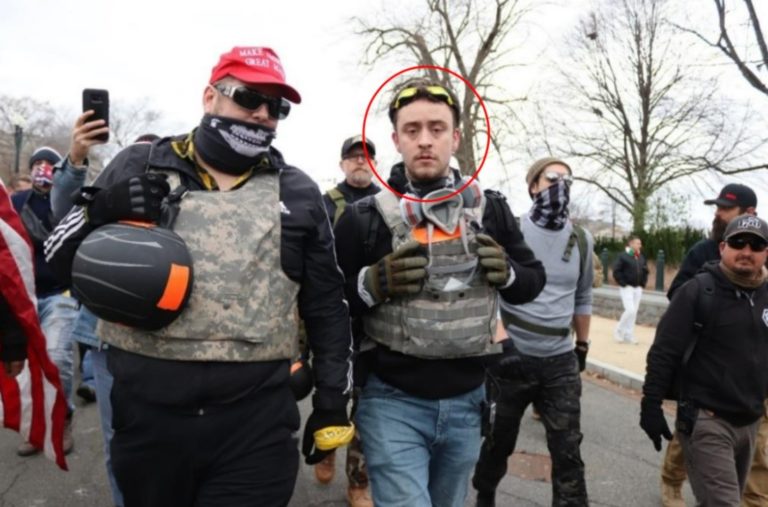
Colon, members Ryan Ashlock and Christopher Kuehne, and another unnamed individual popped into a car that had two of Kuehne’s AR-15s stowed inside. The car was never brought into the nation’s capitol, however.
Once they arrived in Virginia on Jan. 5, Colon admitted the group went to a hardware store where he picked up, among other things, an ax handle. He would later modify it so it could be used as a walking stick and a weapon.
But before they left the shop, Colon said Kuehne suggested they grab a bit of bright orange tape and use it to identify each other as members of the same group in the crowd. According to the initial indictment, the Kansas Proud Boys Colon traveled with wore paramilitary gear, camouflaged uniforms, tactical vests and plates, helmets, and eye protection. They also carried radio equipment.
On the eve of the assault, Colon said his group met with Proud Boy and co-defendant William Chrestman and they discussed how to move “safely” as a group.
According to Colon, it was then that someone in the group said they didn’t come to Washington ”to just march around.”
“Do we have patriots willing to take it by force?” the person asked.
“[Colon] was shocked by this and understood that the individual was referring to using force against the government,” a statement of his offense notes.
In the moment, Kuehne, who has pleaded not guilty, said he still had his guns in his car and another member of the group piped up, saying the Proud Boys should “go in and take over.”
Meeting around the Washington Monument on the morning of Jan. 6, Colon said the group was joined by siblings Felicia Konold and Cory Konold of Arizona.

In Snapchat videos Felicia Konold posted describing the riots, she said she was recruited by the organization in Kansas. In one clip, she shows off a Proud Boys challenge coin of sorts that she received.
Her acceptance into the group would be notable given that the network is a self-professed “chauvinistic” organization steeped in misogyny. Sometimes, however, according to the Southern Poverty Law Center, the Proud Boys have created offshoot chapters for wives or girlfriends.
According to court records, with their group amassed, Colon, Kuehne, Ashlock, Chrestman, and the Konold siblings began marching through the street toward the Capitol, chanting. Chrestman shouted to the crowd: “Do you want to take your house back?”
They would scream back, “Yes!”
Chrestman, prosecutors say, urged them on.
“Take it,” he allegedly told the mob.
Once on the west side of the Capitol, they scaled a wall, searched for higher ground, and then found a way inside. But the group was first met by police struggling to keep rioters back. As U.S. Capitol Police fired non-lethal projectiles at them, Chrestman allegedly screamed at the officers: “You shoot and I’ll take your fucking ass out!”
Konold, prosecutors say, was meanwhile urging people to keep fighting. All in the group but Ashlock made it inside of the Capitol.
Once in, Colon said they spotted retractable doors being lowered by police to keep rioters from spreading into another part of the building.
That was when Colon said he used his hands to stop the door and then put a chair in the way to keep it open. Kuehne, he said, was nearby with another person using a podium as a doorstop.
Colon admits to being inside the Capitol for roughly 50 minutes before he and co-defendants fled.
In addition to his sentence, Colon will pay $2,000 towards restoring the U.S. Capitol. The damages to the complex alone hover around $1.4 million. If he is forced to pay a fine on top of the sentence and restitution, it could total up to $250,000.
Louis Colon Plea Agreement by Daily Kos on Scribd
Another plea agreement for a different Proud Boy appears to be in the works, too.
On April 22, U.S. District Judge Colleen Kollar-Kotelly issued an order noting that prosecutors and lawyers for Nicholas “Nick” Kennedy, also known as Squatch, have “progressed in discussions regarding pretrial resolution” and requested another status hearing be held in June.
The 41-year-old of Sikeston, Missouri, faces six counts including obstruction of an official proceeding, civil disorder, entering and remaining in a restricted area, disorderly conduct in a capitol building, and parading in a capitol building. Prior to the April 22 order, Kennedy pleaded not guilty.
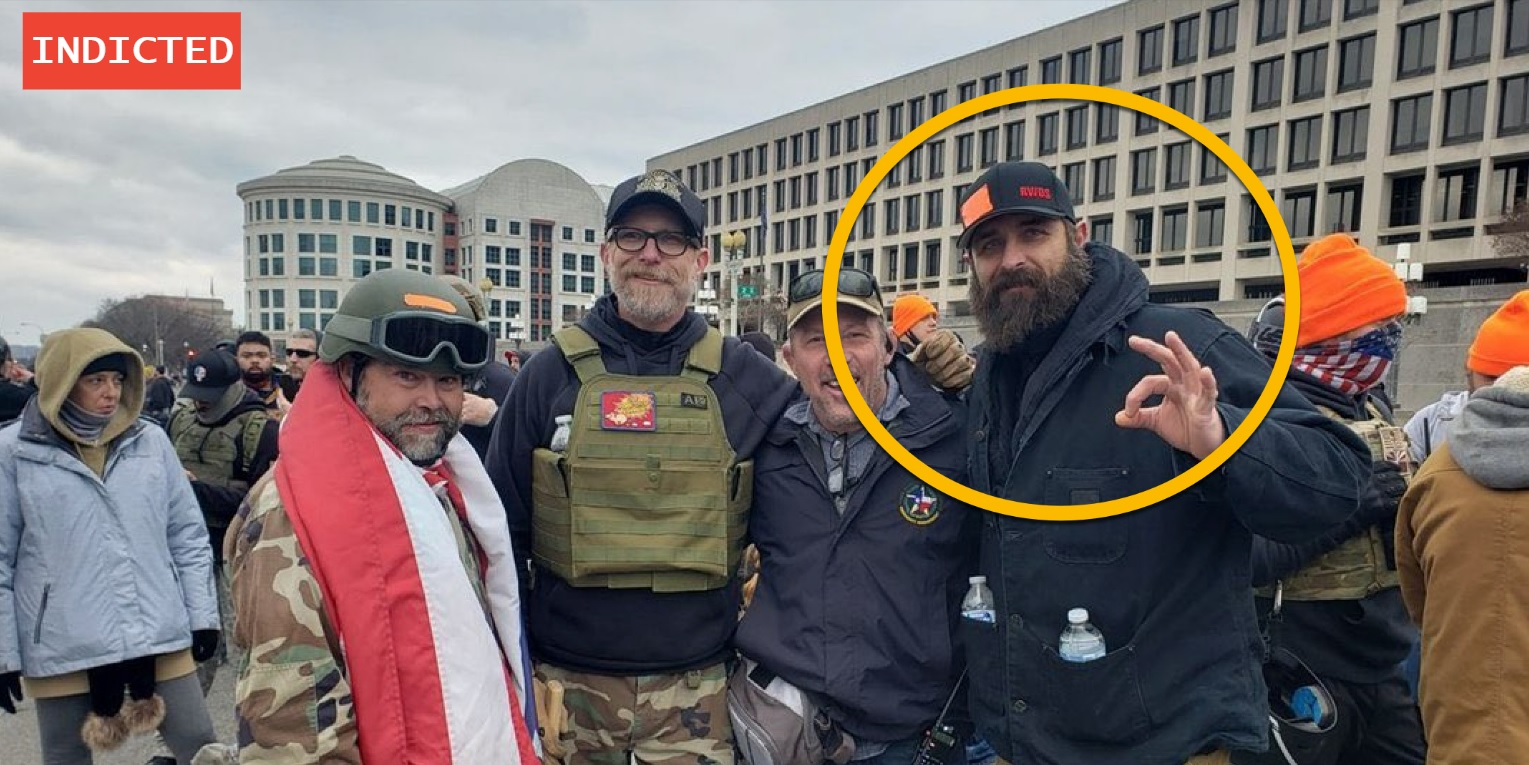
When news of his indictment first emerged, his picture, Cash app handle, and email were posted in the Proud Boys’ Telegram channel, as noted by Jan. 6 sleuths Sedition Track last year.
An attorney for Kennedy did not immediately return a request for comment to Daily Kos on Thursday.