Projected real GDP growth for the 4th quarter relative to pre-pandemic growth: 6.1%
Rank of heart disease and cancer among leading causes of death over the last year, per the CDC: #1, #2
Rank of Covid-19: #3
Number of voter fraud claims, out of 11-million votes cast, forwarded to Florida law enforcement after the 2020 election: 75
Percent chance that this has given Florida cult governor Ron DeSantis the impetus he needs to create his own Election Gestapo to intimidate and persecute Democrats: 100%
–
Your Thursday Molly Ivins Moment:
My favorite running story these days is the Year 2000 Problem. This is the wonderful news that come midnight Dec. 31, 1999, all computers will tick over a notch and announce that it is Jan. 1, 1900.
If you believe the most dire analyses of the consequences of this slight misunderstanding, planes will then fall from the sky, ballistic missiles will run amok, global financial markets will crash, hospital life-support systems will shut down, your microwave won’t work, your Pontiac won’t start, and in general, a fine time will be had by all.
—April, 1997
CHEERS and JEERS to schlepping through the hallowed marble halls again. Here’s a fun fact: 99.8 percent of Americans had no idea that Congress had adjourned for an extended Easter break. And here’s another fun fact: 99.9 percent of Americans have no idea that Congress is back in session.
Yes, under the leadership of Nancy Pelosi in the House and John Kennedy Jr. in a Chuck Schumer mask in the Senate, the dueling chambers are once again drafting drafts, gaveling gavels, shouting shouts and, depending on the circumstances, either flocking to or fleeing from the press with their “note pads” and “flash bulbs.” The good news: President Biden’s judicial nominees are expected to continue enjoying an easy path to confirmation. The bad news: with Joe Manchin and Kyrsten Sinema still tragically consuming oxygen and fluids, President Biden’s legislative agenda is expected to continue going through this rigorous process:
Thankfully, the Affordable Care Act that Biden helped pass a dozen years ago includes coverage for chiropractic services. He’s gonna need ‘em.
CHEERS to predictions of doom. As Russia continues launching everything but nukes and literal kitchen sinks at Ukraine to little effect, Vladimir Putin’s allies have basically dwindled to our Republican party, Tucker Carlson, Belarus, North Korea, on-air propagandists who stand in a little circle on live Russian TV spouting shit like “Ukraine destroyed our national toilet paper reserve on orders from Satan Hitler,” and all the corrupt Russian oligarchs. Well, almost all the corrupt Russian oligarchs:
A Ukrainian oligarch who made his fortune with help from the Kremlin is now denouncing Vladimir Putin, even as he fights extradition to the U.S. on corruption charges.
Firtash is under house arrest in Austria. This is his morning wake-up call. Looks quaint, but they’re playing gangsta rap.
In an exclusive interview with NBC News while under house arrest in Austria, billionaire Dmytro Firtash said the Russian president cannot win in Ukraine. “He is never going to come out victorious,” said Firtash, who became fabulously rich selling Russian natural gas to Ukraine with the help of powerful Russian interests. “No matter what happens, Russia will lose.”
If he could, Firtash said he would tell Putin: “It’s time to stop. There will be no victory. The longer this war takes, the worse it will be for the Russian people. Not just for the Ukrainian people.”
Wow. Very candid of him to say that. But we’re still keeping his yacht. Gotta store all that Russian toilet paper for Satan Hitler somewhere.
CHEERS to #5. Happy 264th birthday to President James Monroe—the last Founding Father to occupy the White House. He creeped people out by wearing his revolution-era clothing and a powdered wig at a time when doing so was long out of style. He also told Europe and Russia to keep their paws off the west and then sucked up to the AARP by snagging Florida. And then there was this bit of insanity (From Secret Lives of the U.S. Presidents by Cormac O’Brien):
Secretary of the Treasury William Crawford once came calling on the president with a stack of patronage recommendations, all of which Monroe rejected.
Monroe’s first attempt to chase Crawford from his home with puffs of air from his fireplace bellows failed to dislodge the Treasury Secretary.
Enraged, Crawford threw a temper tantrum and demanded to know whom Monroe intended to appoint; the president replied it was none of Crawford’s damn business.
Crawford snapped and actually advanced on the chief executive with his cane raised, calling Monroe a “damned infernal old scoundrel.” Monroe then stepped to the fireplace, seized a pair of fire tongs, and chased his secretary of the treasury from the Executive Mansion.
Historians call it “The night Monroe went mad.” Fox News calls it “Saturday night with Jeanine Pirro.“
CHEERS to toting the tykes. Today is the 26th Take Our Daughters and Sons to Work Day. It’s a time to show the kiddies how Mom and Dad’s productivity gets cranked up to the max, while their paychecks do not. What fun! I believe I speak on behalf of the entire nation when I say to children of the military personnel who control our nukes: please don’t push any blinking red buttons or turn any keys. Well, unless the code’s been authenticated, of course.
CHEERS to pigskin fever! Round 1 of the NFL draft is today. Moments after he hears the word “draft,” Ted Nugent will instinctively respond by shitting his pants.
–
Ten years ago in C&J: April 28, 2012
CHEERS to something that looks really awesome on your resume. President Obama named this year’s gaggle of Medal of Freedom winners. The awards are given out for “An especially meritorious contribution to the security or national interests of the United States, world peace, cultural or other significant public or private endeavors.” This year’s gaggle (click the link above for their bios) is pretty damn awesome:
Madeleine Albright, John Doar, Bob Dylan, William Foege, John Glenn, Gordon Hirabayashi, Dolores Huerta, Jan KarskiKarski, Juliette, Gordon Low (Girl Scouts founder—a sly choice), Toni Morrison, Shimon Peres, John Paul Stevens and Pat Summitt
I admit I was shocked to see that John Glenn hadn’t gotten one yet, but he’s gonna live to be 150 so what’s the rush, I guess. Besides a medal, each honoree gets a ribbon, a tie clip and a monogrammed umbrella sword. Now you know why no Medal of Freedom winner has even been mugged.
–
And just one more…
CHEERS to a life well-lived…and lived…and lived. I always thought that there were only two things in life that are certain: taxes, and the endless bickering between Mr. Spock and Dr. McCoy. But apparently I was lied to by adults in whom I’d put all my trust, because apparently there’s a third thing: death. And last week it struck down an innocent woman in the prime of her life:
Although she didn’t quite make it to her goal of 120 years old, Kane Tanaka still lived long enough to become the world’s oldest person—a title she held for the past three years, and attributed to family, sleep, hope and faith.
All she’s saying is give peace a chance.
Tanaka died last week at 119, Japanese authorities announced. Tanaka, who had been living at nursing home in Fukuoka, died on Tuesday at a hospital.
According to Guinness World Records, Tanaka was born prematurely on Jan. 2, 1903—the same year the Wright brothers brought powered flight to the world. She was the seventh child in her family.
When she was 19, she married Hideo Tanaka, and helped run a family business selling sticky rice, udon, and the Japanese dessert zenzai.
Doctors say she died of an acute case of being 119, but police say they plan to bring in the recently-crowned world’s newest oldest person for questioning. Neighbors report she’s doing “way too much smirking.”
Have a nice Thursday. Floor’s open…What are you cheering and jeering about today?
–
Today’s Shameless C&J Testimonial
“I just want Cheers and Jeers to be ‘The Twilight Zone’ and all go away.”
We start this morning with Robin Givhan of The Washington Post making a distinction between what a “public square” truly is and whatever it is that Elon Musk plans to do with Twitter.
True public squares may be places where words can flow unobstructed to a vast audience, but speaking in these open-air venues means navigating unavoidable considerations and complexities. In a true public square, you face your neighbors. Whatever you might have a hankering to get off your chest has to be unloaded with the full knowledge that those standing nearby can see precisely who’s doing the talking.
Audiences in the public square are more demanding. A lone man hawking misinformation on the street corner is more easily denounced or even ignored than some unseen face behind a Twitter account that spews hearsay and make-believe. Gullibility is abundant on Twitter. In real life, skepticism thrives. We dodge census takers, petition drives and panhandlers because we doubt their spiel or we simply don’t want to be bothered.
In real life, we try to suss out the truth of people by taking note of their body language. We make eye contact. We use all our senses to assess folks and make judgments. Those judgments aren’t free of stereotypes or prejudices, but still, they’re rooted in something, in some sort of evidence, some shred of humanity. Twitter isn’t a public square as much as it’s a sensory deprivation chamber in which we’re trying to figure out who to trust, who to believe, with little more to go on than a little blue check.
A “public square”, in other words, has rules and norms which, of course, conservatives don’t seem to like to apply to themselves.
Adam Serwer of The Atlantic says that when it comes to a battle between Musk’s notion of free speech and his bottom line, you can be sure what will win out.
For those who are not terminally online, a little explanation is in order. Compared to the big social media giants, Twitter is a relatively small but influential social network because it is used by many people who are relatively important to political discourse. Although the moderation policies of a private company don’t implicate traditional questions of free speech—that is, state restriction of speech—Twitter’s policies have played a prominent role in arguments about “free speech” online, that is, how platforms decide what they want to host.
When people talk about free speech in this more colloquial context, what they mean is that certain entities may be so powerful that their coercive potential mimics or approaches that of the state. The problem is that when private actors are involved, there’s no clear line between one person’s free speech and another: A private platform can also decide not to host you if it wants, and that is also an exercise of speech. Right-wing demands for a political purge of Twitter employees indicate just how sincerely conservatives take this secondary understanding as a matter of principle rather than rhetoric.
The fight over Twitter’s future is not really about free speech, but the political agenda the platform may end up serving. As Americans are more and more reliant on a shrinking number of wealthy individuals and companies for services, conservatives believe having a sympathetic billionaire acquire Twitter means one less large or influential corporation the Republican Party needs to strongarm into serving its purposes. Whatever Musk ends up doing, this possibility is what the right is actually celebrating. “Free speech” is a disingenuous attempt to frame what is ultimately a political conflict over Twitter’s usage as a neutral question about civil liberties, but the outcome conservatives are hoping for is one in which conservative speech on the platform is favored and liberal speech disfavored.
Qian Julie Wang of The New York Times writes about life on the New York subway and how she fears losing it.
I feel more connected with myself and my community on the subway than I do anywhere else. But as the tunnels have endured several high-profile assaults recently, culminating in a shooting on the same line my mother used to take to work in Sunset Park, I feel that connection fading and a piece of me withering. The subway defines home for a city of people united — above distance, race, class and labels — in relentless pursuit of dreams. And I am more scared of losing that home now than ever before.
In hopeful reclamation, I turned to Twitter, calling for subway memories. As the many responses came in, I reeled from laughter to tears and back. In poured absurd stories of navigating the trains in impossibly elaborate costumes; of dodging urine streams, cockroaches and rats; of in-car concerts, break dancing, and a cappella. Of course there were accounts of violence, of children followed and women groped. But more than anything else, there were stories of community: good Samaritans assisting the lost, the sick, the drunk; passengers jumping to help others with luggage; readers bonding over books; dance parties sparking on platforms; and lifelong friendships forming from chance encounters. And time and again came a seemingly unanimous conclusion: The subway is the best, most cathartic public place to cry.
A little too romantic of a view about life on the subway? Maybe. Maybe not.
Kimberly Atkins Stohr of The Boston Globe wonders just how Harvard University is going to implement its proposed reparations program.
A massive report, years in the making, was released this week detailing the institution’s ties to and enrichment from the enslavement of Black people. It’s full of gut-wrenching details, from the more than 70 human beings who were owned by faculty, staff, and even presidents of the university, to the remains of 15 Black people from the antebellum era found among the holdings of Harvard’s Peabody Museum, to the fact that a third of the university’s endowment from the first half of the 19th century came from donors whose fortunes were fueled by the slave trade.
It also comes with a major pledge: a $100 million commitment to implement a set of recommendations designed, in the words of Harvard President Lawrence Bacow, “to approach the future in ways that properly reckon with our past.”
But if the recent efforts by other colleges and universities in the Ivy League and elsewhere to atone for the ways they benefited from human enslavement are any guide, the hard part for Harvard is just beginning. These schools are learning just how difficult, 150 years after abolition, it is to figure out what reparations should look like.
Gustavo Arellano of the Los Angeles Times writes about all of the utter pettiness of Los Angeles County Sheriff Alex Villanueva, including the sheriff’s recent threats to a reporter for the Times.
He spent most of an hourlong conversation with me last month railing against unflattering photos of him published by this paper and the supposedly excessive number of Black division chiefs in the Sheriff’s Department’s past. He then claimed in a social media post that he was refusing to meet with the L.A. Times editorial board to seek their endorsement … right around the time he was meeting with them. (The board didn’t endorse him).
None of those moves put a single criminal behind bars or improved public safety — you know, the job that a majority of L.A. County voters asked Villanueva to do when they elected him in 2018. Instead, we’ve seen an administration of tantrums unworthy of a preschooler denied their “Peppa Pig.” And he just went through his worst one yet. […]
Allison Hope writes for CNN on the possible deadly consequences of the anti-LGBTQ backlash now underway
Take the three people who were attacked as they were leaving a drag show in Old Town Pasadena, or the gay club in Brooklyn that was set on fire, or the deaths of two Black, transgender women in Chicago, at least one of which was ruled a murder (the other is still under investigation). This was all in the past month, and it doesn’t capture the full scope of heinous acts.
While attacks on our community are sadly nothing new, this current environment, in which public officials use dangerous rhetoric while peddling bills that discriminate against us, feels ever more fraught. It doesn’t help that some Republicans are increasingly perpetuating the harmful myth that liberals and members of the LGBTQ community are grooming children – a move that shatters any illusions that the US has become fully understanding and accepting of our LGBTQ lives and experiences. {…]
…In all, more than 250 bills have been introduced in state legislatures this year with the aim of stripping away the rights of LGBTQ Americans, including in sports, libraries, schools and other facets of civic life. There was even a recent attempt in Tennessee to define common law marriage as one between one man and one woman. Thankfully, the bill died before it made it out of the general assembly, but I fear the fight to undo marriage equality may only be beginning.
Heather Digby Parton of Digby’s Hullaballoo writes that the right is losing the culture war— at least according to multiple polls— but that you wouldn’t know that from the media coverage.
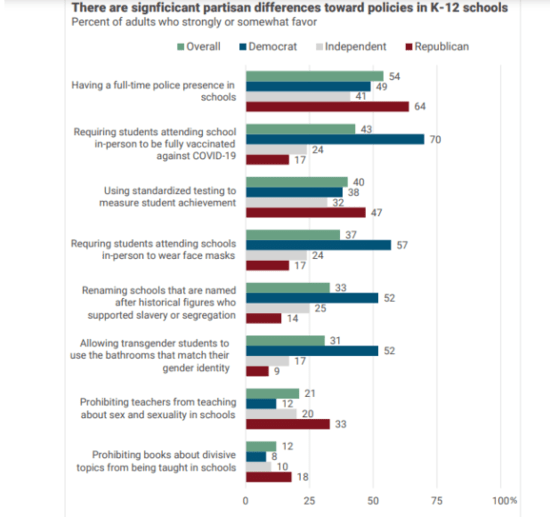
I know the only people who matter in America are Real American Trump voters, but this is ridiculous. On half those questions even a majority of them don’t agree. There is some contention on the trans bathroom issues and renaming schools between the two parties but not really that much. These are new issues that people are sorting through. But overall I think these issues are way overplayed.
Americans writ large aren’t calling for the fainting couch over teaching Black history and they don’t want to ban books in school. And although it isn’t asked I highly doubt that a majority of Americans think that gay teachers are “grooming” kids to become transgender. This is yet another ginned up culture war issue that the media always try to turn into a Big national Concern because they just can’t not take the bait.
Some of these numbers on this one chart ARE interesting.
Megan Moltini of STATnews writes about President Joe Biden’s attendance at the White House Correspondents’ Dinner at a time when COVID-19 cases are on the rise in D.C. and nationwide.
In late March, White House press secretary Jen Psaki tested positive for the virus, her second breakthrough infection. A few weeks later, an outbreak at the annual Gridiron Club dinner seeded infections among House Speaker Nancy Pelosi and three members of President Biden’s cabinet. And on Tuesday, Vice President Kamala Harris tested positive at the White House and had to cancel a meeting with Biden.
Yet on Saturday, Biden is planning to step into a tuxedo and into a cavernous underground ballroom for the White House Correspondents’ Dinner, the first time a sitting president has attended since 2016. Despite rising coronavirus cases in the D.C. region, up to 2,600 guests are expected to attend in full pre-pandemic “Nerd Prom” regalia — satin lapels, glittering gowns, and mask-free faces — albeit with proof of vaccination and a same-day negative Covid test. […]
At least one other American weighing similar risks reached a different conclusion. Late Tuesday night CNN reported that Anthony Fauci, the 81-year-old infectious disease expert and Biden’s chief medical adviser, would no longer attend the dinner amid concerns for his own health and worries it could turn into another superspreading event.
David Ignatius of The Washington Post notes the escalation of the war of words between Russia and NATO but wonders what the ultimate cost will be to both sides.
Defense Secretary Lloyd Austin, a man careful with his words, stated it plainly Monday after a trip to Kyiv to bolster Ukraine’s resistance: “We want to see Russia weakened to the degree that it can’t do the kinds of things that it has done in invading Ukraine.” Austin repeated that message Tuesday after talks with NATO allies in Germany.
This is a high-stakes strategy — efforts to degrade another country’s power by military and economic means usually don’t end well — and I asked the White House to elaborate on the comments. “We want Ukraine to win,” a National Security Council spokesman responded. “We intend to make this invasion a strategic failure for Russia. One of our goals has been to limit Russia’s ability to do something like this again.”
The West’s assessment as it tightens the screws was bluntly stated Monday by Secretary of State Antony Blinken: “Russia is failing; Ukraine is succeeding.” That’s certainly true after the first two months of war, but the bloodiest days of this campaign might lie ahead. The questions going forward are whether the pressure strategy will succeed in crippling Putin, and at what cost.
Alice Tidey of Euronews thinks that Poland and Bulgaria will be OK with the shutoff of Russian gas—for now.
According to the International Energy Agency (IEA), coal supplied a little over 40% of Poland’s energy mix in 2020, followed by oil (about 30%) and natural gas (about 18%), with the rest coming from biofuels and waste as well as other sources of renewables including wind and solar.
Yet, Poland generates less than half — 46% — of its energy need, producing about 80% of the coal it consumes, but just 20% of gas and 3% of oil. The rest is thus met by imports. About half of the gas and nearly two-thirds of the oil Poland imports come from Russia, according to Forum Energii, a think tank.
These figures are high but still much lower than a few years ago when about 80% of Poland’s gas imports came from Russia.
When the Gazprom decision came through, Moskwa claimed the country had been preparing for just such a scenario and that “thanks to infrastructure investments, such as the Baltic Pipe or connections with other Member States, the Polish gas system, as one of the few in the European Union, is able to completely abandon supplies from Russia.”
She added that gas reserves were at 76% capacity.
Rachel Ashcroft of The Article writes about some notions (primarily the United Kingdom’s) of the concept of patriotism.
Ukrainian patriotism has drawn admiration from people around the world. But for some in the UK, such outward displays of patriotism can seem alien. The majority of Britons are uncomfortable with declaring love for their country. Patriotism is largely a Right-wing sentiment: according to 2020 data, only 17% of those on the British Left are proud of Britain, compared to 58% of people on the Right.
However, patriotism is arguably a misunderstood concept. It is too often confused with nationalism, or dismissed as foolish. But patriotism has plenty of advantages. It can neutralise sinister nationalistic tendencies, as George Orwell — a lifelong man of the Left — once argued. And as we see daily on the news, drawing on a wellspring of patriotism can benefit a country in wartime, when morale needs to be at its strongest.
Historically, philosophy has shown little interest in patriotism. Instead, it’s been left to literature’s most famous names to come up with a definition. In the late 19th century, Leo Tolstoy stated that patriotism “is merely the preference of one’s own country or nation above the country or nation of anyone else”. But if everyone thinks their country is “the best”, then who is actually right? That line of reasoning led Tolstoy to dismiss patriots as fools.
Ms. Ashcroft is right about Orwell and while she’s mostly correct that philosophy has tended to show little interest in notions of patriotism, the greatest statements ever made about what we have come to call “patriotism” are in Plato’s Apology and Crito, IMO.
Adam Gopnik of The New Yorker writes that with all of the naysayers writing about an underwhelming victory for Emmanuel Macron in last week’s French presidential election, Macron is the first French president to win reelection in 20 years.
Successful pragmatists in power will never have the glamour of even unsuccessful ideologues. The British journalist Helen Lewis satirized the grudging reluctance to recognize the significance of Macron’s first election, in 2017, writing, “We must now confront an uncomfortable question. Why did so many French people vote for Emmanuel Macron? Was it a lack of economic anxiety, or a lack of racism?” Insisting that Le Pen’s predictably increased result since her last standoff with Macron, five years ago, was the real story misses the point. Macron is the first sitting French President to have been reëlected in twenty years. He also now becomes the first President of the Fifth Republic, which was instituted in 1958, since de Gaulle to be returned to office by a direct popular vote, while still holding a parliamentary majority. (Jacques Chirac was in “cohabitation” with a left-wing government when he was reëlected in 2002, and François Mitterrand was with a right-wing one in 1988.) Most elections in democracies are close; this one is notable for how close it wasn’t. Nor did Macron tilt right. On the easy material, for instance, of Muslim women wearing hijab, he was forthrightly protective of a religious minority in a climate in which Zemmour proposed a law that children only be given “French” first names.
It will be an ugly second term: there will be demonstrations, and the President will be called an even worse failure than he had been before. Loud declarations of the death of democracy will be shouted from the rooftops, and the next unanswerable crisis that France confronts will be once again confronted. In other words, French political life will carry on as it has since 1958—or really, since 1789. But the worst have been kept out of power, and didn’t come near winning it. There is much work to be done, and the coming legislative elections will be significant. Macron will not have an easy time, but what French President ever has?
Patrick Roger of Le Monde in English writes about some of the possible reasons that Marine Le Pen won the French non-Pacific overseas territories.
“Of course, the Le Pen vote shocks me,” said the president of the executive council of Martinique, Serge Letchimy (Parti Progressiste Martiniquais). “This is not what Aimé Césaire, Frantz Fanon and Edouard Glissant taught us. However, it is also a sign, an indicator of deep discontent, which the crises experienced during this last five-year period have exacerbated, and disagreement with governmental policy that has been done this way for decades. But we must be careful to make sure that this current atmosphere of dissent does not then turn into support for unacceptable ideas.”
There are several diverse reasons for this general dissent. Mayotte does not have the same reasons for anger as French Guiana, nor in Guadeloupe, Martinique, Reunion or New Caledonia. Nevertheless, there is a lingering feeling that overseas territories, with their idiosyncrasies and their own structural difficulties, are not taken into account in all their complexity and are even “ignored,” “abandoned” and “disdained” – terms that frequently come up.
“There is a general sense of unease in West Indian societies, with no vision for the future, which is not specific to the overseas territories but is particularly pronounced there,” said Emmanuel Gordien, a virologist at Avicenne Hospital in Bobigny in Seine-Saint-Denis, a northern suburb of Paris. Dr. Gordien is Guadeloupean and is active in efforts to promote the remembrance of slavery. He recently went to the West Indies to advocate for the Covid-19 vaccination policy, which is rejected by a large part of the population. “It is first of all an unease linked to identity, but it is also linked to an economic, social and societal malaise,” he said. “And, above all, there is no prospect of an end to this malaise. Local politicians don’t do anything. Many of them have no credibility – people only see them as a kind of social worker. But on the big issues, they provide no solutions.”
Finally today, Jeffrey Barg, The Grammarian writes for The Philadelphia Inquirer writes about the faulty grammar of U.S. District Court Judge Kathryn Kimball Mizelle in her ruling overturning mask mandates nationwide.
The word sanitation, which is what masks help do, is key. The plaintiffs, who wanted to get rid of the mask mandate, claimed that “of animals or articles found to be so infected or contaminated” applied to each noun that preceded it, including sanitation. In other words, according to the plaintiffs, unless a person is already “infected or contaminated” — that is, COVID positive — the CDC has no authority to enact sanitation measures: i.e., forcing them to wear a mask. That led Mizelle to conclude that, in mandating masks, the CDC was out of bounds.
The problem with this reading, as the government points out, is that for it to make grammatical sense, the word or would have to appear before destruction. If someone were to be “infected or contaminated,” then sure, the government could go to town inspecting, fumigating, disinfecting, and sanitizing them. (This week’s news that the youngest detainee at Guantánamo was cleared for release is a good reminder of how much our government likes inspecting and fumigating people.)
But that conjunction isn’t there. Without that tiny or, every word from destruction to human beings is part of one isolated noun phrase that functions the same as the nouns that precede it: inspection, fumigation, and so on. Because sanitation doesn’t rely on “infected or contaminated” for its meaning, sanitation itself should be a legitimate function of the CDC — which would mean that mandating masks is well within the agency’s purview.
Russia continued making slow, grinding progress on Wednesday, taking five settlements, repulsed on six other approaches, and pushing into some of the larger towns. Ukrainian resistance is stiff.
🇷🇺 have taken control of Zarichne and has continued to advance in Yampil’. 🇺🇦 blew a bridge near Yampil’, likely the bridge over the Siverskyi Donets river in the direction of Sivers’k 🇷🇺 continues to make gradual progress in Popasna. pic.twitter.com/PyzeAvNiQL
I won’t belabor the point I’ve made repeatedly—how Russia guilty once again of spreading its forces thin across way too many lines of attack. Yes, they’ve had some tactical victories, taking a town here or there, but they are still failing their strategic goal of taking the entire Donbas region and building a land bridge that extends all the way across Ukraine’s south, through Odesa, and on to Moldova’s Transnistria region.
Remember, Russia had loads of tactical victories around Kyiv, Sumy, Chernihiv, and Kharkiv. How’d that turn out for them strategically?
Now, Russia is having trouble finishing the job in Mariupol, much less take Donbas. It’s been two weeks since Russia announced their big Donbas offensive, yet Russia has managed to push only ~22 kilometers (14 miles) to the south and west. That leaves just another 240-320 kilometers (~150-200 miles) of roads to go to close the gap to the south (depending on the route), not to mention all the territory in the middle, which at around 5,000 square miles, would entirely fit the state of Connecticut.
Uh, what’s Russia doing pushing west of Izyum, away from all that Donbas territory it’s supposed to be focused on?
Russia has taken just a sliver of all that territory, and it is already distracted, pushing in all sorts of different directions that aren’t Donbas. As the Institute for the Study of War reported today, their advances today to the west of Izyum “takes Russian forces away from their main objective of Donetsk and Luhansk Oblasts.” So great, congrats Russia on your small tactical gains! But strategically, they remain a mess, and what meager progress they’ve made has come at a horrifying cost. Don’t take it from me, take it from Igor Girkin, the Russian nationalist who ran the separatists’ 2014 war effort. He posts regular video updates on Telegram, where is is losing his mind over Russia’s current progress.
Main battles are taking place south of Izyum, and between Uhledar and Huliapole. Can the Russian army destroy the Donetsk group of the enemy using the existing forces? For me there is no obvious answer. I don’t know what forces are concentrated, what is their moral spirit, how are they equipped and trained, what aviation and artillery support is available.
But in the last three days there was practically zero advancement of the Russian forces north of Izyum, only tactical successes in some places. In the south, we took a few localities but the enemy frontline is not broken through. Witnesses say the artillery and aviation work tremendously, destroying resistance as soon as it emerges. This is WW1 tactic which any way doesn’t lead to any quick results.
As I said earlier time is of the essence for a quick victory of the Ukraine which finishes its 3rd mobilization stage, in total around 300,000 people […] If Ukraine manages to create 10 divisions, 100,000 troops, or 50 BTGs, then this […] force will be capable of of cardinally reversing the course of the combat action […]
So I believe if the operations drags down, if the Ukrainian forces are not destroyed in 1-1.5 months, then the battle could change dramatically, and the enemy will be able to seize the advantage, and it’s possible they will do it.
Everyone points to Russia’s “tactical successes,” but one must only look at a map, at the Oryx list of confirmed casualties, and at the pace of the campaign to know that taking a village here or there is of little value if it’s not working toward the broader strategic goal. A week ago, Girkin was even more pessimistic.
In conditions were Russian troops will have to storm one city agglomeration after another, number of troops comes to the foreground. And in this regard, neither [Russian] nor [separatist forces] have a serious advantage, unfortunately.
Let’s imagine that the first line of defense of [Ukrainian armed forces] south of Izyum and near Hulliapole is broken and our forces begin offensive in convergent directions, can they quickly link up in deep Ukrainian rears, creating two encirclement rings (inner and outer)? With a guarantee that the enemy won’t break them immediately and won’t create their own ‘salients’ for the advancing forces? […]
I doubt it. Why? Because for that you need A LOT of detachments aimed not only for breaking through but also for firmly establishing in the territories […]
So, after a certain time, in this area, the same situation will repeat as in Rubezhnoe-Severodonetsk, Popasnaya, Avdeevka and Maryanka, where united forces are advancing extremely slowly and with huge losses (especially among the infantry), or not moving at all (Avdeevka).
The separatist’s former top commander has taken stock of the current battlefield situation, and concludes that their manpower losses are unsustainable. Pretending that Russia has 180,000 troops in the region, which they don’t, and ignoring that most would be logistical support, that would still only be 30 soldiers (a platoon!) for every square mile of that Donbas region that remains to be conquered. Yeah, that’s a simplistic argument, but it points to how few forces they have for that Connecticut-sized region. Meanwhile, they don’t even take care of the soldiers they have, treating them as expendable cannon fodder:
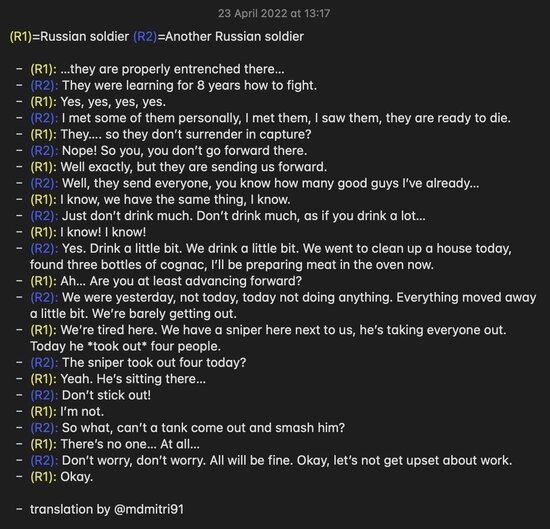
Here is another Russian soldier’s account of the Donbas front lines in late March and early April. Follow the link and read the whole thing (same with the Girkin links above). It’s breathtaking.
By mid-April there were a couple of men left of our “pre-war” company [150 troops in an infantry company] . Volunteers and reservists were already being sent to the battle. Volunteers in masses were with experience of 2014-2015, but here it is absolutely other war and their experience does not help anything. And the reservists are miners caught on the streets without the slightest experience. Nobody cares. Put your submachine gun in your hands and go forward under the mortars. There was a catastrophic shortage of men, fighters were not allowed to leave the front line for a month or more. Many went nuts from such loads. Some began to drink heavily, fortunately there was no problem with booze at the front. Mathematically there was almost no chance of getting out alive and uninjured. The longer you stay there, the less chance you have. Of those I was friends with or shared bread with, eight people died in a fortnight. The rest were wounded or shell-shocked. Within a week, three company officers had changed – two were killed. There were no company-platoon level officers left at all.
Igor Girkin says the separatist-held territories of Donbas are tapped out, no more troops to give. Indeed, they’ve conscripted men up to the age of 60. There are only so many more Chechens to send, and they don’t seem too excited to be bearing the brunt of Russia’s war.
Russia executed 2 Chechens who refused to go to war in Ukraine on 25 April, Musa Taipov, niece of Dzokhar Dudaev and member of the Presidium of the Government of the Chechen Republic of Ichkeria and the official representative of the CRI in France, says – our sources
The May 9 Victory Parade should prove an inflection point: does Vladimir Putin use the occasion to call for a mass mobilization to bolster the war effort, or will he keep pretending that it’s merely a “limited military operation” that remains splendidly on track, dooming the entire effort? Ukraine’s regular army and Territorial Defense Forces have bought time for those 300,000 reservists out west to train and get equipped. A couple more months, and they’ll be riding into battle in Polish T-72s, American and European armored personnel carriers, and lots of sweet, sweet, modern artillery. How will Russia respond, even as it attrits its existing forces on the daily?
Ukraine’s recent raids in Belgorod and Kursk would’ve been great fodder to gin up war fervor amongst the Russian populace. Instead, Russian state propaganda passively stated that the facilities merely “caught fire.” Curious, isn’t it? Stunningly, Putin is afraid to call for shared sacrifice, even as state propaganda ramps up the hysteria on the nightly. Apparently, it’s easier to support war when it’s the poor regions and foreigners doing the dying, rather than Moscow and St. Petersburg.
Russian state TV is raging about WWIII and an inevitable escalation over Russia’s invasion of Ukraine. Citizens are being primed to believe that even the worst outcome is a good thing, because those dying for the Motherland will skyrocket to paradise.https://t.co/PzAt9jCBLtpic.twitter.com/DK2mXXWdfe
Content warning: This story contains descriptions of child abuse.
In an effort to generate publicity for his scandal-ridden Senate campaign, Missouri Republican Eric Greitens posed on Monday with Donald Trump Jr. at a shooting range. As he empties his semi-automatic pistol into the targets, he pointedly mutters, “Liberals beware.” For his part, Trump Jr., mugging for the camera, adds, “Striking fear into the hearts of liberals everywhere, folks,” after both he and Greitens fire semi-automatic weapons.
Striking fear into the hearts of liberals, RINOs, and the fake media. Great day of shooting in Missouri with .@DonaldJTrumpJr! It’s time to Make America Great Again, Again. pic.twitter.com/urMdIS7KX4
The staged event was clearly edited and spliced for maximum effect and dissemination on Twitter by Greitens himself.
Unfortunately (and as they are both well aware), neither Greitens nor Trump are likely to face any repercussions or consequences for what is essentially an expression of approval and implicit permission for Republicans to murder Democrats. The use of suggestive or “stochastic” invitations for Republicans to terrorize Democrats is now—thanks to Donald Trump—an accepted and familiar staple of Republican rhetoric. It provides an opportunity for channeling their base’s already well-stoked hatreds while allowing both Greitens and Trump Jr. plausible deniability for actually fomenting and encouraging violence: the “We were only joking!” defense. Conversely, any criticism is automatically characterized as overreaction and, implicitly, weakness.
The fact that less discerning viewers may take it quite seriously and act on such threats is of no concern to these people, because at present there is little that a hypothetical shooting victim whose attacker felt motivated or validated in his actions by this video can do to trace liability or responsibility back to Trump Jr. and Greitens.
Stochasticterrorism is “the public demonization of a person or group resulting in the incitement of a violent act, which is statistically probable but whose specifics cannot be predicted.”
The word stochastic, in everyday language, means “random.” Terrorism, here, refers to “violence motivated by ideology.”
From the same source, four factors are indicative of this type of terrorism:
A leader or organization uses rhetoric in the mass media against a group of people.
This rhetoric, while hostile or hateful, doesn’t explicitly tell someone to carry out an act of violence against that group, but a person, feeling threatened, is motivated to do so as a result.
That individual act of political violence can’t be predicted as such, but that violence will happen is much more probable thanks to the rhetoric.
This rhetoric is thus called stochasticterrorism because of the way it incites random violence.
For Greitens in particular, the “shock value” of employing these demonstrative tactics is particularly revealing. He is attempting to distract from serious allegations of child and spousal abuse that have come to light in a custody dispute with his former wife, Sheena Greitens. In an affidavit filed last month, Sheena Greitens provided some of the details of that alleged abuse, which she claims she will back up with photographic and other evidence as the case proceeds.
As CNN reports:
“In early June 2018, I became afraid for my safety and that of our children at our home, which was fairly isolated, due to Eric’s unstable and coercive behavior,” she said. “This behavior included physical violence toward our children, such as cuffing our then three-year-old son across the face at the dinner table in front of me and yanking him around by his hair.”
Sheena Greitens said she and others were so concerned about Eric Greitens’ behavior that they limited his access to firearms on three occasions. She said she was concerned about the “escalation of physical violence” and eventually, “I started sleeping in my children’s room simply to try to keep them safe,” according to her affidavit.
The irony that Greitens is denying his former wife’s allegations while at the same time escalating the very violence-fueled rhetoric and use of firearms that she describes in her affidavit—albeit now in the pursuit of his political ambitions—is fairly inescapable.
The sad fact is that this type of rhetoric will continue to proliferate as long as Americans continue to treat both the tactics and those who employ them as legitimate rather than something despicable and unworthy of our country.
Boeing has had its share of problems over the past several years—its planes abruptly dropping out of the sky like remote-controlled canned hams being chief among them. But while the whole “oops, our plane crashed but it won’t happen again—erm, okay, it happened again, but this time we’ve really fixed it—lol” PR nightmare has continued to dog Boeing, in one important way we can all relate to the company’s problems, because Donald John Trump has made those problems worse.
Boeing also doesn’t expect deliveries of the plane to start until 2025, more than a year later than it previously forecast. Its shares were down more than 7% in morning trading Wednesday after it reported results.
Boeing has enjoyed a resurgence in demand for its 737 Max plane, which returned to service in late 2020 after two fatal crashes. But production problems and certification delays have hampered other aircraft programs.
Another drag on the company’s earnings? The deal Trump struck with Boeing for its work on the new Air Force One, which has bored a $660 million revenue crater into the company’s balance sheet. In fact, the deal was so bad for Boeing, CEO Dave Calhoun says the company should have rejected it:
Calhoun spoke Wednesday on the company’s quarterly earnings call, just hours after Boeing disclosed that it has lost $660 million transforming two 747 airliners into flying White Houses.
“Air Force One I’m just going to call a very unique moment, a very unique negotiation, a very unique set of risks that Boeing probably shouldn’t have taken,” Calhoun said. “But we are where we are, and we’re going to deliver great airplanes.”
The former president, an aviation enthusiast, took a keen interest in the new presidential jets, involving himself in everything from contract negotiations to the plane’s color scheme. As part of the deal, Boeing signed a fixed-price contract that required the company, not taxpayers, to pay for any cost overruns during the complicated conversion of the two airliners.
So should we be thanking Trump for saving taxpayers money while sticking one of America’s biggest employers and most essential corporations with a giant bill? Does that make up for all the money he wasted on golf trips or take any of the sting out of Jared Kushner’s grotesque $2 billion conflict of interest? Maybe, but given that the company is a key fixture in our military-industrial complex, it’s a safe bet they’ll get that money back one way or another.
And maybe we should be happy that Trump was sticking to his managerial strengths—i.e., picking out colors for things—instead of, say, negotiating an even worse deal with the Taliban. But I have a feeling at least $100 million of the cost Boeing has been forced to eat involves a complex apparatus for hosing the excess McRib sauce off POTUS.
In fact, I’d be a little shocked if Trump’s new plane—which I can only hope he’ll never see up close—looks and feels a bit like the car Homer designed for himself on The Simpsons.
Over the weekend, Republicans in Michigan were busy in Grand Rapids at their spring convention. This is where members of the Michigan GOP go to discuss strategy, who is running to represent them, who they will support, and how much support they will give to various candidates. Traditionally, this would also be the time to discuss policy distinctions between candidates and the lines they are and are not willing to cross in regard to compromise—depending on the candidate and district in question. AHAHAHAHA. That last part was a joke. The Republican Party has zero policy platforms that fall within the purview of our Constitution!
The conservative civil war is raging across the country, and while traditional media is mostly worried about their personal stock portfolios, GOP operatives continue to battle it out between the recently solemn neocons of the party versus the furiously misdirected MAGA-cum-tea party fascists in the party. The Michigan convention was filled with all of the bile we have come to expect from a meeting of Republicans. The major “themes” (because once again, there is no policy in the GOP) were anti-LGBTQ+, anti-education rhetoric wrapped up in “parental rights” and the promotion of Trump’s big lie that the election was stolen.
Tony Daunt was a longtime Michigan state GOP committee member. I say ‘was’ because on Tuesday night, Daunt reportedly resigned from the state committee, saying the Republican Party is going down a sewer hole.
The Detroit News was able to get a copy of the emailed resignation that Daunt sent to Judy Rapanos, chairwoman of the 4th Congressional District Republican Committee. In it Daunt criticized what he said was a litmus test of loyalty to disgraced disaster of a person Donald Trump. In fairness to Daunt, he described Trump as a “deranged narcissist.”
Daunt isn’t some woke liberal cancel culture warrior, mind you. He is a dyed-in-the-wool conservative who believes the Democratic Party has “myriad failures” that the GOP should run candidates against. Daunt has supported proposals like doing away with Michigan’s personal income tax and is highly critical of government spending over tax cuts—the classic, proven-to-fail policies that conservatives have always pushed.
And while he believed the GOP should be trying to win elections by going after Democratic Party policy, he now says his fellow “feckless, cowardly party ‘leaders’ have made the election here in Michigan a test of who is the most cravenly loyal to Donald Trump and re-litigating the results of the 2020 cycle.” Maybe the most damning part of Daunt’s resignation letter is Daunt’s assertion that Michigan GOP leader know the election fraud claims are lies and Trump’s general election claims are lies. The best part? He calls Trump an “undisciplined loser.”
“Incredibly, rather than distancing themselves from this undisciplined loser, far too many Republican ‘leaders’ have decided that encouraging his delusional lies — and, even worse — cynically appeasing him despite knowing they are lies, is the easiest path to ensuring their continued hold on power, general election consequences be damned.” That’s the stuff. Who will or won’t Daunt and other Republicans like him vote for this coming fall, nobody knows. Hopefully this conservative civil war continues to erode the Republican Party in the same way the party has been eroding America for the last five decades.
A California bill could end offshore drilling for the state, though drilling further out in federal waters near the coast would still continue. SB953 seeks a “relinquishment of the leases and termination of all oil and gas production associated with these leases” from the companies still in operation. The bill was brought forth by state Sen. Dave Min in the wake of the October 2021 oil spill near Huntington Beach in which a pipeline running from the Port of Long Beach to Platform Elly ruptured, sending 25,000 gallons of crude oil into the ocean. The bill cleared the Natural Resources and Water Committee on Tuesday and has been re-referred to the Senate Appropriations Committee, so it could be a while before SB953 moves any closer to becoming law.
Once passed, it could take at least a yearn and a half before drilling ceases. Though 11 leases are active in state waters, just three offshore oil and gas platforms remain. The bill would not impact the 23 platforms in federal waters, which includes Platform Elly. Advocates nonetheless believe that SB953 could send a strong message were it to become law. “The only way to prevent more oil-related disasters like the one we experienced in October of 2021 is to transition off of fossil fuels as quickly as possible,” Natural Resources Defense Council Director of California Government Affairs Victoria Rome said in a press release. “SB 953 allows for negotiations with the industry on how to voluntarily relinquish their state leases. If an agreement can’t be reached, the bill requires termination of those leases with fair compensation provided to the leaseholders.”
According to a poll conducted in the wake of the spill, a full 70% of Californians oppose more offshore oil drilling. Though a recent Phys.org piece contended that SB953 could prove costly for residents, Sen. Min assured Spectrum News 1 that “it won’t affect oil prices even a cent.” There is also precedent to limiting offshore drilling, most recently with Huntington Beach and Laguna Beach tightening restrictions. But it was the 1969 Santa Barbara oil spill that truly changed the way the California coastline looked in the wake of a major disaster, prompting the California State Lands Commission to place a moratorium on offshore drilling in state waters. The disaster even inspired the first Earth Day, according to Smithsonian Magazine.
There is absolutely a chance that actions inspired by the 2021 Huntington Beach oil spill could further strengthen the movement against drilling, though there is still an uphill battle to be fought against federal offshore drilling, to say nothing of the oil and gas drilling still occurring on California’s lands. Some movement has been made on a local level, such as Los Angeles’ ban of any new oil and gas wells and its commitment to phase out old wells within five years. But last year’s ban of oil and gas wells from being drilled within 3,200 feet of schools is comparatively weak in terms of environmental justice and true climate change mitigation.
Outside the Supreme Court building on Tuesday, pro-refugee advocates chanted “Si, se puede” (“Yes, we can”) and “Say it loud, say it clear, refugees are welcome here.” Inside, justices heard oral arguments around the previous administration’s inhumane Remain in Mexico policy, officially known as Migrant Protection Protocols (MPP).
The big question is not the legality of the program itself (though it is illegal), it’s whether the Biden administration has the power to end it. (Of course it does, but we are not the Supreme Court.) In light of an openly hostile 6-3 court, the odds do not seem good at all. But following Tuesday’s hearing, observers seemed to indicate that a ruling in favor of the administration could be possible. Maybe.
“Questions from conservative and liberal justices during nearly two hours of arguments suggested that the court could free the administration to end the ‘Remain in Mexico’ policy that forces some people seeking asylum in the U.S. to wait in Mexico for their hearings,” The Washington Postreported.
CNN reports that while right-wing justices asked “tough questions of the administration … Chief Justice John Roberts expressed sympathy for the government’s argument that it wants to end a program that had been put forward by the previous administration.” Vox, meanwhile, reported justices seemed “fed up with a Trump judge who sabotaged Biden.” That right-wing judge forced himself into foreign policy, because reinstating this policy has required cooperation from Mexico. “Judge Matthew Kacsmaryk is not secretary of homeland security, even though he might think he is,” Vox said.
Of course, how justices vote is a whole different matter, and this is a right-wing court that has had no qualms about using the secretive “shadow docket” to issue momentous decisions, as Daily Kos’ Joan McCarter has previously noted. So we’ll see what really happens in late June when the court is expected to issue a decision on this case.
“They tried to bury us. They didn’t know we were seeds.” I’m thinking of all the families I have met who have suffered at the hands of the harmful and racist Remain in Mexico policy. Remain in Mexico needs to go. All families deserve to be #SafeNotStranded 📸 @fams2getherpic.twitter.com/45D2m99xJw
🗣Say it loud, say it clear: refugees are welcome here. The cruel “Remain in Mexico” policy must go — it’s subjected tens of thousands of people to horrific violence & danger and denied them due process. People seeking asylum should be #SafeNotStranded. #RMXMustGo#SCOTUSpic.twitter.com/EzXvgBggOL
— National Immigration Law Center (@NILC) April 26, 2022
The Supreme Court is hearing arguments about the Biden administration’s attempts to end the “Remain in Mexico” immigration policy. @ReichlinMelnick of @immcouncil says the case centers on “whether or not a new president has the authority to ever end his predecessor’s programs.” pic.twitter.com/2VZyyrAjy5
In the meantime, we know that Remain in Mexico continues to inflict harm on vulnerable people, because that was the entire point of the program when it was instituted by the previous administration. It’s been more than two years since a government attorney representing that administration admitted in court that everyone enrolled in Remain in Mexico could be at risk of being kidnapped by a cartel. President Biden’s Department of Homeland Security acknowledged these dangers in the October 2021 memo that again attempted to terminate the policy following Kacsmaryk’s ruling.
There’s also the possibility that Remain in Mexico remains a danger to asylum-seekers even if the Biden administration wins. Both Vox and Immigration Impact said Brett Kavanaugh was among justices who suggested the case could go back to Kacsmaryk.
“Despite the October memo not being before the court, Justice Kavanaugh expressed significant skepticism that the Biden administration had explained itself enough in its 39-page memo terminating the program,” Immigration Impact said. “Unfortunately, that suggests that even a victory for the Biden administration in this case may not be enough in the long run to end MPP.”
More than two years into the pandemic and some people still haven’t learned right from wrong. Despite the number of arrests in connection to and warnings that selling fake vaccine cards is illegal, some people, especially Trump supporters, continue to do so. In the most recent incident of selling fraudulent vaccine cards to the Feds, a Colorado man identified as Robert Van Camp was arrested on Tuesday. Van Camp faces a charge of conspiracy to defraud the United States in a federal court with an investigation spanning multiple states. He is accused of running a business that sold cards in several states.
“It was the purpose of the conspiracy for Van Camp, Co-Conspirator-1, and their co-conspirators to (a) fraudulently obstruct the government’s administration and distribution of COVID-19 vaccines and the government’s federal employee vaccination mandate,” the arrest complaint stated.
Van Camp was arrested after allegedly selling fake COVID-19 vaccination cards to at least four undercover agents after obtaining an electronic copy of a blank card. Prosecutors said Van Camp carried out the scheme with a co-conspirator who had a top-secret security clearance. His partner has been unidentified in court records.
“Pretty fucking nice, huh? I call them a work of art,” Van Camp told an undercover federal agent who was pretending to buy cards.
To another agent, Van Camp bragged about selling hundreds of cards, including in “Honduras, Costa Rice, Canada, France, Turks and Caicos, twelve different states, so my cards are fucking worldwide.”
“I mean, these things are gold,” he said, noting he sold some for over $170 each.
In efforts to hide his business, prosecutors said, Van Camp referred to the cards by code names and told buyers to do the same, calling them “gift cards.” His scheme lasted over a year.
According to court documents, Van Camp claimed he was making and selling the cards because of vaccination requirements.
”I’m not making cards ’cause I’m bored, I’m making cards ’cause I’m in the middle of a fucking war and I, and I have a lot of guns and ammo, like an arsenal,” he told one of the undercover agents, according to the court document.
The Trump fan arrested for distributing fake vaccine cards previously posted a picture of himself wearing only a Trump flag. https://t.co/9D8rW2KQVP
Since the start of the pandemic, people have been creating fake vaccine cards in an attempt to make a quick buck off those individuals unwilling to follow safety precautions. Daily Kos reported multiple warnings issued by the FBI noting that fraudulent cards not only increase the risk of COVID-19, but that both buying and selling the fraudulent cards is illegal and could be charged as forgery. Making or buying counterfeit vaccine cards violates federal laws and can result in heavy fines and imprisonment.
According to CNBC, after announcing charges against two people in California who allegedly raised more than $140 million by falsifying COVID-19 tests, the U.S. Department of Justice announced Wednesday that criminal cases against 19 other defendants are in process. Van Camp was amongst the defendants, many of whom were medical professionals. He was noted as the one who bragged about selling vaccine cards to Olympic athletes.
“And like I said, I’m in 12 or 13 states, so until I get caught and go to jail, fuck it. I’m taking the money!” he said according to court records. “I don’t care, I’ve saved a thousand lives.”
Seems like he is going to care now that he has been caught. Saving lives, though? Who is he kidding?
Republicans are teeing up their next move toward making the U.S. government completely unable to function. If they take control of the House, as they are favored to do, they will come in already having laid the groundwork to begin impeaching Cabinet officials, starting with Homeland Security Secretary Alejandra Mayorkas.
On Monday, 133 Republican House members sent Mayorkas a letter accusing him of “disregard for the enforcement of U.S. immigration laws” and actions that have “willingly endangered American citizens and undermined the rule of law and our nation’s sovereignty.” Basically, Mayorkas has not kept every single one of Donald Trump’s hateful immigration policies in place.
Though the letter doesn’t use the word “impeach,” it makes a not very veiled threat: “Your failure to secure the border and enforce the laws passed by Congress raises grave questions about your suitability for office.”
House Minority Leader Kevin McCarthy made the threat explicit in the Monday border visit he used to try to distract from having been caught in a set of big lies about his attitude toward Trump and Jan. 6. “This is his moment in time to do his job,” McCarthy said of Mayorkas. “But at any time if someone is derelict in their job, there is always the option of impeaching somebody.”
Mayorkas is supposedly “derelict,” while Republicans have nothing bad to say about expensive and useless theater conducted at the border by Texas Gov. Greg Abbott.
But a move to impeach Mayorkas probably wouldn’t be the end of Republican efforts to hobble President Biden’s administration and make being a Cabinet official from one party punishable by impeachment if the other party held the House. The reporting at Axios can be faulted on many fronts, but the outlet has excellent Republican sourcing. Here’s what it takes from its sources: “For the first year of President Biden’s term, it was mostly the hard right of the GOP who entertained impeaching the president and his Cabinet secretaries. But those deliberations are now happening among a much larger group — even with virtually no precedent or legal justification.”
One Cabinet official has ever been impeached in U.S. history. Republicans are getting ready to make that commonplace, not because Cabinet officials suddenly magically got worse, but because the Republican Party is committed to sabotaging not just a Democratic administration but voters’ faith that the government can function effectively.