Daily Kos was born on May 26, 2002. That makes 2022 our 20th anniversary year, and just one of the ways we’re celebrating is by bringing back theKoscars! One of the things that makes Daily Kos special is our open platform, where community members can publish stories alongside staff. The Koscars seeks to acknowledge and honor outstanding writing contributions from everyone. The entire Daily Kos membership is “the Academy,” so your votes decide the winners.
Before we can get to voting—a beloved Daily Kos activity indeed—we need nominees. This week, we are requesting nominations for Outstanding Commenter. This category is to recognize people in the Daily Kos Community who mostly make their views known by writing comments. Nominate someone today!
On to this week’s category!
Outstanding commENTER
There are a lot of writers here who don’t put their name on stories, yet we all know exactly how they feel on a wide variety of topics. They do this by making comments on stories authored by others, offering just the right spark to get a conversation started, or jumping into an existing thread with an offbeat point of view, a unique turn of phrase, or something engaging that makes folks smile.
This Koscar is intended for someone who mostly makes comments. It doesn’t mean this person has never ever written a story, but nominations should be reserved for people whose contribution to Daily Kos is most closely associated with comments. The honor will apply to the writer’s whole body of work, so you do not have to nominate a specific favorite comment. Still, you might want to link to a few representative gems anyway to encourage people to vote for your selection when voting begins in a few weeks.
Also, this is about quality, not quantity. Looking through profile pages can easily tell us who has made the most comments in terms of raw numbers. But some people who comment a lot don’t add much substance to the conversation, while others who comment less frequently make you sit up and take notice every time you see their name. If someone just popped into your mind as you read that sentence, then that is the person we want you to nominate.
Remember that commenters who receive multiple mentions have a better chance of making it into the final list of nominees. Nominations will be open as long as this story is accepting comments. And don’t be shy: You can even nominate yourself!
Finalists in all categories will be presented on Tuesday, May 17 when the voting begins! Two winners in each category will be announced on our 20th anniversary: Thursday, May 26!
Foreign and domestic events being what they are, a project like this can be a welcome distraction from talk of war, Supreme Court controversy, and general anxiety over the upcoming midterm elections. Let’s celebrate the best of who we are, the best of what we have to offer, and the best of what we have done to effect progressive change.
here’s how YOU can participate in the Koscars:
Be on the lookout for the nomination request each week.
Read, recommend, and comment so it will stay visible on the Trending List as long as possible.
Make nominations in each category, including seconding nominations made by others (where applicable).
Vote when the final list of nominees is presented on Tuesday, May 17.
Congratulate the Koscar winners on our 20th anniversary: Thursday, May 26!
In the comment sECTION below, please share your nominations for Category #7: Outstanding Commenter.
The Koscar in Category #6 will go to someone who writes regularly but is not a member of the paid staff. How can you tell if an author is eligible for this category? Look for the word “Community” in blue letters under the author’s name at the top of the story just below the title.
Category #6 is intended for people who write stories. (Category #7 is for people whose writing contribution is mostly in comments.) The award will apply to the author’s whole body of work, so you do not have to pick out a single story. Still, you might want to link to a favorite (or two) anyway to encourage people to vote for your selection when voting begins in a few weeks. And don’t be shy: You can even nominate yourself!
As always, authors who receive multiple nominations have a better chance of making it into the final list of nominees. Nominate someone today!
Former Fox News host Bill O’Reilly is going viral and, unsurprisingly, it’s not for a good reason. A video of O’Reilly exploded online Tuesday. In the video, the 72-year-old right-wing, disgraced host can be seen belittling a JetBlue employee at John F. Kennedy International Airport, all because his flight was delayed.
“What you’re gonna do … it’s three hours late,” O’Reilly is heard saying in the video. When the employee responds, O’Reilly can be heard interrupting the employee and pointing at him as he continues: “No, no, no. You’re going to find out.”
It only gets worse. O’Reilly then resorts to name-calling, including calling the employee “a (expletive) scumbag.” When the employee attempted to respond, O’Reilly served up a hypocrisy sandwich, saying, “Don’t talk to me like that.”
Of course, despite clearly threatening the employee, O’Reilly denied threatening him and then immediately took a shot at his livelihood. “You’re going to lose your job,” O’Reilly told the employee, before walking away.
The video of the incident, which occurred on Sunday, April 3, was exclusively obtained by the Daily Mail.According to the outlet, O’Reilly planned to be on his way to the Turks and Caicos Islands in the Caribbean when his flight was delayed by over three hours.
On Sunday, former Fox host Bill O’Reilly threatened a JetBlue employee at JFK Airport after his flight to Turks & Caicos was delayed: “You f*cking scumbag! You’re gonna lose your job!” pic.twitter.com/30LFyNy2Yj
A fellow passenger recorded the incident, noting that he was shocked by O’Reilly’s remarks and attitude. “I couldn’t believe how arrogant he was,” the passenger told Daily Mail.
O’Reilly took to Twitter to defend himself and accuse the airline employee of being the arrogant one during the incident.
“The character assassins on social media completely lying about my interaction with a JetBlue guy who misled passengers during a five-hour delay,” he posted on Twitter. “I expected this.”
Airline flight changes have been common since the start of the pandemic. Multiple airlines including JetBlue announced that they would be altering flight schedules due to staffing shortages that are contributing to delayed flights and cancellations.
“Despite hiring more than 3,000 new crewmembers already this year, like many businesses, we remain staffing constrained and these disruptions exacerbate an already challenging staffing situation,” JetBlue said in a statement earlier this year.
Realistically, O’Reilly should have planned for delays which are, of course, frustrating. But harassing an employee is never the right approach.
This isn’t the first time that O’Reilly has faced negative headlines. He was fired from Fox News following a sexual harassment scandal in 2017. He now hosts a podcast. An avid supporter of Donald Trump (who also faces numerous sexual assault accusations), O’Reilly called the accusations against himself “completely unfounded claims.”
Omarosa Manigault Newman is best known for being Omarosa. Omarosa is best known for being a pretty wretched reality television star who rose to a form of celebrity during her many appearances on The Apprentice, hosted by disgraced president Donald Trump. When Trump won the electoral college vote in 2016, Omarosa ended up becoming one of the myriad White House aides to subsequently find themselves pushed out of a job in the following weeks and months.
Omarosa owed her position in Trump’s White House to her self-serving narcissism—something Donald Trump responds to in people, as the transactional nature of their existence mirrors his. However, like Donald Trump, Omarosa is willing to do and say anything, and throw anyone under a bus to make a buck, and realized very quickly that her best avenue of revenue, post-White House, was to write a tell-all book. Unhinged: An Insider’s Account of the Trump White House is that book, which details her time with the disgraced President. How much of the book is true remains to be seen—and heard, as Omarosa provided audiotapes as proof of some of her claims.
Since that time, Trump has predictably lashed out at Omarosa, while also predictably suing Omarosa for violating her nondisclosure agreement (NDA). He lost that lawsuit in 2021. Now, it is time for Trump to pay the piper.
On Thursday, the Washington Post reports that an arbitrator ordered “Donald Trump’s presidential campaign to pay Omarosa Manigault Newman $1.3 million in legal fees over the Trump campaign’s unsuccessful lawsuit against her.” For all of Trump’s resources (read: other people’s money), his lawyers never seem to win these unwinnable cases.
Millions of people around the globe visit the Caribbean each year, thrilled to vacation there and experience not only the beaches and well known-tourist destinations, but also to explore the region’s amazing biodiversity. There are over 11,000 plant species, and 72 are unique to the region. A major attraction has always been the amazing coral reefs, and efforts to preserve them have been ongoing for many years.
It is important that we support the efforts of governments and organizations that are on the front lines of the fight to preserve the region’s unique natural resources.
The countries in the Caribbean, like other small island developing states (SIDS), are on the frontline of the battle against climate change. For many developed countries in the global North, climate change is still an academic issue – something to be debated and investigated. For them, the discussion centres mostly around what will happen by the end of this century. However, for us in the Caribbean, climate change is a clear and present danger, something that we are living and experiencing every day of our lives.
The facts are clear and irrefutable. The Sixth Assessment Report of the Intergovernmental Panel on Climate Change has shown that atmospheric levels of carbon dioxide are at their highest concentrations in at least two million years, while the concentrations of the other two greenhouse gases, methane and nitrous oxide, are at their highest levels in at least 800,000 years. It has been 45 years since our planet had a colder-than-average year, and human influence has warmed the climate at a rate that is unprecedented in the last 2,000 years.
For SIDS, this is translating into more excessively warm days, significant variability in rainfall, warmer oceans, loss of coastlines due to sea level rise, more intense droughts, more frequent flooding, and more severe hurricanes. Our marine and terrestrial ecosystems are under threat. Our rich biodiversity is in peril. Water insecurity is becoming a serious concern. Food security is being threatened by warmer temperatures and changes in rainfall patterns. Our oceans are getting warmer and more acidic, and this is negatively impacting our fisheries sector. Additionally, our coral reefs are being damaged by the increasing ocean temperatures and acidity, and this in turn is affecting the dive sector and the tourism industry on which so many of our island economies depend.
Fletcher explores the need for the governments in the Caribbean to demand climate justice from the world’s major powers and calls for nations to support the United Nations Human Rights Council 2021 position “that having a clean, healthy and sustainable environment is a human right.”
The University of the West Indies Mona Climate Studies Group at (CSGM) says Caribbean islands need to pay attention to the second installment of the United Nations Intergovernmental Panel on Climate Change, known as the Sixth Assessment Report (AR6).
The report, which was released in February, presents a dire warning of the significant implications of inaction for the globe and the region; noting that even temporarily exceeding the global warming of 1.5°C that is anticipated in the next two decades will result in severe effects, some of which will be irreversible.
CSGM says while the report covers the global impacts, vulnerabilities, and risks of climate change, Chapter 15 is dedicated to addressing small islands in the Caribbean, Indian, and Pacific Oceans.
Details of a grim future facing the Caribbean should not obfuscate the efforts being undertaken to combat the impact of climate change. One such effort has been ongoing in Belize at the Laughing Bird Caye National Park pictured above, and detailed in a 2021 story from the BBC’s Veronica Perkova, who notes that “when Hurricane Iris hit southern Belize in 2001, the country’s magnificent corals were destroyed. But within 10 years, a radical restoration project brought the reef back to life.”
When Lisa Carne first visited the island in 1994, there were so many large, bright reddish-orange interlocking elkhorn corals that she could hardly swim through or around them. The reef was abundant in fish, corals, lobsters, crabs, sponges and sea turtles. But after the hurricane all of this was destroyed. With only a few surviving corals, the scene looked more like a graveyard
…
For five years after Hurricane Iris, the reef lay bare. There were few live corals, schools of fish or lobsters, and the seabed was covered in reef rubble and encrusting sponges. Carne began pitching her restoration ideas in 2002, but for several years had no luck. Then in 2006, the US listed Caribbean acroporid corals (the fastest growing type of branching coral in the Caribbean, and the main reef-building one) as endangered, and a local funder approved Carne’s proposal to restore the reef.
…
In 2013, Carne registered a non-profit community-based organisation in Belize called Fragments of Hope and two years later added a US branch. Fragments of Hope developed a coral restoration training course, endorsed by the Belize Fisheries Department, which has certified over 70 Belizeans to date, says Maya Trotz, a professor of civil and environmental engineering at the University of South Florida and a US board member of Fragments of Hope. The restoration supplements local people’s incomes from tourism and fishing with restoration jobs. “Fragments of Hope engages young people, and has created colouring books and puzzles about the reef, featuring artwork of a local artist,” says Trotz. “Over 2,500 have been distributed to date to schools across Belize.”
This YouTube video from Cameron Sabin tells more of the stunning story.
The Belize Barrier Reef Reserve System is one of the longest barrier reefs in the world, second only to the Great Barrier Reef in Australia. It’s made up of 7 different protected areas, including the world famous Belize Blue Hole. In 2001 though, Belize’s barrier reefs were severely damaged by Hurricane Iris. Corals were completely uprooted and the reef was left in a dire state. Laughing Bird Caye National Park was particularly hard hit. That destruction made the restoration of Belize’s coral reef all the more remarkable, especially at a time when coral reefs around the world are under threat from climate change, coral bleaching, severe weather, development, and more.What started off as a small reef restoration research project has since blossomed into a full-blown, country-wide conservation movement. The organization Fragments of Hope started off by raising young corals and replanting them when they were big enough to be put on the reef, but since then local Belizeans have joined the effort and the Belizean government has even adopted more stringent protections for the Belize Barrier Reef Reserve System.
Check out this video to learn even more about Carne’s organization, Fragments of Hope.
Of course coral is not the only area of concern of conservationists’ efforts in the Caribbean. The list posted by James Fletcher above demonstrates the sheer number of challenges. Many of those efforts will be highlighted on Earth Day, the theme of which is “Invest in Our Planet” for 2022.
Seven state and federal agencies will celebrate Earth Day by offering a two-day virtual conference promoting climate resilience and equity in Puerto Rico and the US Virgin Islands, on April 19-20.
Nearly 80 speakers and moderators working with climate change issues in the islands will share their perspectives in plenary talks and breakout sessions and dialog with the public.
The US Environmental Protection Agency (EPA), the Puerto Rico Department of Natural and Environmental Resources (DNER), US Geological Survey, US Department of the Interior (DOI), the US Department of Agriculture (USDA), the National Oceanic and Atmospheric Administration (NOAA), and The Nature Conservancy are conducting the event.
The MAP team is in the Bahamas! We are here with Waterkeepers Bahamas and Earthcare to teach a mangrove restoration workshop. Mangroves are incredibly important in the Bahamas due to their ability to protect against coastal erosion and provide a buffer against storms. They are home to many marine species that are important to local fisheries and the tourism industry. Mangroves are a nature-based solution that can help to address many of the interconnected challenges we face relating to climate change, biodiversity loss and supporting sustainable livelihoods.
Hurricane Dorian caused huge devastation in Grand Bahama in 2019, destroying over 70% of the mangrove forests on the island. Many community groups, including Waterkeepers and Earthcare, are trying to restore these vital ecosystems. “It is hard to believe the devastation caused by Hurricane Dorian until you see it for yourself, there are dead mangrove trees as far as the eye can see” said Laura Michie, our Restoration Manager and CBEMR trainer. “This workshop aims to enhance understanding of mangrove ecology and stakeholder needs to improve project outcomes for mangroves and communities.”
In light of the potential for mangroves to also store huge amounts of carbon, these trees are set to play a pivotal role in many conservation and restoration projects. “It is great to see so many groups working on mangrove restoration, but it’s vital that these projects are done right for them to be successful,” said Laura. Sadly, many attempts to restore these valuable ecosystems fail, largely due to a lack of understanding of underlying ecological and social pressures. Mangrove planting initiatives around the world have met an unfortunately high rate of failure.
— MangroveActionProject (@MangroveProject) April 11, 2022
Barbados, meanwhile, is engaging its residents with a climate change photo challenge.
For example: 🏖 Is the sargassum seaweed impacting your recreational activities at the beach? 🌱 Is drought stopping the plants in your kitchen garden from growing? 🌊 🏡 🌀 Has your home been damaged by a hurricane or flooding? pic.twitter.com/bXHxyt9hud
As Earth Day looms, please amplify and pass along this information! Feel free to post any information you have in the comments, where I’ll be posting even more upcoming Earth Day events, and, as always, serving up the weekly Caribbean News Twitter roundup.
An elementary school assistant principal in Virginia is claiming “reverse racism” in a lawsuit against her school district after an equity training she attended went horribly wrong.
Emily Mais claims she was “forced out” of a job “she loved” when the Albemarle County Public Schools district implemented an anti-racism policy for teachers, which the suit calls a “radical program that scapegoats, stereotypes, labels, and ultimately divides people based on race.”
The 45-page complaint adds that “instead of training faculty members to embrace students of all races,” the program “promotes racial division and encourages racial harassment.”
But here’s where things get a little murky. Mais’ suit also alleges that the district’s anti-racism curriculum, titled Courageous Conversations About Race: A Field Guide for Achieving Equity in Schools by Glenn Singleton, is “critical race theory,” and we know a lot of folks in Virginia are not happy about CRT being taught in schools—even though it isn’t. And Mais, who believes race-related training is CRT and that CRT is racist, claims she she wasn’t able to oppose the training without appearing to be racist herself. Befuddling, right?
But if Mais isn’t just a little bit racist or at the very least insensitive, then why during the last session in June 2021, with of all the equity, justice, and anti-racism education she and other teachers were getting, did she refer to people of color as “colored” people?
Mais alleges it was just a “slip of the tongue” and the suit claims she “apologized,” but others in the room at the time, according to the suit, refused to accept her apology and she was asked to attend additional meetings with the district’s superintendent, the school’s guidance counselor, and an equity specialist, according to The Daily Beast.
Mais is being represented by attorneys from the Alliance Defending Freedom, a legal advocacy group founded in 1994 by “leaders in the Christian community,” The Daily Beast reports.
In the legal challenge, Mais is described as a “Christian” who “believes that all human beings are created in the image and likeness of God.” Mais also says that she believes that “racism is morally evil,” and then cites Dr. Martin Luther King Jr.’s famous quote—the one often used by people who don’t know any other quotes by King—“[people should] not be judged by the color of their skin but by the content of their character.”
And, according to The Daily Progress, Alliance Defending Freedom is also representing a group of parents and their children suing the school district over the district’s anti-racism policy, calling it CRT “that views everyone and everything through the lens of race. Far from exploring ideas or philosophies surrounding justice and reconciliation, that ideology fosters racial division, racial stereotyping, and racial hostility,” the suit alleges.
So it seems as if Mais’ suit and her “slip of the tongue” and her hostility against CRT aren’t totally disconnected.
In case you were wondering, there’s a wave of parents across the nation that wrongly believe CRT is being taught in K-12 schools. Again, critical race theory is a law school course, and it’s not, despite what Mais and others in Virginia think, a secret curriculum meant to indoctrinate children.
“We have a strategic plan that talks about values. … Equity has been an important one,” district spokesperson Phil Giaramita told The Daily Beast. “Our racism policy is very consistent in what we say our principles and values are as a school division. … We’re talking about equity of opportunity. Every student should have the same opportunity, an equal opportunity to achieve their highest level. That’s really what the policy is designed to ensure.”
Mais is seeking back pay and other damages, according to the complaint.
As we get progressively closer to midterm elections, we’ve seen Republicans at all levels of government use LGBTQ+ people as a scapegoat for just about everything bad happening in this country. Yes, we’re still living in a global pandemic. Yes, young children still aren’t eligible for the vaccine. Yes, unhoused folks continue to live in inhumane conditions. Yes, police continue to display disproportionate violence and abuse against people of color. But Republicans only want to fan a certain kind of fire, and that’s why they’re so happy to target LGBTQ+ people, including kids.
Real issues don’t matter to conservatives, and especially not when it’s election season. They like to keep their fanbase fired up enough to get them to the polls, and as evident by the slew of anti-trans legislation about sports and health care, it’s clear they’ve found their hysteria of the year. Too, a handful of Republican governors have gotten on board with the backward Don’t Say Gay legislation, and the flames are already causing problems across the country. One example comes to us out of Maryland, where The Washington Post reports that the Carroll County Public School District banned Pride flags. Why? It’s “political” and a “gateway” for other flags, apparently.
According to the Los Angeles Blade, a chapter of Parents, Families, and Friends of Lesbians and Gays (PFLAG) donated a “collection” of “small” Pride flags to the district. The parent of a student in the district brought the flags to school. Teachers were reportedly encouraged to display the flags to show support for the queer community. Makes sense.
Superintendent Steven Lockard said the flags were available for any staff members who wanted them, and any remaining flags were kept in the main office.
“Staff are not required to take donations if they choose not to,” Lockard added. “It’s also important to reiterate that Carroll County Public Schools, as we talk about in all of our meetings, strives to meet all the needs of students in our system.”
Sadly, the school board president, Kenneth Kiler, described the circumstances as the lags being “shoved down” teachers’ throats. He claimed that’s not inclusive and “not the way it out to be.”
If you’re not comfortable as an ally to LGBTQ+ youth, you shouldn’t be a teacher, but I digress.
Tara Battaglia, who serves as a member of the school board, described the flags as a “gateway” for other flags that “people will not like.” She went on to compare the school’s decision to ban the Confederate flag and said the “premise” behind the Pride flag was “social advocacy,” which is “political.”
Donna Sivigny, who also serves as a member on the board, argued that students need protection from the political agenda behind Pride flags. She went on to argue that the flags create a hostile environment and suggested the flags create an environment that is not politically neutral.
Sivigny alleged that “many” teachers have told her they’ve felt pressured into putting the flags up in their classroom. Lockard says they’ve received no complaints from teachers about the flags.
There is nothing innately political about LGBTQ+ rights and inclusion. Just like there’s nothing innately political about Black Lives Matter T-shirts or posters. Human rights do not belong to any political party and are not tied to any particular political candidate or elected official. Students (and teachers and other staff members) have every right to be seen and supported as their full authentic selves without conservatives pushing their identities into a political talking point, but here we are.
Sivigny advocated for a new flag policy, which would ban all flags except for the American flag, Maryland state flag, and Carroll County flag for classrooms in the district. The school board will hear public comments before voting on the subject.
Mind you, students are not allowed a vote, even if they speak at or are otherwise participants in school board issues. Imagine if we let the already marginalized young people impacted by these policies have a practical voice? But conservatives would rather parrot the talking points of elected Republicans who couldn’t care less about the people they’re serving than listen to the needs and feelings of the actual students whose lives hang in the balance.
President Biden is expected to sign an executive order on Earth Day allowing for the inventorying of old-growth and mature forests across the country, the Washington Post reports. The Friday order will allow the Forest Service and Bureau of Land Management to use that information to draft policies protecting forests from any threats the agencies identify. It’s unclear what definition the administration will be using for mature and old-growth forests, as the terms tend to vary from ecosystem to ecosystem. For example, the old-growth forest found in Muir Woods in California has trees as old as 1,200 years, while some of the old-growth forests in Minnesota have trees much younger—albeit still centuries old.
What the executive order doesn’t do outright is ban logging. However, the Forest Service and Bureau of Land Management do have jurisdiction over timber sales from federal forests and could thus limit the practice. The Washington Post adds that the order will extend to limiting foreign deforestation efforts and include an inventory of additional natural resources meant to calculate their value. While the Washington Post does mention that the executive order will promote “economic development in regions with major timber industries,” it’s anyone’s guess what that looks like and whether it includes conservation efforts in addition to boosting communities reliant on logging without harming forests in the process.
Forest management is a tricky process given the way climate change has impacted wildfire seasons in parts of the U.S. Rising temperatures and ongoing droughts have led to drier conditions that only increase the threat of devastating fires that burn more acreage faster and at higher temperatures than in previous years. The logging industry has responded by calling for “forest thinning,” basically cutting down trees to benefit the industry while not really doing a whole lot to mitigate fire threats. True fire mitigation calls for Indigenous stewardship, with tribes using their vast knowledge to prevent more devastating fires from decimating regions. Such stewardship goes hand-in-hand with the Biden administration’s environmental justice goals. But until the executive order is released, there’s no certainty that the Biden administration will do anything more than leave it up to federal agencies to monitor forest fire threats.
Even if Indigenous stewardship ends up as a component of Biden’s executive order, there’s always the possibility that the following administration will take unkindly to conservation efforts and effectively revoke it. As the Trump administration moved to undermine progress on public land conservation, the Biden administration swiftly moved to undo the damage that had already been done once the president took office. This has led to a back-and-forth in which the Interior Department was forced to resume oil and gas leasing sales at the behest of an injunction issued by U.S. District Judge Terry Doughty, a Trump-appointed judge with a history of problematic rulings.
A three-judge federal court has hijacked Ohio’s legislative redistricting process and rewarded Republican obstructionism by announcing on Wednesday that if the state’s GOP-dominated redistricting commission fails to produce constitutional maps by May 28, it will implement maps that the state Supreme Court previously ruled were unconstitutional instead.
The Ohio Supreme Court has rejected four different sets of maps for the state House and state Senate drawn by the commission, all for the same reason: They violated voter-approved amendments to the state constitution barring partisan gerrymandering. Those same amendments, however, forbid state courts from ordering the adoption of judicially crafted maps, leaving the Supreme Court with the power merely to order the commission—which consists of five Republicans and just two Democrats—to keep trying again.
But now Republicans have no incentive to try a fifth time, as the Supreme Court recently ordered, because if they fail to do so, the federal court will simply impose their third set of maps. In a 2-1 decision, two judges appointed by Donald Trump said they’d adopt those maps—despite the fact the Supreme Court found they violated the state constitution “beyond a reasonable doubt”—simply because Republican Secretary of State Frank LaRose told local election officials to prepare to use them before the justices had a chance to rule on their validity.
Federal courts cannot be barred by the Ohio constitution from imposing their own maps to remedy violations of the U.S. Constitution, and in fact they must do so in the event of an impasse to ensure that elections can be held using legal maps. (The GOP-drawn maps the state used for the last decade are now badly malapportioned in addition to being gerrymandered.) But in a dissent, Judge Algenon Marbley, who was named to the bench by Bill Clinton, castigated the majority for failing to “respect[] state policies to the maximum extent” by settling on plans that are “irredeemably flawed.”
Instead, said Marbley, the state should use a plan crafted by a pair of outside mapmakers hired by the commission, which expert witnesses who testified before the federal court said “satisfies all constitutional requirements” with minor changes. The commission claimed it abandoned that plan because it was incomplete—a reason the majority cited for spurning it—but Marbley noted that an expert for opponents of the GOP’s maps completed the necessary adjustments in a matter of hours.
Yet with the majority’s decision, “Republican Commissioners will benefit directly from a crisis they created,” wrote Marbley, “and which the Ohio Supreme Court has attributed squarely to them.” And because the GOP’s maps would only take effect for 2022, the same situation could unfold in future years. As Marbley explained, “The 2024 Commission, faced with the options of ceding political power or simply waiting out adverse court decisions, likely will be tempted to take the same course.”
Unmentioned by the dissent is that Republicans are trying to wait out the state Supreme Court in another way as well: Control of the court is up for grabs in November, and the outcome could easily yield a majority that would side with the GOP in any future disputes since the court’s redistricting rulings this year have all been on a 4-3 basis.
Democrats and redistricting reformers are essentially out of options at this point. While an appeal of the federal court’s ruling is possible, any such appeal would go directly to the U.S. Supreme Court, where challengers would expect a very unfriendly reception. The Ohio Supreme Court, meanwhile, has contemplated holding commissioners in contempt. To date it’s declined to do so, but even if it does, there’s no reason to think Republicans would produce constitutional maps since they’ll get exactly what they want as long as they hold out until May 28.
Come Friday, Earth Day turns 53. “Earth” is an anagram of “heart.” Which is appropriate since demonstrating our heartfelt love for the Earth ought to be on the top rung of everyone’s priority list. Earth, our home, and so far the only known place in the universe where thereare beating hearts, deserves—requires—our deepest affection. For our own sake and that of our offspring generations, every day should be treated like Earth Day. All too often, however, as shown by the seemingly relentless parade of bad environmental news, we humans don’t deliver on that.
Just a decade after the first Earth Day in 1970, along came Ronald Reagan, a president whose twisted views of something as obvious as old-growth forest preservation left environmental advocates aghast: “A tree is a tree, how many more do you need to look at?” Although expressed less moronically, he delivered similar views (as well as policies and top appointments) on public lands, pollution, the ozone hole, organic farming, global warming, advocates of renewable power sources and conservation, as well as on us laughable idealists whom he said wanted everyone to “freeze to death in the dark.”
Since then, the Republican Party, which once could boast numerous elected advocates of sound environmental policy, is now brimful of lawmakers eager to demolish or at least sabotage key environmental legislation enacted in the past half-century. Carrying out their donors’ desires, they obstruct, dilute, disinform, and pretend that burning fossil fuels doesn’t kill 8 million people around the planet every year and that protecting the world’s biodiversity should never stand in the way of a new subdivision or palm oil plantation. They treat even the mention of remedies for environmental injustices as a joke. But they are who they are. Or, as Donald Trump once said about the horrific COVID-19 death toll, “It is what it is.” Given who’s in the GOP’s 2022 candidate queue for Congress, it could be a lot more of what it is come January.
Rather than focus on these connivers and know-nothings, Earth Day, this 1 day out of 365, should be a time to renew our efforts in prompting the revolution in values and attitudes needed to deal with the climate and other environmental crises being inflicted on the planet. And also a time to celebrate environmental victories. Paying homage to what we’re doing right or are trying to do right is a healthy alternative to eco-negativity, personally and politically. Yes, there is plenty yet to do, on climate most especially. Yes, some environmental successes have been undermined. But let’s divert attention away from them until another day. Acknowledging that we have already made significant progress and continue to do so in big and small ways can invigorate our hopes and boost our determination to achieve still more in the face of daunting obstacles, most particularly in the form of dark money-funded foes.
Any fair-minded roster of positive environmental news would be miles long, but my list here is short and dedicated mostly to very recent stories, with the idea readers will offer examples of your own. Let’s start by taking note of eco-positive federal legislation and treaties enacted over the past half-century. It can be argued that some of this legislation didn’t go far enough and some isn’t enforced as well as it should be. That, however, doesn’t negate the fact that implementing these laws has cleaned up our air and water, protected much land from continued or new exploitation, helped the survival of species on the brink. removed poisonous emissions from power plants and tailpipes, and mandated improved waste treatment, among so many other things.
Environmental Legislation that continues to make a difference
• Wilderness Act of 1964 • National Environmental Policy Act of 1969 • National Environmental Policy Act of 1970 • Federal Environmental Pesticide Control Act of 1972 • Clean Water Act of 1972 (amended 1990) • Ocean Dumping Act of 1972 • Marine Protection, Research and Sanctuaries Act of 1972 • Endangered Species Act in 1973 • Safe Drinking Water Act of 1974 • Convention on International Trade in Endangered Species of 1975 • Toxic Substances Control Act in 1976 • Resource Conservation and Recovery Act of 1976 • The Federal Land Policy and Management Act of 1976 • Comprehensive Environmental Response, Compensation, and Liability Act of 1980 (Superfund) • Alaska National Interest Lands Conservation Act of 1980 • Pollution Prevention Act of 1980 • Montreal Protocol of 1987 • Water Quality Act of 1987 • Medical Waste Tracking Act of 1988 • Solid Waste Disposal Act of 1989 • North American Wetlands Conservation Act of 1989 • Oil Pollution Act of 1990 •California Desert Protection Act of 1994 • Sustainable Fisheries Act of 1996 • Roadless Area Conservation Rule of 2001 • Energy Independence and Security Act of 2007
It’s been 130 years since California condors have been seen in northern California. They were driven to near extinction, beginning with the arrival of Gold Rush settlers in the mid-19th century. With a wingspan of up to 10 feet, they are the largest flying bird on the continent. Hunting for sport, poisoning of meat to kill wolves and bears, and use of the now-banned pesticide DDT brought the population to just 22 California condors concentrated in central California by the 1980s. Their original range went from British Columbia to Baja California. Since then, about 300 have been released into the wild, but none in northern California. Now under the supervision of a member of the Yurok Tribe, four of the young birds—three males and a female—are soon to be released in a project that began in 2008.
Yurok Wildlife Department Director Tiana Williams-Claussen (center) releases a condor during a training in Big Sur.
The Yurok, with 6,200 enrolled members the largest tribe of Indigenous people in a state that once put a bounty on their scalps, call the bird prey-go-neesh, a sacred scavenger. Working with Redwood National Park and state parks, with funding from, among others, the U.S. Fish and Wildlife Service and Bureau of Indian Affairs, they hope to create a self-sustaining population in northern California and southern Oregon.
At a media event last week, Yurok tribal chairman Joseph L. James said, “For countless generations, the Yurok people have upheld a sacred responsibility to maintain balance in the natural world. Condor reintroduction is a real-life manifestation of our cultural commitment to restore and protect the planet for future generations.” James presented Yurok Wildlife Department director and culture bearer Tiana Williams-Claussen with a beaded award for her helming the condor project for the past 10 years.
Said Redwood National Park Superintendent Steven Mietz, “We are listening to the original people and following their lead in how we manage the park to restore this very damaged landscape. As we heal this landscape and bring back the condors, and we start to restore the previous majestic glory of the redwood forest, we are also healing the relationship with each other and we are healing our relationship with the original Indigenous people.”
It’s estimated by energy consultants Wood Mackenzie that by 2030, solar energy will supply 50% of sub-Saharan Africa’s electricity needs. Some of that will be supplied by giant, utility-scale solar farms, but most will be generated by off-grid standalone systems. That’s the case in part because the cost of solar panels fell 82% from 2010 to 2020, 97% since 2000.
That’s good news for all kinds of reasons, including the fact that switching from kerosene lamps, candles, and wood-burning fires to solar electricity could save the lives of hundreds of thousands of the 1 million sub-Saharan Africans estimated to die from smoke-related ailments each year. Not to mention reducing greenhouse gas emissions, including methane and black carbon with their severe climate impacts. According to GOGLA, the Netherlands-based off-grid solar industry association, substituting a single solar light for candles or a kerosene lamp averts 1,200 pounds of carbon dioxide emissions a year.
Officials check out a residence with a newly installed solar system under the Cana Challenge. The challenge was launched in December 2021 to spur companies, individuals, and government organs to voluntarily make contributions to light up a Rwandan family that is off the grid and cannot afford electricity.
Wood Mackenzie estimates that 370 million residential households in the region now use solar, and 250,000 customers have solar-based mini-grids. That’s out of a total population of 1.3 billion. It’s one thing to switch in a developed country from utility-supplied electricity generated from fossil fuels to rooftop solar panels. It’s life-changing to switch from burning kerosene or wood to using solar electricity.
Yariv Cohen reports that 70-year-old Nakabonye, from the Rwanda village of Rusura, points to her granddaughter and says, “She can now do her homework after dark. Her grades have been constantly on the rise.”
Smallholder farmers represent a large share of the people purchasing solar home systems in the rural parts of the country, and the light is helping them with their work at home. “We used to bring Casava to clean inside the home and had to finish before nightfall,” says Maria, 53, from Kabunjwiri, “now we can continue after dark.” The added time to sort out crops leads to more products for sale, higher income, higher food security, and more business opportunities. 80% of those surveyed said their income increased. According to McKinsey, more than 60% of SSA’s working population are smallholder farmers, and the added working hours can lead to a better future for millions, both directly and indirectly. […]
“My kids are getting better grades now because they have more hours of light to study .”Says Claude, 36, from Ngando. “Their motivation is higher, making them happier to go to school.”
In the 1980s, scientists concluded that man-made chemicals, particularly chlorofluorocarbons, had created an ever-expanding hole in the stratospheric ozone layer that shields the environment, including humans, from the sun’s harmful ultraviolet radiation. Initially, major companies that manufactured more than 100 of these ozone-depleting substances (ODS) denied the chemistry involved and even that the hole existed. They labeled as “alarmists” the scientists and others sounding the warning. But over a few years, as the scientific conclusion was reinforced with additional evidence, activists hit the streets and the situation became too obvious for politicians to evade, even though some certainly tried.
Consequently, 35 years ago, in September 1987, the Montreal Protocol to phase out ODS was agreed to and ratified two years later. Eventually, 197 countries signed it.
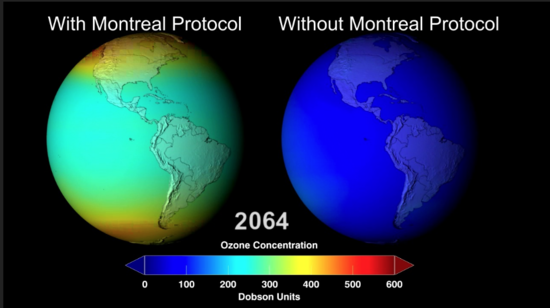
Comparison of the “Projected” (Left Sphere) and the “World Avoided” (Right Sphere) if chlorofluorocarbons and other ozone-depleting chemicals were not banned through the Montreal Protocol.
It’s working. According to a 2018 study by the World Meteorological Organization (WMO), if the phaseout had not been implemented, the ozone hole would be about 2.5 million square miles larger than it is now. Instead, it has been shrinking by about 1%-3% per decade since the year 2000. And though the hole is still enormous and fluctuates in size from year to year, scientists expect it to be fully repaired in the northern hemisphere by the 2030s and in the southern hemisphere by the 2060s.
The U.S. National Center for Atmospheric Research (NCAR) estimates that 443 million Americans won’t get skin cancer by 2100 because of the Montreal Protocol. In fact, NCAR reported, the agreement prevented more than 99% of the potential health harms that would have occurred from ozone depletion without it.
For 33 years, the Goldman Environmental Prize (GEP) has been awarded to a wide array of “ordinary people who take extraordinary actions to protect our planet.” One thing that quickly became obvious soon after the prizes were begun in 1989 is how many of those ordinary people are women. Shocker, eh? The GEP website notes:
Many of the people consistently speaking out against environmental dangers—and suggesting solutions—are women. Conventional wisdom suggests that women get involved in environmental movements because of an innate connection to the earth. Though this is often true, and many cultures value spiritual relationships with the natural world, there is more to the story. The overarching reason for women’s involvement in environmental issues is often more practical and immediate. […]
For International Women’s Day March 1 this year, the site spotlighted a few of the multitude of women who have focused on environmental impacts throughout history:
Dr. Rebecca Cole, a Black physician born in Philadelphia in 1848, was one of the first people to connect poor health with environmental problems. When she noticed that Black communities were suffering from diseases at higher rates because of their poor living conditions, she advocated for “Cubic Air Space Laws” to prevent overcrowding in impoverished neighborhoods.
Hoticulturalist Kate Sessions, the “Mother of Balboa Park,” wanted to create more green space in Southern California, so in 1892 she asked the city of San Diego to let her lease 30 acres of barren land in exchange for planting 100 trees a year.
Naturalist Margaret Thomas Muriestarted a conservation campaign in 1956 that eventually resulted in the establishment of the
Arctic National Wildlife Refuge in Alaska, which remains the largest wildlife refuge in the United States. Goldman Prize winner Sarah James (United States, 2002) has continued to protect the refuge from oil drilling and other threats.
Inaugural Goldman Prize winner Lois Gibbs (United States, 1990) mobilized her community to protest the chemical waste contaminating her community in Niagara Falls, New York. Her work resulted in the creation of the EPA’s Superfund program and inspired countless people to embrace grassroots environmental activism.
Ecologist Rachel Carson wrote Silent Spring in 1962, a book that exposed the dangers of chemical pesticides to wildlife and the environment. Her work helped shape public opinion and launch the start of the US environmental revolution in the 1960s.
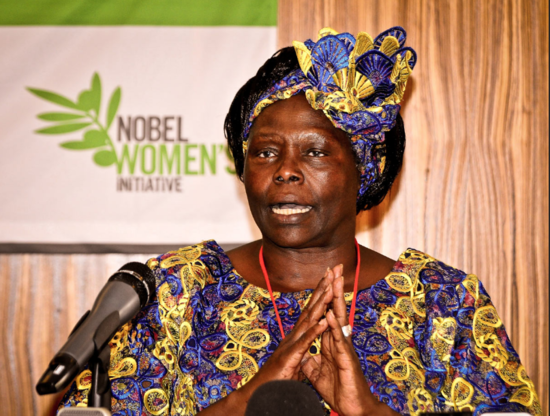
Professor Wangari Maathai (GEP—Kenya, 1991) started Kenya’s Green Belt Movement in 1977 to fight against deforestation and desertification. Her lifelong environmental and human rights advocacy has inspired people worldwide to launch similar tree-planting and poverty-reduction initiatives. […]
Swedish teenager Greta Thunberg, who first gained attention by conducting climate strikes at school, has become a household name by urging people across the globe to educate themselves about the dangers of climate change and take action to stop it.
Nemonte Nenquimo (GEP-Ecuador, 2020) galvanized her Indigenous community in Ecuador and launched a global campaign to protect half a million acres of Amazon rainforest from oil drilling. Her efforts have inspired other Indigenous communities to take legal action to preserve their land and wildlife.
Humpback whales nearly went extinct in the mid-20th Century, declining from an estimated 27,000 animals in 1830 to just 450 in the mid-1950s. But, as a result of the commercial whaling ban of 1986, biologists believe that the population will be “nearly recovered by 2030.” Some populations of the migratory humpbacks are still endangered or threatened while others are stable. Those that travel to Hawaii, for example, aren’t threatened or endangered, while those that travel to Mexico are threatened, and those that travel to Central America are endangered.
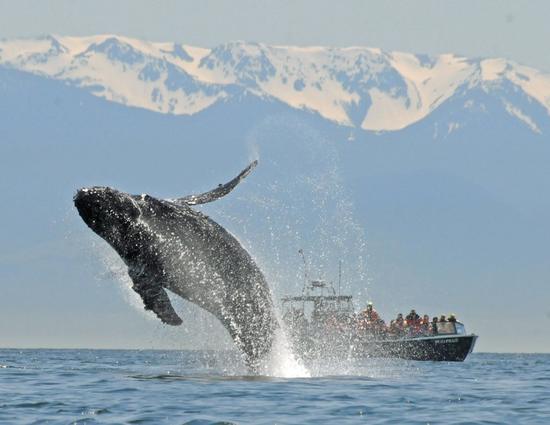
A humpback whale breaches in the Haro Strait of the Salish Sea.
Twenty-five years ago, zero humpbacks showed up in the Salish Sea north of Seattle. This year, reflecting a remarkable rebound, about 500 the whales appeared, and a record number of calves—21—showed up with them, according to a tally of scientists and whale watchers with the Pacific Whale Watch Association (PWWA). Just 11 calves were documented the previous year.
Said Wendi Robinson, a naturalist with Puget Sound Express, “2021 has been a banner year for female humpbacks coming into the Salish Sea with new calves. Calves only travel with mom for a year or so and then they’re on their own. Once they’re familiar with our waters, they will often return year after year to feed.”
PWWA Executive Director Erin Gless said, “We’re not sure why there were so many calves this year,” she says. “It’s possible the last two years had an abundance of food for the whales, or it could be as simple as the fact that as the number of adult whales in the population grows, so too does the number of calves we can expect to see each year,” adding that the whales are making up for lost time. “We are seeing lots and lots of whales, which is super exciting.”
Thanks to actual journalist Judd Legum and crew, we’re finally able to look inside some of those math textbooks Florida Gov. Ron DeSantis and his Republican gubbermint found to contain “indoctrination.” Legum’s Popular Information was able to find copies of eight of the rejected textbooks.
A clue that even Ron DeSantis knows that his Department of Education is reeeeeally stretching in their claims of “indoctrination” might be his emphasis on “social-emotional learning” as a new bogeyman. Even with fascist Republicanism’s new, expansive definitions of “critical race theory,” you can’t squeeze out much panic from a math textbook. But if you expand your complaints to complaints about children being indoctrinated into giving a flying shit about anyone around them, sure, you can probably find quite a bit more to object to.
So that’s what team book-banning appears to be leaning on most heavily in order to winnow down which math textbooks can be shown to Florida’s impressionable preteens. Barney the Dinosaur and his sharing is caring crap is right out. Barney was a damn communist, and Florida Republicans are going to make sure young children aren’t exposed to something called (checks notes) “critical thinking” or “learning to work together.” That child over there is learning to “value the ideas of others!” Witchcraft!
Legum has some nice pictures of what appears to be the most objectionable content. In one first-grade math textbook, children are told that when we “work together” on solving problems, we “listen to our friends and teachers.” In another textbook, first-graders are encouraged to “share your ideas,” “ask helpful questions,” and “disagree respectfully.”
Communism! It’s all communism! The Republican Party has been completely retooled around the idea that nobody should ever “disagree respectfully.” If you disagree with someone you should tell them to take off their mask, you should cough in their face, you should make big ol’ banners that insinuate swear words to bash the president you disagree with, you should get them fired, you should ban the books they write, and you should declare that everyone except for you is a pedophile!
Do you think even for a moment Florida Republicans are going to let a first-grade math textbook through that encourages kids to “disagree respectfully” or “value ideas from others” when learning how to work in groups? Truly, communism is afoot in our public schools. This is yet another reason, Republicans will insist, why parents need to be given vouchers so that they can go to private Republican schools where they can learn how to not value ideas from others and not disagree respectfully.
Oh, and also curiously enough, both of those examples are illustrated with drawings that feature A Black Person. Coincidence? Hard to say, but it became a theme in Popular Information’s examples of theoretically objectionable content. Other examples include short profiles of non-white mathematicians; a genetics-themed math problem that notes Black Americans are far more at risk of sickle cell anemia than white Americans; and another brief example from a high school textbook noting that “stereotyping” can lead to faulty “inductive reasoning” versus “deductive reasoning,” which may have been objected to either because it uses the word “prejudice” or may have been nixed because of Republican opposition to teaching basic critical thinking skills. It’s hard to say.
There is, however, also evidence that this whole thing might in fact just be another cheap Republican grift of the sort that the DeSantis hivemind keeps managing to “accidentally” create. The Tallahassee Democrat reports that the curious outcome of the DeSantis administration rejecting the long list of textbooks it rejected is that there is only one remaining publisher whose books are approved for Florida’s regular K-5 math programs. Just one!
That publisher? Accelerate Learning, based in Houston, Texas, a company that was acquired by Carlyle Group CEO Glenn Youngkin—who resigned a few years later to run for the Virginia governorship; once ensconced there, one of his very first moves was to, yup, ban objectionable textbooks from Virginia classrooms.
That’s a pretty odd coincidence in quite the string of weird Republican coincidences, especially considering that Accelerate Learning does not, the The Tallahassee Democrat reports, appear to shy away from the sort of terribly divisive “diversity” language that has Florida Republicans going absolutely batshit in every other venue. But maybe limiting textbook choices for K-5 students to just one well-connected company is just an accident, in the same way that it’s an accident that language about “learning to work together” is now railed against as “social-emotional learning” and triggers all the Florida fascists’ buttons. There are so many scandals blending together in so many ways that, as we’ve seen, not even the people in the middle of them appear to know what the hell they’re doing or why.