On Jan. 6, Jones led a crowd to the U.S. Capitol, chanting things like, “We’ve only begun to fight,” and saying, “We’re not surrendering.” Owen Shroyer, a host on Infowars, the conspiracy theorist website owned by Jones, marched along with Jones and climbed up on stacks of chairs at the Capitol along with Jones to make speeches. Shroyer has been charged with four misdemeanors. Earlier this year when he appeared before the select committee investigating Jan. 6, Jones told his viewers he invoked the Fifth Amendment “almost 100 times.” If he now wants to cooperate, that’s quite a turnaround.
Marcy Wheeler points to Shroyer’s case in cautioning against taking Jones’ sudden desire to talk to the police too seriously, noting that the Justice Department has already debunked Shroyer’s claims about his own actions that day, claims echoed by Stop the Steal organizer Ali Alexander. “If Jones were to proffer a DIFFERENT story, then Alexander would be on the hook for a not-true story he told Jan6, and Shroyer would be on the hook for the not-true claims that a judge already ruled against,” Wheeler tweeted. Additionally, Jones and Shroyer have the same lawyer, she noted, so “Jones’ ability to proffer with Pattis would be limited by Pattis’ representation with Shroyer, unless their interests coincided.”
So if Jones cooperated in good faith, he’d either be selling out his buddies or he would be joined by at least one of them. But mostly, “good faith” and “Alex Jones” do not go together.
Texts recently revealed in the seditious conspiracy trial of Oath Keepers related to Jan. 6 show that Jones was among the right-wing leaders the Oath Keepers and the First Amendment Praetorian, a militia, discussed providing security for.
Three of Jones’ companies, including Infowars, just filed for bankruptcy—but it looks less like a sign of legitimate financial distress than an attempt to evade paying damages in three lawsuits brought by families of victims of the Sandy Hook school shooting, families he called “crisis actors” after their children were murdered, families in some cases harassed by his followers. The bankruptcy filings also came after Jones was held in contempt of court and fined until he sat for a deposition. And they were despite his popular dietary supplement business that charges jacked-up prices for particularly low doses of common vitamins and other supplements.
In addition to his role in the attack on the U.S. Capitol and his vile harassment of the families of murdered children, Jones has claimed that the government uses both “weather weapons” and chemicals that turn people (and frogs) gay. He promoted the pizzagate conspiracy theory and called Robert Mueller a “demon.” He stopped a group of mothers and children being driven to a charity and screamed at them in the name of stopping child trafficking. Infowars shares a hosting service—and through it, technical staff—with sites owned by the white supremacist leader Nick Fuentes.
Granted, federal prosecutors sometimes have to work with terrible people to get evidence against even worse people. But Jones is a very special piece of work—and unless he can provide a lot of documentation, there’s never any reason to believe a word he says. If the Justice Department can use Jones to move up the Jan. 6 chain to get closer to people like Roger Stone and Donald Trump, that would be great. It’s just hard to believe that Jones is in earnest.
Last May, the Department of Energy’s National Renewable Energy Laboratory released its SolarAPP+ to assist installers with solar permits. The program, which is currently in use in nine communities in Arizona and California, has saved applicants invaluable time thanks to its error-catching system. As SolarAPP+ comes up on one year of use, more than 4,700 permits have been issued, amounting to more than 31 MW of approved power. Thousands of homes have been able to take advantage of renewables and many more households are looking to do the same. According to NREL data, four more communities are in various testing phases with SolarAPP+ and communities across the country have expressed interest in using the program.
Amber D’Ottavio, the vice president of product management for Accela, the software developer that created SolarAPP+, told Utility Drive recently that “this is just the beginning.” D’Ottavio envisions success stories like the more than 2,100 permits issued in Tucson will inspire other agencies, as will advancements within SolarAPP+ itself. At this juncture, SolarAPP+ is only available for residential use, but D’Ottavio told Utility Drive that Accela is already looking to expand its use to commercial and non-rooftop solar permits as well as expediting the overall permitting process so that applicants no longer have to print out their documents and can instead submit them digitally.
In addition to panels themselves, SolarAPP+ also allows for storage permits. More than 300 of the permits issued through the software have included battery storage. That number will likely increase as the California cities of Beaumont, Modesto, Oceanside, and Richmond move further along in their piloting and testing phases. Solar and battery storage are considered key renewable technologies in the quest to reach net-zero. The adoption of such innovations must escalate and scale considerably, according to the International Energy Agency. A report from last year from the IEA noted that, “for solar power, it is equivalent to installing the world’s current largest solar park roughly every day.” Luckily, there are regions in the U.S. that are forging a path forward, especially when it comes to solar adoption.
According to the industry magazine Solar Power World, April 3 saw California get 97% of its power from renewable energy—a new record for the state, albeit one that was achieved briefly at around 3:39 PM that day. Still, advocates believe it’s a sign of a fully renewable future that aligns with the state’s goal of providing carbon-free power by 2045. Additional solar projects in California will see millions of acres of desert land developed for solar projects, along with off-shore wind projects marking a first for the state, which has many wind farms in its interior but not along its coast.
A Democratic super PAC is launching a $3.5 million ad buy in several key battleground states designed promote President Joe Biden’s economic accomplishments ahead of the 2022 midterms.
According to Politico, American Bridge 21st Century is placing the TV, digital, and radio spots in Arizona, Georgia, Pennsylvania, and Nevada, all of which are host to key Senate battles that could determine who controls the upper chamber. The ad buy builds on a $5 million investment in the same states announced by American Bridge in March.
The ads feature swing voters and attempt to walk the line between highlighting Biden’s historic job creation and sympathizing with the effect of rising prices on consumers.
In one ad, Jodi, an Arizona retiree, says she hasn’t “always voted Democrat” but adds that “Joe Biden reflects my values.” As headlines flash across the screen noting that Arizona has fully recovered all the jobs lost to the pandemic, Jodi says Biden “deserves a lot of credit” for the turnaround in Tucson.
“Costs are still high,” she admits, “but Joe Biden knows that and he’s doing what he can to bring those costs down.”
After touting Biden’s push to bolster “Buy American” manufacturing, Jodi says the policy would mean “more jobs, and less expensive goods to buy.”
While there’s more work to be done, “Joe Biden gets it,” she concludes.
In another ad, former Pennsylvania Republican Lindsey tells viewers the president is focused on creating “access to better jobs and lowering costs and getting this economy back on track.” An AP headline onscreen reads, “Pennsylvania Payrolls Up, Jobless Rate Down in February.”
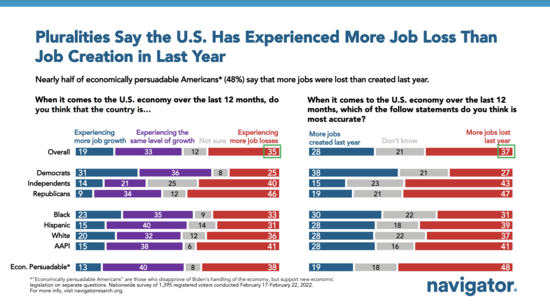
Early efforts to set the record straight on Biden’s stewardship of the economy are a crucial piece of boosting Democratic chances this fall. Polling has shown that many (if not most) Americans don’t even realize the U.S. economy added jobs last year rather than lost them. In fact, Biden’s economy created a historic number of jobs last year—more than any other year on record—and it is continuing to thrive in 2022.
Yet a Navigator Research survey released this week found that a 35% plurality of Americans say the U.S. has lost more jobs over the past year than it created. Just 19% said the U.S. has seen job growth, and 33% said the country has seen about the same level of growth.
Not all advertising is created equal—both substance and timing help determine how effective ads can be at achieving their goals.
Early advertising will likely yield more bang for the buck for several reasons. For one, the airwaves aren’t entirely saturated yet. Two, setting a baseline level of understanding about the facts is foundational to allowing Democrats to focus on other messages down the road. Three, Democrats don’t have the Fox News propaganda bullhorn that Republicans enjoy, so early advertising is at least one way to attempt to level the playing field.
Yesterday, Ukrainian President Volodymyr Zelenskyy was complaining about the “Groundhog Day” of having to repeat time and time again his nation’s critical defensive needs. What a difference a day makes, with hundreds of millions of dollars of aid streaming in daily. He now sounds … happy?
Zelensky, tonight: “I am very pleased to say, with cautious optimism that our partners started to understand our needs better … And when exactly we need this. Not in weeks, not in a month, but immediately. Right now, as Russia is trying to intensify its attacks.”
The New York Times has a great story on the massive logistical effort to move weapons to Ukraine. One of the big takeaways: nations are flooding gear into Ukraine, but few want to actually talk about it: “[N]ations are trying not to advertise to Moscow exactly what is being provided. France says it has supplied 100 million euros of military equipment to Ukraine, without specifying what it has sent. Some countries have no desire to goad the Russian bear.” There’s also this sentence, which is either the scoop of the week, or an embarrassing journalistic error:
The United States has also agreed to provide some 155-millimeter howitzers, along with 40,000 matching rounds, while trying to buy Soviet-standard ammunition from countries that use it, including nations outside of Europe, like Afghanistan and even India, a longstanding buyer of Russian arms.
The U.S. is trying to buy weapons from the Taliban? Did India, one of the few nations still happy and eager to do business with Russia, actually get approached to sell arms headed to Ukraine? Did they say “yes”? In any case, 30 countries are assisting Ukraine in its war effort, which is 30 more than are assisting Russia, all coordinated by the United States. No one does logistics like the United States.
Meanwhile, Russia’s broad-based assault along the entire Donbas front has netted them some small gains.
With 🇷🇺forces gains in the areas between Rubizhne and Lyman, it is possible that the 🇺🇦forces are withdrawing across the Siverskyi Donets river (dotted black line) to take advantage of the natural defence that it could provide. pic.twitter.com/zUt2QiL1pN
Losing any ground sucks, of course. But the tactical withdrawal is a legitimate tool in any army’s toolbox, and Ukraine has several layers of defensive lines set up. None of these losses are particularly strategic, the way Izyum was. If the plan is to fall back behind the Siverskyi Donets river, you better believe dug in positions are already in place, but with a river assisting in the defense—just like the Irpin halted the Russian advance toward northwest Kyiv. Ukraine’s Severodonetsk salient is unfortunately becoming more and more exposed, with a city that has been absolutely pummeled sine the beginning of the war. There were celebrations in pro-Russian channels last night that Ukraine was falling back from Severodonetsk, but I’ve seen no real confirmation. Ukraine did announce that every single food storage site in the city had been destroyed by Russian shelling and the city was full cut off from supplies, which certainly seems ominous.
In total, Ukraine’s General Staff claimed 10 Russian attacks yesterday, which is double the intensity of the previous weeks, when we’d see four to six daily attacks. The Institute for the Study War noted that “Russian forces have not achieved any major breakthroughs, nor have they demonstrated any new capability to conduct multiple successful, simultaneous advances.” You know me, I don’t see how Russia gets its shit together. If a “major offensive” ever materializes, I suspect it’ll feature troops rushing forward as someone yells “charge!” except that half the troops won’t hear it because their radios won’t work or were sold for booze, while another quarter will be like “no thanks.” Ukrainian defenses will inevitably be pushed back from sheer numbers, but then what? Russian losses will continue to be horrific, while Ukrainian reserves gear up in the west, and heavy artillery, suicide drones, and more armor joins the fight.
Strelkov Igor Ivanovich is a Russian nationalist who formerly served as minister of defense of the Donetsk People’s Republic (one of the two separatist regions in Donbas). He’s turned into a fierce critic of Russia’s management of the invasion: (Run through Google Translate)
If the enemy [Ukraine] had few forces, the protection of communications [supply lines] could be partially ignored. But the Armed Forces of Ukraine (thanks to mobilizations) already have enough forces—comparable to the number of our troops in the theater. In addition, the enemy has the ability to shorten the front line and transfer the released forces to threatened areas—the Russian Federation does not have complete air supremacy simply because of the insufficient number of strike aircraft and the negligible number of strike drones. At the same time, the enemy can hold the front line near Donetsk with relatively small forces due to the excellent engineering equipment [trenches] that has been produced for many years […]
Thus, after some time in these areas, the situation will repeat itself, which already exists in the areas of Rubizhnoye-Severodonetsk, Popasnaya, Avdeevka and Marinka, where the Allied forces are moving forward very slowly and with very heavy losses (especially in the infantry). Or they don’t advance at all (Avdeevka).
The enemy is “more than completely” satisfied with this method of warfare. Why? – Because the Armed Forces of Ukraine need another one and a half to two (maximum —three) months to prepare large reserves […] while Russian forces “bleed”, storming the fortified cities of Donbass […]
In this regard, I remind you that the so-called “Ukraine” is finishing the THIRD STAGE OF GENERAL MOBILIZATION. It has a human resource (200-300 thousand people) and a technical capability (a huge flow of various weapons from Europe and the USA) to not only maintain a sufficient number of its troops at the front, but also create new reserves. And to create them “in quantity” (even 100 thousand people – this is about 50 battalion tactical groups, including reinforcements and rear infrastructure – that is, about 10 full-blooded divisions).
“So-called ‘Ukraine…’” My god these people are assholes.
Ivanovich does an audit of reserves available to Russia forces, and basically concludes they can’t keep up without a general mobilization in Russia itself, which Vladimir Putin seems wholly uninterested in pursuing. Now Ivanovich has an ulterior motive—to convince Russia to fully mobilize and fully commit to the war, instead of depending on his home region’s almost-depleted supply of cannon fodder, in Donbas. After all, they’re conscripting men as old as 60. They’re scraping the bottom of the barrel.
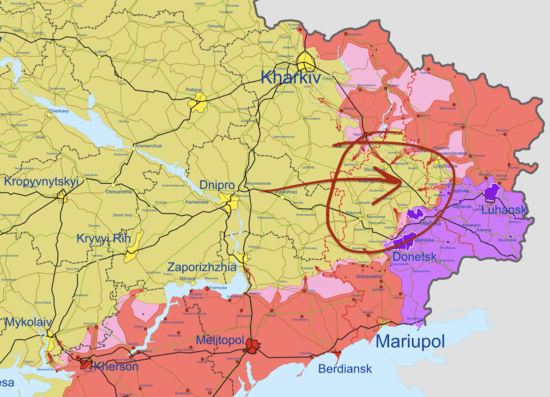
But he is right—the best case scenario for Russia at this point is the conquest of the Donbas pocket still held by Ukraine:
Circled area is Ukrainian-held Donbas territory.
In reality, Russia likely doesn’t have enough troops to take that entire territory (from top to bottom it’s 200 kilometers of distance, or 120 miles), but if they did, they certainly won’t have manpower and logistical juice to push beyond. Meanwhile, Ukraine is building and modernizing its armed forces, and before long will have the offensive capability to seriously contest its lost territory—including territory lost in 2014.
The rain will end Sunday, and then it looks sunny and warm, in the mid-70s and 80s next week. That means the ground will start to dry out, which will make it easier for armor to move. Let’s hope rain returns to the forecast soon, keeping General Mud in the fight as long as Ukraine is on the defensive.
Looking to the south, however unlikely, it sure would be nice to liberate Kherson this week.
🔸Russian occupation forces advanced the pseudo referendum’s date in the Kherson region to April 27 🇺🇦Operational Command South reports that Russia has sped up its preparations for the sham referendum to proclaim the “Kherson people’s republic”https://t.co/8W0wstu779
The Daily Kos Elections Morning Digest is compiled by David Nir, Jeff Singer, Stephen Wolf, Daniel Donner, and Carolyn Fiddler, with additional contributions from David Jarman, Steve Singiser, James Lambert, David Beard, and Arjun Jaikumar.
●Fundraising: Daily Kos Elections is pleased to present our comprehensive roundups of fundraising data for the first three months of 2022 for both the House and the Senate. Our data includes the numbers for every incumbent (excluding those who’ve said they’re not seeking re-election) and notable announced candidates.
Six of the 10 House Republicans who voted to impeach Donald Trump last year are running for re-election, and while they all have serious opposition, our fundraising charts show that they each ended March with a clear financial edge over their intra-party foes. The most prominent member of this group is Rep. Liz Cheney, who faces Trump-endorsed attorney Harriet Hageman and a few minor contenders in the August primary to serve as the sole representative for dark-red Wyoming.
Hageman hauled in $1.31 million, which even a few years ago would have been an unthinkably massive quarter for a House candidate, and had $1.06 million on hand. Cheney, though, lapped her by raising $2.94 million, and she finished with $6.77 million in the bank.
Over in South Carolina’s 7th District in the Myrtle Beach area, meanwhile, Rep. Tom Rice outraised Trump’s pick, state Rep. Russell Fry, $342,000 to $267,000, and the incumbent enjoyed a $2 million to $448,000 cash-on-hand advantage. The only other Republican who brought in a notable amount for the June primary was Horry County School Board chair Ken Richardson, who raised $112,000, self-funded another $500,000, and had $274,000 left. A runoff would take place if no one earns a majority of the vote.
We turn next to Michigan’s 3rd in the Grand Rapids area, where Trump’s forces have consolidated behind conservative commentator John Gibbs’ bid to deny renomination to freshman Rep. Peter Meijer in August. The incumbent, though, outpaced Gibbs $544,000 to $123,000 for the quarter, and he ended March with a gigantic $1.51 million to $82,000 cash-on-hand lead. The winner will need to quickly focus on attorney Hillary Scholten in a seat that redistricting transformed from a 51-47 Trump constituency to one Joe Biden would have carried 53-45: Scholten, who was the 2020 Democratic nominee, took in $483,000, and she had $470,000 available.
The three remaining contests are taking place in states that use the top-two primary system rather than party primaries. In California’s 22nd District in the Central Valley, Republican Rep. David Valadao raised $405,000 for the quarter and has $1.64 million to defend himself in a southern Central Valley seat that Biden would have won 55-42.
Valadao’s best-funded intra-party foe is former Fresno City Councilman Chris Mathys, who brought in a mere $18,000 but had $310,000 on hand thanks to previous self-funding. The other Republican in the race is King County School Board Member Adam Medeiros, but he had just $36,000 in the bank. (Trump has yet to make an endorsement here.) The one Democrat on the ballot is Assemblyman Rudy Salas, who raised $252,000 and had $309,000 on hand.
Next up is southern Washington’s 3rd District, where incumbent Jaime Herrera Beutler took in $602,000 and finished with just over $2 million. The GOP’s supreme master is supporting Joe Kent, an Army veteran who has defended Putin’s invasion of Ukraine, but that endorsement hasn’t deterred his fellow Republicans, evangelical author Heidi St. John and state Rep. Vicki Kraft. Kent outraised St. John $441,000 to $219,000 and finished March with a $1.07 million to $283,000 cash-on-hand lead; Kraft, though, had only $4,000 to spend. No Democrats have raised much, but Team Blue could still secure a general election spot in a seat Trump won 51-46.
The last member of this sextet isRep. Dan Newhouse, who raised $218,000 and had $928,000 on hand in the neighboring 4th. Trump’s pick is 2020 gubernatorial nominee Loren Culp, a far-right ex-cop who took in just $46,000 and had $24,000 in the bank. The GOP field also includes businessman Jerrod Sessler, who raised only $9,000 but finished last month with $147,000 in the bank, and state Rep. Brad Klippert, who had all of $5,000 available. The most notable Democrat in this 57-40 Trump eastern Washington seat is businessman Doug White, who took in $124,000 and had $147,000 on hand.
There’s far more to see nationwide, and you’ll want to bookmark both our House and Senate charts.
THE DOWNBALLOT
● Yes, it’s a tough-looking midterm, but Democrats can still go on offense! The Downballot takes a deep dive into 10 House districts across the country where Republicans are vulnerable for a variety of reasons, whether due to redistricting, retirements, long-term demographic trends, or plain old GOP infighting. Our tour runs from the eastern tip of Long Island in New York all the way to sunny Southern California, with many stops in between.
Co-hosts David Nir and David Beard also investigate Ron DeSantis’ turbocharged gerrymander aimed at undermining Black representation; discuss two more Republican Senate primaries where Trump endorsements have made a mess of things; call out a Democrat for running an offensive ad that risks contributing to anti-Asian hatred; and take stock of upcoming elections in France and Australia. You can listen to The Downballot on all major podcast platforms, and you’ll find a transcript right here by noon Eastern Time.
●AL-Sen: Former Business Council of Alabama leader Katie Britt is running a new ad ahead of the May 24 Republican primary where Britt says she learned to respect the Second Amendment growing up in Alabama. The commercial shows her at a shooting range shooting clay pigeon targets with a shotgun every time she mentions one of Joe Biden’s supposed policies on topics such as taxes, inflation, immigration, and abortion.
●GA-Sen: Democratic Sen. Raphael Warnock’s latest ad features the senator telling how he isn’t a magician who can fix Washington overnight but instead has focused on providing more jobs, fixing infrastructure, and expanding healthcare.
●NC-Sen: The Club for Growth is spending $1.5 million on a new ad where far-right Lt. Gov. Mark Robinson talks to the camera trying to portray former GOP Gov. Pat McCrory as a liberal, arguing he “put liberals in charge of state textbooks” and “backed liberal Democrat judges,” after which Robinson says Rep. Ted Budd is the true conservative in the race. In an interview with WRAL, McCrory defended himself by arguing that state law required that he appoint members to the textbook commission recommended by the state education superintendent, who at the time was Democrat June St. Clair Atkinson.
●OH-Sen: Far-right billionaire Peter Thiel has upped his support for Protect Ohio Values PAC, which is backing venture capitalist J.D. Vance in the May 3 Republican primary, adding $3.5 million on top of the $10 million donation he made last year.
Meanwhile, the Club for Growth began airing an ad against 2018 candidate Mike Gibbons last Friday, the same day Donald Trump endorsed Vance. The Club’s spot intersperses clips of Gibbons and Joe Biden speaking about taxes to portray Gibbons as supportive of tax increases on the middle class.
State Sen. Matt Dolan also has a new ad where he touts his record of “cutting taxes, protecting Ohio jobs, securing the border, and funding the police” and contrasts it with the childish name calling by his primary opponents.
●PA-Sen: Penn Progress, the James Carville-backed super PAC that is supporting Rep. Conor Lamb in the May 17 Democratic primary, is airing yet another ad that tries to paint Lt. Gov. John Fetterman as too extreme to win the general election by tarring him as a socialist. The PAC continues on this line of attack even though their first ad using that label was pulled off the air after it relied on an erroneous and since-corrected news report to falsely claim Fetterman is a “self-described socialist.”
Touting Lamb’s record as a former prosecutor and Marine who won three tough elections and fought Republicans to protect Social Security, the spot points out by contrast how Fetterman once sought an endorsement from the Democratic Socialists of America and that he’s been called a “silver spoon socialist.” However, the narrator elides the fact that Fetterman didn’t get that endorsement in part because he told DSA he doesn’t identify as a socialist, and they downplay how the silver spoon quote comes from a former state Republican Party chairman.
Governors
●IL-Gov: People Who Play by the Rules PAC, which is funded by billionaire megadonor Richard Uihlein, has a new GOP primary ad that goes after Aurora Mayor Richard Irvin over his past statements from 2021 supporting Black Lives Matter, making the baseless claim that BLM “destroyed cities” and arguing that Irvin supports a movement that stands for looting and defunding the police. Irvin has been trying to distance himself from those past statements, running an ad earlier this year where he calls himself a former “tough-on-crime prosecutor” and says, “All lives matter. It isn’t about color.”
●LA-Gov: Republican state Sen. Sharon Hewitt has confirmed her interest in potentially running for governor next year, though she says a decision is likely months away.
●NE-Gov: Businessman Charles Herbster has launched his first ad in the May 10 GOP primary since several women accused him of sexual misconduct last week, and it’s a minute-long spot where Herbster doesn’t acknowledge the scandal but says “the establishment” is lying about him just like they supposedly did with Trump.
In response to ads that have alleged he really lives out of state and paid his taxes late, Herbster argues he’s a bona fide Nebraskan whose business successes don’t stop at the state line. He claims early in his career that he once faced the tough choice of paying his employees or his taxes and chose the former but that he later paid “every penny” he owed in taxes and fees after turning his business around.
Another Republican, University of Nebraska Regent Jim Pillen, began airing a positive spot last week where he’s surrounded by his young grandchildren who ask him policy questions on issues such as taxes, “amnesty,” and inflation, with Pillen responding each time with a pig-related phrase such as “hogwash” or “when pigs fly.”
●OH-Gov: Former Cincinnati Mayor John Cranley has debuted the first negative ad in the May 3 Democratic primary, comparing the performance of Cincinnati during his recent tenure with Dayton under former Mayor Nan Whaley, his primary rival. Cranley’s spot points to Cincinnati’s population growth (which was a rate of 4% between the 2010 and 2020 censuses) in contrast to Dayton’s decline (-3%) as evidence of his successful economic leadership and supposed mismanagement by Whaley. He argues he is the best Democrat to take on GOP Gov. Mike DeWine in the fall.
●RI-Gov: Businesswoman Ashley Kalus is spending $109,000 to launch a minute-long ad that introduces herself to voters ahead of the Republican primary in September. The spot focuses on inflation, and Kalus speaks to the camera while rattling off a list of priorities such as making Rhode Island more affordable, protecting parental involvement in education, and fighting drug addiction and crime.
House
●CA-41: The Democratic-aligned Welcome PAC is publicizing a poll from Tulchin Research taken in late February and early March that shows Democrat and former federal prosecutor Will Rollins holding a 42-41 lead over longtime Republican Rep. Ken Calvert in a suburban Riverside County district that Trump would have carried just 50-49. This is the first poll we’ve seen from anyone here.
Rollins has been endorsed by neighboring Democratic Rep. Mark Takano and former Sen. Barbara Boxer, and he raised $466,000 in the first quarter and started April with $618,000 in the bank. Another Democrat competing in the June top-two primary, engineer Shrina Kurani, raised $141,000, self-funded $9,000, and had $208,000 in the bank. Calvert faces only minor intra-party opposition, and he brought in $587,000 last quarter and finished with $1.4 million on-hand.
●OH-11: Former state Sen. Nina Turner, who lost last year’s special election Democratic primary to now-Rep. Shontel Brown, is out with a negative ad for next month’s primary that argues the incumbent has a record of lining her own pockets while failing to do anything for voters.
Starting off by remarking upon how recent inflation has hit working families hard, Turner’s spot claims that Brown “opposed Biden’s plan” for a “living wage” and voted to raise her own pay by $7,000. The latter claim could lead viewers to believe the pay raise vote happened during Brown’s tenure in Congress while inflation ate up Ohioans’ paychecks, even though the ad cites a 2016 vote from when she was on the Cuyahoga County Council.
Turner’s spot then revives an unsubstantiated allegation she made during last summer’s special election that Brown faced an ethics investigation after she “voted for millions in corrupt contracts.” However, as we noted at the time, Turner’s accusation that Brown was referred to the Ohio Ethics Commission relies on a story co-authored by left-wing essayist Walker Bragman, who notoriously wrote a 2016 piece headlined, “A liberal case for Donald Trump.” But Bragman’s own story acknowledged at the very end that the commission refused to “confirm or deny” any such investigation existed, and there was no reliable reporting as to whether it did.
●PA-12: Former Pennsylvania Securities Commission head Steve Irwin’s new Democratic primary ad shows him playing an accordion while the narrator contends that some in Congress merely “want to make noise” while others “want to work in harmony.” They praise Irvin as someone who will protect voting rights, invest in vocational job training, and put Biden’s infrastructure law to work “repairing our unsafe bridges.”
●TN-05: The Tennessee GOP’s executive committee voted Tuesday evening to keep three candidates off the August primary ballot for not meeting the party’s definition of a “bona fide” Republican: former State Department spokesperson Morgan Ortagus, who is Trump’s endorsed candidate; businessman Baxter Lee; and music video producer Robby Starbuck. Ortagus responded, “Our team is evaluating the options before us,” while Starbuck declared, “The fight has only just begun.” Lee’s team, meanwhile, defended their man as a Republican “through and through,” but it didn’t say whether he’d be challenging his dismissal.
So what’s the rumpus? The state GOP’s bylaws state that, in order to be a so-called “bona fide” party member, a candidate must have voted in at least three of the last four statewide primaries or been “actively involved” in state or county Republican activities; Democrats have a similar requirement, except candidates only need to have participated in three of the last five nomination contests. Ortagus only moved to Tennessee last year from D.C., so she hasn’t been there nearly long enough to meet this criteria, while Starbuck is in the same boat, since he relocated to the state just three years ago. Lee is more established, but his campaign says he was bounced because he hadn’t voted in a sufficient number of recent primaries even though he’d taken part in 10 of the last 12.
Party leaders can still vote to classify a candidate as “bona fide” if someone vouches for them or if a contender appeals the initial rejection. That’s just what the trio hoped would happen after they were initially kept off the ballot earlier this month, but the GOP’s executive committee didn’t go along: According to state party chair Scott Golden, 13 members of the 17-person body voted to keep Ortagus and Starbuck off, while 11 were against Lee. When the New York Times asked Golden if the decision was final, he said it was “possible the members could change their minds” before the deadline for a reversal passes Thursday at noon local time.
Ortagus infuriated powerful local Republicans when she entered the race for this newly gerrymandered seat in January, so much so that state Sen. Frank Niceley sponsored a bill that would impose a requirement that House candidates need to have voted in the previous three statewide general elections to be eligible to run. (The legislation, which appears to be unconstitutional, will not go into effect until next cycle because Gov. Bill Lee only allowed it to become law after the April 7 filing deadline.)
But Niceley took the dispute in a much uglier direction when he recently told NBC, “I don’t think Trump cares one way or the other” about Ortagus’ candidacy. “I think Jared Kushner—he’s Jewish, she’s Jewish—I think Jared will be upset. Ivanka will be upset. I don’t think Trump cares.”
Ortagus, who is Jewish, fired back Tuesday night with a tweet saying that Niceley “should be ashamed of his repeated anti-Semitic rhetoric.” Niceley, who backs former state House Speaker Beth Harwell, was not ashamed, responding, “Attempting to construe my off-hand comments about the Trump family as antisemitism is unfair and inaccurate.” Last week, Nicely made headlines for a speech he gave on the Senate floor in which he said that Adolf Hitler should serve as an inspiration for homeless people.
Mayors
●Washington, D.C. Mayor: Mayor Muriel Bowser has earned an endorsement from SEIU 32BJ, which represents property service workers, as well as UNITE HERE Locals 23 and 25, for the June Democratic primary.
Prosecutors
●Maricopa County, AZ Prosecutor: The Maricopa County Board of Supervisors on Wednesday voted to name prosecutor Rachel Mitchell, who is one of the three Republicans competing in this year’s special election to succeed Alistair Adel, as interim county prosecutor, and she was sworn in later that day.
The other two Republicans competing in the August primary, Anni Foster and Gina Godbehere, had sought the appointment as well, and they reacted to the unfavorable Board decision in very different ways. Foster, who is Gov. Doug Ducey’s general counsel, tweeted that she “will make an announcement about my future plans in the coming days,” while Godbehere declared she was leaving behind her post as prosecutor for the City of Goodyear “to pursue my candidacy.” Whoever ultimately wins the GOP nod will take on Democrat Julie Gunnigle, who narrowly lost to Adel in 2020, for the final two years of the term.
Obituaries
●Former Rep. Brad Ashford, whose 2014 win gave Democrats their only victory in a Nebraska House race since the 1994 GOP wave, died Tuesday at the age of 72 two months after he announced that he had brain cancer. Ashford previously served as a Democrat, Republican, and independent during his two stints in the state’s unicameral legislature, though as we discuss in our obituary, he was never fully at home in either party during his long career in local and national politics.
Ashford underwent his fourth and final party switch when he challenged Republican Rep. Lee Terry in 2014 in the Omaha-based 2nd Congressional District. The newly-reminted Democrat had a very tough task ahead of him especially as the political climate worsened for Team Blue, but Terry, who had declared during the 2013 government shutdown that he would keep taking his salary because “I’ve got a nice house and a kid in college,” proved to be an especially weak incumbent.
This contest attracted over $1 million from outside groups on each side, and Republicans sought to protect their endangered incumbent by portraying Ashford as weak on crime. The GOP ran ad after ad charging that Ashford supported a law that would allow a Black inmate named Nikko Jenkins to get out of jail early for murder, messaging that Democrats compared with George H.W. Bush’s still-infamous Willie Horton ads. Jenkins, though, gave Terry the most unwanted endorsement imaginable, when he used a hearing to proclaim, “Hey you guys, vote for Lee Terry! Best Republican ever!”
Ashford, who campaigned as a centrist, ultimately unseated Terry 49-46, which gave Democrats a rare pickup on an overall awful night, but his attempts to win another term failed. You can find far more on the many twists and turns of Ashford’s long career in politics in our obituary.
TWO brand new Tom the Dancing Bug books!Tom the Dancing Bug Awakens; and Tom the Dancing Bug, Without the Bad Ones! Order today, RIGHT HERE AND NOW.
“Each week Ruben Bolling takes an unassuming little blank white rectangle and fills it up with clever cartoonery, sneaky commentary, and more political laughs than you can shake a stick at. All hail Tom the Dancing Bug!” –Matt Groening
JOIN Tom the Dancing Bug’s INNER HIVE. Join the team that makes Tom the Dancing Bug possible, and get exclusive access to comics before they are published anywhere, sneak peeks, insider scoops, extra comics, and lots of other stuff. JOIN THE INNER HIVE TODAY.
Tomorrow is the 51st Earth Day, an event we celebrate every year to remind ourselves that we do not, in fact, have to be the biggest parasites on the third rock from the sun. We choose to be. Unlike the other parasites, we know what we’re doing to this planet…and how…and why…and the kinds of things we must do to stop turning it into a ball of uninhabitable human-made garbage. (Awful as it is, the pandemic at least briefly provided us a glimpse of the cleaner planet we used to know.) To mark the occasion, this year I pledge to…
☼ Save water by enlisting the cat to teach me how to switch over exclusively to tongue baths.
☼ Dispose of my spent fuel rods properly instead of selling them to children as “Super Happy Fun Time Glow Sticks.”
Continued…
☼ Restrict my use of “fracking” to its handiness as an adjective paired with the word “idiots” to describe people who displease me.
☼ Contribute to healthy forests by teaching the red-hatted cultists that watering trees “with the blood of tyrants” actually kills them. Fracking idiots.
☼ only visit salons that rely on used cooking grease to power their testicle tanners.
See, this is the problem with plants. They grow to monstrous size and punch holes through the delicate ozone layer.
☼ Fart only on odd-numbered days. (This one will be tough. I may need to attend support group meetings to stay on the wagon.)
☼ Vote for Democrats.
☼ Continue not interfering with the coal industry’s timely demise.
☼ Encourage “teachable moments” by pointing at people drinking out of plastic water bottles and yelling into a bullhorn, “You resource-sucking energy whore, you’re killing us!!!” And then hand them an educational pamphlet.
☼ Retrofit our car with hybrid technology so it only runs on gas when the team of kittens gets too tired to pull it.
☼ Clone a grand army of Greta Thunbergs in my lab. Or, to be more precise, continue cloning an army of Greta Thunbergs in my lab.
In short, as an inhabitant of this spectacular planet, I’ll continue to try and treat it with the respect it deserves by following the Four Rs: “Reduce, Reuse, Recycle, and Reelect Democrats.”
And now, our feature presentation…
–
Cheers and Jeers for Thursday, April 21, 2022
Note: Due to a totally-foreseen accident involving a testicle tanner, an army of ferrets in red jumpsuits and a packet of sunflower seeds, there will be no C&J on Monday. Back Tuesday to defer all questions about the incident to my attorney. —Mgt.
Rise in pre-tax profits last year among American companies versus 2020, the highest rise since the 1950s and much of it due to using “inflation” as a cover to price gouge customers according to watchdog group Accountable.US: 25%
Percent of renters who expect to own a home in the future, down from 51% last year according to the Federal Reserve Bank of New York: 43%
Expected number of jobs in Moscow alone, according to its mayor, that are expected to evaporate because of Vladimir Putin’s invasion of Ukraine: 200,000
Tons of asphalt that’ll be replaced during the repaving at the Portland, Maine Jetport: 34,000
Number of years Chuck Grassley has held elected office: 63
–
Your Thursday Molly Ivins Moment:
May I remind you what this election is about?
Abu Ghraib, Guantanamo, unprecedented presidential powers, unmatched incompetence, unparalleled corruption, unwarranted eavesdropping, Katrina, Enron, Halliburton, global warming, Cheney’s secret energy task force, record oil company profits, $3 gasoline, FEMA, the Supreme Court, Diebold, Florida in 2000, Ohio in 2004, Terri Schiavo, stem cell research, golden parachutes, shrunken pensions, unavailable and expensive health care, habeas corpus, no weapons of mass destruction, sacrificed soldiers and Iraqi civilians, wasted billions, Taliban resurgence, expiration of the assault weapons ban, North Korea, Iran, intelligent design, swift boat hit squads, and on and on. …
Bush ran on a pledge of “restoring honor and integrity” to the White House. Instead, he brought us Tom DeLay, Roy Blunt, Katherine Harris, John Doolittle, Jerry Lewis, Richard Pombo, Mark Foley, Dennis Hastert, David Safavian, Jack Abramoff, Ralph Reed, Karl Rove and an illegal and immoral war in Iraq.
JEERS to Planet Chaos. At C&J, when it comes to BREAKING NEWS, we know what you want and what you need. Since I know your time is valuable, and since we won’t be meeting up here again until tomorrow night, and since no one else is available—RIP, Edward R. Murrow—to gather, analyze, prioritize, edit, and report the news, and since the lamestream media is fixated on nothing but testicle tanners and Will Smith’s impending divorce, here’s a quick rundown of what’s going on globally, compiled from over four thousand documents I spent half the night analyzing. Caution: #5 will SHOCK you:
Myanmar, China, Syria: Don’t forget the genocides also happening here, please. Exposed Wires: Don’t touch! Yemen: Don’t even go there. Germany: Don’t worry, we’re re-arming for good this time. Central America: Don’t bet the farm. South Africa: Don’t even think about it. International Space Station: Don’t jump! Thailand: Don’t touch my mango sticky rice. United Arab Emirates: Don’t spill your caviar on my yacht. Polar Ice Caps: Don’t mind us, we’re just converting from solid to liquid. New Zealand: No worries here, we’re doing great!
Conclusion: New Zealand is not a team player.
JEERS to stupids for Jesus. In my home state of Ohio, a professor at a university just won several hundred thousand dollars for claiming that he was being forced to refer to students by their preferred pronouns against his sincerely-held religious convictions:
Nick Meriwether, a philosophy professor at Shawnee State University in Portsmouth, Ohio, sued the college in 2018 after he was disciplined for not using she/her pronouns to refer to a transgender woman, according to a news release from Alliance Defending Freedom (ADF).
In a January 2018 philosophy class, Meriwether responded to the student by using the phrase “Yes, sir.” Once the class ended, the student asked Meriwether to use she/her pronouns when addressing her, but Meriwether refused to do so.
The court ruled that university officials violated the professor’s free speech rights when they disciplined him.
That story again: Students at Shawnee State University now free to refer to Professor Nick as “Miss Meriwether” or they’ll see him in court.
CHEERS to going back in time half a century (your time travel coordinates may vary). Happy Kindergarten Day. It’s the day when we fondly look back and remember those golden moments sitting around in a big building eating paste, running around with shoes untied, making crude misspelled signs on construction paper with giant markers, not making it to the bathroom in time, throwing tantrums, enjoying extended nappy time, and babbling constant nonsense with no particular point. Or As the House Freedom Caucus calls it: Thursday.
CHEERS to the energizer monarch. Queen Elizabeth II marks her birthday—number 96—today. As an American descended from the patriots who violently overthrew the yoke of British oppression over 245 years ago, I should be bitter and vindictive toward her and her country full of haggis-inhaling wankers who wanted to tax the knee stockings off our legs. But, of course, I can’t. I mean, for Benny Hill’s sake, look at that face:
The pandemic still prevents me from my usual routine of flying across The Pond and properly marking the occasion by singing the birthday song and giving her a pinch to grow an inch. It’s probably for the best. Obamcare’s great, but I’ve hit my limit for time spent in traction.
JEERS to the man-made creature that created a black lagoon. Today marks the 12th anniversary of the Deepwater Horizon oil disaster, which killed 11 rig workers and a whole bunch of sea life, and spewed 134-million gallons of crude into the Gulf of Mexico. On the first anniversary in 2011 I wrote in C&J: “like the perpetrators of the ’08 financial collapse, many among the oilpocalypse’s guilty parties will, mark my words, go unpunished.” And so they mostly did, and we apparently learned nothing from it:
[G]overnment data reviewed by the Associated Press shows the number of safety inspection visits has declined in recent years, although officials say checks of electronic records, safety systems and individual oil rig components have increased. […]
The busted blowout preventer made for some of the most horrifying live television in April of 2010. And it could absolutely happen again.
“I’m concerned that in the industry the lessons aren’t fully learned—that we’re tending to backslide,” said Donald Boesch, a university of Maryland professor who was on a federal commission that found the BP blowout was preventable. […]
Warnings and citations to companies for safety or environmental violations peaked in 2012 and have since fallen faster than inspection visits. The decline accelerated under the current administration. … Fewer inspections and citations suggests safety improvements after the spill are unraveling, said Matt Lee-Ashley, formerly of the Interior Department.
As if he doesn’t have enough on his plate, President Biden has this problem to fix, too. But the big question that’s been keeping me up since that fateful night in 2010 is: “Hey, Tony Hayward! Did you get your life back yet??!” Or, to be more accurate, it’s the question the guy I hired still asks over and over under his bedroom window with a bullhorn every night.
–
Ten years ago in C&J: April 21, 2012
JEERS to punishing the poor. Republicans claim that drug testing welfare recipients will SAVE MONEY! and SNARE DRUG USERS! and REDUCE APPLICATIONS! Except, y’know…
[A] Florida law requiring drug tests for people who seek welfare benefits resulted in no direct savings, snared few drug users and had no effect on the number of applications, according to recently released state data.
Naturally, since the results don’t save money in the slightest, Governor Rick Scott will stop this invasive and demeaning practice, right? Wrong. It was never about saving money—it was all about funneling money to his drug-testing company buddies. The demeaning part was just a happy side benefit. Awesome job, Florida voters. When you elect an idiot, you don’t mess around. [4/21/22 Update: Today Florida’s governor is Ron DeSantis, making Florida ground zero for proof that Darwin’s theory of evolution also works in reverse.]
–
And just one more…
CHEERS to Hannibal’s favorite son. Mark Twain, a man whose bullshit detector went to 11, died 112 years ago today, on April 21, 1910. He went out just as he predicted—with Halley’s comet. But not before Mr. Samuel Langhorne Clemens pumped out decades of literary brilliance and observational wit whose edge is still razor-sharp:
“Patriot: the person who can holler the loudest without knowing what he is hollering about.”
“The two most important days in your life are the day you are born and the day you find out why.”
Twain with pootie.
“Always respect your superiors; if you have any.”
“Reader, suppose you were an idiot. And suppose you were a member of Congress. But I repeat myself.”
“Conservatism is the blind and fear-filled worship of dead radicals.”
“It is not best that we should all think alike; it is a difference of opinion that makes horse races.”
“Wrinkles should merely indicate where the smiles have been.”
“It’s easier to fool people than to convince them that they have been fooled.”
He was anti-slavery, pro-women’s rights, clear-eyed about religion, and a supporter of labor unions. Occasionally humorous, too. Pay your respects here. But don’t offer him one of his beloved cigars, please. Those things can kill ya.
Have a nice Thursday. Floor’s open…What are you cheering and jeering about today?
–
Today’s Shameless C&J Testimonial
“You are never going to escape the Cheers and Jeers kiddie pool. A part of you will be somewhere in it, even if it’s a tiny bit of dust.”
We begin today with Gilles Paris of Le Monde in English writing that President Emmanuel Macron is widening his lead over his far-right challenger Marine Le Pen for the second round of the French presidential election.
With only four days until election day, he still has the upper hand over far-right candidate Marine Le Pen with 56% of the vote (versus her 44%). His margin has also slightly increased since the first round, meaning that his opponent is losing some steam. These results are all the more significant as they are based on a very large panel of more than 7,000 registered voters who are sure that they will go to vote, which considerably reduces the margin of error (most French polls use a sample size of just over 1,000 voters).
Emmanuel Macron’s lead may seem comfortable – except that it is also the smallest lead ever recorded in a presidential election runoff in which a far-right candidate is on the ballot. Two factors can explain the narrowing of the race, which is becoming a dog fight. Back in 2017, Emmanuel Macron was totally unknown. He was given the benefit of the doubt and won with 66% of the vote. This is no longer the case today and his image has suffered from the five years he has spent in power.
Only 25% of the surveyed voters say that “he understands the problems of people like us.” Seventy-two percent believe that “he defends above all the interests of the privileged classes” and the same share of voters is convinced that “he has divided the French people.” Even more embarrassing for the man who portrays his opponent as a risk to the republic: He is seen as more authoritarian than her (55% vs 51%).
I just noticed for the first time that Le Monde’s English language site is up and running and looking good.
Macron and Le Pen held their only debate of the presidential campaign last night.
Norimitsu Onishi and Constant Méheut of The New York Times report that in spite of Macron’s widening lead over Le Pen, large pockets of France do not like Macron. At all.
No French president has been the object of such intense dislike among significant segments of the population as Mr. Macron — the result, experts say, of his image as an elitist out of touch with the ordinary French people whose pensions and work protections he has threatened in his efforts to make the economy more investor-friendly.
Just how deep that loathing runs will be a critical factor — perhaps even the decisive one — in the election against his far-right rival, Marine Le Pen. Recent polls give Mr. Macron a lead of around 10 percentage points — wider than at some points in the campaign, but only a third of his winning margin five years ago.
“Macron and the hatred he arouses is unprecedented,” said Nicolas Domenach, a veteran political journalist who has covered the past five French presidents and is the co-author of “Macron: Why So Much Hatred?,” a recently published book. “It stems from a particular alignment. He is the president of the rich and the president of disdain.”No doubt Mr. Macron could end up winning re-election despite his unpopularity.
Even if a groundswell of voters does not turn out to vote for him, what matters for him is that enough voters come out to vote against her — to build a “dam” against the far right.
Switching to domestic news, Renée Graham of The Boston Globe says that the COVID-19 pandemic unmasked the selfishness of much of the country.
As a nation, Americans never nailed the whole “we’re in this together” thing during this ongoing pandemic. The greatest public health crisis of our lifetime has often been met with indifference, and not just by Trump, who labeled himself “a wartime president” but was really COVID’s accomplice. While refrigerated trucks were parked outside of hospitals as mobile morgues to accommodate the overwhelming number of COVID deaths, some preferred to burn masks to protest pandemic restrictions.
Once headlines verified what many of us anticipated — that COVID, enabled by systemic and institutional racism, would have a disproportionate impact on Black and brown communities — scores of white people, some of them armed, took to the streets and state houses for raucous anti-lockdown tantrums.
People went from cheering health care workers to cheering the fact that they would no longer have to use one of the most effective mitigation devices during this pandemic. That puts the elderly, immunocompromised, and children too young to be vaccinated at risk. What’s being hailed as a victory for independence and personal choice feels like surrender.
Aaron Blake of The Washington Post does a data analysis that shows that now that COVID-19 mitigation measures have become simply another battle of political partisanship, white Americans are now consistently dying at higher rates than people of color.
A few weeks after the coronavirus emerged in the United States, a grim pattern was obvious. Black Americans were dying of covid-19 at disproportionately high rates. Articles in early April 2020 identified that pattern in Chicago and in Michigan. ProPublica tracked a similar effect in other places.
But soon after that, the country’s response to the pandemic changed. Thanks in part to President Donald Trump having argued that the virus posed little risk and was soon going to vanish from the United States, Republicans began to express far less concern about being infected. They reported being less likely to take preventive measures against contracting the disease, such as wearing a mask. And, over time, Republican parts of the country began seeing higher rates of mortality than places that voted for Joe Biden in November 2020.
And, inextricably, White Americans — a demographic the vast majority of Republicans are part of — began consistently dying at higher rates than non-Whites.
I kinda sorta feel like I knew this already from reading Charles Gaba’s work on a similar (if not the same) topic.
Leave it to Rex Huppke of USA Today (formerly of the Chicago Tribune) to find a way to combine the end of the transportation mask mandates with Tucker Carlson’s techniques of testicle tanning in the same column.
While the loudest among us hailed the end of masks on flights like it was Victory in Europe Day, tweeting gleeful images of their unmasked midair mugs grinning ear-to-ear, a majority of Americans would just as soon everyone keep their masks on for the time being, as COVID-19 continues to spread and pose a threat to many.
On Wednesday, a poll by The Associated Press-NORC Center for Public Affairs Research showed that “56% of those surveyed favor requiring people on planes, trains and public transportation to wear masks, compared with 24% opposed and 20% who say they are neither in favor nor opposed.”
Put me firmly in the majority. While my risk is low – I’m vaccinated, boosted and in good health – I still don’t want anything to do with COVID-19, and I don’t want to put others at risk when a simple face mask adds an additional layer of protection.
Put me firmly in the majority. While my risk is low – I’m vaccinated, boosted and in good health – I still don’t want anything to do with COVID-19, and I don’t want to put others at risk when a simple face mask adds an additional layer of protection.
E.J. Dionne of The Washington Post says that the protection of American democracy is too important for the Jan. 6 Committee and the Department of Justice to be concerned that the investigation is too “political.”
Worry about what might or might not look “political” is itself a political consideration that should not impede equal justice under the law. If a president is not above the law, a defeated former president isn’t, either.
A central lesson from the ambiguous end of special counsel Robert S. Mueller III’s investigation of Russian interference in the 2016 elections is that both the Jan. 6 committee and the Justice Department must be explicit about any crimes they determine Trump committed and take appropriate action. Otherwise, Trump and his minions will loudly claim exoneration, even in the face of revealed facts to the contrary.
This is why the Jan. 6 committee should not be reluctant to make a criminal referral to the Justice Department if it concludes that Trump broke the law. Yes, there is legitimate debate about this. Especially if Garland is already moving toward an indictment, some committee members worry that a referral might make legal action look — that word again — political.
Kyle Cheney and Betsy Woodruff Swan of POLITICO report that one of the final pieces of the Jan. 6 insurrection puzzle that remains unsolved is former Vice President Mike Pence’s response to Trump’s request to overturn the 2020 election results.
That gap of information looms as the House panel works to finalize a minute-by-minute account of Trump’s actions on Jan. 6, when he pushed Pence to prevent the transfer of power to Biden. Committee Chair Bennie Thompson (D-Miss.) has remained publicly undecided about whether to seek testimony from Pence himself, noting that Pence’s closest advisers have cooperated fulsomely. But investigators must also confront whether Pence’s side of that conversation — for which no Pence advisers were present — is significant enough to ask him to fill in the blanks.
It’s unlikely the committee will attempt to force Pence to testify. There are imposing legal obstacles for subpoenaing a former vice president, and the panel considers Pence a witness, not a target of their probe. Whether they ask for his voluntary help is another question.
Candace Bond-Theriault writes for The Nation that The Manhattan Institute’s Christopher Rufo, having already lied about critical race theory, is now going after queer theory.
His rhetoric and anti-fact-based campaigns are extremely dangerous. He is effectively deploying anti-Black—and now anti-LGBTQ—sentiment to achieve a longer-term and broader white Christian nationalist objective of purging critical thinking from schools. This has been a long-standing goal of the conservative movement: to develop a generation or more of adults who have not been trained to critically think about the world, their role in it, or what life can be like beyond trying to fit into the once-majority white cisheteronormative Christian mold. If they can stop our children from learning how to think, then they will be easier to manipulate with appeals based in falsehoods and bigotry such as those peddled by Rufo.
Teaching children how to think critically is paramount to ensuring that our future generations grow into informed and responsible participants in our democracy. And most children are already curious by nature. In her book Teaching Critical Thinking: Practical Wisdom, Black feminist thinker bell hooks rightly declares, “Children are organically predisposed to be critical thinkers…. Sadly, children’s passion for thinking often ends when they encounter a world that seeks to educate them for conformity and obedience only. Most children are taught early on that thinking is dangerous.”
Dennis Aftergut of NBC News warns that Florida governor Ron DeSantis looks to be the competition for Donald Trump for the 2024 Republican nomination for president in all the ways that matter.
Certainly, what’s happening now in Florida looks a lot like the thought control that has happened in totalitarian societies. Whether in the Soviet Union, Nazi Germany or today’s China, the banning of books is a central strategy for strongmen. DeSantis has no qualms using that playbook if he thinks it will benefit him politically.
And it very well may be benefitting him politically.
More and more, DeSantis looks like Donald Trump’s chief rival for the 2024 presidential nomination. Trump has a far bigger Republican audience — for now. But according to Frank Luntz, a veteran GOP pollster, Trump’s popularity may have already peaked.
Meanwhile, DeSantis’ political star is on the rise. His favorables among independents are above 60 percent, according to a March 25 McLaughlin & Associates’ poll. The conservative National Review’s editor, Rich Lowry, has an explanation: DeSantis comes “without the distracting obsessions of the former president.”
Keep that in mind as you consider areas where DeSantis presents an even clearer present and future danger than Trump does.
Gov. Ron DeSantis (R-FL) threatens Twitter after it activated “poison pill” plan to prevent Elon Musk’s acquisition: “We’re gonna be looking at ways the state of Florida potentially can be holding these Twitter board of directors accountable for breaching their fiduciary duty.” pic.twitter.com/55OFO90AjJ
Speaking of Elon Musk, John Cassidy of The New Yorker has a couple of questions about Musk’s plans to pursue a takeover of Twitter.
The first one is whether he is serious about launching a hostile takeover, with all the costs that would entail. Wall Street isn’t convinced. On Monday afternoon, Twitter’s stock was trading at about forty-seven dollars, well below the $54.20 in cash that Musk has offered. If investors thought the takeover was very likely to happen, the stock price would be trading at close to Musk’s offer price, or maybe even above it in anticipation of a possible bidding war. On Friday, Twitter’s board rebuffed Musk by adopting a so-called poison pill, which would enable the company’s other shareholders to buy more stock at a discount if Musk raised his ownership stake above fifteen per cent. (After accumulating some seventy-three million Twitter shares in recent weeks, he currently owns about nine per cent.) But Twitter’s stock was trading below Musk’s offer price even before the company adopted its defensive ploy, which Musk could conceivably challenge in court.[…]
…The other big question, of course, is what Musk would do with Twitter if he did acquire it. At Thursday’s ted event, he said that the social-media platform “has become kind of the de-facto town square,” and added, “It’s just really important that people have both the reality and the perception that they are able to speak freely within the bounds of the law.” In response to a question about how Twitter should decide whether a certain tweet crosses the line between legitimate free speech and harmful content that needs taking down, he said, “I do think that we want to be just very reluctant to delete things, just be very cautious with permanent bans. Time-outs, I think, are better than permanent bans.”
To social-media experts, these statements raised red flags. In an effort to remove hate speech and other harmful content, Twitter and other social-media platforms have in recent years invested heavily in artificial intelligence and human moderators. Although Musk hasn’t said explicitly that he would reverse these initiatives, he has frequently expressed frustration with how Twitter operates—despite the fact that its current content policies are a response to some flagrant abuses. “When you talk about a public square, it’s a flawed analogy,” Alex Stamos, a former senior executive at Facebook who flagged Russian disinformation during the 2016 Presidential election, told the Washington Post. “In this case, the Twitter town square includes hundreds of millions of people who can interact pseudo-anonymously from hundreds of miles away. A Russian troll farm can invent hundreds of people to show up in the town square.”
Binyamin Appelbaum of The New York Times writes that the problem of air pollution is even more acute and immediate than the problem of climate change.
The menace of air pollution doesn’t command public attention as it did in the 1960s, when thick smog yellowed urban skies. But evidence has piled up in recent years that the real progress the United States has made in reducing air pollution isn’t nearly good enough. Air pollution is a lot deadlier than we previously understood — and, in particular, studies like the analysis of heart attacks during the pandemic show that the concentrations of air pollution currently permitted by federal policy are still far too high.
In an assessment of recent research, the World Health Organization concluded last year that air pollution is “the single largest environmental threat to human health and well-being.”
The low quality of the air that we breathe should be regarded as a crisis. It also presents an opportunity. The existential threat of climate change has come to dominate debates about environmental regulation. Proposals to curb emissions, once presented as public health measures, are now billed as efforts to limit global warming.
I didn’t particularly like the idea of posing the problem of air pollution against climate change; climate change isn’t “a distant specter” on the horizon (only its worst effects are) and the solutions to the two problems are the same: cutting down on fossil fuels.
But then I read Zoha Tunio’s Inside Climate News report of air pollution in southeast Asia (primarily focused on India) and now I wonder if Appelbaum is more right than wrong.
Finally today, Andrew Roth and Pjotr Sauer of the Guardian report on the signs of war fatigue in Russian society.
On both sides of a polarised Russian society, the failures of the first stage of the war have raised the stakes of the conflict, turning what the Kremlin calls a “special operation” into an existential one.
“We are seeing that the fate of Putin, Russia and society as a whole is being merged into one,” said Greg Yudin, a sociologist. “I hear more often that while people think the war might have been a mistake, they say there is no way back; they say ‘we’ve got to finish the job.’”
Marina Litvinovich, an opposition activist and politician who has remained in Russia, said she saw the war as a stress test for the government that threatened to bring down the “colossus with clay feet” that Putin had built over 20 years in power.
But among ordinary Russians, she also sees clear signs of war fatigue brought on by a flood of information from the early days of the invasion. Apathy is on the rise.
With the ubiquity of smartphones, the on-the-ground details of Russia’s war against Ukraine have been more closely documented than any war. The footage is omnipresent, even allowing independent observers to make detailed catalogs of destroyed equipment. The movement of Russian troops is being tracked by satellite, as well as by pinging electronic devices they have stolen and taken with them. We can hear individual conversations between Russian soldiers and their families. We have a great deal of information.
But we still don’t have the slightest soggy clue as to what the Russian “strategy” actually is. Even after weeks of war, the military experts who interpret these things can’t wrap their heads around just what we’ve been seeing. It’s not only in the fine details, either. For example, it’s not even clear as of today whether the predicted and planned “major Russian offensive” in eastern Ukraine is happening now. We don’t know if these new Russian attacks are simply prelude to a “real” Russian attack that will come later or if this is the actual planned offensive because the current attacks are so seemingly uncoordinated and poorly followed-up that experts can’t agree on what they’re seeing.
The Pentagon has been especially grave in its warnings of what Russia is capable of, and its newest reports again speculate that Russia’s actual “major offensive” is not yet underway; what we are instead seeing now is an initial softening-up of Ukrainian lines that will be followed by competent Russian advances in force after Russia has impotently tossed currently fighting battalions into the woodchipper, the Pentagon insists. These warnings need to be taken seriously, and nobody should imagine that Ukrainian defenders currently under heavy artillery fire are thinking that Russia is for now only going easy on them.
But we have also seen that U.S. intelligence has consistently had deep insight into how top Russian officials think the war will go, even as they appear to have been caught unprepared by the realities of the Russian assault. That might still be instructive here; there seems little question that in offices surrounding Vladimir Putin, every official insists that the Great Russian Victory is coming just around the next corner. U.S. intelligence seems to have unfettered access to those particular fantasies.
When it comes to the utter incompetence and corruption that has hollowed out the Russian military, though? Nobody in either the Pentagon or elsewhere in the U.S. government appears to have had the slightest clue as to how severe those problems would turn out to be. What we have here might be dueling truths. Top Russian military officials have every balcony-avoiding reason to insist to Putin that the “real” attacks have been very competently planned, prepared for, and are coming any minute now.
But on the ground, what Putin’s fellow kleptocrats can actually manage may look like what we see now: An increase in the tempo of the fighting, important-sounding reports bragging that now Russian artillery has been firing off even more than they previously have, but without any greater plan than the hope that sheer Russian numbers will eventually kill off Ukraine’s defenses somewhere along the front, upon which Russia Will Win.
It’s not an entirely implausible plan, especially given Russia’s history of accomplishing few plans more advanced than that one. It means, however, that we’re still in this nebulous space in which Ukraine must prepare for the possibility of sudden Russian genius, even as every last battle suggests that their invaders are more focused on stealing home appliances than they are on keeping their troops fed.
If you’re confused, it means you’re paying attention; military analysts with decades of experience watching Russia and writing up documents on what the Russian military can and can’t do are even more confused than you are.
The reason Ukraine is now getting heavy weapons that NATO had been so reluctant to give them before, however, is a direct result of Ukraine being able to hold off Russia for this long, this well. Few in NATO still believe Russia has the military force of a superpower.
The night before the Jan. 6 insurrection in the U.S. Capitol, Virginia state Sen. Jennifer McClellan came across an envelope tucked inside her father’s Bible. Inside was a receipt for $2.12: the poll tax her father paid in 1948 to vote in Tennessee, a financial barrier meant to exclude Black voters in the decades after Reconstruction. Later that month, she carried the weight of that family history as she prepared to introduce the Voting Rights Act (VRA) of Virginia alongside Del. Marcia S. “Cia” Price, the lead sponsor in the Virginia House of Representatives.
As two Black women born and raised in the South, Price and McClellan share similar family histories of voter discrimination, and they joined a host of women of color to create and shepherd what is arguably the most comprehensive voting legislation standing in the country today—all in the former capital of the Confederacy and heartland of Jim Crow. The significance of getting this sweeping legislation passed was not lost on either of them as waves of voter suppression bills were making their way into statehouses across the country, ushering in what many have dubbed “Jim Crow 2.0.” And as the U.S. undergoes the first redistricting cycle in decades without the protections of the federal Voting Rights Act of 1965 and multiple state legislatures put forward maps intentionally gerrymandered to strip communities of color of their electoral power, the need for legislative intervention has never been more clear.
“I have noticed that every time Black and brown people gain social, political, and economic power or advancement, there’s usually a backlash that includes violence, propaganda, and voter suppression,” said McClellan.
There are other historical parallels, too: just as the “Bloody Sunday” attacks on civil rights marchers in Selma, Alabama, horrified the American public and finally galvanized the political will to pass the federal Voting Rights Act of 1965, the Virginia Voting Rights Act made its way through the legislature in the aftermath of the racial injustice that followed George Floyd’s murder. In February 2021, the bill was passed by the Democrat-controlled legislature along party lines, and a month later, then-Gov. Ralph Northam signed it into law, making it the first state-level Voting Rights Act in the South.
While there are several existing state-level Voting Rights Acts—in California, Washington, and Oregon, for example—Virginia’s VRA is the first passed in one of the states previously covered by the federal VRA’s preclearance requirement due to its long history of segregation and racially discriminatory voting laws.
Made up of state Senate Bill 1395 and state House Bill 1890 and modeled closely after the federal Voting Rights Act of 1965, Virginia’s VRA offers a comprehensive package of voter protections against suppression, discrimination, and intimidation, including discrimination and intimidation based on race. The legislation also includes a handful of pro-voting measures, such as requiring translated election and voting materials for certain language-minority populations and accessibility accommodations for voters who are over the age of 65, physically disabled, or require language assistance.
What’s more, it revives in Virginia a now-defunct provision of the federal Voting Rights Act that was key to protecting against gerrymandering: the preclearance regime. Under Section 5 of the federal Voting Rights Act, nine mostly Southern states with a history of racial discrimination, along with several cities and counties, were required to submit any changes to their election procedures—including redistricting maps—to the federal government for review and approval. But in its 2013 Shelby County v. Holder decision, the Supreme Court ruled that the formula for deciding which states Section 5 covered was outdated and thus unenforceable, freeing up states to implement suppressive voting legislation and redistricting maps that diminish marginalized communities’ voter power and access without the federal government preventing it.
But Virginia’s VRA restores preclearance on a local level, requiring local election offices to submit any proposed voting changes for public review or for assessment and potential certification by the state attorney general. In both cases, the state attorney general must evaluate the impact of the proposed change on communities that have been historically targeted for discriminatory voting practices: namely, Black, Indigenous, and communities of color.
Given that the last hope for federal voter protections for the foreseeable future died this January, many are now looking to state-level remedies, and Virginia’s VRA offers a promising model.
For federal legislation, decades of success followed by waning hopes
The success of the Voting Rights Act of 1965 was heralded as “the single most effective piece of civil rights legislation ever passed by Congress.” Signed into law on Aug. 6, 1965, its impact on getting voters of color to the ballot box was almost immediate: In Mississippi, a “special coverage” state under the new preclearance regime, the percentage of registered Black voters skyrocketed from 7% in 1964 to 67% just five years later. Fifteen years after the Act became law, the percentage of registered Black voters in the South was higher than anywhere else in the U.S., and by the mid-1980s, there were more Black public servants in office in the South than in the rest of the country combined.
Beyond increasing Black political participation, the VRA was also an effective safeguard against racial gerrymandering, largely thanks to the preclearance requirement. Under preclearance, covered states had to prove to the Justice Department that proposed laws were not discriminatory before they could go into effect.
“Covered jurisdictions frequently modified or withdrew proposed voting changes after receiving a formal letter from the Department requesting additional information in support of the preclearance submission,” Assistant Attorney General Kristen Clarke testified before Congress last August. Those proposed voting changes that required preclearance included any law, practice, or procedure affecting all redistricting done after the decennial Census. “The preclearance process often resulted in jurisdictions deciding to voluntarily mitigate the impact of potentially discriminatory changes even when the Department did not issue a written request for additional information.”
And when states did not make changes voluntarily, preclearance allowed the Department of Justice to step in and object. In Texas, another state under preclearance before Shelby, the Justice Department has objected to the state legislature’s map-drawing at least eight times in less than three decades. In total, the Texas Tribune reported, the department objected to 207 voting changes made in that time period—more than in any other state subject under special jurisdiction. In fact, a 2018 report from the U.S. Commission on Civil Rights stated that Texas had violated the Voting Rights Act with racially gerrymandered maps in every redistricting cycle since the Act was enacted. Within hours after the Shelby decision was passed down, the state implemented a strict photo ID law, which had previously been rejected under preclearance.
And in Arizona, which has an independent redistricting commission, the DOJ objected to the commission’s first-ever proposed state legislative map (in its inaugural 2000 cycle) because it divided certain election districts so Latinos would no longer be the majority, forcing the commission to continue revising its plan until it was eventually precleared in 2003.
But now, without an active coverage formula to enforce preclearance, gerrymandered maps can only be challenged after they’ve already been formally adopted.
“I think one of the really important impacts of [the Shelby County case] is that it really puts it on communities of color to litigate after the maps have passed,” said Adam Podowitz-Thomas, senior legal strategist for the Princeton Gerrymandering Project. “By striking down that preclearance regime, you’re putting minority voters on their back foot where they’re having to defend themselves rather than being proactively defended by the government in the way that they had been before.”
While Section 2 of the federal VRA still prohibits racially discriminatory voting procedures, including racial gerrymandering—and provides a right of action for private citizens or the government to bring challenges against them—the Supreme Court’s decision in the Arizona case Brnovich v. Democratic National Committee last July effectively narrowed the scope of those challenges. The Justice Department, for its part, can still proactively sue noncompliant jurisdictions under Section 2, but doing so requires the department to anticipate which jurisdictions could be in violation of the Voting Rights Act, a time- and labor-intensive pursuit that requires research often on the precinct level.
A dead end with Congress
With the Voting Rights Act of 1965 gutted, new proposed bills have been put forward to fill the gaps but so far have gone nowhere in Congress. The Freedom to Vote: John R. Lewis Act would have established nationwide standards for voting access—and, by extension, nullified many of the Republican-led voter suppression bills enacted across the country after Shelby. The legislation also would have restored the federal VRA to its full strength, including reinstating its preclearance provision with a new coverage formula. Additionally, the Freedom to Vote: John R. Lewis Act would’ve made Election Day a federal holiday; instated online, automatic, and same-day voter registration; restored voting rights to formerly incarcerated persons convicted of felonies; made interfering with voter registration a federal crime; and strengthened efforts to draw majority-minority districts under the parameters set under the Voting Rights Act.
“It would have been really transformative from the standpoint of communities of color,” said Michael Li, senior counsel in the Brennan Center for Justice’s democracy program—particularly when it comes to redistricting.
Thanks to Shelby, this redistricting cycle is the first in decades without the full protections of the Voting Rights Act. “What we’re seeing this decade is a lot of racially discriminatory maps in states like Texas and Georgia being defended on the basis of partisanship,” he said. “[The Act] would have banned partisan gerrymandering in congressional redistricting, which would have been huge.”
But on Jan. 19, Republicans in the Senate blocked the bill with the aid of Democratic Sens. Joe Manchin and Kyrsten Sinema.
A model for state-level solutions
Given the effectiveness of the federal VRA of halting racial gerrymandering and other racially motivated voter suppression when it was at full strength, there’s cause to hope Virginia’s state-level version could have a similarly protective impact. Virginia’s VRA outlines a path for Virginians to bring civil lawsuits against any election procedure changes if it would negatively impact minority communities or lead to voter suppression—recreating Section 2 on the state level.
Before Shelby, localities had to submit all proposed changes to the Justice Department, and all submissions were accessible online. “It was pretty easy to have a bird’s eye view of all the different things that were happening in the state,” said Tram Nguyen, co-executive director of New Virginia Majority. Nguyen helped craft the bill language that ultimately became law. But after, “a lot of things were flying under the radar,” she said. “We have 133 localities in Virginia, and I’ll be honest, sometimes you’d get blindsided by the changes that were happening.”
Marcia Johnson-Blanco, co-director of the Voting Rights Project at the Lawyers’ Committee for Civil Rights Under Law, whose team at the Voting Rights Project also worked on the bill, also lamented the lack of visibility on voting law changes once required under federal law. But, at least in Virginia, the notice of passage, as well as the preclearance requirement, are no longer missing. “We really wanted to make sure that those were part of the state voting rights bill, and we do see it as a significant model for other states to emulate.”
Alongside Virginia’s VRA, only three other states have state-level models of the federal Voting Rights Act: California, Oregon, and Washington. California’s (CVRA) makes it easier for voters of color to bring discriminatory vote dilution claims before a court in “at-large” local elections (elections in which all voters cast their ballots for all candidates in the jurisdiction, which can prevent voters of color from voting for their candidate of choice) than it was under Section 2, and Washington’s builds on the CVRA by expanding its scope to both at-large and district-based local elections, whereas Oregon’s applies only to local voting systems for elections for school districts, education service districts, and community college boards. None of these VRAs provide substantial safeguards against racial gerrymandering in either state legislative or congressional redistricting.
And among them, only Virginia includes preclearance in its statute, but that could soon change. The proposed John R. Lewis Voting Rights Act of New York (S.1046/A.6678) is currently with the state legislature and restores preclearance on the state level. Under the federal Voting Rights Act, New York only had certain counties covered under Section 4, but the John R. Lewis Voting Rights Act (NYVRA) would expand coverage across the state. Building on the existing state law voting rights protections, the NYVRA could rival Virginia’s and become “the strongest and most comprehensive state voting rights act to date” if enacted.
A parallel strategy
For the foreseeable future, experts say they are no longer looking to federal courts or to Congress to protect voting rights. “The solution should be federal, but with the way everything is right now, I don’t have any optimism, quite frankly,” said Christopher Lamar, senior legal counsel at the Campaign Legal Center.
Li, for his part, will continue paying close attention to what the states will do next in lieu of federal oversight. “I do think that states are increasingly going to be ‘the laboratories of democracy,’ to use Justice [Louis] Brandeis’ phrase.”
As of Jan. 14, 250 bills with restrictive provisions had been introduced, pre-filed, or carried over in at least 27 states, according to the Brennan Center for Justice; at the same time, 399 bills expanding voter access were also being introduced, pre-filed, or carried over in at least 32 states. In the years to come, access to the ballot may expand and constrict with the changes in administration. But with aggressive gerrymandering entrenching one-party control this cycle, the power of the people to influence the tides faces ever more pernicious resistance.
Virginia’s VRA was passed when Democrats had the “trifecta,” in which both state chambers and the governorship were controlled by their party. But last November, Republicans won back the governorship and retook the House of Delegates. And while Virginia’s VRA was enacted through the legislative process, making it harder for future voter suppression efforts to stick, it is still vulnerable.
“Yes, [the Act] was reactive to Virginia’s history, but it was also proactive because of what we were seeing in other states,” Del. Price toldThe New York Times last year. “And we knew that we were not immune to it.” So far, in 2022, Virginia leads the nation in new proposed restrictive voting legislation.
“I’ve lost count of how many bills have been introduced trying to roll back all of the advances we’ve made,” said Nguyen. “So, yes, we’re having to do a lot more defensive work.”
But advocates haven’t given up entirely on federal voting protections, either. What’s needed, said Johnson-Blanco, is a parallel strategy. “The state strategy offers an opportunity to build these pockets that allow for voting protections as we continue the federal fight, but there needs to be both. We need to have protections for all voters of color, no matter where they live. Your right to vote should not be determined by your geography.”
Sen. McClellan agrees, but she knows that willpower on the federal level will require a change in the makeup of Congress. For now, she believes the fight ahead will be among the states. “We can’t just sit back and wait for the federal government,” she said. “We’ve got to fight this out on the state and local levels until Congress acts.”
Frances Nguyen is a freelance writer, editor of the Women Under Siege section (which reports on gender-based and sexualized violence in conflict and other settings) at the Women’s Media Center, and a member of the editorial team for Interruptr, an online space for women experts to disrupt discourse in traditionally male-dominated focus areas. She is currently working on a creative nonfiction portfolio on race, identity, and the American Dream.
Prism is a BIPOC-led nonprofit news outlet that centers the people, places, and issues currently underreported by national media. We’re committed to producing the kind of journalism that treats Black, Indigenous, and people of color, women, the LGBTQ+ community, and other invisibilized groups as the experts on our own lived experiences, our resilience, and our fights for justice. Sign up for our email list to get our stories in your inbox, and follow us onTwitter, Facebook, andInstagram.