
Republicans triggered by protecting the planet to hold anti-Earth Day summit in Nebraska
This post was originally published on this site
Lawmakers hellbent on making their own Manifest Destiny will gather in Lincoln, Nebraska, on Earth Day to hold an anti-environmentalist summit. The “Stop 30×30 Summit” is meant to address an ambitious plan proposed by the Biden administration to protect at least 30% of the U.S.’s land and 30% of its oceans by 2030. Instead of looking toward conservation and environmental justice for the sake of combatting climate change, the Republicans featured in this summit will mostly pitch bringing back colonialism by way of land grabs. According to Nebraska Gov. Pete Ricketts, the 30×30 plan constitutes government overreach and could prevent states like his from making the most out of the land it has a history of destroying. So hurt was Ricketts that he wasn’t consulted by the Biden administration on this plan that he sent a letter to the president last year opposing 30×30 and has billed himself ever since as being the first governor to oppose the plan.
Ricketts eventually signed an executive order in an attempt to prevent the 30×30 plan from taking effect in Nebraska even though the Biden administration admitted the program would be voluntary, albeit with incentives offered for adopting it. In an interview with Nebraska Public Media, Nebraska Farm Bureau President Mark McHargue, comically explained that Ricketts was on to something since the government didn’t check with Nebraskans who use the lands its looking to protect. “We need to make sure that the people that use the land every day have good input, ’cause I think that we’re the best decision-makers,” McHargue told the outlet. “The failure of the administration to reach out and have a solid conversation with those that actually control the land, that’s concerning.” You know who really has great insight on America’s lands? The Indigenous community essential to the 30×30 plan.
Joining Ricketts for this anti-Earth Day summit as keynote speakers are former Interior Department Secretary David Bernhardt, who literally spent years lobbying for the oil and gas industry before joining the Trump administration, and Colorado Rep. Lauren Boebert, a Republican with a 0% rating from the League of Conservation Voters who introduced a bill to prevent 30×30 from taking effect. Boebert, who recently flexed her political might to rally against adding gray wolves to the endangered species list, is pretty much the exact person I think of if I want to make sure I’m doing right by the environment. She’s like a bizarro barometer: If I’m doing something she hates, chances are it’s for the benefit of the planet. Fellow anti-30×30 bill co-sponsor Sen. David Cramer of Nebraska will also be in attendance, as will Beck Norton Dunlop, who the website tells me is a Ronald Reagan Distinguished Fellow with the Heritage Foundation—an honor I wouldn’t bestow on my worst enemy.
This $75-per-ticket event ($125 per person if you didn’t buy before April 7) is a fairly clear attempt to continue lining the pockets of its organizers, the American Stewards of Liberty. According to research from Accountable.US, the group “is largely funded by taxpayer dollars, raking in over $700k from county governments in recent years. It also received a $54,000 forgivable loan through the Paycheck Protection Program in 2020. The nonprofit uses the vast majority of its money—94%—to pay hefty salaries to its husband-wife executive duo, Margaret and Dan Byfield.” The organization has consistently pushed back against conservation efforts, raking in donations in the process. In Kern County, Utah, alone, the group received $483,000 from officials who wanted their expertise in blocking the 30×30 plan. It’s anyone’s guess just how much the American Stewards of Liberty will receive for this event, where sponsorship registration ranges from $1,000 to $10,000.
McConnell-aligned PAC makes record early investment to boost raft of misfit candidates
This post was originally published on this site
A super PAC aligned with Senate Majority Leader Mitch McConnell has made a record-breaking amount of ad reservations, mostly starting in August, for the midterm election.
The Senate Leadership Fund’s $141 million ad buy outpaces the Democratic Senate Majority PAC’s early investment of $106 million by some $35 million, but it’s not exactly a show of strength despite what the head of the Republican super PAC would have us believe.
“This is such a strong year that we need to invest as broadly and deeply as we can,” Senate Leadership Fund President Steven Law told Politico.
Listen and subscribe to Daily Kos Elections’ The Downballot podcast with David Nir and David Beard
The truth is, Senate Republicans are tantalizingly close—just one seat away—to retaking the majority, and yet they will be trying to carry a bunch of Trumpian misfits across the finish line.
Take the PAC’s heaviest commitment of $37 million in Georgia, where Republicans have one of their best pickup chances but are saddled with alleged wife abuser Herschel Walker, who has written about his struggles with violent episodes partially fueled by his multiple personalities.
Walker reported strong Q1 fundraising of $5.5 million, but it pales in comparison to the whopping $13.6 million raised by Democratic incumbent Sen. Raphael Warnock of Georgia.
So Senate Republicans’ brightest pickup hope maintains a couple-point edge in polling, but he’s carrying a load of personal baggage and is being significantly outraised by his opponent. All that context puts a slightly different spin on the GOP’s heavy investment in Georgia from show of strength to sign of concern.
Law admitted as much, saying Democratic candidates’ advantages in fundraising nearly across the board necessitated the Senate GOP super PAC to “try to level that playing field.”
Even so, Law insists Senate Republicans are still huge favorites this fall.
“The only thing that ever concerns me when you’re in an environment that’s this good, and there’s so much talk about the red wave, is that complacency sets in,” Law said.
But the president of Democrats’ Senate Majority PAC had a different take on the hefty Republican spending in 2022. “The GOP carries the burden of bad candidates and a badly damaged brand,” noted JB Poersch.
And if fundraising is any measure, Senate Democrats have a fighting chance in November, with their four most vulnerable senators—Raphael Warnock in Georgia, Mark Kelly of Arizona, Catherine Cortez Masto of Nevada, and Maggie Hassan of New Hampshire—all surpassing the hauls of their leading GOP challengers.
Interestingly, Hassan didn’t make the Leadership Fund’s top target list after the GOP failed to recruit New Hampshire Gov. Chris Sununu to run for the seat. However, both the McConnell- and Schumer-aligned super PACs will surely pour additional funds into the races depending on how they take shape.
Here’s where the GOP’s Senate Leadership Fund has planned its initial investments:
- Georgia (offense): $37 million
- North Carolina (defense): $27 million
- Pennsylvania (defense): $24 million
- Nevada (offense): $15 million
- Wisconsin (defense): $15 million
- Arizona (offense): $14 million
- Alaska (defense): $7.4 million
Supreme Court refuses to hear death row appeal even though juror admitted racist belief
This post was originally published on this site
The Supreme Court ruled on Monday to refuse to hear a death row inmate’s appeal, even with a juror’s admittance to holding racist sentiments. In the case of Kristopher Love, a Black man convicted of capital murder in the course of a robbery in Texas, prospective jurors were asked if they harbor bias against members of certain races or ethnic groups and if they believe some races or ethnic groups “tend to be more violent than others,” according to elements of the case laid out in Justice Sonia Sotomayor’s dissenting opinion.
The juror in question, No. 68, answered “no” to the first question but “yes” to the second. “He explained that ‘[s]tatistics show more violent crimes are committed by certain races. I believe in statistics,’” Sotomayor wrote of the juror’s words.
She said in her opinion: “When racial bias infects a jury in a capital case, it deprives a defendant of his right to an impartial tribunal in a life-or-death context, and it ‘poisons public confidence’ in the judicial process.”
The juror also claimed that he had seen statistics to this effect in “news reports and criminology classes” and that his answer was based on those statistics, rather than his “personal feelings towards one race or another.” He said according to court documents that he did not “think because of somebody’s race they’re more likely to commit a crime than somebody of a different race” and he told the defense that he would not feel differently about Love “because he’s an African American.”
Listen and subscribe to Daily Kos Elections’ The Downballot podcast with David Nir and David Beard
Love’s attorney tried to get the juror excluded before he was seated, arguing that “leaving this man on the jury would be an invitation” to a possible death sentence based “on his preconceived notions and beliefs that have to do with the race of the defendant.” The court denied the attorney’s challenge without explanation, and Love was convicted and sentenced to death, according to Sotomayor’s dissent.
Love argued on appeal that he was “denied the constitutional right to an impartial jury” because the trial court seated a “racially biased juror.”
Sotomayor wrote:
Rather than address this federal constitutional claim on the merits, the Court of Criminal Appeals of Texas held that, ‘even if we assume that the trial court erred in denying Appellant’s challenges [to the juror at issue and another prospective juror] for cause,’ Love could not show any harm under Texas law.
Sotomayor deemed the lack of appeal review a violation of the Sixth and 14th Constitutional Amendments guaranteeing the right to an impartial jury. She wrote:
Instead, the Court of Criminal Appeals “assume[d]” that the juror at issue was biased, but concluded that allowing him to sit on the jury was harmless.2021 WL 1396409, *24. That is an inherently contradictory determination. If the juror were indeed biased, then because he sat on the jury, Love’s conviction and sentence “would have to be overturned.”
Justices Stephen Breyer and Elena Kagan joined Sotomayor’s dissenting opinion. “Over time, we have endeavored to cleanse our jury system of racial bias. One of the most important mechanisms for doing so, questioning during voir dire, was properly employed here to identify a potential claim of bias,” Sotomayor wrote. “Safeguards like this, however, are futile if courts do not even consider claims of racial bias that litigants bring forward.
“The task of reviewing the record to determine whether a juror was fair and impartial is challenging, but it must be undertaken, especially when a person’s life is on the line.”
Legal experts and journalists called out Republican justices and appeals court officials alike for their inaction. Slate legal reporter Mark Joseph Stern tweeted: “The court’s refusal to consider Love’s case is another good example of how the six conservative justices can effectively overrule left-leaning precedent by simply letting bad decisions stand.”
Shanlon Wu, a former federal prosecutor, tweeted that “racism in the law can never be ‘harmless error.'”
“Justice Sotomayor dissent rightly states that Texas appeals court reached an ‘inherently contradictory determination’ by reasoning that allowing a biased juror could be harmless error,” Wu said in another tweet. “In upholding this decision SCOTUS upholds racism in the law by pretending it can be ‘harmless.’”
Contribute to organizing and advocacy to end capital punishment
Ukraine update: What we learned from the first day of Russia's big Donbas offensive

This post was originally published on this site
Season two of Putin’s war in Ukraine is now underway, and while it’s early, we’re starting to get an idea of Russia’s designs. Say goodbye to a push toward Dnipro (the notion was idiotic), and so long pipe-dream pincer—a 200-kilometre attempted encirclement of Ukrainian defensive positions on the eastern Donbas front—that was stupid too. What we’re getting instead is the same shit from the last eight years: direct attacks on the entire Donbas front lines. It looks like this:
Not only is the entire front under pressure, but the Izyum salient is pushing toward Slovyansk (pre-war population 111,000), and Kramtorsk (population 157,000). The pincer maneuver would’ve aimed to cut off Ukraine resupplies to this entire region, starving a third of Ukraine’s army into submission. Perhaps after Mariupol, which still hasn’t fallen, Russia decided that would take too long—parades must be marched on May 9 after all. So Russian troops are gunning for the region’s two major population and cultural centers, cutting them off from supplies, and maybe attempting a Mariupol-style operation to take them.
For once, a Russian move doesn’t appear utterly idiotic. This is what they should’ve done at the start of the war when they were at full strength. Russia can’t maintain long supply lines. This minimizes that deficiency while also making them less vulnerable to Ukrainian artillery hitting them hard from the west. And broad pressure across a wide line means they can keep doing their small-scale advances without having to figure out how to mass forces for a major singular push. In other words, it’s making lemonade out of lemons.
The amount of territory exchanging hands was minimal, but of course it’s early.
So Russia is making the best of the hand it’s been dealt, but let’s talk about that hand, because … it’s still not great.
Russia began the war with 120-130 battalion tactical groups (BTG), which have a paper strength of 800-1,000 troops, 1,200 tanks, and around 5,000 infantry fighting vehicles. We’ve discussed at length how most BTGs showed up understrength, and how few soldiers in a BTG are actually combat troops (230, to be exact). The problem has only gotten worse as the war has attritted unit strength (dead, wounded, and destroyed equipment), and soldiers desert and outright refuse to redeploy after fighting in Kyiv, Kharkiv, and Sumy regions. Russia has lost at least 519 tanks and 838 armored fighting vehicles. Those are just publicly available, visually confirmed losses, which means the real number is even higher. So unbelievably, Russia has lost around half the tanks they likely started with, and those were their best, most modern tanks. The stuff coming in from reserve piles is 1960s crap.
The Pentagon thinks another 22 BTGs are currently being rebuilt/retrofitted outside of Ukraine, and another 12 around Mariupol (though the open source intelligence community has only been able to identify around six).
You look at those numbers, and wow, that sounds like a lot! Yet 22 are still hypothetical units, not engaged. Ukraine claims many of these units are refusing orders to deploy, and they’ve released intercepted calls supporting that assessment. Whether it’s six or 12 around Mariupol, they’re still stuck there trying to deal with only 1-2,000 remaining Ukrainian defenders, in a massive city-sized factory literally designed to withstand a nuclear attack (no joke).
So for now, as the big offensive gets underway, we’re talking 76 BTGs. At full strength, that would be 760 tanks, 3,000 infantry fighting vehicles, and 17,480 soldiers. Of course, we’ve seen Russia put all manner of unqualified, untrained soldiers in vehicles, so let’s assume double that were thrown into the wood chipper: that’s still only about 35,000 troops trying to take and hold an area that is hundreds of square miles, with deeply entrenched and protected defensive positions. (If I were Russia, I’d station a garrison outside the factory and move everything else to the north. Not worth the lives, equipment, and effort to root out Ukrainians when they’re cornered in this pocket.)
Of course, we know know that Russia isn’t fielding full-strength BTGs. They never did—the entire concept of the BTG was designed by grifters to make it easier to pilfer material and money—a regiment kept one BTG ready for missions like Syria and stole from the other two for villas, dachas, and vodka. The Russian army was ill equipped to send 120-130 of its total 170 at the start of the war. It’s even worse now. Take this video, for example:
It’s not a gigantic column. It’s a BTG. Except that instead of 40 IFVs, I counted 30 or so. No tanks when it’s supposed to have 10. And as you can see, there are lots of supply trucks, so no matter how many soldiers they force into combat roles from the supply teams, they can’t get them all on the front lines. They need to ferry fuel, ammo, and supplies. They need their mechanics and other maintenance people alive to fix broken gear. Too bad we can’t count soldiers, but already, this BTG is below combat strength (it has lost over a third of its vehicles even before it reaches the front). Not that Russia cares, since it’s just throwing them into frontal assaults without thought of tactics.
With enough artillery, air support, and frontal assaults, Russia might finally punch through some of the prepared lines. Seems kind of inevitable, actually. Then what? They fight their way to Sloviansk and Kramatorsk and once again find what they’ve found in every city of any significant size: Russia doesn’t know how to do urban warfare, and a small, outgunned defensive garrison can tie up Russian forces nearly indefinitely.
The two cities will be reduced to rubble, that we can assume. But that doesn’t end resistance. In fact, it gives defenders more places to hide and ambush the enemy. And these two towns are not Mariupol, isolated, deep in the country’s southeast corner, far from friendly lines. There’s an entire Ukrainian army breathing down their necks just on the western edge of the Donbas region. By most estimates, one-third of the Ukrainian army is in Donbas, which means that most of the rest is right outside the door, preparing to engage.
Meanwhile, Ukraine is on the offensive around Kharkiv, threatening Russia’s supply lines. It looks like this:
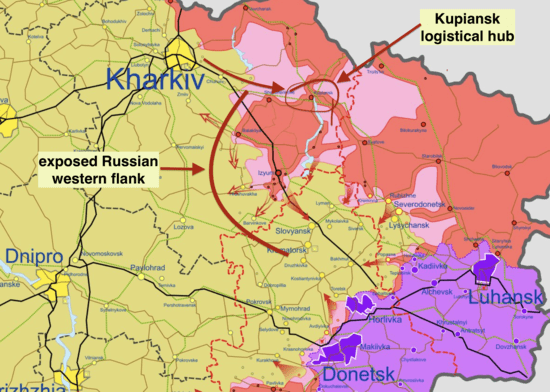
Two major rail lines from Russia converge at Kupiansk, as well as another from the Russian-occupied east. Take that out, and that entire Izyum salient is in trouble. Of course Russia is attempting to connect that salient with Russian-held territory in the east, but even if they connect, losing direct access from Russia will dramatically reduce Russia’s abilities to resupply that entire area, and bottleneck their supply lines into fewer roads—both slowing down the pace of supply (traffic jams), and making those convoys easier ambush targets.
My guess is that Kupiansk is too valuable to lose, and Russia will have to move troops north to protect those supply lines. That’s called “fixing the enemy in place.” Every BTG babysitting their supply lines north of the Izyum salient is one less BTG on the offensive down south, just like every BTG trying to dislodge Ukraine from the Azovstal steel plant is one less BTG pushing north.
Please note that I write these late at night before going to bed, Pacific time. Lots can change by the time the morning crew publishes this live. We are definitely in “fog of war” territory here, so I’m using the best available information at the time I write this. On Tuesday, I’ll be digging for details on the specific attacks: Is Russia attacking with larger force, or are they still limited to one or two BTGs per attack? Also, word is that Ukrainian artillery reinforcements are making it to the east in time to engage. Will we see some of the results? If true, that’ll make things particularly unpleasant for Russians on the Izyum salient. I’ll be paying close attention to Kharkiv and whether Ukraine pushes that attack, and whether Russia rushes defensive troops to protect their lines.
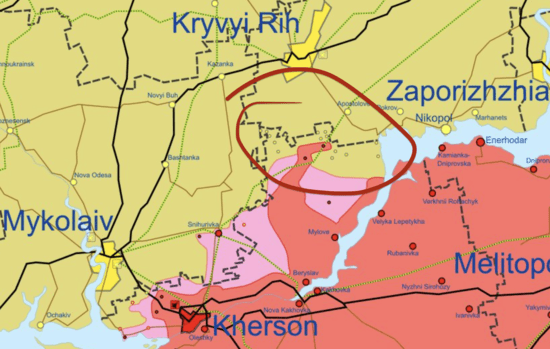
As for Kherson down south, Russia is laying down a wall of artillery, preventing Ukrainian forces—lacking sufficient armor and artillery of their own—from traversing that wide-open exposed terrain. I suspect Ukraine will prioritize the eastern Donbas front over Kherson’s liberation for the time being. Still, Ukraine continues to reportedly roll back Russian forces from the Kryvyi Rih approach. The little white circles (look like dots) I circled below are all settlements liberated in the last few days.
One last thought: Russia must really be freaked out about arriving Western arms shipments and Putin’s May 9 deadline, because this attack is coming at a really shitty time: spring rainy season. While the forecast is showing less rain than it did yesterday, it’s still wet season, preventing the ground from drying out.
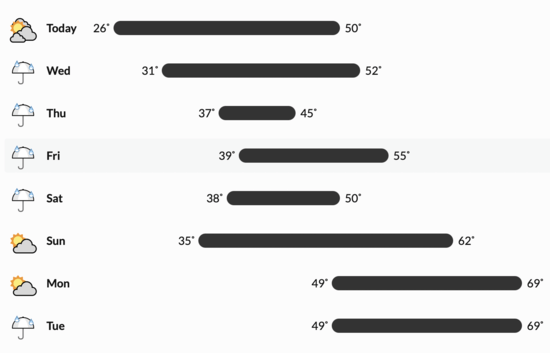
Russia’s heavy equipment will need to either stay on roads, where they are easy to ambush and target with artillery, or they risk a losing confrontation with General Mud. Not that any of the good guys are complaining, however. Ukraine could use all the help it can get.
Morning Digest: Wisconsin Supreme Court adopts new map shrinking Black representation in Milwaukee
This post was originally published on this site
The Daily Kos Elections Morning Digest is compiled by David Nir, Jeff Singer, Stephen Wolf, Daniel Donner, and Carolyn Fiddler, with additional contributions from David Jarman, Steve Singiser, James Lambert, David Beard, and Arjun Jaikumar.
Subscribe to our podcast, The Downballot!
Leading Off
● WI Redistricting: The Wisconsin Supreme Court voted 4-3 on Friday to adopt new legislative maps proposed by the state’s Republican-run legislature, following a U.S. Supreme Court ruling that overturned the state court’s earlier decision to enact maps drawn by Democratic Gov. Tony Evers.
The Wisconsin court had selected Evers’ plans because they best complied with its earlier directive that any new maps represent the “least change” possible compared with the existing districts. That decision effectively locked in the GOP’s already considerable gerrymanders, despite the fact that the court went with maps submitted by the state’s Democratic governor.
But in an opinion castigated as “bizarre” and “shocking” by legal experts, the U.S. Supreme Court struck down the Evers maps last month because the Wisconsin court had failed to conduct a full-blown analysis as to whether the Voting Rights Act required the drawing of a seventh majority-Black Assembly district in the Milwaukee area. That ruling prompted Wisconsin Justice Brian Hagedorn, a conservative who originally joined with the court’s three liberals to pick Evers’ proposals, to switch sides and pick GOP lawmakers’ maps—the same maps that Evers had vetoed, prompting the impasse that led to the courts taking over the redistricting process in the first place.
Hagedorn explained his change of heart in a brief concurrence, saying that the U.S. Supreme Court’s ruling would have required an intensive factual analysis under the VRA for which there was insufficient time remaining this year. As a result, he wrote, the only “race-neutral” plan available to the court was the one submitted by Republican legislators, which reduces the number of Black seats from six to five.
In a detailed dissent joined by her two fellow liberals, Justice Jill Karofsky excoriated the majority, pointing out that the removal of a Black-majority seat in Milwaukee was “an equally suspect, if not more egregious, sign of race-based line drawing.” She insisted instead that the court should further develop the evidentiary record, despite Hagedorn’s protests, and pointed out that a bare majority of the court was, in effect, overriding Evers’ veto on its own—an act that otherwise requires a supermajority of the legislature.
This may not be the end, however. Both Hagedorn and, in particular, Karofsky indicated that the Republican map the court wound up picking could itself be vulnerable to further litigation on similar grounds—namely, that it fails to comply with the Voting Rights Act’s mandate to ensure sufficient representation for Black voters. But given the overt partisanship on display in both high courts—the one in Washington and the one in Wisconsin—such claims might nevertheless fail to gain traction.
Redistricting
● KS Redistricting: Democratic Gov. Laura Kelly has signed the new maps for the state House and Senate passed late last month by Kansas’ Republican-held legislature, though they must first undergo a mandatory review by the state Supreme Court. The exact deadline for the court to act is not yet set: The legislation enacting the new districts must first be published in the state’s official newspaper, the Kansas Register, at which point Attorney General Derek Schmidt has 15 days to ask the Supreme Court to review the maps. Once he does, the justices have 10 days to issue a ruling.
Senate
● CA-Sen: Businessman Dan O’Dowd is running for Senate in California, but he’s apparently not looking to unseat incumbent Alex Padilla. Instead, Politico reports, he wants to put the hurt on Elon Musk … who, you may have noticed, is not on this year’s ballot, in the Golden State or any other.
O’Dowd, who filed to run as a Democrat, has reportedly booked $650,000 worth of TV time to air ads attacking Musk, whose software for “self-driving” Tesla vehicles O’Dowd has blasted as dangerously unsafe. It also so happens O’Dowd runs a company called Green Hills Software, which he says has made him a billionaire, that competes in this space. (The spots aren’t available yet, but Politico’s Christopher Cadelago says they’re being made by high-profile Democratic ad-maker Mark Putnam.)
As Cadelago notes, O’Dowd is entitled to much cheaper ad rates as a Senate hopeful than he would be as a private individual, under an FCC rule that guarantees candidates what’s known as the “lowest unit rate.” The ins and outs of that rule are complex, but it can yield huge savings, which is why super PACs, for instance, can pay twice as much or more than campaigns.
But if O’Dowd really is a billionaire, this penny-pinching seems like a rather minor consideration. However, as Cadelago suggests, there may be another advantage at play: The Federal Trade Commission’s “truth-in-advertising” rules don’t apply to political ads, which might allow O’Dowd to level charges against Musk that might otherwise run afoul of the FTC. In addition, as we point out whenever third-party advertisements get yanked for inaccuracies, stations are obligated to air candidate ads no matter their content. As long as O’Dowd is willing to stomach a Musk lawsuit, then, he can blanket the airwaves with whatever accusations he likes.
Of course, some unnamed Democrats are fretting that O’Dowd could in fact secure the second slot in June’ top-two primary and join Padilla on the general election ballot in an all-Democratic matchup—something that happened in California in both 2016 and 2018. O’Dowd has tried something like this before, though, and was quite unsuccessful: In 1994, back when California still used traditional primaries, he tried to prevent Sen. Dianne Feinstein from winning renomination but finished third with just 12% of the vote.
● NV-Sen: Republican firm OH Predictive Insights has conducted a poll on behalf of the nonpartisan Nevada Independent that finds Democratic Sen. Catherine Cortez Masto holding modest leads against both of her prospective Republican opponents. Cortez Masto bests former state Attorney General Adam Laxalt, who has the support of Donald Trump and national Republicans, by 42-34, and she edges out Army veteran Sam Brown by 43-35. OH Predictive Insights’ previous poll from late January had Cortez Masto defeating Laxalt by a similar 44-35; their prior release didn’t include Brown.
These latest results are notably better for the incumbent than a recent Suffolk University poll that showed her trailing Laxalt by 43-40 and beating Brown by only 40-39, but OH Predictive Insights indicated that one key reason for the difference was that their survey sampled all registered voters. By contrast, Suffolk had polled those whom they viewed as likely voters, implying that they thought turnout would favor Republicans this fall.
● OH-Sen: Late on Friday afternoon, Donald Trump endorsed venture capitalist J.D. Vance with just weeks to go until the May 3 Republican primary, frustrating many Republicans in Ohio who had scrambled to dissuade him after it was first reported that Trump could throw his backing to Vance and raising eyebrows among many observers questioning the logic of Trump’s pick.
Before reinventing himself as the most sycophantic of Trump supporters and as someone who delights in trolling liberals on Twitter by making outrageous statements in order to generate a backlash that he can ride to greater media attention and visibility among conservatives, Vance was unambiguous about his disgust for Trump in the 2016 election cycle. He once labeled himself a “never Trump guy,” and in a number of since-deleted tweets, Vance among other things called Trump “reprehensible” and stated he was voting for conservative independent Evan McMullin that year.
Vance’s total about-face on Trump may have won him the race to the bottom for Trump’s endorsement between himself and primary rivals such as former state Treasurer Josh Mandel, who similarly stokes liberal backlash on Twitter, but it remains to be seen whether it will successfully win him the nomination. Indeed, most polls have found Vance lagging behind in third or fourth place in a crowded field where Mandel and businessman Mike Gibbons have frequently led. However, those same polls have also found a significant share of voters still undecided, and Vance may be counting on Trump’s endorsement to persuade those GOP voters still up for grabs.
To that effect, Vance has already put half a million behind a TV ad that showcases Trump’s endorsement and vows that Vance will “continue Trump’s fight” on immigration, abortion, and opposing Joe Biden.
● PA-Sen: Former hedge fund manager Dave McCormick’s latest Republican primary ad features shots of the candidate riding in a long convoy of motorcycles while he promises via a voiceover to take on the left and “keep America great.”
● Senate: The Mitch McConnell-aligned Senate Leadership Fund, which is the main super PAC on the Republican side in Senate races, has reserved a whopping $141 million in TV ads from Sept. 6 through Election Day across seven states:
- Alaska: $7.4 million
- Arizona: $14 million
- Georgia: $37 million
- Nevada: $15 million
- North Carolina: $27 million
- Pennsylvania: $24 million (begins Sept. 13)
- Wisconsin: $15 million
Republicans currently hold Alaska, North Carolina, Pennsylvania, and Wisconsin, while Democrats are defending Arizona, Georgia, and Nevada. Reporting earlier this month indicated that Senate Majority PAC, which is SLF’s counterpart on the Democratic side, had reserved $108 million across six of these same states with the exception of Alaska.
Notably absent from either party’s reservations was Democratic-held New Hampshire, which is the only remaining state up this fall where Joe Biden won by just single digits.
Governors
● MN-Gov: First quarter fundraising reports are available for all candidates in Minnesota’s election for governor, and Democratic Gov. Tim Walz led the pack with $1 million raised and $4.1 million cash-on-hand. Walz’s numbers were far ahead of his potential GOP rivals below, though the governor doesn’t have any notable primary challengers:
- Former state Sen. Scott Jensen: $256,000 raised, $774,000 cash-on-hand
- Former state Senate Majority Leader Paul Gazelka: $99,000 raised, $406,000 cash-on-hand
- Healthcare executive Kendall Qualls: $467,000 raised, $168,000 cash-on-hand
- Former Hennepin County Sheriff Rich Stanek: $149,000 raised, $40,000 cash-on-hand
- State Sen. Michelle Benson: $53,000 raised, $38,000 cash-on-hand
- Dermatologist Neil Shah: $75,000 raised, $22,000 cash-on-hand
● NE-Gov: In the wake of last Thursday’s story from the Nebraska Examiner where several women accused businessman Charles Herbster of sexual assault, state Sen. Brett Lindstrom has unveiled a poll of the May 10 Republican primary from 3D Strategic Research to argue that Herbster’s advantage in the polls was eroding even before the publication of last week’s bombshell news. The survey, which was conducted from April 10-12, finds Lindstrom tied 27-27 with University of Nebraska Regent Jim Pillen while Herbster, who has Trump’s endorsement, is close behind in third at 23% and state Sen. Theresa Thibodeau is far back at 6%.
Lindstrom had previously released another poll from the same firm taken in early March that had Herbster ahead of Pillen by 30-23 and Lindstrom back in third with 20%, and the few other publicly available polls to date had also found Herbster in the lead, all of which were also conducted before the accusations against Herbster became public.
● WI-Gov: Former Republican Gov. Tommy Thompson, who was elected to four terms between 1987 and 2001, says he has decided not to run for his old job again. The 80-year-old was last on the ballot in 2012 when he was the GOP’s unsuccessful nominee against Democratic Sen. Tammy Baldwin.
House
● OH-11: Democratic Majority for Israel PAC, which is backing Rep. Shontel Brown ahead of her rematch with former state Sen. Nina Turner in the May 3 Democratic primary, is running a new ad that praises Brown for standing with Joe Biden and voting for his infrastructure spending law last year.
Cartoon: Accurate political labels
This post was originally published on this site
Support these comics by joining the Sorensen Subscription Service!
Follow me on Twitter at @JenSorensen
Abbreviated pundit roundup: Trump judge bans masks for travel, InfoWars bankruptcy, and more
This post was originally published on this site
Not surprisingly, a Trump-appointed Florida judge has banned masks for travel. We begin today’s roundup with an analysis of the decision from Lawrence Gostin at The Daily Beast:
On Monday, Judge Kathryn Kimball Mizelle in Florida threw out the Centers for Disease Control and Prevention’s mask mandate for air travel and other forms of mass transportation. Deaths from COVID-19—and the mask mandates intended to prevent them—may be on the wane nationwide, but whatever you think about such policies, this is the latest and most egregious example of a judge acting as a partisan warrior in the COVID-19 culture wars.
Mizelle was appointed to the federal bench by President Trump in 2020. She was 33, and had been practicing law for only 8 years. She had nevertried a case as a lead attorney. The Senate confirmed her even though the American Bar Association gave her a rating of “not qualified.” This nominee should have been rejected by the Senate not because of her judicial philosophy and not because of her age, but because she simply didn’t have the credentials and experience to be a federal judge with lifetime tenure.
Now she is substituting her opinion for that of scientific professionals at the CDC, and dictating health policy in America. The outcome could be disastrous, only serving to further embolden the right-wing activists who dispute the reality of this horrifically lethal pandemic.
So if I am denied entry to a swimming pool because I have open, festering sores all over my torso, then I really am being “detained” on the sidewalk? If they won’t let me into the movie theater because of my visible case of the Black Death, I really have been “quarantined” in the parking lot? I am neither a lawyer, nor do I play one on this blog, but this does not impress me as legal reasoning. But, Lordy, does it make sense as politics.
You see, Judge Mizelle is one of those folks that the Federalist Society sent up the pneumatic tube that led from its labs to the White House. She clerked for Supreme Court Justice Clarence Thomas, and was rated as “not qualified” by the American Bar Association. She was 33 when she was nominated and confirmed as the 2020 lame-duck session was winding down. She was eight years out of law school and had never tried a case of any kind. Her husband was chosen to be acting general counsel at the Department of Homeland Security through his connection to that noted devotee of the Constitution, Stephen Miller. She had no experience, but she had the golden resume.
The RNC has pulled out of presidential debates. Here’s David Frum’s take:
Debate organizers may now try to appease the RNC, but the effort may well only make an already tense situation worse. If you believe that Chris Wallace is biased against Republicans, whom would you regard as an acceptable alternative? Joe Rogan? Tucker Carlson? Alex Jones? Russian state TV’s Vladimir Solovyov? Maybe the only way to satisfy [Trump] fans is to just let Trump interview himself for 90 minutes, to be followed by a panel applauding Trump and ridiculing his rival?
At New York magazine, Matt Stieb has the details on InfoWars going broke:
It’s reaping season for Alex Jones’s pan-conspiracist outfit down in Austin, Texas. After years of sowing misinformation and hate through the vaudevillian rants of its owner, Infowars filed for Chapter 11 bankruptcy protection on Monday.
According to court filings, the website’s frequent shilling of overpriced dietary supplements was not enough to stave off financial trouble. Infowars claims it has as many as 48 creditors and up to $10 million in estimated liabilities — with estimated assets of $50,000 or less.
Kat Bouza breaks down the Taylor Lorenz/Libs of Tik Tok story making the rounds:
When a well-known reporter on the internet culture beat writes about a viral right-wing social media account, what’s the proper response? Well, if you’re a conservative on the internet, the best course of action is to get really upset and let everyone on Twitter know just how you’re feeling.
That’s the method a special segment of Twitter deployed Monday upon learning of Washington Post columnist Taylor Lorenz’s plans to publish a story about the wildly popular (and much maligned) Libs of TikTok — an openly bigoted and homophobic social media account that reposts so-called “liberal” content culled from various platforms repackaged to produce maximum engagement via rage clicks.
On a final note in case you missed it, here is Jane Mayer’s analysis of the campaign against Biden’s nominees:
Rather than attack a single candidate or nominee, the [American Accountability Foundation]. aims to thwart the entire Biden slate. The obstructionism, like the Republican blockade of Biden’s legislative agenda in Congress, is the end in itself. The group hosts a Web site, bidennoms.com, that displays the photographs of Administration nominees it has targeted, as though they were hunting trophies. And the A.A.F. hasn’t just undermined nominees for Cabinet and Court seats—the kinds of prominent people whose records are usually well known and well defended. It’s also gone after relatively obscure, sub-Cabinet-level political appointees, whose public profiles can be easily distorted and who have little entrenched support. The A.A.F., which is run by conservative white men, has particularly focussed on blocking women and people of color. As of last month, more than a third of the twenty-nine candidates it had publicly attacked were people of color, and nearly sixty per cent were women.
Ukraine update: Zelenskyy says new Russian assaults in Donbas are now underway
This post was originally published on this site
Ukrainian President Volodymyr Zelenskyy today publicly announced that Russia’s long-expected Donbas offensive has now begun, with Russia boosting offensive operations throughout eastern Ukraine. What precisely that means is not yet clear; while Russian missile and artillery strikes have escalated in the past few days, the details on Russian ground assaults aren’t yet known. The newest ISW report remains skeptical that Russia will be any more successful in these attacks than in its failed Kyiv operations, though heavy casualties on both sides are all but assured.
One report suggests Russia may be attempting to surround and take Slovyansk, southeast of Izyum; this is at odds with previous intelligence suggesting—implausibly—that the Russian offensive would be aimed at taking far-off Dnipro, bypassing Ukraine’s most entrenched eastern defenses entirely. A Slovyansk attack would be a more incremental approach, but Ukrainian defenses there are robust.
Ukraine is not only defending, however. It’s also continuing to press Russian supply lines, a tactic that proved devastatingly effective in degrading Russian forces around Kyiv to the point that Russia was forced to retreat. Now those operations are targeting Russian lines leading to Izyum, a city recently captured by Russia that has been the staging ground for these newest attempted Russian drives southward.
There remain few scenarios in which Russian kleptocrat Vladimir Putin can carve out a win, no matter how the war unfolds from here. The sanctions currently dooming Russian attempts to replace the equipment being lost are likely to remain in effect for many years to come. While Putin has now arrested numerous of his own officials in an attempt to find scapegoats for Russia’s displays of military incompetence, the many opportunities for Russia to deescalate and declare partial victory are now behind us. Throwing Russian troops haphazardly toward the frontlines in an attempt to exhaust Ukraine territorial defense forces regardless of Russian costs appears to be one of the few plans Putin’s handpicked and thieving military leaders believe they might have the skills to accomplish.
Some of today’s news:
Black immigrants welcome Cameroonian TPS, continue urging relief for Ethiopia and Mauritania
This post was originally published on this site
In a victory for Black immigrants and Black-led organizations that have been leading this years-long fight, the Biden administration announced on Friday that it will designate Cameroon for Temporary Protected Status (TPS), citing “extreme violence perpetrated by government forces and armed separatists.”
The decision stands to shield from deportation tens of thousands of Cameroonian immigrants who are already in the U.S., advocates said.
“TPS will provide an urgently needed measure of stability and security for an estimated 40,000 people from the deadly conflicts in Cameroon,” said the Temporary Protected Status Deferred Enforced Departure Administrative Advocacy Coalition (TPS-DED AAC). The coalition urged the Biden administration to “follow this announcement with swift implementation of TPS and immediate cessation of deportations to Cameroon to ensure protection.”
RELATED STORY: Menendez urges TPS for Cameroon and Ethiopia: ‘The United States must continue to lead’
But it is a bittersweet victory. Numerous advocates noted that while they celebrated the “life-saving protection TPS will provide for thousands of Cameroonians,” they also mourned the “harm that came to those who were deported back to dangerous conditions.” Human Rights Watch said in a February report that Cameroonian asylum-seekers deported from 2019 to January 2021 faced abuses following their return, including arbitrary arrest, extortion, and rape.
Listen and subscribe to Daily Kos’ The Brief podcast with Markos Moulitsas and Kerry Eleveld
“It is not lost on us that the journey to get to what should’ve been an obvious decision took years instead of days,” the UndocuBlack Network said. For comparison, Ukraine’s designation for Temporary Protected Status came within 10 days of Russia’s unprovoked invasion.
“A key step towards remedying the harms caused by the delay in designation is a strategic and equitable implementation plan,” UndocuBlack continued. “We urge the administration to immediately publish a Federal Register Notice (FRN) to provide eligible Cameroonians the opportunity to apply for TPS as soon as possible. An FRN publication would also officially open the registration period needed to facilitate the release of Cameroonians who are currently detained by ICE and CBP.”
The organization, which steadily fought for relief alongside Cameroon Advocacy Network and Haitian Bridge Alliance, also urged the administration to waive registration fees (officials waived certain application fees for Afghan refugees last fall) and a “culturally competent community outreach plan” to reach as many eligible people as possible.
UndocuBlack also urged relief for other Black immigrants facing imminent risk. “The current conditions in Cameroon made it a textbook case for TPS designation. Other majority-Black countries, with very similar conditions, must also receive TPS designation immediately. We hope Mauritania with the widespread practice of enslaving its Black population and Ethiopia with the armed conflict and humanitarian crisis in its Tigray region will also receive TPS designation soon.”
Foreign Relations Committee Chair Robert Menendez last month urged relief for Cameroon and Ethiopia in a statement supporting the Biden administration’s designation of Afghanistan for Temporary Protected Status, writing it was “critical that TPS is not politicized to preference some countries over others. As I have said before, Black migrants are too often excluded when these important decisions are made.”
Following news of Cameroon’s designation last week, affected immigrants “who have lived in fear of imminent deportation said they feel like they can finally breathe,” Human Rights Watch said.
“I was almost deported myself [last year], but was taken off the plane,” one man told Human Rights Watch. “Thinking of the fact that there were many Cameroonians deported who faced hard times in jails in Cameroon … God has spared me. With this [TPS] news, it’s like a new day.” Both Human Rights Watch and affected individuals also urged the Biden administration to return recently deported Cameroonians. “It has been a nightmare, but now I feel safe,” another man told Human Rights Watch. “However, I will only be satisfied when the US government does something about my brothers that were deported, and those of us who have been unjustly treated by the immigration court system.”
“The United States recognizes the ongoing armed conflict in Cameroon, and we will provide temporary protection to those in need,” said Department of Homeland Security Secretary Alejandro Mayorkas. “Cameroonian nationals currently residing in the U.S. who cannot safely return due to the extreme violence perpetrated by government forces and armed separatists, and a rise in attacks led by Boko Haram, will be able to remain and work in the United States until conditions in their home country improve.”
RELATED STORIES: Following disturbing human rights report, advocates again urge deportation relief for Cameroonians
Complaint says ICE subjected African asylum-seekers to degrading, full-body restraint
Cameroonians fleeing conflict are in dire need of Temporary Protected Status
Trump's 'parade of supplicants' advised to woo the ocher ape with big fonts and color photos
This post was originally published on this site
I’m trying to think of anything more undignified than sucking up to colossal loser Donald Trump after everything that’s happened in the past few years—telling him he won elections he lost, groveling for his endorsement, buying overpriced tchotchkes at his cult compound/golf resort, and pretending you’re not staring directly into the sallow, rheumy eyes of primordial evil.
I wouldn’t hire Trump to manage a Chuck E. Cheese, unless I actually wanted to open a strip club with an animatronic jug band and didn’t know who to bribe or murder to make that happen. And yet, according to a profoundly pathetic Sunday New York Times story, Republicans as a whole still can’t get enough of his unique blend of feral charisma and sultry lunch meat sweats.
The story is long, sad, and eye-gougingly horrific, but we pretty much already knew the broad strokes of everything that’s in there. Republicans are cashing in their souls for endorsements, and Trump is devouring those souls like so many saucy McNuggets. Pretty standard fare for the sell-out-democracy party.
That said, one portion of the story did grab my eye, because there’s such a huge disconnect between what these GOP hopefuls—almost all of whom went to college—are likely thinking in the parts of their brains they’ve decided to keep alive and what they’re actually doing these days to curry Trump’s favor.
Mr. Trump enjoys flattery and is not above rewarding sycophants. But insiders say bringing compelling visual material matters, too. Big fonts are crucial. With photos and graphics. In color.
“He’s not a real big digital guy, so we had printouts,” said Joe Kent, who has since won Mr. Trump’s backing for his effort to unseat Representative Jaime Herrera Beutler of Washington, one of the 10 Republican impeachment votes.
…
Good God, is being in Congress really worth this degradation? Is being in the GOP worth it? If I had to choose between behaving this way to stay politically relevant or chaining a pair of slumbering antelopes to my vintage Sam and Frodo nipple rings, it would probably come down to a coin flip.
The Times charitably refers to the GOPsters visiting Trump at Mar-a-Lago as a “parade of supplicants”—possibly because “caravan of ass-kissers” was deemed too déclassé for the paper of record. But Trump biographer Michael D’Antonio sums up these ingratiation celebrations pretty well.
“What was The Apprentice but a sad scramble of people behaving like crabs in a bucket to be lifted out by him?” said D’Antonio. “How are these people anything other than contestants vying for his approval?”
That’s a good analogy, but like most analogies, it’s a bit imprecise. Crabs in a bucket have far more dignity. If the GOP ever reaches crabs-in-a-bucket levels of seriousness again, maybe we can talk. But for now, they’re still beholden to the worst sentient being on this or any planet. And, well, the vast majority of them seem just fine with it.
It made comedian Sarah Silverman say, “THIS IS FUCKING BRILLIANT,” and prompted author Stephen King to shout “Pulitzer Prize!!!” (on Twitter, that is). What is it? The viral letter that launched four hilarious Trump-trolling books. Get them all, including the finale, Goodbye, Asshat: 101 Farewell Letters to Donald Trump, at this link. Or, if you prefer a test drive, you can download the epilogue to Goodbye, Asshat for the low, low price of FREE.