
Amazon moves its army of union-busters to the next warehouse over, this week in the war on workers
This post was originally published on this site
Following the Amazon Labor Union’s huge win in Staten Island, they’re going for it again. Workers at another, smaller warehouse—called LDJ5—will begin voting on April 25, and Amazon is once again going hard with its union-busting campaign.
“All those union-busters that were there to union-bust 8,000 workers at JFK8 have walked across the street and are in our little building of 1,600 people,” LDJ5 worker Madeline Wesley told reporters at a press conference last week. “They’re really fighting us, and they’re playing really dirty.”
The union has filed a complaint with the National Labor Relations Board over captive audience meetings being conducted by veteran union-buster Rebecca Smith. The workers at LDJ5 will face enormous intimidation in the coming 10 days, but they can also look at JFK8 and take their inspiration.
“I can’t believe the building across from us, JFK8, got a union,” 18-year-old Ursula Tomaszuk told Labor Notes. “I thought it wasn’t doable until now.”
● National Labor Relations Board General Counsel Jennifer Abruzzo made another big move this week, calling for the reinstatement of the Joy Silk doctrine, which allows the board to order an employer to recognize a union and bargain in good faith. Dave Jamieson has background on Cemex, the union-busting company spurring Abruzzo’s move, which committed “extraordinary violations” of labor law according to a judge.
● By helping self-organized workers, labor can save itself, writes Jon Hiatt, former general counsel of the AFL-CIO.
● Labor experts dismissed the quixotic Amazon union drive on Staten Island. Then they won.
● Depressing but important thread:
● Actors in Waitress tour seek to join labor union.
● The BuzzFeed News Union has a tentative agreement on a first contract.
● Being good at your job can make heroism possible:
●
Listen and subscribe to Daily Kos’ The Brief podcast with Markos Moulitsas and Kerry Eleveld
Listen and subscribe to Daily Kos Elections’ The Downballot podcast with David Nir and David Beard
Connect! Unite! Act! Making history doesn't mean there isn't more history yet to be made

This post was originally published on this site
Connect! Unite! Act! is a weekly series that seeks to create face-to-face networks in each congressional district. Groups meet regularly to socialize, get out the vote, support candidates, and engage in other local political actions that help our progressive movement grow and exert influence on the powers that be. Visit us every week to see how you can get involved!
The confirmation of Ketanji Brown Jackson to the U.S. Supreme Court makes history. It is a watershed moment that puts someone on the bench who can stay for, we hope, a long time, bringing a strong legal mind to the court. It certainly deserves to be celebrated. Just because history was made this week, though, does not mean that we should throw up our hands and say: “Welp, look at what happened! We can all go home now!” Midterm elections often come down to complacency. Did we accomplish everything we needed to accomplish? The answer to this question is always no. History is made every day in big and small ways. The question will be, “Do we allow history to be written by those who see a dark future that lives on nostalgia over reality, or do we want a forward-looking effort to build a history better than anything in the past?”
The problem with nostalgia
If you know me and this series, you know that I really do love and enjoy the thoughts of Brene Brown, and I have no shame at all in admitting that several moments in her new series Atlas of the Heart, streaming now on HBO Max, brought me to tears. One of the items she touched upon is something that I think we don’t address enough in the way it’s tearing apart America, and that is nostalgia.
During the series, her thought on the issue is so simple and so obvious at the same time: “Nostalgia is also a dangerous form of comparison. Think about how often we compare our lives to a memory that nostalgia has so completely edited that it never really existed.”
Think about that and how it manifests itself in the MAGA movement and in so many areas of our culture. When people look back at the past and they toss out “Make America great again,” they are using nostalgia. When they look back at the past, it’s so scrubbed clean of any problems that all they see is what they want to see, and that is what’s both attractive and dangerous.
It’s easy to forget things in the past and focus on good memories. As an example, we can remember all of the best times in our lives, but we often forget the parts that went along with those moments that were terrible.
It is the highs and the lows that help us build the people we are today. I think back to moments in my childhood and I can have some moments of nostalgia. Then I have to remind myself: “Oh yeah, remember, there were a lot of things going around in my life I didn’t like and that I wish could have been different.”
This is the danger of nostalgia. We want something that never existed in reality.
We can use this moment to create reality
So, most who read me know I love science fiction books. If you ask me for recommendations in the comments, I have several good ones right now. Many of them focus on how we create a solution to a problem we face in the future. They do not act as a function of looking backward. The vast majority of science fiction books look at the future because the author knows it’s something that can be changed. It is malleable. It can be changed for good or bad, depending on the acts of the protagonist. Evil could win if bad decisions are made. Good characters can win if they do certain things.
When we look at the confirmation of Jackson to the Supreme Court, we see a moment in history occur. The nostalgic view of it says: “So fantastic! What a moment in history!” The reality is that there was an awful, hateful, racist, out of control hearing on her merits. Her being placed on the court does not undo the events that happened in that committee room.
So in two years or in a few months, will we look back with nostalgia and say: “Look at what was accomplished”? Or will we say: “Look at how far we have yet to go”? The second one is the answer we need.
We cannot find ourselves living in the past. We have to look forward to the future we want, the future we know that we deserve and that our country deserves. It is the only way we stay focused enough to elect the leaders with a clear vision of the future rather than only a desire to make things better.
Activism opportunities!.
TUE 19 APRIL 3:30 pm PDT — “DEEP CANVASSING” TRAINING: HELP US HOLD THE HOUSE!Deep canvassing is a voter communication strategy with proven results in red and purple districts. Active non-judgmental listening in deep canvassing conversations has been shown to change people’s minds and votes on controversial candidates and issues. Indivisible PA is offering an event that will train you on how to ask questions, share your story, and connect with voters more deeply than electoral voter contact normally allows. Then you will actually make “deep canvassing” calls for a progressive candidate in a key PA seat we MUST hold in November. Make a difference in an important swing state, and at the same time add a valuable skill to your political toolbox that will be transferable to any other phone banking or live canvass campaign. Click here for details
TUE 19 APRIL 3:00 pm PDT — FIGHT VOTER SUPPRESSION WITH CFCGThe Center for Common Ground (CFCG) is a voting rights organization led by people of color. CFCG is offering a series of training days on how to encourage higher turnout by talking to eligible PoC voters facing voter suppression and voter discouragement. After you have completed this virtual event you will call voters in North Carolina. Then, if you choose, you can continue phone banking on your own schedule to reach voters in North Carolina, Georgia, and other targeted CFCG states. Early voting for the May 17 NC primary begins in less than two weeks, on April 28. Early voting for the May 24 Georgia primary begins in less than three weeks on May 2! These primaries are critical and NOW is the time to connect with these voters. Each one reach one! Click here for details.
Remember: Whenever you are looking for opportunities to Connect, Unite and Act, the Indivisible website is an excellent resource. Indivisible has chapters in every congressional district, and their site includes a long list of virtual and real-life activism opportunities all over the country. If there is no event happening near you, you can organize one. If there’s no Indivisible chapter close to you, you can start one!
The Joy Collective: Videos to make you smile this weekend
This post was originally published on this site
Guess whose back, back again … with the cutest stuff you’ll see this week. Be sure to keep an eye out on Fridays for some fun videos to give you a welcome change in what you digest online.
Social media is filled with funny moments and stories. Sometimes we just need to step away from the seriousness and take some time to relax; lighter posts allow us to mentally recharge.
As part of a weekly series that aims to make you laugh, Daily Kos will be compiling and sharing viral funny videos from across social media platforms. The news cycle can be a bit much at times. Self-care is needed.
Share your videos and your favorites with us for the next roundup!
We all need balance, so let’s have some joy where we are able.
Starting off with the iconic video of a toddler justifying to his mom why he stole cupcakes.
Have any funny videos you think will bring more joy to Daily Kos readers?
You know the drill! Send them over to me at [email protected], and I’ll try to feature them in the next roundup!
Ukraine update: Goodbye to Moscow
This post was originally published on this site
No matter what “tankie” Twitter has to say, the U.S. Department of Defense has now confirmed that the Russian missile cruiser Moskva (“Moscow”) sank after being struck by Neptune missiles fired by Ukrainian coastal defense. Honestly, the U.S. was very likely aware of this from before the moment when the missiles struck home, because even if Ukraine controlled the Bayraktar drone that distracted the Moskva’s single radar, someone with very sophisticated equipment (like *cough* a U.S. AWACS plane *cough*) had to inform Ukraine that the Russians were genuinely directing their attention at the drone. So the whole gee, we’re not sure, could of been … yes, yes, seems like it was Ukraine act from the U.S. side was a bit of theater.
With a displacement of over 12,000 tons and a length greater than two football fields, the Moskva was a large ship. In fact, it may be the largest ship to go down in war since World War II. Argentina lost the light cruiser General Belgrano during the Falklands War in 1982, but even though that ship carried a crew twice the size of the Moskva, it was actually about 3,000 tons lighter and just a smidge shorter.
And there’s another way that the Moskva may be a larger loss.
The Moskva carried a complement of 510, including officers. If 58 is an accurate count of survivors, then 452 men went down with the flagship of the Black Sea fleet. That Argentine ship in 1982 had a crew of 1,138 when a British submarine scored a direct hit with three torpedoes. Over 250 were killed in the resulting explosions. However, as the ship began to list, the captain ordered the crew to abandon ship. Life rafts were deployed and, despite increasingly bad weather, rescue vessels later pulled 772 men out of the water. Total losses were 323 killed.
Whatever happened with the Moskva under cloud cover on the Black Sea, it does not seem to have been an orderly evacuation. The loss of crew also seems to be largest recorded since World War II.
At this point, Ukraine estimates that 20,000 Russian soldiers have been killed. Oryx records over 2,900 large piece of equipment destroyed, including over 500 tanks. Not only has Russia lost the flagship of the Black Sea fleet, it earlier lost the 370’ long, 3,400 ton landing ship Saratov. At least two other large ships have withdrawn from the fight after being damaged in the same attack that set the Saratov on fire, resulting in its sinking.
Most of what is being spread around Russian television is ridiculous, even as propaganda. But those claims that this is already World War III? Measured on a scale of the losses Russia is racking up, they may be right.
Saturday, Apr 16, 2022 · 8:18:34 PM +00:00
·
Mark Sumner
Russia has captured one of the large factory complexes in Mariupol, and it’s now clear that there was at least some truth to accounts that Ukrainian forces in the city had access to underground passages where they could move and rest without being shelled by Russia.
Saturday, Apr 16, 2022 · 8:23:18 PM +00:00
·
kos
Great community story: Possible reasons why the Moskva did not survive.
Saturday, Apr 16, 2022 · 8:27:12 PM +00:00
·
kos
Apparently, Russia didn’t think having a centralized fire-detection system was worth having on a warship.
Saturday, Apr 16, 2022 · 8:28:40 PM +00:00
·
kos
Apparently, when you openly state that the dissolution of the Soviet Union was “illegal” and that none of the newly independent states are legitimate and have a right to exist, those former USSR republics get a little skittish.
Most Afghan kids evacuated to U.S. are now with family. But for others, the agonizing wait continues
This post was originally published on this site
The Biden administration said last fall that 1,300 Afghan children were in U.S. Health and Human Services (HHS) custody after being unintentionally separated from their parents amid evacuations last summer. In some cases, they were classified an unaccompanied minors after traveling with a nonparent relative. But in other cases, some traveled without any family members at all.
The vast majority of these kids have since been reunited with U.S. relatives since then, ProPublica reports. That’s welcome news. But roughly 200 children continue to remain in HHS custody, “with nobody here who can take them in,” the report continued.
RELATED STORY: Roughly 1,300 children evacuated to U.S. from Afghanistan are waiting to be reunited with parents
Under the Obama administration, the average length of stay for an unaccompanied child in HHS Office of Refugee Resettlement (ORR) custody was 35 days. This is where unaccompanied children are placed until they can be safely connected with a sponsor. But the National Center for Youth Law said that government data as of last month showed that at least 80 of these Afghan kids have been in ORR custody for at least five months, ProPublica said.
Listen and subscribe to Daily Kos’ The Brief podcast with Markos Moulitsas and Kerry Eleveld
“An ORR official, who spoke on the condition of anonymity, said the agency is doing its best to support the Afghan children by providing interpreters, mental health services, additional staffing and, in recent months, Afghan American mentors,” the report said. The official acknowledged that despite attempts to connect kids with these services, kids are still “are grappling with some really terrible things that nobody should have to grapple with.”
In fact, “employees at several shelters described the trauma among the youths as more severe than anything they’d seen,” the report said. This includes fears that something awful has happened to their parents because of the Taliban. It harkens back to similar fears expressed by Central American children ripped from their families at the southern border by the previous administration. “Children feared that they would never be reunited with their parents and, worse, that their parents were dead,” said a 2020 report from Physicians for Human Rights.
ProPublica reports that the State Department is working to move parents who are still in Afghanistan, “but coordinating departures from Taliban-ruled Kabul has proven challenging.”
This means all that Afghan children in U.S. custody can do is wait—and some under the watch of a provider that already faced allegations of abuses against Central American kids stolen from their parents. ProPublica in October reported that Afghan children at a Heartland Alliance-operated facility in Chicago were in severe distress, including allegations that they were hurting themselves and others. But in 2018, Heartland Alliance also faced allegations that a facility it operated in the area had forcibly drugged a separated child, and was punishing others for not adequately cleaning.
The HHS inspector general and the Illinois Department of Children and Family Services said at the time they had each opened a probe into the allegations. During this time, Heartland cleared itself of any wrongdoing, apparently.
Now facing further allegations, Illinois Sen. Dick Durbin has called for an HHS inspector general probe into Heartland Alliance’s Bronzeville facility. “The ProPublica report raises serious and troubling allegations about the health and safety of children in an ORR-supported facility,” Durbin said in a November statement. “As such, I request that ORR take immediate steps to ensure that the children at the Bronzeville center are receiving the support they need, including by providing appropriate interpreters on site.”
“Afghan children, like all unaccompanied children we serve, need a system of care that is trauma-informed and supports their emotional, physical and cultural wellbeing,” tweeted the Michigan Immigrant Rights Center. “We will continue to provide legal services and advocate for children in federal custody.”
RELATED STORIES: At least 34 Afghan children have been classified as unaccompanied after traveling without parents
Advocates urge swift protections for Afghan children who arrived without a parent
Daily Kos Turns 20: It's time to showcase our best work! Up next: The other half of our Staff
This post was originally published on this site
The internet—and the world—was a very different place on May 26, 2002, when Markos Moulitsas dashed off seven sentences and hit PUBLISH on the first-ever post on Daily Kos. Moulitsas—better known as the Kos in Daily Kos and Kos Media, LLC—will be the first to tell you that he never anticipated what was to come.
And now, we’re just weeks from the 20th anniversary of that iconic handful of sentences. In case you haven’t noticed, we kinda can’t stop talking about it or coming up with ways to celebrate. There are the Koscars and my fun little project—This is My Best—and so much more to come!
Some years ago, I’m told, there was a wonderful series called This Is My Best (TIMB), which encouraged Community members to share one piece of their own writing that they were most proud of, rather than the writing of others. One part self-promotion, one part self-confidence, all parts awesome, TIMB encourages writers to press pause on their roles as their own worst critics and take some time to toot their own horns.
RELATED: Daily Kos Turns 20: We want to showcase the ‘best’ thing you’ve written here! Up first: The CC Team
I’m so excited to bring TIMB back for this amazing milestone, and it’s been a blast collecting submissions from the Community Contributors Team, half of our Daily Kos Staff, Kos himself, and you, dearest Community.
This week we’re highlighting the second batch of Staff submissions!
As I noted in the first installment of TIMB, we’re challenging you to reflect on your own writing at Daily Kos and choose your own “best” story.
In the comments, sound off with your own This Is My Bestsubmissions. We’ll be watching and taking note—and using your favorites to create new collections.
Be sure to include a link to your chosen best story and a sentence or two about why you think it’s great. Keep in mind that your “best” story doesn’t need to be your most recommended or the one that got the most comments.
So far, we’ve got nearly 100 of your TIMB submissions; I’ll be using them to keep the party going right up until our joyful 20th anniversary on May 26! But right now, it’s time to check in with the rest of our hardworking Staff and see what stories they’re most proud of.
RELATED: Daily Kos Turns 20: We’re showcasing the ‘best’ stories you’ve written here! Up next: Half our Staff
The April 1 installment of TIMB was the first of three to showcase Daily Kos Staff, and includes my own submission (toot toot!). That collection focused largely on stories that were deeply personal for each writer, which doesn’t happen too often for folks tasked with crafting political analysis and covering progressive issues.
This final installment of Staff selections also includes personal stories, but also includes writing that propelled Daily Kos readers to powerful collective action, vital climate change coverage, and stories that might otherwise have been left in the shadows.
Let’s go!
***
JOAN MCCARTER, Editorial
A new Sagebrush Rebellion? (2008)
The highlights of my early career as a fellow at Daily Kos were my western state road trips for the 2006 and 2008 elections. The 2008 was one epic, beginning in Seattle, stretching east to Omaha, down to Phoenix, and back up, with stops along the way to spend some time with the congressional candidates we’d endorsed. (A favorite, going door-to-door with Wyoming’s Gary Trauner in 2006).
But this 2008 piece distilled much of what I’d been seeing on those trips, and what I was processing as I drove through these huge, gorgeous unpopulated expanses. This all happened before 30% of the country, and too many in the West, lost their goddamned minds thanks to Facebook, so my conclusions haven’t held up—but the writing does. It’s also a favorite because right after I published it, I got an email note from one of my heroes, Ed Quillen, a Denver Post columnist and humorist who I first read in High Country News.
“I really enjoy your work,” he wrote. “You’re one of the few writers anywhere who appears to understand this peculiar empty part of America, especially its political dynamics.”Please keep it up.”
I’ve tried. Quillen died back in 2012. Here’s a lovely tribute for him by his daughter, Abby.
PEREGRINE KATE, Product
There is no safe place (not even Michigan) (2017)
While this story of mine did not attract the most recommendations or the most comments, it holds a special place in my personal archive for several reasons. The story appeared as part of a group effort, for a blogathon related to addressing the climate emergency in the lead-up to major, nation-wide climate demonstrations in April of 2017. I consider both groups and blogathons to be distinctive and valuable features of our site and want to promote them at every opportunity.
For this post I chose to focus on Michigan, my beloved home state, and the threats we face here from the climate emergency related to water, along with the many efforts already underway by environmental justice activists to produce positive change. As we seek ever more diligently to protect our water resources and guarantee safe, clean, affordable water to people, it seems helpful to have this review of our conditions from five years ago. We have achieved some success, but the overall situation has indeed worsened.
We still have so much more to do.
LAUREN SUE, Trending
Rep. Ayanna Pressley reveals stunning bald head and struggle with alopecia (2020)
Rep. Pressley’s story about her struggle with alopecia is one of my favorites because of the bravery it takes to stand in an insecurity, call attention to it, and learn to embrace it. My hair was the stuff of adolescent angst for years, and my journey to accept and celebrate myself as beautiful has been a long one. Pressley represented so much of what is beautiful about Black women when she stood in her truth. Hers is a level of confidence I can only aspire to.
MARK SUMNER, Editorial
The Great Filter: The most important question in history (2018)
[After you asked for this], I stuck four posts up on Twitter, and the “great filter” piece won the poll. So I guess that’s my answer. This one is just riffing on science in a way that was fun. Honestly, I don’t think this is my best.
That probably came in the 640-some stories concerning COVID-19, or in the series on treatments for children with Niemann-Pick disease. But this is the kind of writing I enjoy most—a little history, a little science, a chance to take something that seems obscure or esoteric and fit it into the decisions that we make every day.
It’s the kind of writing I’d like to do more often.
APRIL SIESE, Trending
Youth-led climate change lawsuit against Montana will be heard next year in landmark first (2022)
I deeply enjoyed reporting this because it gave me a chance to speak with someone directly involved in the lawsuit. Too rarely are there positive climate change stories. It was really inspiring to see how the next generation is committed to this fight for environmental justice and an emissions-free world.
SMILEYCREEK, Community
NIXON!! (2011)
It’s fun to remember how innocent I was. This was my political coming-of-age story about “How I Learned to Love the Democrats” by canvassing for … Richard Nixon.
LAURA CLAWSON, Editorial
Solidarity forever, Dan Clawson (2019)
This is my best not because it’s my best writing or a piece that spurred activism or donations, but because my father was the best person I have ever known, and so many of the best pieces of me are the ones that come from him.
JAY CUASAY, Community
Your sweet sixteen somewhere (2021)
Most of my stories have been about local politics, the Black Lives Matter marches, and protests during Donald Trump’s visits to his golf course in my neighborhood. But this story is more personal.
I didn’t write an “About Me” staff introduction when I onboarded, but one thing to know about me is that I have a son, Joshua Emet, who died during labor and delivery, in the early days of Daily Kos. This story is a bit about coming full circle years later, after enduring the Trump years with my wife and daughter.
WALTER EINENKEL, Trending
The Wall Street Journal cries about the poverty of making $400,000 a year (2014)
I chose this story because, frankly, it reminded me of the first story I wrote for Daily Kos. The first month or so of my stories on Daily Kos have been lost to time (and the conversion that came when my personal email was replaced by my work email, and a new account created). At the time, I was working as an intern in the then-“social media” department, mostly making memes for Facebook distribution. Faith Gardner mentioned to me that if I ever wanted to write anything, I should go for it. I ended up writing about a similar business media outlet promoting this same upper middle-class narrative of scarcity and bad personal economics. It was, and remains, a simple and obvious (to me, at least) example of how bankrupt a “free market” and deregulated system of capitalism inherently is.
A close friend of mine’s father once pointed it out to me after I stayed over at his place for a few nights bookending the Christmas holiday season. Watching a business report on television the first night, the broadcast lamented “consumers’ reticence to spend money during the Christmas season,” how “consumer confidence” needed to be up, and there was really no reason why people shouldn’t go out and buy things. A couple of weeks later, on the same nightly business report, the same broadcasters lamented how American consumers really needed to tighten their belts, and think about saving and not spending so much.
I pitched the story to Faith, and I wrote it up, and subsequently, it was well-received and shared. I began writing more and more, and now you are all stuck with me. This story reminds me of that moment, where I crossed into the life I now cherish at Daily Kos.
HUNTER, Editorial
The unlikely redemption of Safety Spider (2014)
In the near future, all political punditry will take the form of long allegories featuring anthropomorphic animals, furniture, or home appliances. This is a simple fact, and the sooner we adjust to it the better off we will be.
REBEKAH SAGER, Trending
Hijacked by his ego, Will Smith missed his opportunity to address bullying, respect for Black women (2022)
I loved working on this because it allowed me to cover something other than straight politics, but still talk about race and the politics involved with race. This was a complex issue. On the surface it looks like a Hollywood ego trip, but dig a little deeper, and there’s more to it that meets the eye—especially for the Black community. It brings up the issue around being held to a different and higher standard, and how Black folks are viewed by white folks and the reactions on social media were a rich hunting ground for commentary.
Most of all, this story gave be the chance to ask myself how I felt about what happened, as a Black woman, a move enthusiast, a Chris Rock and Will Smith fan, and a daughter to a Black man born in the 1930s, who raised me to behave a certain way, lest we all (Black people) be judged.
DAVID NIR, Elections
Flip this seat! Special election to replace Trump’s anti-Obamacare health chief is huge opportunity (2017)
This is the post that started it all. Daily Kos was the first organization to endorse now-Sen. Jon Ossoff, and our community exploded with enthusiasm, donating $400,000 to his campaign in the first week. That massive infusion quickly turned Ossoff into a household name, and you know what happened next: He lost a very close race, setting the stage for now-Rep. Lucy McBath to flip the seat the following year. Ossoff then flipped the Senate along with Raphael Warnock in last year’s runoffs.
We knew him when!
METEOR BLADES, Editorial (Emeritus)
If Trump wanted a real celebration at Rushmore, he’d support Lakota sovereignty over the Black Hills (2020)
While it isn’t my most favorite, it’s on a subject of deep concern to me: Native sovereignty. That’s a hard subject for many non-Natives to wrap their minds around in the abstract, and Trump’s visit to South Dakota two years ago provided an opportunity to present the subject with reference to Mount Rushmore, a national icon nearly everyone is familiar with, but whose true history few know.
Now it’s your turn! To make my job easier (and data entry much faster), please use this format for your submission:
Linked title of story (year published)
A sentence or two in your own words—not an excerpt—about why it’s your “best.”
See you in the comments!
RELATED: Daily Kos Turns 20: Let’s showcase our best work! Up next: The man who started it all—Kos himself
Remember: If you’ve already submitted, there’s no need to do it again, and we are only accepting one story per person. And if you simply can’t narrow down your choice before comments close, we’ll be back with another installment (and opportunity to submit) next week, when I’ll start digging into the Community submissions from the last four weeks.
Democratic Party approves rules allowing states to compete for first-in-the-nation status
This post was originally published on this site
After a long, long period of knowing there was a problem but not doing much about it, the Democratic National Committee is finally allowing other states to challenge Iowa and New Hampshire for their “first in the nation” positions at the front of each presidential election’s Democratic nomination campaign. On Wednesday the party’s Rules and Bylaws Committee kicked off an “application” process inviting states to make their own cases for “first in the nation” status.
Up to five such states will be selected, up from the current four, and there’s nothing here that says Iowa and New Hampshire won’t be chosen to fill two of those slots. But they also aren’t guaranteed those spots, which is a ground-shaking change and one that the two states have resisted with all their might and more than a little vitriol.
There are several reasons for the reform. The Iowa Democratic Party did itself no favors with some truly spectacular technical screw-ups during the last caucuses, and even without those disasters other Democratic-leaning states have long complained that the Iowa-New Hampshire lock on kicking off primary season is unfair and that at the least, those first slots should be rotated so that more state Democratic parties can benefit from the national political coverage those first contests bring in.
There’s a far more pernicious problem with Iowa and New Hampshire’s special status, however.
The two states are among the most white states in the Democratic camp, making them increasingly unrepresentative of the Democratic Party’s national coalitions. That lack of diversity means the two states’ positions as Democratic bellwethers are tenuous at best; Joe Biden was reduced to an also-ran in both states during the 2020 primaries, only to go on to dominate his opponents once the voting moved to more diverse southern states.
Listen and subscribe to Daily Kos’ The Brief podcast with Markos Moulitsas and Kerry Eleveld
That reversal of fortune was predicted by polling and came as no great surprise to campaign experts, but it again demonstrated that Iowa and New Hampshire aren’t great choices if the party wants the first positions to give insight as to how the rest of the race might play out. The two states don’t have such predictive power, and it can even be argued that by skewing media coverage toward whatever candidates 1) have mastered the unique campaign requirements of those two states, and 2) are most favored by mostly-white Democrats, that guaranteed-first status is reliably confusing the status of the race rather than clarifying it.
A more sensible approach would choose the five “first” states to be representative of their regions, and would offer true “first” status to none of them. Most state parties would be glad to have national reporters descend on their diners for the omnipresent stories about how things look on the ground; it allows downballot candidates to get a minor boost of attention earlier in the race than they otherwise might, and allows state party functionaries to boost their own profiles so as to better support those state candidates later on.
In theory, that’s likely the approach the DNC will now take. But it’s also pretty likely the DNC will ease into any such transition in a way that keeps Iowa and New Hampshire near the front of the line because Politics (for now). So don’t be surprised if both states end up among the five for purely, ahem, “traditional” reasons.
Thursday, Apr 14, 2022 · 9:40:47 PM +00:00
·
Hunter
While it remains possible that Iowa could retain its first in the nation status by applying and being selected for it, a rules committee member notes via e-mail that the party’s preference for primaries over caucuses will make it ‘very’ difficult. It’s very likely that the number one spot will indeed go to some other state.
BIPOC gig workers are more likely to be killed on the job, new report says
This post was originally published on this site
by Umme Hoque
This story was originally published at Prism.
Allyssa Lewis spoke to her sister, Isabella, the morning before Isabella died. Allyssa said she called to ask if Isabella could help her do her hair for her birthday, but her older sister was planning to drive for Lyft that day, so they agreed to check in later. At 26 years old, Isabella was doing gig work to make ends meet while simultaneously working for Blue Cross.
Shortly after their phone call, Isabella picked up her first passenger in Garland, Texas. Video footage would later show struggling and the assailant dragging her out of the car before speeding away. Isabella was shot in the side of the head for a fare of around $15.
Despite the fact that she was driving for Lyft, her family still hasn’t heard from the company directly and hasn’t received any financial support. Instead, the Lewises saw a quote in the local paper expressing condolences. Ignoring the human cost, Lyft worried about their financial burden and even sent their insurance company to assess the damages, creating even more grief for a family who simply wanted an acknowledgment of what had happened.
“No amount of money would make [Isabella] come back,” Lewis said. “But justice would be treating this situation like a normal business would. Lyft needs better support, better conditions before situations like this happen. If it does happen, [they need to] handle it better. Instead of worrying about a car, talk about a real person.”
Isabella is one of at least 50 gig workers for companies like Lyft, DoorDash, Instacart, and Uber who have been killed on the job since 2017, according to a new report by Gig Workers Rising. The research compiled reported deaths around the country and found that the majority of workers killed on the job, 63%, are BIPOC, even though people of color are only 39% of the overall workforce.
When loved ones are killed, most families grieve alone and have to pay for the funeral and other costs out of pocket or by setting up an online fundraiser. They don’t receive compensation or support from the companies matching their family members with their killers. Companies aren’t legally required to do anything when a gig worker is killed on the job, but families and workers’ rights advocates are calling for change.
“This could’ve been anyone—what happened to my sister,” Lewis said. “And that means it could’ve been avoided. They need to do better for families in the future.”
Cherri Murphy is a Lyft driver and organizer with Gig Workers Rising. She helped write the report and conduct the research, and she’s seen how the industry has changed since she started driving in 2017.
“I’ve made over 12,000 rides for Lyft,” Murphy said. “And in those rides, I found myself in a cycle: As the number of bonuses decreased, and hours increased, it was a deadly and inflexible cycle. I was working to afford to keep working.”
Because drivers who get work from ride-share apps aren’t classified as workers, they have to take on all financial and safety risks while driving. This means they are responsible for their own costs and expenses, like broken windows and car repairs. They aren’t paid for wait time between rides, and drivers like Murphy were denied unemployment during the pandemic. The health and safety costs for drivers are high, and the report highlights how the potential of death, especially for BIPOC workers, is real.
“Most of these workers who have been killed, they look like me,” Murphy said. “Black and brown workers, killed because app corporations are not doing enough to provide adequate safety for workers. Their philosophy is to have profit rather than safety.”
Safety at work means more than just addressing deaths for drivers like Murphy, which isn’t the only risk for ride-share drivers. Other types of violence, like carjacking, verbal abuse, harassment, and sexual assault are also common. When responding to these safety risks, gig workers are still forced to go at it alone, with no legal access to services or support like paid time off or sick leave.
Gig companies like Uber rose from the ashes of the 2008 financial crisis. Originating as a way for people to make side money, over time the corporations grew their profits while slashing drivers’ security. Changes like raising rates, altering the algorithm, and changing how work is distributed means drivers are having to work more to be able to get by.
These same companies are also spending millions on passing bills that would ensure workers who do work on their platforms never get any rights, like California’s Proposition 22 and Massachusetts’ current gig worker bill. Workers’ rights advocates argue that these pieces of legislation have the capacity to create a permanent underclass of precarious, unsafe, and insecure workers.
Although the number of deaths counted is harrowing, it’s possible that deaths have gone unreported and have been willfully hidden by companies that keep their data closed. In the past, gig companies have forced cases behind closed doors and refused to release information about working conditions for their drivers. To address the crisis, workers are asking for better wages, no forced arbitration, transparency on data and deaths, and the right to form a union.
“This is a systemic issue: not a one-off,” Murphy said. “Racial justice is economic justice. When you pull back the curtain, you realize this is a crisis in the gig economy. There are practices being performed that shouldn’t happen, and it benefits corporations at the drivers expense; it’s causing injuries, emotional and physical abuse. Offloading the responsibility to drivers for profit is an abomination that needs to stop.”
Prism is a BIPOC-led nonprofit news outlet that centers the people, places, and issues currently underreported by national media. We’re committed to producing the kind of journalism that treats Black, Indigenous, and people of color, women, the LGBTQ+ community, and other invisibilized groups as the experts on our own lived experiences, our resilience, and our fights for justice. Sign up for our email list to get our stories in your inbox, and follow us on Twitter, Facebook, and Instagram.
Ukraine update: Two small towns at the center of the world
This post was originally published on this site
This morning, kos wrote about the defensive line established in 2014 between the Russian occupied areas of Ukraine and the areas under control of the Ukrainian military. Russia has been trying, in little ineffective fits and starts, to get around this line and surround the Ukrainian forces that defend it. The whole massive buildup going on at Izyum is part of Russia’s effort to finally, finally pull this thorn from it’s efforts to secure all of the Donbass. If, that is, Russia can manage to move more than a single unit at a time.
This is that same story … on a smaller scale.
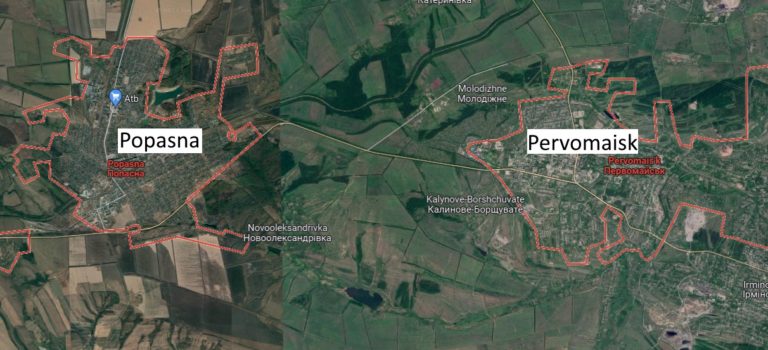
This is an image of two small towns in eastern Ukraine. On the west side is the town of Popasna, population 19,000 (in 2010). On the right is Pervomaisk, population 36,000. Don’t be fooled by the apparent line between the two; that’s just an artifact of the different times when satellites used by Google took images of the area. The left side was captured in the late fall of 2019, the right side in spring of the same year.
From this altitude, nothing appears to be all that unusual about these two mid-sized towns. It’s easy to pick out streets and schools, stores and churches. In the narrow space between the two, there’s nothing that would be called a serious hill and not so much as a single continuously flowing stream, much less a river. It’s just fields. Flat farm fields with a few irrigation ditches. They might as well be in the middle of Illinois. Or Indiana. Or Iowa. One of those ‘I’ states.
But distance is definitely deceiving. There’s nothing ordinary about these two little towns. And while they’ve gotten little attention so far, that two miles between them might be the center of the world.
In April of 2014, pro-Russian separatists driving Russian tanks, firing Russian weapons, and accompanied by Russian forces, captured a number of towns in Luhansk. That included both Popasna and Pervomaisk. In July, Ukrainian forces drove the separatists from the area and in August Ukraine proclaimed both towns “secured.” Only Pervomaisk didn’t seem to be quite so secure. Separatists were still present in the area, and both sides ended up with artillery planted in the middle of civilian neighborhoods, exchanging fire in a very ugly battle. By January of 2015, half the town had either fled, or died. But eventually the town was left in the control of the pro-Russian forces of the Luhansk People’s Army. It’s been that way ever since.
Meanwhile in Popasna, Ukrainian forces retook the town in June, 2014. Then pro-Russian forces took it in July. Then the pro-Ukrainian Donbas Battalion took it a couple of days later. That’s where the town has remained ever since — on the bleeding outskirts of Ukrainian control, held by a mixture of regular Ukrainian military and local territorial defense. As in Pervomaisk, a lot of the population departed. That’s probably good, because in all of what was previously a town of 20,000, there are now two functioning stores. There’s a grocery store on the map, but it’s operated by an aid agency that distributes food to local residents. Electricity is spotty, and good luck getting health care.
Now, here’s a closer look at that apparently nondescript spot of farmland between the two towns.
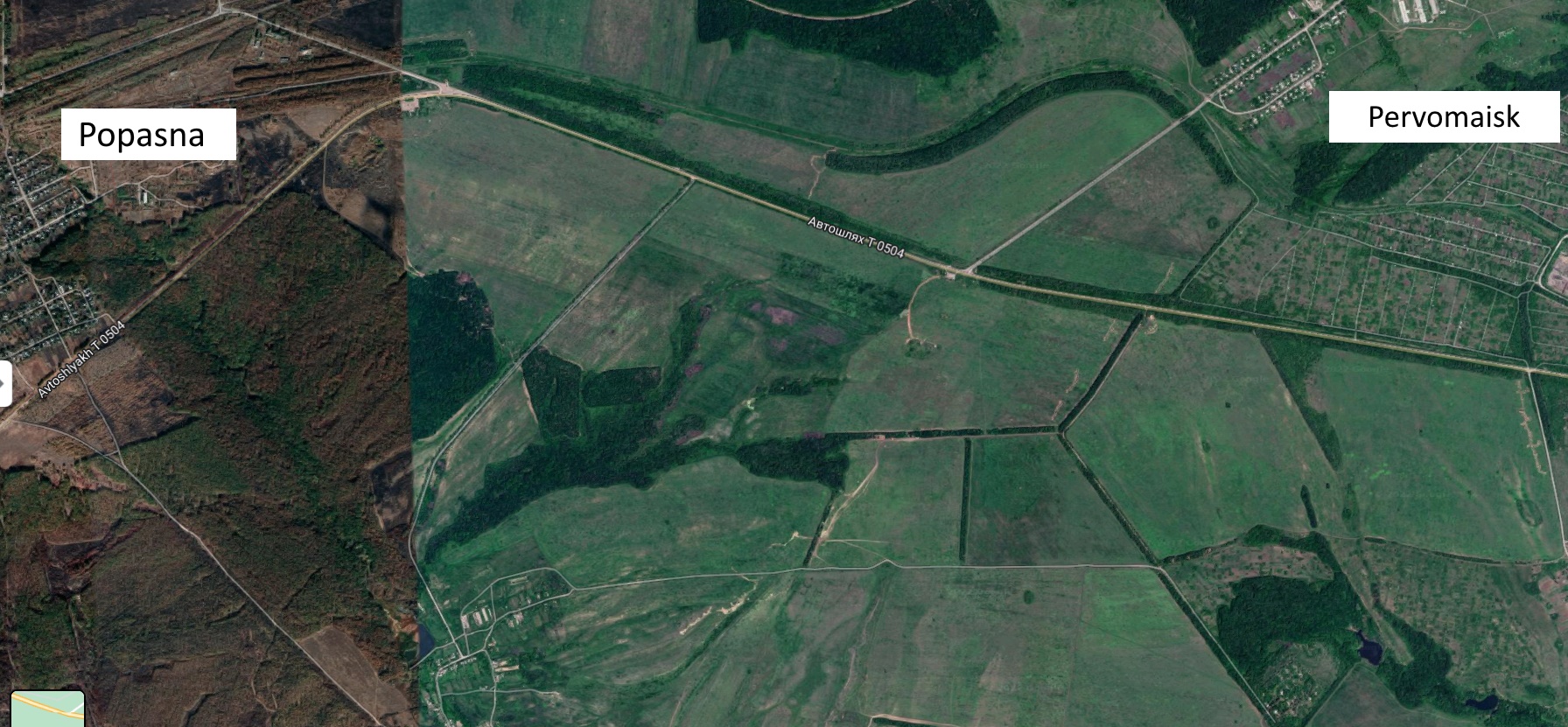
Can you see it? Granted, what’s special here isn’t all that visible at this scale. One thing that might be surprising is that the road that seems so clearly visible on the north edge of this image isn’t really something vehicles can travel along. Not unless they are adept at getting around:
1) Wrecks. Those light spots near the intersection southwest of the Pervomaisk nametag are mostly the remains of vehicles that were blown apart along this course.
2) Potholes. Actually, potholes from hell. There are shell craters in this road, especially west of that intersection, that could swallow a car whole.
3) Mines. That little intersection just east of the Popasna sign marks the west edge of a mine field.
Here’s a closer look at that last one.

But there’s something in the fields between Popasna and Pervomaisk that’s even more special than the mine-laden road. It’s those things that look like barely visible squiggly lines running roughly north -south through the second image above. Seen from close up, they’re definitely not irrigation ditches.

This time the line in the middle of the image really does mean something. It’s where almost exactly one mile of space has been left out. That’s what separates the trenches on the left, dug into some low hills outside of Popasna, from the trenches on the right, which are along a slight rise on the shoulder of a road near Pervomaisk.
These are not a simple ditches. Like the trenches dug across France in World War I, these are elaborate constructions, braced by wood, intentionally non-linear to make them harder to target, and flanked by mounds of earth. Both sets of trenches have locations meant to allow armored vehicles to tuck inside for shelter. Both have gun emplacements for mortars and artillery, either connected to the trenches themselves or in the woods nearby. The Popasna line includes a number of small shelters, likely to allow soldiers to get some respite from the weather, or to act as local command posts.
With all that in mind, here is a news item from Saturday morning.
Rubizhne is about 20 miles to the north. The situation there is more difficult because the Sievierskyi-Donetsk River runs through the area. With the rain that’s been falling across eastern Ukraine in the last two weeks, that again makes bridges a premium item when it comes to moving forces. Both Sievierodonetsk and Rubizhne guard access to bridges.
When word comes that Russian forces have tried to break through at a location like Popasna, what it means—especially right now, in mud season—is that they have attempted to drive a column of vehicles up that wreck-strewn, potholed, heavily mined highway with entrenched forces firing into them from both north and south. It should be no surprise that such attacks are getting regularly repulsed. When kos talks about all the pressure along the defensive line, and Russia’s repeated failures to penetrate the existing defenses, it’s places like Popasna and Pervomaisk he’s talking about.
If you’ve ever been to a famous battlefield, one where the numbers of dead and wounded were simply hideous, odds are it was some place like this. Open fields, with little to no cover, where anyone who wants to be the aggressor has to cross a mile of grass in clear view of dug in defenders.
For eight years, pro-Russian forces have been trying to push west into Popasna. They’ve failed. Likewise, for the same eight years Ukrainian forces have wanted to take back Pervomaisk. They’ve also failed.
Keep in mind that all the images above date from 2019. You can bet that at this point both the trenches and the minefields and the lines of wrecks are all much larger.
Given a few months, when things dry, those attacks can spread out into those flat fields, with tanks and other armor racing straight toward the forces in trenches; forces that at this point you can bet are all but saturated with anti-tank missiles. What happens then? See the dates when Popasna rapidly changed hands in 2014? June. July. Those are the months when forces here won’t be confined to moving along that shot to hell road.
What happens then is anyone’s guess. But if Russia wants to take it, they’re going to have to coordinate more than a single small group of forces.
Saturday, Apr 16, 2022 · 4:35:27 PM +00:00
·
Mark Sumner
The rain won’t go on forever. Neither will the current stand off.
Saturday, Apr 16, 2022 · 4:37:57 PM +00:00
·
Mark Sumner
Here’s a genuine sign of recovery that many of us can feel deeply.
Yes. Yes, I have been very happy after visiting bookshop.
Saturday, Apr 16, 2022 · 4:40:51 PM +00:00
·
Mark Sumner
You may have already seen some version of this. Watch it again.
Great Lakes region marks half a century since adoption of Water Quality Agreement
This post was originally published on this site
This week marked the 50th anniversary of the signing of the Great Lakes Water Quality Agreement, a key piece of legislation that both the U.S. and Canada entered into to protect and restore what many believe is one of the best collections of fresh surface water on the planet. Prior to the agreement, pollution and contamination were a rampant problem, to the point that pesticides were threatening and killing wildlife and oil spills into nearby rivers were similarly destroying this valuable ecosystem. The 1972 agreement aimed to address that, establishing the Great Lakes Water Quality Board and Research and Science Advisory board, both of which have been key in studying the lakes and better ensuring their protection.
Over the years, additional provisions have been added to address invasive species, environmental and health threats, and climate change, the latter of which For Love of Water (FLOW) executive director Liz Kirkwood has especially kept an eye on. “The biggest threat to the Great Lakes is undoubtedly climate change,” Kirkwood said in a statement. “It will alter the waters of the Great Lakes Basin in many ways, only some of them not foreseeable. Warming groundwater, changes in the aquatic food web, and increasing algae blooms are among the expected impacts.” Being that the Great Lakes make up 20% of the planet’s fresh surface water, those changes could severely impact the ecosystem. Around 40 million people rely on the Great Lakes region for drinking water, and the lakes are considered a vital carbon sink.
Kirkwood, whose group advocates for Great Lake preservation, is one of 28 members of the International Joint Commission that makes up the Great Lakes Water Quality Board. She marked the anniversary of the agreement’s signing with a realistic assessment of its efficacy, writing that toxic algae blooms have recently plagued sections of the lakes and that, though the amount of toxic chemicals found in the lakes is lower, much more can be done to restore the lakes to a more pristine condition.
“Yes, the Great Lakes are better off than they would be without the Agreement,” Kirkwood wrote. “The two countries have coordinated efforts to clean up the lakes for decades, keeping the commitment they made 50 years ago. That commitment is to ‘restore and maintain the chemical, physical, and biological integrity of the Waters of the Great Lakes…’ But the Agreement’s 1972 goals are unfulfilled. In particular, the Great Lakes are not ‘free from nutrients entering the waters as a result of human activity in concentrations that create nuisance growths of aquatic weeds and algae.’”
Much can still be done to better protect the Great Lakes and advance this important agreement, including ensuring that protective measures are equally implemented in both the U.S. and Canada. Additionally, Indigenous input is absolutely key to good stewardship of the lakes. It took until 2012 to codify measures that allowed for and encouraged more involvement from First Nations, Métis, and Tribes. It should not take a moment longer for additional environmentally just policies to be implemented as conservationists look toward what the next 50 years could bring for the Great Lakes Water Quality Agreement.
“Canadians, Americans, and Indigenous peoples, particularly the 40 million people who depend on these waters in the Great Lakes region for drinking water, should call on their respective governments to fulfill the promise of this agreement,” Kirkwood said. “And to serve as an example of how countries can and must work together to address water security and sustainability for future generations.”