The Daily Kos Elections Morning Digest is compiled by David Nir, Jeff Singer, Daniel Donner, and Carolyn Fiddler, with additional contributions from David Jarman, Steve Singiser, James Lambert, David Beard, and Arjun Jaikumar.
Politico’s Bill Mahoney wryly writes of the disgraced former governor, “If his supporters covertly knocked on tens of thousands of doors in recent weeks and every one of the people they interacted with kept it a secret, then he could still appear on the primary ballot if he put the signatures in a mailbox on Thursday and they arrived at the board by Monday — which is the final deadline.” Needless to say, even Agent Mulder would question the existence of a clandestine statewide signature-gathering conspiracy, but if Cuomo wanted to challenge Democratic Gov. Kathy Hochul as an independent, he would have until May 31 to submit petitions.
It will still take a little time before we know exactly who’s on the June ballot for governor and U.S. House seats, though. New York allows statewide candidates to earn an automatic place in the primary by taking at least 25% of the vote at their respective party conventions, but the only gubernatorial candidates to hit that threshold were Hochul and Republican Rep. Lee Zeldin.
Everyone else running to lead the state needed to submit 15,000 petitions (with at least 100 each coming from half of the state’s 26 congressional districts), though Mahoney explains that because “it’s fairly easy to get a lot of these thrown out for irregularities, the long-standing rule of thumb has been that the goal should be about 30,000.” Indeed, New York campaigns have long been aggressive about going to court to challenge the validity of their opponent’s signatures. “Fuck them!” former Brooklyn Democratic Party leader Frank Seddio recently said of anyone who might get knocked off the ballot this way. “Breathing shouldn’t be the only qualification for running for office.”
Two Democrats, at least, are prepared to show they can do more than inhale and exhale: New York City Public Advocate Jumaane Williams and Rep. Tom Suozzi each said they turned in 40,000 signatures in their quest to deny Hochul the nomination. For the GOP, wealthy businessman Harry Wilson announced that he’d submitted 36,000, while 2014 nominee Rob Astorino’s team said he’d filed 20,000 “solid signatures.” Former Trump aide Andrew Giuliani, meanwhile, wouldn’t reveal how many petitions he gathered, while Lewis County sheriff Michael Carpinelli acknowledged his campaign was kaput because he’d fallen short.
Major party candidates for the House, meanwhile, need to turn in 1,250 valid petitions, though they too want to provide considerably more to guard themselves against challenges. The state does publish a list of candidates who’ve filed for Congress, but it doesn’t include all House seats: Candidates running for a district that is contained entirely within either a single county or New York City file with their local election authorities, while everyone else files with the state. Under the new congressional map, 10 districts (the 6th through the 15th) are located wholly within the city, while the lone single-county seat anywhere else in the state is the open 4th District in Nassau County.
Election officials can take a few weeks to release their lists of contenders, so it’ll be a little while before we know exactly who will be running for Congress in all 26 districts. We’ll be taking a look at the state of play in each competitive congressional race after first quarter campaign finance reports are in following the FEC’s April 15 deadline.
1Q Fundraising
MN-01: Jeff Ettinger (D): $148,000 raised (in 17 days)
TN-05: Beth Harwell (R): $350,000 raised (in five weeks)
VA-02: Elaine Luria (D-inc): $1.18 million raised, $3 million cash-on-hand
WA-08: Kim Schrier (D-inc): $1.1 million raised, $4.7 million cash-on-hand
Senate
●NC-Sen: The Republican firm Cygnal is the latest pollster to find Trump-endorsed Rep. Ted Budd taking the lead over former Gov. Pat McCrory ahead of the May 17 Republican primary. Cygnal’s survey for the conservative John Locke Foundation (which merged with the Civitas Institute last year) has Budd ahead 32-21, which is a big shift from McCrory‘s 24-19 edge in its January numbers. The last poll we saw giving the former governor the advantage was, ironically, from an early March internal for Budd.
●PA-Sen: Penn Progress, the James Carville-backed super PAC that got its inaugural TV ad yanked from the airwaves the day it debuted for making false claims about Lt. Gov. John Fetterman, has now released a revised version. Instead of calling Fetterman a “self-described socialist”—he in fact has never described himself that way—the spot now says that Fetterman “sought the Democratic Socialists’ endorsement.”
Fetterman did indeed solicit the support of the Pittsburgh chapter of the Democratic Socialists of America in 2017 when he was running for lieutenant governor, but “sought” is the key word, because Fetterman did not receive DSA’s backing. Of note is Fetterman’s response to a DSA questionnaire, obtained by Politico reporter Holly Otterbein, in which he was asked, “Do you identify as a socialist?” His response: “No, I don’t consider myself a socialist.”
Governors
●GA-Gov: A group called Get Georgia Right is airing an ad that bludgeons Gov. Brian Kemp with the Big Lie ahead of the May 24 Republican primary. As ominous drums sound, the narrator claims, “Kemp refused to call a special session before the [Senate] runoff, and the widespread illegal ballot harvesting continued, electing two Democrat [sic] senators. If Kemp can’t beat voter fraud, he won’t beat Stacey Abrams.” There is no word on the size of the buy.
●KY-Gov: Campaign finance reports are in for the first quarter of the year, and Democratic Gov. Andy Beshear raised $1 million and has $2.2 million stockpiled ahead of what will be a challenging 2023 re-election bid in this conservative state. The incumbent begins with a massive financial advantage over his declared GOP foes, but as we’ll discuss, there are plenty of other Republicans who are eyeing this contest.
State Auditor Mike Harmon announced his campaign back in July, but he doesn’t appear to have made good use of his head start. Harmon informed the Lexington Herald Leader this month he’s raised a mere $30,000 so far and had $14,000 on hand, though he insisted he’s “still in the early stages” when it comes to collecting money and understood that “the closer we get, the more I’m going to have to put a lot more focus on fundraising.” The field also includes Eric Deters, an attorney whose license has been suspended several times, who told the paper that he’s willing to self-fund more than $1 million; so far, though, Deters has thrown down just $23,000 of his own money and raised another $12,000.
Neither Harmon or Deters, though, will likely deter many fellow Republicans from getting in (no pun intended). Attorney General Daniel Cameron, who is a former legal counsel to Senate Minority Leader Mitch McConnell, recently made news when he once again declined to rule out a campaign against Beshear, saying, “we’re looking at everything that’s on the table.” Cameron is the Bluegrass State’s first Black attorney general, and he’d make history again if he were elected to the top job in 2023.
Former Ambassador to the United Nations Kelly Craft, who has long been one of the state and national GOP’s most prominent donors, also reiterated in February that she was “leaning heavily toward running for governor.” Commissioner of Agriculture Ryan Quarles, state Sen. Max Wise, and Somerset Mayor Alan Keck each previously expressed interest last summer.
Rep. James Comer also said at that time he had “no plans on running for governor at this moment” and intended to stay in Congress, which he even acknowledged wasn’t quite a no. “My goal for Kentucky is to get a good conservative governor, said the congressman, who lost an excruciatingly close 2015 primary for this office to eventual winner Matt Bevin, adding, “And if I see a good candidate out there that I’m friends with that I think can win, then I’ll certainly support that candidate.”
Secretary of State Michael Adams also declined to rule it out last year, though he said it was unlikely, while the Herald Leader adds that state Rep. Savannah Maddox hasn’t said no either. Finally, while Bevin doesn’t appear to have said anything about running to avenge his narrow 2019 loss to Beshear, political observers have speculated about that idea for some time.
The filing deadline is set for the first week of 2023, and if the last two governor races are any indication, we won’t know for sure who’s running until then. In 2015 Bevin, who had just badly failed to deny renomination to McConnell, announced his ultimately successful bid on the very last day possible. Four years later, the unpopular governor delayed filing to run again despite announcing he was in, which led to plenty of talk that he’d pull the plug on his re-election campaign. Comer, who had lost the primary to Bevin by 83 votes, also made it known he was considering a rematch if the incumbent did run.
Bevin did indeed make it clear he was running just days before the 2019 deadline, though he also used that occasion to announce he was dropping Lt. Gov. Jenean Hampton from his ticket in favor of adding state Sen. Ralph Alvarado. Comer, for his part, finally announced two days later he had “zero desire to run against a multi-millionaire incumbent Governor in a Primary regardless of how unpopular he was.” It would have almost certainly been better for Republicans if they’d swapped Bevin out for Comer (or pretty much anyone else) as Beshear narrowly unseated the incumbent.
●MS-Gov: State House Speaker Philip Gunn last summer made plenty of news when he refused to rule out a 2023 Republican primary bid against Gov. Tate Reeves, and while he’s said little publicly since then, Mississippi Today’s Adam Ganucheau recently wrote that the speaker “is still flirting” with the idea.
●NE-Gov: State Sen. Brett Lindstrom earned an endorsement late last month from Omaha Mayor Jean Stothert ahead of the May 10 Republican primary.
●OK-Gov: Oklahoma Department of Veterans Affairs Director Joel Kintsel announced Thursday that he would challenge his boss, Gov. Kevin Stitt, in the June Republican primary, arguing that “the Stitt administration is rife with corruption, self-dealing and cronyism, and Oklahomans deserve another choice.” Kintsel, who is a former state House parliamentarian but has never run for office before, did not point to any specific allegations in his launch statement.
There’s been little indication that Stitt, who self-funded his successful 2018 bid, is vulnerable to an intra-party challenge. His allies at the RGA, though, recently announced that it would spend $577,000 to support him this month through its State Solutions Inc. affiliate.
●PA-Gov: Campaign finance reports are in covering the period of Jan. 1 to March 28, and the Pittsburgh Post-Gazette has collected the numbers from the main Republicans competing in the May 17 primary:
Former U.S. Attorney Bill McSwain: $1.4 million raised, $546,000 spent, $1.7 million cash-on-hand
State Senate President Pro Tempore Jake Corman: $590,000 raised, $2.38 million spent, $271,000 cash-on-hand
Former Rep. Lou Barletta: $431,000 raised, $318,000 spent, $356,000 cash-on-hand
State Sen. Doug Mastriano: $373,000 raised, $326,000 spent, $1.09 million cash-on-hand
Four other Republicans are also running, but none of them took in more than $150,000 during this time. McSwain, meanwhile, has also benefited from an additional $5.8 million in spending from Commonwealth Leaders Fund, a group funded by the state’s wealthiest man, Jeff Yass.
Democrat Josh Shapiro, who has no intra-party opposition, raised $4.53 million, which is almost as much as those five Republicans put together. The attorney general spent $1.9 million and had $16 million on-hand.
●IN-01: Air Force veteran Jennifer-Ruth Green, a Republican we hadn’t previously mentioned, is running a spot where she touts her military service and pledges to “advance President Trump’s America first policy.” Green faces frontrunner Blair Milo, who is the former mayor of LaPorte, in the May 3 primary to take on Democratic incumbent Frank Mrvan in a seat that Biden would have carried 53-45.
●NY-22, NY-24: Army veteran Steven Holden has left the June Democratic primary for the open 22nd District to instead challenge Republican Rep. Chris Jacobs in the reliably red 24th.
●OR-06: A new group called Justice Unites Us is spending at least $847,000 to support economic development adviser Carrick Flynn in the May 17 Democratic primary for this new seat. Flynn has already benefited from $4.79 million in aid from the crypto industry-aligned Protect Our Future PAC.
Legislatures
●Special Elections: Here is a recap of Thursday’s contest in New York:
NY AD-20: With about 7,100 votes counted, Republican Ari Brown holds a huge 66-34 lead over Democrat David Lobl in a Long Island seat Trump took 52-47 in 2020. Uncounted mail-in votes may shift the margin, but Brown has declared victory in this GOP-held seat.
Many thanks for all the kind comments last week! And as always, if you enjoy this work, please consider helping me keep it sustainable by joining my weekly newsletter, Sparky’s List!
Monday House Democrats begin a two-week “district work period.” House Republicans begin a two-week “cocaine party” period.
Rachel Maddow returns to The Rachel Maddow Show. You won’t believe what she learned to do with nunchucks while she was away.
Tuesday The latest small business optimism index is released. As usual, there’s not much optimism among the smallest businesses, mostly because people keep accidentally stepping on them.
A group of plucky Ukrainian grandmas surround a platoon of Russian troops and apron-snap them to the nearest detention facility.
Continued…
Wednesday Oh poo. Another day, another day JFK Jr. doesn’t show up anywhere.
Mitch McConnell suffers a brief pang of conscience. It quickly passes and his office cancels the 911 call.
All week: Ukrainian farmers continue to harvest their new bumper crop.
President Biden announces another round of initiatives that will help the poor and middle class in the areas of health care, gas prices, child care, and national security. His poll numbers drop six points.
Thursday President Biden cancels his helpful Wednesday initiatives and announces new punitive ones that will make life more miserable for everyone but the rich. His poll numbers go up ten points.
America’s Republican governors issue a joint statement of apology to their citizens and Fox News after they realize they’ve gone a full day without signing a piece of anti-woman, anti-Black, or anti-LGBTQ legislation into law.
Friday The University of Michigan announces the consumer sentiment index for April. Analysts are puzzled as America’s mood swings from rebarbative to effulgent.
The spring fiddlehead forecast is released and, once again, experts are torn between “boiled” and “pickled.”
Saddle up and let’s get this foolishness over with by suppertime.
And now, our feature presentation…
–
Cheers and Jeers for Monday, April 11, 2022
Note: Today is National Pet Day. Be sure to give all your furry and feathered family members a big hug. Or, if your pet is a porcupine or a skunk, perhaps a friendly wave.
CHEERS to feeling the heat…again, maybe? I don’t know what the hell they’re doing over at the Manhattan DA’s office, but it’s just weird. First the previous DA vowed he was going after Trump with guns blazing for “slam dunk” real estate fraud. Then he seemed to slow it down. Then the new DA vowed to speed it up again. Then two prosecutors quit because the new DA told them he was dropping the investigation entirely. Then there was deafening silence. And now, two weeks later, the blazing guns machine is maybe ramping up again:
The Manhattan district attorney, in an unusual statement Thursday, sought to assure the public that his criminal investigation of former President Donald Trump and the Trump Organization is continuing despite the resignations of two prosecutors who were leading that probe. […]
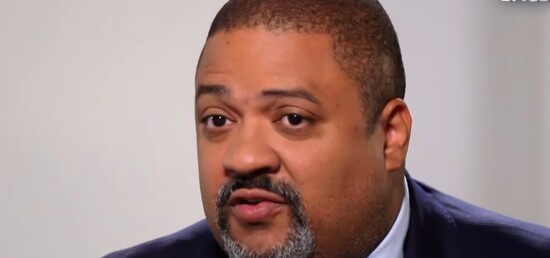
This is Alvin Bragg. Get your shit together, buddy.
[Alvin] Bragg’s statement came two weeks after the disclosure of a letter to him by Mark Pomerantz, who with Carey Dunne, resigned in February from leading the Trump probe after Bragg reportedly told them he had doubts about indicting Trump. “The team that has been investigating Mr. Trump harbors no doubt about whether he committed crimes—he did,” Pomerantz wrote in the letter.
So the on, then off, then on again, then off again investigation of the former president and criminal mushbrain is back on. If only they’d caught him selling loose cigarettes on the street he’d be workin’ the rock pile at Rikers Island by now.
SACRE BLEU! to kicking the goose-steppers right in the ‘ol baguette. The world was on pins and needles Sunday. The planet’s despots were praying that Nazi-not-so-lite Cruella Le Pen would steal France’s soul and leap to first place in the first round of the presidential elections, while democracy-loving nations were hoping that sensible centrist and current wielder of the Roquefort scepter and Brie sash Emmanuel Macron would prevail. Happily…
Macron topped Sunday’s first round of the French presidential election with 28.5% of the vote, ahead of Le Pen’s 23.6%, according to initial projected results.
Biden’s guy came out on top and will easily defeat Trump’s gal on the 24th.
He scored higher than his result in the first round five years ago, and clearly gained support in the final hours of the campaign after his harsh warnings to voters to hold back the far right and protect France’s place on the international diplomatic stage amid the war in Ukraine.
All major candidates, except for the far-right TV pundit Éric Zemmour, immediately called for French people to vote tactically to keep out Le Pen in the second round.
Round two happens on April 24. May good triumph over evil like a steamroller flattening a wheel of camembert. Drolly, of course, with a cigarette hanging off its lip.
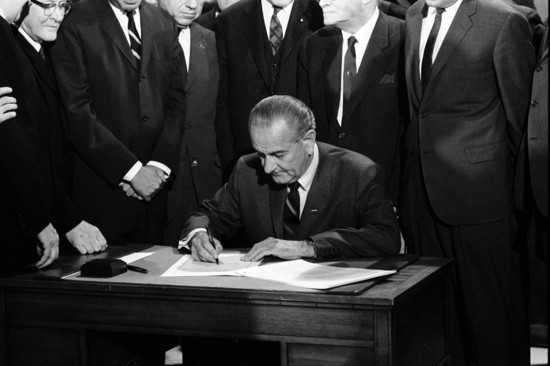
CHEERS to landmark legislation. One week after the assassination of Dr. Martin Luther King Jr., President Johnson signed a companion bill into law 54 years ago today called the Civil Rights Act of 1968, aka the Fair Housing Act. The following housing issues became no-no’s:
Johnson signs the 1968 Civil Rights Act.
1) Refusal to sell or rent a dwelling to any person because of his race, color, religion or national origin.
2) Discrimination against a person in the terms, conditions or privilege of the sale or rental of a dwelling.
3) Advertising the sale or rental of a dwelling indicating preference of discrimination based on race, color, religion or national origin.
The law was expanded in 1988 to include disability and family status, and again in 1993 to prohibit the throwing of lawn darts at the Re/Max blimp.
JEERS to non-refundable tickets. 110 years ago this week, the unsinkable RMS Titanic set off for New York from Southampton, England. That cruise, as we all know, turned out to be a disaster. By all accounts the caviar was much too salty.
JEERS to the law of unintended consequences. This headline from Axios is alarming:
Holy mother of god, you know what this means? Voting for Ketanji Brown Jackson gives you COVID!!! I knew President Biden was up to something—he’s stealthily killing off a majority of the Senate so he can declare himself “King Joey” and give everyone health care, parental leave, reproductive freedom, voting rights, an expanded Supreme Court, free community college and ice cream, and a climate policy that’s the envy of the world. And all I can say about this brazen, unilateral liberal power grab is…please proceed.
P.S. Not to be outdone, the Great State of Maine is making its own bit of judicial history up here. One of our state district court judges—Rick Lawrence—just cleared the legislature’s judiciary committee, putting him one step closer to becoming Maine’s first Black state Supreme Court justice. The only significant hurdle remaining: demonstrating he can eat a lobster bib-less without spilling any butter on his tie.
–
Ten years ago in C&J: April 11, 2012
JEERS to Rickrolling. Looks like we won’t have Santorum to kick around anymore, now that he’s officially leaving the campaign trail. But I say it was inevitable. After all, the golden rule is: whoever wins in South Carolina always becomes the nominee. Always. And since you asked, here’s how I expect it to go down: Ron Paul bows out for medical reasons, Mitt Romney turns back into an Easter Island statue, and Newt Gingrich sails to the nomination and a humiliating 90%-10% defeat at the hands of Obama. This thing is so baked. Wake me up when it’s November 7th. [4/11/22 Update: Ten years later, President Gingrich’s signature achievement, Moon Base Alpha, is doing wonders for America’s child astronaut labor sector. Dig faster, you damn kids—there’s precious metals in them thar craters.]
–
And just one more…
CHEERS to doin’ a little Monday morning endorphin dance. Nothing will come of this. It’s false hope. Don’t put your Easter eggs in this basket. It’s just Lucy holding the football for Charlie Brown again. On the other hand, I’ve been wrong a time or two. (See our flashback above.) So maybe this will be our Cinderella story:
A federal judge signaled Friday that she’ll likely allow a group of Georgia voters to move forward with their constitutional challenge against GOP Rep. Marjorie Taylor Greene, which claims she can’t run for reelection because she aided the January 6 insurrectionists. […]
Cross ‘em if ya got ‘em.
The 14th Amendment of the US Constitution prohibits officeholders from returning to elected positions if they supported an insurrection. The challengers claim that Greene can’t run for reelection because she “aided” the January 6 insurrection, allegedly planned with protest organizers and “encouraged” the violence that disrupted the Electoral College certification.
If the challenge is dropped, we’ll have to dislodge her in a way befitting her performance in Congress for the last year and a half: bug spray.
Have a tolerable Monday. Floor’s open…What are you cheering and jeering about today?
–
Today’s Shameless C&J Testimonial
“If you’re in the Cheers and Jeers kiddie pool, don’t be a jerk. Also if you are not in the Cheers and Jeers kiddie pool, don’t be a jerk.”
Jan. 6 Panel Has Evidence for Criminal Referral of Trump, but Splits on Sending
The shift in the committee’s perspective on making a referral was prompted in part by a ruling two weeks ago by Judge David O. Carter of the Federal District Court for Central California. Deciding a civil case in which the committee had sought access to more than 100 emails written by John C. Eastman, a lawyer who advised Mr. Trump on efforts to derail certification of the Electoral College outcome, Judge Carter found that it was “more likely than not” that Mr. Trump and Mr. Eastman had committed federal crimes.
The ruling led some committee and staff members to argue that even though they felt they had amassed enough evidence to justify calling for a prosecution for obstructing a congressional proceeding and conspiring to defraud the American people, the judge’s decision would carry far greater weight with Mr. Garland than any referral letter they could write, according to people with knowledge of the conversations.
Awful. What terrible judgement about the ability to ascertain what is important. What is truly important. This is one of the biggest if not biggest political story of the 21 st century. https://t.co/ogBjJDp0Bn
An exiled Russian journalist’s diary: ‘How can I help, here and now?’
The Kremlin has cracked down on independent media — but far from Moscow, their work continues
What can I do? How can I help personally? These questions have been on my mind since Putin announced on the fourth day of the war that he was preparing Russian nuclear weapons, and it became clear that this would definitely not end quickly and things would only get worse.During the first week of the war, Russian society was not yet cut off from the rest of the world, locked up voluntarily-compulsorily in the largest cage on earth. Because Putin presented the war as a “special operation”, and didn’t warn the public or even those close to him what he was about to do, the state propaganda machine was caught unawares.
…
But I’ve lived my entire adult life under Putin — I turned 30 this year — so I knew that the authorities would very quickly put a stop to all this, silencing and punishing those who spoke out. I knew that in a matter of days the independent media would be quashed, my friends would (at best) be out of work, and society would be left to consume only propaganda.
Now, in the #UkraineWar, we see the grisly results of elite stupidity and venality (advertising $$ and political donations from big oil). Europe is spending vastly more on Russian energy imports than they are by aiding Ukraine. U.S. is equally to blame for its FF subsidies./2
— John Tirman has an idea (@JohnTirman) April 9, 2022
There is growing speculation that following the Battle of Kyiv the Russians are now going to consolidate their forces in the east and south to restart major offensives. This could include surrounding Ukrainian forces in the Donbas and or even, as one general hypothesised on CNN, a large thrust to seize the strategically located Ukrainian city of Dnipro.
Rushing Russian soldiers back into the war would be a sign of the panic engulfing Putin’s leadership and represent a huge risk for the Kremlin
The problem is that this would rely on a Russian army that does not seem to exist. Any force able to launch major operations in the east to advance rapidly through Ukrainian positions and seize major Ukrainian cities would need to be capable of quickly rebuilding and resupplying defeated units, learning a great deal from its earlier mistakes and mastering complex operations. The Russian army has struggled mightily with all of these things so far.
The UN Security Council has been completely ineffective during the 🇷🇺-🇺🇦 war.
That’s not new, nor unexpected,…nor a problem.
Just to make sure that we’re on the same page: the UN Security Council is the key governing body of the United Nations. The mission of the UN Security Council is described in Article 24 of the UN Charter.
Art 24 says, “In order to ensure prompt and effective action by the UN, its Members confer on the Security Council primary responsibility for the maintenance of international peace and security.”
Be “Prompt and Effective” at maintaining peace?
During the Ukraine-Russia War, the Security Council has been viewed as neither.
…
On the other hand, the failure of the UN Security Council to consent to an action doesn’t prevent a state (major power or not) from taking an action.
That’s been seen clearly in the case of the Ukraine-Russia War.
Make of the prediction what you will, but the fact that Dems now need to win the presidential popular vote by 3-4 points to have a good chance of winning the Electoral College is a serious problem that’s not going away. https://t.co/m03dNsjuvc
In the Judiciary Wars, Republicans Like Lindsey Graham Play Dirtier Than Democrats
The South Carolina senator whined about Democratic tactics all through Ketanji Brown Jackson’s hearings. Oh, please.
Graham’s monologue summed up the prevailing Republican view that in the battle for the judiciary, craven Democrats destroy lives with personal attacks while Republicans battle honorably by sticking to the nominee’s record.
That narrative ignores that it is possible to destroy someone’s life by smearing their record, such as falsely accusing someone of being soft on child porn traffickers.
Further, there are other ways to be indecent toward judicial nominees beyond savaging their work. Ask Merrick Garland. In 2016, when he was a Supreme Court nominee, he wasn’t asked any “hard questions,” as Graham suggested. Garland wasn’t asked any questions at all, because Senate Republicans refused to give him a hearing to fill the seat of Justice Antonin Scalia.
By focusing on an allegation of attempted sexual assault when a teenage Kavanaugh was supposedly drunk at a party, Democrats might have looked like political dumpster divers. But after the powerful testimony of Kavanaugh’s accuser Christine Blasey Ford and Kavanaugh’s petulant defense—which included asking a U.S. senator (and daughter of an alcoholic) if she was drunk—polls showed that more Americans believed Ford than Kavanaugh, and most opposed his confirmation. Moreover, what outraged Republicans overlook is that when Democrats focus on sexual misconduct charges during a judicial nomination process—as they did with Kavanaugh in 2018 and, back in 1991, with Clarence Thomas—they aren’t pursuing a strategy designed to steal a seat away from the president’s party.
Context: Trump was prez for a little more than 10 months of the pandemic. Biden has been for 14.5 months. The death rate under Biden is lower, even as it *increased* worldwide. Thus, our share of worldwide deaths is significantly lower now.https://t.co/KGdAOiKL4upic.twitter.com/07uGEczcfO
We’re used to seeing conservatives accuse the powerless of sex crimes. We’re not used to seeing them accuse the powerful of the same.
Something I’ve been meaning to tell you. My dad is a pedophile. I’m not the victim. As always, though, there’s never just one. The ties that bound my family have largely come undone. Pain is now a feature, not a bug, of our lives.
It’s a story without end, never mind a happy one.
So you can imagine what it felt like to see Republicans in the United States Senate using the word “pedophile” (as well as “child-predator”) during the confirmation hearings of Judge Ketanji Brown Jackson.
Their use of it was loose, irrelevant, warped and worse. The purpose was advancing conspiracy theories already spreading. The goal was smearing the new Supreme Court justice with the smell of evil.
Worst of all, by overusing it, they watered down its meaning. They hollowed out its moral vital essence. They created conditions in which my dad and other pedophiles can now plausibly say their crimes weren’t so bad. Just look at what the Democrats are doing.
They’re the real criminals.
They’re the ones who should be eliminated.
Child abuse, predation, child molestation and rape – these are real problems responsible citizens much find humane ways of addressing while serving the often conflicting needs for rehabilitation and justice.
By trivializing them, the Republicans insult us.
They piss on the wounds of real victims.
The biggest electoral risk to Republicans is not any of their clowning, it’s just calm straightforward discussion of what conservatives believe about economics. https://t.co/LJ5HvGi45d
Ketanji Brown Jackson Was a Public Defender. Here’s Why That’s a Great Thing.
Jackson would be the first justice since Thurgood Marshall to represent significant numbers of criminal defendants. I learned firsthand how important that is
About a quarter century ago, when I was a newly minted, untenured assistant law professor in Oregon, the state’s new governor nominated me to join the newly created Criminal Justice Commission. I had worked for the governor’s campaign, drafting position papers that enabled him, a Democrat in a very tough year, to win unexpected endorsements from police groups and rural sheriffs. This panel was tasked to examine state and local criminal justice issues. My appointment was not exactly a reward. It promised a lot of hard work and paid exactly nothing, but I felt proud to have a chance to serve my new home state.
But it was not to be. The new Republican majority in the state senate rejected my nomination out of hand. After my second year of law school, I had spent the summer as a clerk at the Federal Public Defender office in New Mexico. I know the FPD stint was the sole reason for my rejection because no one in the Senate Republican Caucus actually knew who I was. I use my middle name, Garrett, for all professional practice and writing. The Republican senators had boldly announced that they opposed “George Epps.” (In fact, at first, I thought they were opposing my sainted Uncle George, many years in his grave after a fabled career dealing cards at the Richmond, Virginia, Elks Club.)
Whoever the nominee really was, “George Epps” was rejected in a floor vote, and my brief political career ended.
We are making a grave mistake if we don’t take this both literally and seriously. When a sitting congresswoman declares LGBTQ people as an existential threat to the country, it lays the foundation for violence. I’m pleading with you, stop blowing this off as a side show. pic.twitter.com/I9H8uK4aYA
— Alejandra Caraballo 🏳️⚧️🇵🇷 (@Esqueer_) April 8, 2022
As Russia continues to mass troops in Ukraine’s east, U.S. military leaders are warning that they expect Russia to launch a “major” offensive from the captured city of Izyum in coming days. What we don’t know, however, is what such an offensive will truly look like.
On one hand, Russia is massing “hundreds” of vehicles in new convoys headed towards Izyum in preparation for such an offensive. On the other hand, many of the forces headed to Russia’s new front are the battered remnants of previous Russian offensives, likely to now be significantly less effective in combat than they once were, traveling down supply lines just as long and tenuous as the ones Russia was forced to abandon north of Kyiv, bogged down by the same command incompetence as before.
Russia continues to use raw numbers to force their way into territory that they may or may not be able to keep, and it’s anybody’s guess as to whether the gamble will pay off. Some of this weekend’s news:
When Joe Biden ran against President Donald Trump in 2020, he promised to fight back against anti-immigrant policies, including those that punished “sanctuary cities” and gave more local authorities power to act as an extra arm of federal immigration enforcement.
More than one year into Biden’s presidency, his administration has done little to support so-called sanctuaries—cities, counties, or states limiting how much they help federal agents investigate, arrest, or detain immigrants.
Biden told voters he would dial back Trump’s expansion of cooperation agreements between local police officers and agencies like Immigration and Customs Enforcement (ICE). Instead, the Biden administration has left such collaborations in place and is even trying to convince local governments that refused to cooperate with ICE under Trump to do so now, a Capital & Main review of government documents and speeches shows.
While Trump used the presidential pulpit to drive sanctuary cities and undocumented immigration more broadly into a kind of culture war, the Biden White House has made it a lower priority, said Benjamin Gonzalez O’Brien, a San Diego State University political science professor who co-wrote a 2019 book about the history and politics of sanctuary policies.
Donald Trump holds a law enforcement roundtable on sanctuary cities, in the Roosevelt Room at the White House on March 20, 2018, in Washington, D.C.
In Congress, deep partisan divisions and internal party disagreements endure, and have caused immigration reform efforts to stall out, as Republicans falsely accuse Biden of overseeing “open borders” and Democrats fail to pass any of the nearly half-dozen immigration bills introduced so far.
But immigration remains a part of daily life in communities across the country, and local and state governments continue to pass laws and elect officials on one or the other side of the issue. These local decisions on whether or not to collaborate with federal enforcement can affect public safety and trust in law enforcement, including by diverting resources or encouraging racial profiling.
“We’re going to see the battle over sanctuary policies play out [in different localities] until we get some kind of national legislation,” said O’Brien. “There are still millions of people living in a legal gray zone who are afraid of leaving the house and interacting with other members of their community because that threat of deportation hangs over their head.”
The “main engine“ of deportation
As a presidential candidate, Biden pledged to end Trump’s historic expansion of local-federal cooperation on immigration enforcement because the partnerships—known as 287(g) agreements—“undermine trust and cooperation between local law enforcement and the communities they are charged to protect.”
But under Biden, the federal government is still relying on local police partnerships as “the main engine of the deportation system,” said Lena Graber, a senior staff attorney with the Immigrant Legal Resource Center in San Francisco, who studies the role of local police in immigration enforcement.
More than 140 local law enforcement agencies are currently signed up to help ICE, including by sharing information with federal agents when they arrest, detain, or intend to release an undocumented immigrant.
A Capital & Main analysis of ICE data shows that under Trump, 111 sheriffs’ departments began partnering with ICE for the first time through the 287(g) program. Nearly half of all local agencies that did so were in Florida and Texas. Some pro-immigrant advocates, policy analysts, and civil rights groups say Trump’s aggressive recruitment of local sheriffs facilitated discriminatory policing, such as racial profiling, that has separated families and created legal and financial challenges for people otherwise living quietly in the community.
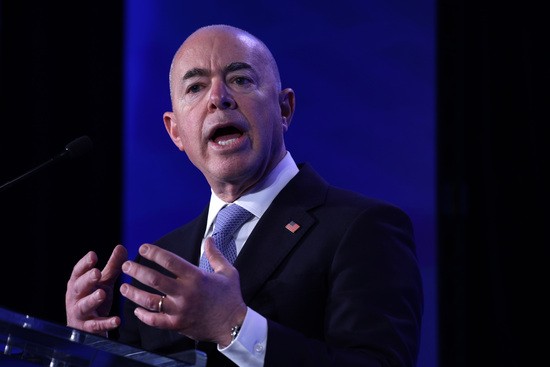
Alejandro Mayorkas, the head of the Department of Homeland Security, recently sought to convince mayors that they should resume collaborating with federal immigration authorities.
Under Biden, ICE has only ended its collaboration with one sheriff’s office, Bristol County in Massachusetts, after guards responded to immigrant detainees protesting conditions during the COVID-19 pandemic by shooting pepper balls and siccing dogs on them. The Biden administration has the authority to order ICE to cancel such partnerships at any time, Graber said. “It’s the easiest policy thing for them to do.”
Instead, contrary to campaign promises, the administration intends to expand local cooperation. Alejandro Mayorkas, the head of the Department of Homeland Security, which oversees ICE, recently sought to convince mayors that they should resume collaborating with federal immigration authorities because “the agency of today, and what it is focused upon, and what it is doing, is not the agency of the past.”
U.S. Secretary of Homeland Security Alejandro Mayorkas
But the mayors of several cities—including Berkeley, Philadelphia, and New York—have already said through spokespeople that they don’t intend to expand cooperation with ICE.
Prominent immigrant legal services groups called Mayorkas’ pitch a betrayal of the president’s commitments and warned in a public statement directed to him that such partnerships “co-opt local resources into questionable, racially discriminatory purposes, and strip communities of safety and public trust.”
Biden’s pick to run ICE, Ed Gonzalez, has promised to continue such local cooperation if he is confirmed by Congress. As sheriff of Harris County, Texas’ most populous county, he canceled his department’s 287(g) agreement. During Trump’s final year in office, Gonzalez criticized the tactic, tweeting that “Diverting valuable law enforcement resources away from public safety threats would drive undocumented families further into the shadows & damage our community safety.”
Within the last year, states like Illinois and New Jersey passed laws limiting the ways their police departments and jails can cooperate with immigration enforcement.
When it comes to supporting sanctuaries, the Biden administration has taken some steps.
Biden’s administration has repealed a Trump-era ban that barred sanctuary cities like New York from receiving some federal grants. Under Biden, ICE has limited the scope of who its agents should arrest and detain, has committed to ending worksite raids and is now arresting and detaining fewer people within the United States than under Trump.
But the biggest change so far has been in how the administration talks about undocumented people, said César Cuauhtémoc García Hernández, an Ohio State University law professor who specializes in the intersection of criminal and immigration law. In contrast with Trump, “we don’t see the kind of racist, abrasive, offensive language coming from the president,” García Hernández said. But the Biden administration is still struggling to find its footing when it comes to differentiating its actual immigration policies.
García Hernández said that city, county, and state governments still have a “good amount of wiggle room when it comes to making life easier or harder for immigrants to live in their communities.”
The direction in which local authorities go is not so much a matter of law, but of their politics, he said.
The tug-of-war over undocumented immigrants
In the years since Trump turned up the pressure on immigrant sanctuaries, some state legislatures across the country have passed laws pushing in opposite directions, with some enacting sanctuary-style policies and others banning them.
Within the last year, states like Illinois and New Jersey passed laws limiting the ways their police departments and jails can cooperate with immigration enforcement, including by banning them from entering any new contracts to detain immigrants for ICE.
Some states have strengthened long-standing protections for undocumented immigrants. Oregon, the nation’s oldest sanctuary state, faced pushback from conservative state legislators over such policies during the Trump administration, and responded last summer. The state’s Democratic lawmakers passed a “sanctuary promise” law intended to reinforce immigrant access to social services and block local police from sharing information with ICE or detaining immigrants.
No matter which way states go, immigration enforcement agencies still have the power to investigate, arrest and detain people anywhere in the country.
Some local agencies have pushed back against such efforts, including the counties of Kankakee and McHenry, outside of Chicago. They sued Illinois, saying the state couldn’t stop them from getting paid tens of millions of dollars per year to detain immigrants for ICE. But a federal judge recently ruled that the state does have the constitutional power to ban its counties from doing so.
At the same time, some states are going in the opposite direction by requiring their local agencies to cooperate with federal immigration enforcement. Texas, Florida, and South Carolina are among at least 10 states that passed laws blocking their cities and counties from engaging in “sanctuary” practices during Trump’s presidency. A federal judge ruled that Florida’s ban is unconstitutional because it was adopted with discriminatory motives. A federal appeals court upheld most of Texas’ 2017 law, but legal challenges are pending.
No matter which way states go, immigration enforcement agencies still have the power to investigate, arrest, and detain people anywhere in the country, including in sanctuaries. To do so, ICE relies heavily on its expansive and long-standing partnership networks with local and state authorities. “Some are so deeply embedded that they remain in place irrespective of whether or not a community is a so-called sanctuary jurisdiction,” said Jorge Loweree, policy director of the American Immigration Council.
For example, California has passed severallaws over the years intended to stop state and local police from sharing information with ICE or transferring people into ICE custody. But despite these protections, some sheriff’s offices have worked with ICE anyway. These partnerships have sometimes led to potentially illegal practices, such as when California’s prison system transferred a U.S. citizen into ICE custody in 2020. The man was detained for a month by immigration authorities during the pandemic until a judge finally ordered him released. In Seattle, also a longtime sanctuary, ICE similarly detained another U.S. citizen in 2019.
ICE also has access to a wide range of databases created by police agencies and information companies, such as the data mining corporation LexisNexis and the software creator Palantir, which was co-founded by the Trump-supporting billionaire Peter Thiel. Some immigrant rights advocates told Capital & Main these databases can help immigration officers obtain information that local agencies decline to provide.
Some sheriffs with a history of cooperating with ICE paid an electoral price in 2020, particularly in progressive pockets of the South.
Nonetheless, since Trump made anti-immigrant policies a centerpiece of his presidency and both campaign runs, some pro-immigrant activists have pushed back through local elections.
Max Rose, who directs the North Carolina-based Sheriffs for Trusting Communities, said his group works with local organizers across the country to elect more progressive sheriffs to replace those who have “fueled mass deportation, doubled down on over-policing in communities of color, and built jails that prioritize expansion rather than treatment and reentry.”
Rose said the communities he works with “are pretty tired of law enforcement demonizing immigrant families, and doing so at the expense of doing their job.” As a result, some sheriffs with a history of cooperating with ICE paid an electoral price in 2020, particularly in progressive pockets of the South. Democratic sheriffs ran and won on promises to cut such ties, including in Georgia’s populous Gwinnett and Cobb counties, where advocates claim community safety and relations have since improved.
The immigrant-friendly sheriffs “showed there’s a winning message on immigration,” Rose said. “It’s a line that the Democrats are trying to walk around the country. But I think there’s a path that was cleared in 2020.”
Some hardline sheriffs who had close relationships with the Trump administration are also expected to face challengers in elections later this year. Among them is Sheriff Thomas Hodgson in Bristol, Massachusetts, the only county to have its ICE partnership terminated by the Biden administration.
Rose said that because Trump so polarized immigration enforcement and cooperation with local police, it’s no longer “politically palatable” for Biden to continue those same policies.
While some sheriffs continue “demonizing and scapegoating immigrants in their community,” Rose said, “we know it should no longer be acceptable for any sheriff to abuse that power, and to play the role of federal immigration enforcement.”
Peter Thiel says a “finance gerontocracy” — Warren Buffett, Jamie Dimon and Larry Fink — is keeping #Bitcoin from reaching $100,000. Billionaire calls Berkshire CEO a ‘sociopathic grandpa.’ https://t.co/XlRn0jq9vnpic.twitter.com/JQQVXLwtSk
— Holger Zschaepitz (@Schuldensuehner) April 7, 2022
Peter Thiel is arguing that there is a plot by billionaires Warren Buffett, Jamie Dimon, and Larry Fink to oppress a market tradable item—Bitcoin—and because of their wealth, these men are able to so successfully manipulate the market that they are blocking the advancement of an entirely new form of currency.
Thiel accused the trio of using investing practices focused on environmental, social and governance goals as a “hate factory” to undermine Bitcoin and other businesses.
This is interesting. Mr. Thiel is openly proclaiming that three market funds and the CEOs behind them are using “hate factory” practices and are destroying the market for a “revolutionary” product. Now, I have my own feelings about Bitcoin. Admittedly, with no nation-state behind it, and no taxable structure in place that truly governs it, and the fact that the times I see it come up with my friends in IT revolves around ransomware requests demanding payment in Bitcoin, I’m not likely the first investor in Bitcoin. I may have some other issues, too: Producing Bitcoin through mining via ASIC or PC hardware is power intensive and not great for the environment.
Thiel’s argument really boils down to market manipulation. If you have people who are so wealthy they can manipulate the market and control the outcome for all investors, the answer would be to limit their ability to control the market, as Thiel alleges. This is interesting, considering Thiel’s multi-billion-dollar 401k fund, which was used to buy into startups and grow to gargantuan size, as ProPublica discovered:
And thanks to the Roth, Thiel’s fortune is far more vast than even experts in tallying the wealth of the rich believed. In 2019, Forbes put Thiel’s total net worth at just $2.3 billion. That was less than half of what his Roth alone was worth.
The solution to this is simple: If all of the power is concentrated in three organizations, as Thiel seems to allege, and the market is shifted against “the people,” then that would be a call for regulation, and for taxes that make it less lucrative to behave in such a manner. While I believe Thiel, at least in the case of Bitcoin, is just crying sour grapes about a volatile market, the way he is making his case leads to only three possible conclusions: regulate, tax, or both.
He doesn’t really want that, though. He just wants to complain and blame others rather than admit that the market controls itself and that the market needs reform that may or may not be conducive to Bitcoin, in the same way that it would impact all investment instruments.
While the reality of his policy would impact everyone, what Peter imagines are taxes hitting his “enemies” but he, himself, not being impacted. Just enough to knock down other investors.
Conservative voters, the overwhelming majority of whom do not own multibillion-dollar stock portfolios, will cheer him on, imagining one day they could be just like him if everything went just perfectly for them. Wake up, suckers.
Welcome back to the weekly Nuts & Bolts Guide to small campaigns! If you listened to the GOP, you would believe that Republicans themselves have the sole monopoly on churches. In their eyes, Democratic ideas, families, and candidates are not welcome inside of a church and may find themselves being stoned with rocks upon entrance. What a bunch of nonsense. While there is a clear divide between church and state, the Democratic Party message is the story of the New Testament for Christians in many ways: it is the story of acceptance. Many faiths share similar stories.
Islam, Hinduism, and Judaism, as examples, all talk about the good of the community. This common theme is a daily part of the Democratic message: Uplift the poor and the hungry. Feed those in need. Welcome the stranger. Show love to those who need it, and clothe those who are struggling. If I asked how well that message lines up with each party, the difference would be crystal clear. While Republicans talk about “rising socialism,” I have to wonder what they are talking about. With elected Republicans representing mostly the Christian community, I assume they introduced their children to Christ and his teachings and most of their children learned about the loving, kind God that flipped over the money changers’ tables, opposed profiteering, gave shelter to a sex worker, and told a community they had a responsibility to take care of those in need by welcoming refugees. How does any of this line up with the Republican Party? It doesn’t. So, how do we work to make good friends with our local religious community when running for local office?
Show up
I cannot talk enough about the importance of just showing up. Attend a Mass in a local community church and meet with parishioners afterward. Do some service work within the religious community locally that invites one-on-one conversations about how your beliefs matter to you. Maybe you don’t believe everything the church believes, but you do believe in some key things that are meaningful. Are we doing enough to make a better life for everyone in America? Do we help take care of the poor and the sick? Most Christian churches, even lay Christian members, are familiar with Mark 25:
For I was hungry and you gave me food, I was thirsty and you gave me drink, I was a stranger and you welcomed me, I was naked and you clothed me, I was sick and you visited me, I was in prison and you came to me.’ Then the righteous will answer him, saying, ‘Lord, when did we see you hungry and feed you, or thirsty and give you drink? And when did we see you a stranger and welcome you, or naked and clothe you? And when did we see you sick or in prison and visit you? And the King will answer them, ‘Truly, I say to you, as you did it to one of the least of these my brothers, you did it to me.’
If you’ve ever read a book on a good relationship, you know part of the equation is active listening: hearing what is being said, internalizing it, and repeating it back to the original sender. When we do this we acknowledge what is being said and we make the other party feel seen. I’m going to be really honest: I struggle with this. Too often, we think up our response and we just wait for someone else to not talk so we can launch into what we want to say. Showing up is not just a physical place, it is showing up in full with our mind and body, and being an active participant. Don’t try to talk over someone else with what you want to say. Listen to what they are saying, relay it back to them with no changes, and wait for them to invite you to discuss what you care about in the conversation. This is how we honor the participants. The smaller your campaign, the more important this tool becomes.
Connect in a way that is meaningful and has a purpose
A Democratic candidate once said, within my earshot, that he hoped the nearby Democrats would “slip on a patch of ice and all die” because of the perceived lack of value in the room; they were older and they just wanted to talk. He had better things to do, it seems. This does not work in building a winning campaign. When you connect to a religious audience, you have to do so in a way that is meaningful and that shows purpose.
If your appearance at these events is only perfunctory and designed to check a box, you will not get much out of them. Campaigns have many different elements that are critically important. Time, Message, and Money are some of the items I focus on with everyone who runs. Time, though, is the one item that is the most important because there is absolutely nothing you can do that gets time back. Making every meeting productive and meaningful matters to help your campaign become successful.
If you are “checked out” of a meeting, you are not helping your campaign because people around you will feel used as props and they can sense the disrespect. Religion can be very important to attendees and treating it like a normal campaign stop will never, ever work.
Go back, however, and watch some of the greatest politicians you know. Here’s President Obama singing “Amazing Grace”:
Think about more than the fact that he is singing, and watch the ministers around him, and the feeling that’s in that room. There is a connection that says: I honor tradition, and I honor what this means to this community, and I honor the members here. It is all done within a short period of time. This is a U.S. president utilizing reflective listening and putting more than an appearance back into the community. Instead, he is thoughtfully responding to the emotional state in the room.
It doesn’t need to be prompted by a tragedy. It can also be about joy and purpose. Utilizing a church only in times of great need and grieving is just waiting on something terrible. Celebrating joy is an even more powerful tool of connection. Delivering meals on wheels is one example.
We cannot abandon those who have faith
There are overwhelming numbers of people who practice a faith who are strong Democratic voters. Black Protestant voters. Jewish voters. Catholic voters have favored Democratic candidates in most elections. Not taking the step to connect our beliefs to their faith is a loss on our part and it risks losing generations of work.
Be willing to take the time and the interest to go through this process thoughtfully, intentionally, and get to the result you need in order to be successful. Walking away or deciding before you start not to participate in no way helps your campaign.
The number of refugees who have fled Ukraine after Russia’s invasion has now topped 4.5 million, according to the United Nations, and is expected to grow even more as Ukrainian officials to advise civilians in Luhansk and Donetsk to leave those regions before new Russian attacks.
Getting out, however, remains dangerous. The death toll from a Russian missile strike on a Kramatorsk train platform crowded with evacuating civilians has now risen to 57. That attack has been condemned unequivocally as a war crime; Russian commanders can provide no possible military justification for launching missiles against civilian passenger stations unless their “military” orders include a land-clearing genocide.
Russia’s use of war crimes as alleged military tactics appear to have been the tipping point for NATO nations, which have become increasingly willing to provide the sort of hard-hitting offensive weapons that the coalition had previously been refusing. The United Kingdom is now said to be providing new armored vehicles and possibly anti-ship missiles, though almost certainly not the Harpoon missiles that Ukraine lacks launch capabilities for. Poland is delivering T-72 tanks. Lithuania will reportedly be training Ukrainian troops on the use of Western-produced gear, while the U.S. military is now publicly highlighting their efforts to train Ukrainian soldiers being provided with new Switchblade drones. Top U.S. military leaders have also been discussing new weapons transfers requested by Ukraine.
Ukraine’s success in repelling the attacks on Kyiv, coupled with the subsequent documentation of widespread war crimes in the places where Russian soldiers briefly took control of, may yet prove the turning point of the war. It shocked western nations into providing heavier gear after weeks of waffling—but it also likely demonstrated to western leaders who feared “provoking” Russian autocrat Vladimir Putin that any such weapons transfers would not be in vain. Ukraine’s defenders have proven themselves; now international pressure is not over whether to provide the nation with more firepower, but how to most rapidly deliver it.
Former California congressman and pretend-cow bête noire Devin Nunes appeared on the Leni Riefenstahl White Power Hour Thursday morning to tell lies so outlandish they would shame Donald Trump. Or, well, maybe not Donald Trump, so much as someone whose jaw doesn’t unhinge when he swallows whole rotisserie chickens.
Fox Business’ Maria Bartiromo, who was actually once journalism-adjacent before dedicating herself full time to bigoted bath salts hallucinations, invited Nunes onto Mornings with Maria to respond to grotesquely rich dude Elon Musk’s recent acquisition of a 9.2% stake in Twitter.
Instead, Nunes took it as a chance to set the record straight about the flailing and failing Trump vanity project Truth Social, for which Nunes left Congress to become CEO.
It was fucking weird, man.
Check it out:
Devin Nunes promoting Trump’s new site, calls Twitter a “ghost town”: “There’s not very much activity over at Twitter right now, especially when you compare it to sites like ours, where we’re just in our beginning stages as we continue to test and bring people on day by day.” pic.twitter.com/AJG3a1WNrN
BARTIROMO: “Joining me right now is the CEO of Trump Media and Technology Group. He is former California congressman Devin Nunes. Devin, it’s great to see you. Thanks very much for being here. What is your reaction to Elon Musk taking a 9% stake in one of your competitors, certainly, Twitter?”
NUNES: “Well, I think it’s very interesting, because you know, the goal that President Trump has, and what I have, and our team here at Truth Social, is to open the internet back up so that the American people can get their voice back. So it’s clear that Twitter is kind of a ghost town. They desperately need Elon Musk to be there so, it’s probably something that Elon wants to do.
I think he probably believes in free speech like we do, but at the same time there’s not very much activity over at Twitter right now, especially when you compare it to sites like ours where we’re just in our beginning stages as we continue to test and bring people on day by day. Our interactions are already beating Twitter. And so Elon’s going to have a lot of work to do there, but we want everybody. We see Truth Social as something like a rising tide that lifts all boats. We want people to get their voice back, and at Truth Social we’re doing that, and it’s working.”
Of course, down here on the reality-based community of Planet Earth, Truth Social is failing hard. It’s like crickets and tumbleweeds got together to create an elite strike force of mutant tumble-crickets that’s swiftly occupying abandoned Jazzercise franchises across the upper Midwest.
In fact, it sucks so profoundly, even Trump isn’t using it.
Former President Donald Trump might be joining the conservative social media platform Gettr following the lackluster performance of his Truth Social app.
Trump has “privately fumed” about Truth Social’s failure to attract a sizeable audience since its launch in February, according to The Washington Post, which cited an unnamed source familiar with the matter.
The source also told The Post that the former president is now considering joining Gettr—a competitor to Truth Social that claims it is “founded on the principles of free speech.”
Then again, not everyone in Fox-land is as obtuse as Bartiromo. Just six minutes after Nunes fired the gaslight up to 11, he was gainsaid by Lou Basenese, a Wall Street analyst who had previously claimed Truth Social was “dead on arrival.”
“In tech, you have to move fast, break things, and build it,” said Basenese. “You guys are moving slow, there’s no visibility on when it’s going to get built. My question to you is this: If Elon Musk lets Trump back on Twitter, what is the reason for Truth Social at that point? Because he has 88 million followers there … So would President Trump go back on Twitter if allowed, and at that point, what do you do with the business that you’re trying to build?”
After that, Basenese and Nunes had a little bicker about whether Twitter really is the “ghost town” Nunes claims. To be clear, it isn’t (second tweet).
Later in the segment, one of Bartiromo’s business guests points out Truth Social still has a slow wait list to get on (he’s been waiting), that Twitter is not a “ghost town,” and Truth Social might have no reason to exist anymore if Elon Musk gets Trump back onto Twitter. pic.twitter.com/9rAK1zkGRN
I’d be willing to bet almost anything that Trump told Nunes he has to get better at being on the teevee, and that’s how this Orwellian apologia on behalf of Poof Social—the amazing disappearing Twitter knockoff—ensued. And Bartiromo just sat there, as if the stuff Nunes was saying bore any resemblance to things currently happening in consensus reality.
Of course, most of Fox’s viewers will buy this spin—until they actually try to sign up for Truth Social, that is. The waitlist is looooonnng, and engagement is low, low, low, low, low, low, low. And while Fox viewers regularly gobble up lies like chirping baby birds, it’s likely even they would realize what a disaster Trump’s latest business venture is—if they ever got an up-close look.