It’s not your imagination. In 2021, attempts to ban books reached their highest level since the American Library Association started tracking the issue 20 years ago, with 729 challenges to 1,597 books. The books under attack were overwhelmingly ones by or about Black or LGBTQ people, which matters.
“What we’re seeing right now is an unprecedented campaign to remove books from school libraries but also public libraries that deal with the lives and experiences of people from marginalized communities,” Deborah Caldwell-Stone, the director of the American Library Association’s office for intellectual freedom, told The New York Times. “We’re seeing organized groups go to school boards and library boards and demand actual censorship of these books in order to conform to their moral or political views.”
Along with the efforts to get books removed from classrooms and school libraries and, increasingly, public libraries come direct attacks on librarians, in the form of bills that would open them up to criminal charges for having books on the shelves—and in particular available to minors—that some prosecutor somewhere decided were obscene.
Caldwell-Stone told CNN’s Ronald Brownstein that the library association is “deeply concerned that one of these bills will eventually pass and will be used as a means of both intimidating librarians or actually charging them with crimes—based on this falsehood that mainstream materials, published by mainstream publishers, are somehow ‘illegal speech’ unprotected by the First Amendment.”
While the efforts to take books out of libraries are cloaked in the language of the parental right to decide what their own children will read, Caldwell-Stone explained the distinction between a parent preventing their child from reading a specific book and the demand to remove the book from the library. Libraries, she said, “don’t disagree with parents who want to guide their children’s readings … but they stand firmly opposed to one family dictating what is available to everyone else in a school library or a public library.”
The attacks on books by and about Black and LGBTQ people are part of a Republican culture war effort to whip up their base for November’s elections. But they also have real effects on the kids who are being told they don’t matter, or that their lives are so unacceptable that books reflecting them should be banned as obscene. And that’s a lot of kids being targeted by privileged white people whose voices are heard and taken as legitimate in school board meetings and in the media and when they complain to the authorities. Brownstein offers a lineup of statistics underlying the full-scale freakout:
Children of color have constituted a majority of the public school K-12 student body since 2014, according to federal statistics, and now make up nearly 55% of the total. Gallup recently reported that 1 in 5 members of Generation Z, as well as 1 in 10 millennials, identify as LGBTQ, far more than in older generations. And the Public Religion Research Institute has found that more than a third of young adults identify as secular, without affiliation with any organized religion.
In the short term, Republicans are trying to get their base angry and scared enough to turn out in droves in November. In the long term, they’re engaged in a pitched battle to claim themselves as the only legitimate judgment about education or parenting or who matters in this country. And they don’t care how many kids or librarians or teachers they have to trample on to do it.
If Republicans are truly interested in finding all those election irregularities they’re obsessed with, they’d better start looking at themselves.
The latest member of the GOP mired in voter fraud accusations is former President Trump’s aide Matt Mowers, who held a senior role in the State Department and is now running for Congress in New Hampshire. Mowers took it upon himself to vote in two states during the 2016 presidential primaries.
According to the Associated Press, during the time Mowers worked as director of New Jersey Gov. Chris Christie’s presidential campaign, he voted via absentee ballot in New Hampshire. But just a few months later, after Christie’s run began to stall, Mowers re-registered in New Jersey using his parents’ East Brunswick home address.
The New Hampshire Department of Justice indicates that it is “reviewing the matter” regarding Matt Mowers voting in two states during the 2016 presidential primaries.
New this afternoon from @NH_DOJ regarding @mowers voting in New Hampshire & New Jersey in the 2016 presidential primaries: “Our Election Law team is aware of the Associated Press report and is reviewing the matter.” #NH01#NHPolitics#WMUR
On June 7, nearly two weeks after candidate Trump received the Republican Party nomination and weeks after casting that New Hampshire absentee ballot, Mowers voted in New Jersey, AP reports.
The National Conference of State Legislatures (NCSL) defines “double voting” as “voting more than once “in the same election” and says that states prohibit it. But that’s not really as clear as you’d assume.
“Double voting is often listed as a felony in states, and can come with hefty fines or jail time. Although statistics show it to be rare, it is also difficult to identify and difficult to prosecute when it does occur,” the NCSL writes about whether or not double voting is a crime.
In New Hampshire, it is illegal to vote in two states, but according to AP, an exemption can be used if a voter “legitimately moved his or her domicile.”
That said, in Mowers’ case, it’s the irony and hypocrisy that really stand out.
Gail Huff Brown, spouse of Republican Sen. Scott Brown and former television host, is running in New Hampshire’s 1st Congressional District against Mowers. Brown told the New Jersey Globe that “The Republican Party is the party of election integrity, and we cannot nominate someone who has engaged in voter fraud and expect to be taken seriously on the topic. … We can do better.”
That we can all agree on. We should do better. So, why do Republicans continue to play hard and fast with the voting rules?
On Sep. 19, 2020, about three weeks before North Carolina’s voter registration deadline for the general election, Trump’s former chief of staff, Mark Meadows, claimed to be living in a 14-foot by 62-foot mobile home in Scaly Mountain, North Carolina. The trouble is, it doesn’t appear to be true. Now Meadows is being investigated by authorities in North Carolina for possible fraud.
North Carolina state law outlines that in order to vote in that state you must reside in the claimed address for at least 30 days prior to the election. Debbie must not have read the top of the voter form, which clearly states that “fraudulently or falsely completing this form is a Class I felony under Chapter 163 of the NC general statutes.”
But the outrageous part is that not only are GOP candidates continuing the falsehood of the Big Lie, but they’re using it to undermine Democrats’ legitimate wins.
Michigan Democratic Sen. Gary Peters is battling former opponent John James after James refused to concede his loss to Peters, The Detroit News reports. James’ camp is claiming voting integrity issues in the election.
“It’s sad and it’s pathetic. They lost,” Peters told the press. “It’s very clear. Just count the votes. I understand Mr. James has been running for four years, he’s lost twice now. I understand that doesn’t sit well with him.”
James told The Detroit News he is launching an investigation into the election so voters can believe it was “fair and honest,” and only after the investigation has been completed will he “accept the results and the will of the people.”
One has to wonder if the Meadows or Mower will get the same treatment as so many others do—especially if they happen to be Black.
As I reported in February, Pamela Moses, 44, was sentenced to six years in prison for trying to register to vote. Moses, a longtime Black Lives Matter activist in Memphis, Tennessee, told The Guardianthat what happened to her was a straight-up “scare tactic” designed to keep her—and people who look like her—from voting.
After serving time for a felony offense, she was out on probation when she tried to vote in 2016. She learned then that under North Carolina regulations, as a convicted felon, she wasn’t allowed to vote. However, she hadn’t been informed of that when she registered.
“I had no intention to trick anybody or be malicious or any kind of way,” she told The Guardian. “If you expect us to know that we should know we should not do something, then we should not be on the list or even allowed to do it.”
Mowers is hoping to unseat Democratic Rep. Chris Pappas in the 2022 GOP primaries.
Republicans never let a terrible idea go to waste. If one Republican-controlled state passes a harmful law that will do violence to vulnerable people, it’s a virtual certainty that several other Republican-controlled states will follow suit. That’s how it’s been with the Texas abortion bounty hunter law, and it’s how it’s shaping up with Florida’s notorious “Don’t Say Gay” law.
Ohio and Louisiana Republicans are already considering their own versions of the Florida legislation, which prohibits teachers from talking about gender identity or sexual orientation to students in kindergarten through third grade, and limits how those subjects can be discussed with older students. In Texas, Lt. Gov. Dan Patrick says he’ll make a similar bill a priority when the state legislature starts its next session in January. If he’s going to jump on board with every oppressive bill introduced in any state between now and January, the Texas legislature is going to have a lot to get done.
The thinking behind such bills “is that parents will be allowed to decide when they want their children to learn about LGBTQ+ issues instead of having the school talk about them at an age that may be too early or confusing,” Marissa Higgins explained about the Florida bill. “Mind you, there are undoubtedly LGBTQ+ children (and teachers, custodians, principals, parents, and so on) in every school in Florida right now. They might not be ‘out,’ they might not have the language yet, but they’re there. The only thing that comes from not talking about LGBTQ+ identity is that people lack knowledge, and down the road, may live with internalized queerphobia and feelings of confusion and self-hate. It doesn’t stop anyone from being queer to simply be silent about it.”
But silence—and the knowledge that you are seen as unacceptable or dirty that comes with enforced silence—is enough for Republicans.
A viral social media post exposed some gaps in the logic of the Florida law, enraging right-wing groups in the process:
Dear Florida parent/caretaker:
The Florida house of Representatives has recently ruled that “Classroom instruction by school personnel or third parties on sexual orientation or gender identity may not occur in kindergarten through grade 3 or in a manner that is not age appropriate or developmentally appropriate for students.”
To be in accordance with this policy, I will no longer be referring to your student with gendered pronouns. All students will be referred to as “The” or “them.” I will no longer use a gendered title such as “Mr.” or “Mrs.” or make any references to my husband/wife in the classroom. From now on I will be using the non-gendered title “Mx.”
Furthermore, I will be removing all books or instruction which refer to a person being a “mother,” “Father,” “husband” or “wife” as these are gender identities that also may allude to sexual orientation. Needless to say, all books which refer to a character as “he” or “She” will also be removed from the classroom. If you have any concerns about this policy, please feel free to contact your local congressperson.
Thank you, Mx. XXXXXXXXXX
“Man” and “woman” are gender identities, guys. Heterosexuality is a sexual orientation. Florida Republicans—perhaps soon to be followed by Ohio and Louisiana ones—technically did ban those identifications as well. Because it wouldn’t occur to Republicans that what they think of as normal and right could fall under the category of “gender identity” or “sexual orientation.” They expect that everyone will know what they mean and fall in line, because the very vagueness and broadness of the law is itself a threat.
Relatedly, the Ohio bill also contains familiar bans on teaching about race and racism, or, as it calls them, “divisive or inherently racist concepts.” Again, by being extremely vague and broad, it may limit speech even more than carefully written, highly specific language would do.
”I think it’s probably by design, that they just want to instill fear, that if you wonder if something may or may not be considered controversial or considered divisive or considered illegal under this legislation, the safest bet is to just not talk about it at all. And that’s the real harm that’s caused because that deprives our students from a complete and honest education,” Ohio Education Association President Scott DiMauro told CNN.
That harm comes whether the concepts being banned are “trans people exist” or “racism exists.” And Republicans are dedicated to harming as many kids as possible.
As GOP states across the country make moves to ban abortion and restrict residents from obtaining essential health care services, some Democratic states are making moves of their own. Colorado’s governor signed HB 22-1279 on Monday to ensure that Coloradans who want reproductive care, including abortions, will be able to get it in the state. The bill will guarantee abortion access—regardless of whether the U.S. Supreme Court overturns Roe v. Wade.
“In the State of Colorado, the serious decision to start or end a pregnancy with medical assistance will remain between a person, their doctor, and their faith,” Gov. Jared Polis said in a statement after signing the bill into law on Monday.
“This bill simply maintains the status quo regardless of what happens at the federal level and preserves all existing constitutional rights and obligations,” he added.
It took about 24 hours to pass the bill when it was proposed, according to House Majority Leader Daneya Esgar.
“It’s more important now than ever to protect women and people who choose to be pregnant or choose not to be pregnant across the state,” Esgar said.
Blue states are racing to pass legislation guaranteeing abortion protections, and GOP-majority states are passing their own bans as the Mississippi law makes its way to the Supreme Court. The Mississippi law has the ability to limit abortion rights across the country by overturning Roe v. Wade.
Similar to those of at least 15 other states that have codified the right to access abortion services, Colorado’s “Reproductive Health Equity Act” bans both local and state governments from interfering in reproductive health care.
Because of bans in other states, officials in Colorado are also planning for the possibility that neighboring state residents will travel across borders to seek care.
Across the country, GOP majority states have taken to targeting reproductive rights, with many passing their own versions of the Heartbeat Bill or similar abortion bans that severely limit when abortions are possible but disregard unusual circumstances, including rape.
The latest state to join this horrific trend is Oklahoma, whose lawmakers passed a bill to ban all abortions unless necessary to save a pregnant person’s life, beginning 30 days after conception. In addition to banning doctors from performing abortion procedures, the legislation passed Tuesday allows citizens to sue abortion providers for up to $10,000 if they help end a pregnancy, The Washington Post reported.
The atrocities in Bucha were only uncovered after Russian forces withdrew rapidly under fire from advancing Ukrainian troops. Now, as Ukrainian forces go town to town across northern Ukraine, more horrors are being discovered. Survivors are telling stories of civilians gunned down without warning, of homes set on fire for no reason, and of people being taken from their homes and executed, apparently for the amusement of the occupiers.
In Borodyanka an apartment building above a shelter holding hundreds of people was blasted into ruins, and despite being told of the situation, it appears Russian forces made no effort to remove the rubble that they had generated. Ukrainian workers are clearing the wreckage now, all too aware of what they are likely to find. The destruction in the town, 20 miles northwest of Kyiv, is considered the worst seen anywhere so far.
Of course, the world hasn’t seen everything. In Mariupol—where Russian forces deliberately bombed an opera house labeled with the word “children” and where thousands have been taken away to unknown locations inside Russia—weeks of shelling are now being followed with weeks of fighting street by street, while over 100,000 people remain trapped inside the tightening circle. With limited communications, Mariupol isn’t producing the steady stream of images seen early in the invasion. What’s happening in the city, especially in the sections now occupied by Russia, is impossible to say.
But there are horrible clues …
⚡️Mariupol City Council: Russia uses mobile crematoriums to erase evidence of its war crimes. According to the council, Russia’s special brigades collect and burn the bodies of murdered residents. Tens of thousands of civilians may have been killed in Mariupol, it added.
— The Kyiv Independent (@KyivIndependent) April 6, 2022
Even before the tanks rolled across the Ukraine border, there were reports of these crematory units being seen on the ground with Russian forces. The assumption was that they were to be used to incinerate the bodies of Russian soldiers lost in battle, disguising the extent of their own losses. Similar units were reportedly seen following fighting in the Donbas region in 2014 and 2015. At the time, Ukrainian officials reported that multiple such mobile crematoria were being used to incinerate dozens of bodies per day.
Based on what’s been seen of the cruelty of forces involved in this invasion, it’s very easy to believe the claims coming from Mariupol. However, it is not possible at this point to know if there is any truth behind these reports. But the mayor of the besieged city put it in the starkest terms imaginable.
“The scale of the tragedy in Mariupol is something the world has not seen since the time of Nazi concentration camps,” said the mayor. “The Russians have turned our whole city into a death camp.”
From the first day of the war, Ukrainian President Volodomyr Zelenskyy made it clear that Ukraine was ready to surrender the idea of joining NATO as part of a peace agreement with Russia. Instead, Zelenskyy proposed that Ukraine make a separate agreement with several other countries that would promise to offer assistance in case Ukraine was attacked. That would allow Ukraine to meet Russian demands that it not join NATO, but wouldn’t leave the nation standing on its own in case Russia decided to come back for another bite.
At the first two meetings between Russian negotiators and Ukrainian representatives in Belarus, Russia seemed to be accepting of this idea. But at the talks in Istanbul, Russian demands appeared to be that Ukraine strip itself of weapons, not join NATO, and not be allowed to be a part of any security pact. Essentially, that Ukraine stand helpless against any future attack. Which was not exactly the right demand to make when Russian forces in Ukraine were losing.
Since that point, Zelenskyy has seems to have put the idea of Ukraine joining NATO squarely back onto the table. However, it seems he’s still negotiating an alternative.
BREAKING: Germany says it is in confidential talks with Ukraine about security guarantees
In light of the discoveries in Bucha and elsewhere, it’s become clear that even if civilians are not killed outright by a Russian military that has deliberately targeted hospitals, homes, schools, and shelters, what happens to civilians when a village or town is occupied by Russian forces can be even worse. So it’s understandable that Ukrainian officials are working desperately in an effort to evacuate civilians who remain in Kharkiv, Donetsk, and Luhansk oblasts. These are the areas where the most intense fighting is expected to occur in the near future, and where Russian forces are advancing to occupy new locations.
Both special trains and busses are now engaged in a full time effort to shuffle people from these oblasts to Kyiv and points west.
We can only hope that those Russian soldiers who were involved in Bucha were also the ones given this assignment.
These trenches dug by Russian forces during their invasion of the region were dug in the most irradiated areas of the Chernobyl Radiation Area, see this map of soil Caesium radiation around the disaster area, with the location of the trenches marked. No wonder some got sick. https://t.co/hbvVuatJS1pic.twitter.com/kbBhfKR070
I hate to keep hammering this particular horror. But there are reports that when Russians occupied the town, there were noises coming from the basement where residents of the apartment block had sheltered. But Russian troops threatened to shoot anyone who tried to dig them out.
Leaving this alone until there is more actual news from the site. Miracles remain possible.
With Congress set to leave Washington, D.C., for two weeks at the end of this week, Senate Republicans continue to drag their feet on two critical pieces of legislation: rescinding permanent normal trade relations (PNTR) with Russia, along with codifying President Joe Biden’s energy imports ban; and passing desperately needed COVID-19 funding to allow the administration to continue to fight the global pandemic. The House has already done both of these things, but both will have to go from the Senate back to the House to be passed again there, since the Senate will have made changes. Which means both are very likely to be delayed until Congress reconvenes during the last week of April, if not May.
Senate Majority Leader Chuck Schumer attempted to file cloture Tuesday on the $10 billion COVID-19 relief bill to which Republicans have already agreed. That vote failed 47-52, with Schumer voting no so that he can retain the ability bring the bill back up. Sen. Ron Wyden (D-OR) also voted no.
“The need to continue funding the fight against COVID is clear, but I cannot support siphoning off essential resources for rural communities, tribes and small businesses in Oregon and nationwide just to pad drug companies’ profits,” Wyden said. He continued, “It’s pure politics that Republicans insisted vital COVID assistance be drained to pay for this bill. I remain committed to finding solutions […] needed to battle this public health crisis without making rural America, tribes and small businesses foot the bill.”
The funding has already been chopped by more than half from the administration’s initial ask. At $10 billion, it would allow for the purchase of more vaccines and therapies, and would allow testing and research to continue. It contains no funding at all for USAID to help developing nations stave off the disease. It also includes no funding for the administration to continue to pay for testing, vaccinations, and treatments for the uninsured.
Those critical elements were cut because Republicans refuse to pass a bill with them. They are also refusing to allow a vote unless they get an amendment to the bill to force the Biden administration to reinstate the Title 42 restrictions imposed during the Trump administration and authored by white supremacist Stephen Miller. The administration announced the end of the policy last week. Republican governors immediately sued and now Republican senators are tying up COVID-19 vaccine, testing, and treatment funding in protest.
The administration has been urging the funding for weeks, warning that money are running out—and fast. “We have enough tests on hand to weather the surge,” Biden said last week. “But without funding, we’re not going to be able to sustain the testing capacity beyond the month of June. And if we fail to invest, we leave ourselves vulnerable if another wave of the virus hits.”
That’s one global emergency. On the other big one, Ukraine, the U.S. Congress is lagging behind the rest of the world, thanks to the Republicans in the Senate who can stop anything from happening even though they do not have a majority. The European Union (EU) is proposing further sanctions; its fifth package banning Russian coal; banning all transactions by four Russian banks; banning all Russian and Russian-operated vessels from using any EU ports, as well as a ban on Russian and Belarusian commercial transport in the EU; and another €10 billion worth of bans on Russian advanced semiconductors, machinery, and transport equipment.
In addition to that, European Commission President Ursula von der Leyen announced Tuesday that the EU is “working on additional sanctions, including on oil imports, and we are reflecting on some of the ideas presented by the member states, such as taxes or specific payment channels such as an escrow account.”
Meanwhile, Senate Republicans are still balking at revoking Russia’s PNTR status with the U.S. The sanctions language Sen. Rand Paul (R-KY) demanded be included hasn’t been settled, and other unnamed but most likely Republican senators are demanding other changes. It’s looking more and more unlikely that this agreement will be reached before the Senate’s recess. As Sen. Wyden told reporters, “every day of delay” puts “more money into Putin’s hands.”
Republicans are so intent on preventing President Biden from having any kind of win at all, they are presenting a divided government face to the rest of the world—and to Vladimir Putin. That’s terrible for the U.S., but indescribably bad for Ukraine, giving Putin more license to indiscriminately slaughter Ukrainian citizens.
It doesn’t help that on Tuesday 63 House Republicans voted against a resolution “Calling on the United States Government to uphold the founding democratic principles of the North Atlantic Treaty Organization and establish a Center for Democratic Resilience within the headquarters of the North Atlantic Treaty Organization.” Yes, they voted against upholding the democratic principles of NATO.
The Republican Party is posing a clear danger to the actual republic.
This week on The Brief, host Kerry Eleveld was joined by guest host Carolyn Fiddler, Daily Kos’ communications director and nation’s foremost authority on state legislatures. They discussed important ways to shape Democrats’ messaging as we head towards November with Joe Sudbay, a host on SiriusXM Progress and political strategist with over thirty years of experience at both the state and federal level, who shared his thoughts on important messaging opportunities to help Democrats improve their chances in this year’s midterms.
With so much at stake in this year’s midterm elections, Eleveld and Fiddler wanted to highlight some of the really great opportunities for Democrats across the country to focus on and offer listeners important information that they can use to make informed decisions about the issues they care most about. Eleveld pointed out that the true power to create change lies with voters: “The [real] heroes in 2018 and 2020 were voters—a coalition of white, Black, Latino, and Asian American voters who came together to save the country from a slide towards fascism under Republican rule. We can do it again, and we want you to have the knowledge of what we’re seeing so that you can use it, too, in your everyday lives.”
Fiddler had just returned from assisting with a candidate training in Pennsylvania—a key midterm swing state that’s home to a major gubernatorial race, a “hugely consequential” U.S. Senate race for an open seat, and state legislative races this cycle—and offered updates from this critical battleground.
In Harrisburg, Fiddler joined forty or so candidates running for state legislative office for the first time and learning how to run a winning campaign:
This is the first cycle in at least twenty years where the maps for the state legislative maps are remotely competitive. These candidates have a lot on their plates … These maps are new, fairly recently settled. Democrats do have to pick up a decent number of seats, and it might be a multi-cycle prospect, but we said that about Virginia in 2017, too … but [in Virginia] it definitely changed the landscape dramatically to have Democrats within one seat in the majority, and working working towards that in Pennsylvania will absolutely be a worthwhile endeavor, even if they don’t win the majority this time around—which, there is a path. It is narrow, but it does exist.
“The energy in the room was just really, really great,” she added.
Fiddler also named fracking and education as major issues. “There are a lot of bad things Democrats have to invest time in rolling back when they do win back power.”
“Does it help that Democrats and President Biden ushered through a big bill to address infrastructure needs? Is that like a help to candidates?” Eleveld asked.
Fiddler highlighted the need for Democrats to be more vocal and aggressive in taking credit for their accomplishments and all of the work they do:
It is, especially if Biden’s approval numbers improve by the fall. The credit-taking is a big deal, and Democrats are notoriously bad at it … There are things for which Democrats can claim credit in Pennsylvania through this bill, but in terms of how much it’s like, ‘Hey, Biden did this great thing for us,’ you know, that sort of inserting state legislative campaigns into the national narrative on purpose may or may not happen. The landscape is still taking shape. Republicans are going to attach Democrats to Biden anyway, it’s what Republicans do—they nationalize everything, because they don’t have anything local to run on.
“Nationally, they don’t have much to run on, either,” Eleveld quipped.
Sudbay then joined Eleveld and Fiddler to share more about how “Republicans keep handing Democrats issues on silver platters” and why he wants to see Democrats claim credit more aggressively for what they do to address these issues.
According to Sudbay, cracks in the GOP are being exposed on a near daily basis: “Republicans are in extreme disarray—I mean, they’re fighting amongst themselves all the time. Mitch McConnell fighting with Rick Scott, some of them hate Trump but they’re afraid … Trump dumps candidates he doesn’t support. A bunch of Republicans in Georgia trying to defeat Herschel Walker because he’s kind of a damaged candidate. So they’re all fighting amongst themselves.
“There’s almost like a rule in the media, you know, if Democrats are holding a press conference and someone sneezes, the Capitol Hill press corps immediately describes [it as] ‘Democrats in disarray,’” he noted.
“You know, it does feel like that’s the narrative as opposed to Republicans clearly infighting just consistently over the last year,” Fiddler agreed.
Sudbay believes it is incumbent upon Democrats to lean in on good news and to take credit for the good things they do:
[Democrats] are doing good things. Is it everything we want? No. But is it markedly better than if Donald Trump had won [in 2020]? Absolutely. The vaccine rollout was amazing. We more or less have COVID under control—not as much as we want to but … that’s an important move forward. We have Democrats trying really hard to pass good legislation. Last week alone, on Thursday, Democrats in the House passed a bill to cap insulin prices. That is a real issue for the American people. Now it’s going to the Senate.
Sudbay listed off other things to be excited about, including House Democrats passing federal marijuana legislation and Ketanji Brown Jackson’s coming confirmation.
Eleveld believes voters need to be given more positive reasons to care and get more involved:
Thinking about how you can talk to people about these issues [is] kind of interesting … for a lot of people, that just shuts them down—hearing that things are so bad that they’re about to collapse, or hearing your worst fear—it just kind shuts them down. It’s too overwhelming … [we need to] make them feel empowered. Make them feel like can be part of something that’s bigger than themselves, and they have the power to vote, they have the power to get involved, they have the power to enact the change that they want to see through casting their vote, knocking on doors to help other people cast their vote, writing them, calling them … giving money, whatever their gig is.
She also called out this opportunity for older generations to lead the way and make a difference for younger generations:
As [a] Gen Xer … this is our chance to make a difference. We haven’t had a chance to make a difference for future generations yet; this is our chance to do it. But we can do something real here—we can do something fundamental. We can do something important for future generations … It feels like a slog, but if you invest in it, if you say, ‘Look, this is really important that we win this fight,’ and god, if you want to see people who are fighting the fight, look over at Ukraine. Look at what the folks there are enduring in order to fight for freedom, in order to fight against what a horror show President Vladimir Putin’s Russia is. We can do this, and this is our chance to really make a difference. I invite everybody to get involved.
The Daily Kos Elections Morning Digest is compiled by David Nir, Jeff Singer, Daniel Donner, and Carolyn Fiddler, with additional contributions from David Jarman, Steve Singiser, James Lambert, David Beard, and Arjun Jaikumar.
●MI-04: Michigan Rep. Fred Upton, who was one of 10 Republicans to vote to impeach Donald Trump last year, announced Tuesday that he would not seek a 19th term this fall. In an email to supporters, Upton said he believed “it is time to pass the torch,” though the person who will most likely be claiming that beacon in the new 4th Congressional District is his colleague and would-be primary foe, Trump-backed Rep. Bill Huizenga.
While it’s possible that Upton’s departure will entice someone else to run against Huizenga in the August GOP primary, they’d need to collect at least 1,000 valid signatures by the April 19 filing deadline. No notable Democrats have entered the race so far for the new version of the 4th, a southwestern Michigan seat Trump would have carried 51-47 in 2020.
Huizenga announced back in December, right after the state’s new congressional maps were completed, that he’d be seeking re-election in the new 4th, and he earned an endorsement from Trump last month. Upton, by contrast, spent months keeping the political world guessing as to whether he’d go up against Huizenga in the primary or retire, though until Tuesday, it seemed that he had one more race in him: In February, Upton launched a $400,000 ad campaign in which he told viewers, “If you want a rubber stamp as your congressman, I’m the wrong guy. But if you want someone committed to solving problems, putting policy over politics, then I’m asking for your support.”
Upton, though, said at the time that he was still undecided about 2022, and his retirement announcement proves he wasn’t just playing coy. On Tuesday, he insisted that redistricting mattered more to him than any backlash from his impeachment vote, saying, “My district was cut like Zorro—three different ways.” However, it was Huizenga who, at least on paper, was more disadvantaged by the new map: While about two-thirds of the residents of the new 4th are currently Upton’s constituents, Huizenga represents only about a quarter of the seat he’s now the frontrunner to claim.
Upton’s decision ends a long career in politics that began in the late 1970s when he started working for local Rep. David Stockman, and he remained on his staff when Stockman became Ronald Reagan’s first director of the Office of Management and Budget. In 1986, Upton decided to seek elected office himself when he launched a primary challenge to Rep. Mark Siljander, who had succeeded Stockman in the House in 1981, in an earlier version of the 4th District.
Siljander was an ardent social conservative well to the right of even Reagan: Among other things, he’d unsuccessfully tried to torpedo Sandra Day O’Connor’s nomination to the Supreme Court in 1981 because he didn’t feel she was sufficiently conservative, and he even threatened to vote against the White House’s priorities in an attempt to thwart O’Connor. Siljander, though, had taken just 58% of the vote in his 1984 primary, which suggested that a significant number of primary voters were unhappy with him.
Upton argued that, while both he and Siljander were “conservative Republican[s],” the incumbent had ignored his constituents to focus on international issues. Upton, by contrast, insisted that he’d work better with the party’s leadership and seek committee assignments that would allow him to direct his energies to domestic concerns. The race took a dark turn late in the campaign when audio leaked of Siljander telling local clergy members to aid him in order to “break the back of Satan,” arguing that his loss “would send a shock wave across America that Christians can be defeated in Congress by impugning their integrity and smear tactics.”
Upton ended up dispatching the congressman 55-45, a convincing thumping that both sides attributed to Siljander’s comments. Upton’s team, while denying that the outcome represented a loss for the religious right, predicted, “Fred’s tactics will be much more moderate and more reasonable.” Upton easily prevailed in the general election and had no trouble winning for decades; Siljander, for his part, was last in the news in late 2020 when Trump pardoned what an angry Upton described as “a series of federal crimes including obstruction of justice, money laundering and lobbying for an international terrorist group with ties to Osama bin Laden, al-Qaida and the Taliban.”
In 2002, Upton easily turned back a primary campaign from state Sen. Dale Shugars 66-32 in what was now numbered the 6th District, but when the burgeoning tea party turned its wrath on establishment figures in 2010, the longtime congressman had become much more vulnerable to intra-party challenges. His opponent that year was former state Rep. Jack Hoogendyk, who had badly failed in his quest to unseat Democratic Sen. Carl Levin two years earlier but argued that Upton was insufficiently conservative. The congressman outspent Hoogendyk by an 18-to-1 margin but prevailed only 57-43, which enticed Hoogendyk to try again in 2012.
However, while the anti-tax Club for Growth ran commercials this time against Upton, who by now was chair of the Energy and Commerce Committee, the incumbent worked hard to emphasize his opposition to the Obama administration and won by a larger 67-33 margin. That was the last time he faced a serious primary challenge at the ballot box, but in 2014 he went through his first expensive general election campaign when law professor Larry Lessig directed his Mayday PAC, which he called his “super PAC to end super PACs,” to target Upton.
Mayday spent over $2 million to aid a previously unheralded Democrat named Paul Clements, and while Upton didn’t come close to losing in that red wave year, Democrats hoped his 56-40 showing meant he could be beaten in a better political climate. Clements sought a rematch in 2016, but Upton won by a 59-36 spread.
In 2018, though, the congressman faced a considerably tougher battle against physician Matt Longjohn at a time when the GOP was on the defensive nationwide. Upton got some surprising help during that campaign when Joe Biden delivered a speech in his district that was paid in part by an Upton family foundation; Biden, who was apparently motivated to praise Upton because of the congressman’s work on a bill called the 21st Century Cures Act, declared the congressman was “one of the finest guys I’ve ever worked with” and “the reason we’re going to beat cancer.” Ultimately, the congressman prevailed 50-46 in what was by far the closest race of his career. Afterwards, Longjohn’s campaign manager said Biden’s involvement was “brutal at the time and stings even more today.”
Democrats hoped they could finally take Upton down in 2020, but Upton returned to form and beat state Rep. Jon Hoadley 56-40 as Trump was carrying his district 51-47. Two months later, Upton responded to the Jan. 6 attack by voting for impeachment, a vote that arguably did more than anything else to close out his lengthy time in Congress.
1Q Fundraising
PA-Sen: John Fetterman (D): $3.1 million raised, $4.1 million cash-on-hand
NH-Sen: Kevin Smith (R): $410,000 raised (in nine weeks)
FL-07: Rusty Roberts (R): $173,000 raised (in 10 days)
MI-12: Janice Winfrey (D): $200,000 raised (in six weeks)
RI-02: Joy Fox (D): $175,000 raised (in two months)
SC-01: Nancy Mace (R-inc): $1.2 million raised, $2.3 million cash-on-hand
Senate
●AZ-Sen: Monday was the deadline for candidates to file for Arizona’s Aug. 2 primary, and the state has a list of contenders here. We run down all the major contests in their respective sections of the Morning Digest, starting with the Senate race.
Democratic Sen. Mark Kelly won a tight 2020 election for the final two years of the late John McCain’s term, and he’ll be a top GOP target this fall as he seeks re-election. Five Republicans are running to take him on (though Gov. Doug Ducey, to the frustration of Senate Minority Leader Mitch McConnell, is not one of them), and polls show that a large plurality of primary voters is undecided.
The most prominent contender may be state Attorney General Mark Brnovich, though he attracted heaps of abuse last year from Trump for not doing enough to advance the Big Lie. The only other current elected official is state Corporation Commissioner Justin Olson, but he’s struggled to attract attention. The field also includes self-funding businessman Jim Lamon; former Thiel Capital chief operating officer Blake Masters, whose former boss is heavily financing a super PAC to boost him; and retired Air Force Maj. Gen. Michael McGuire.
●OH-Sen: Venture capitalist J.D. Vance and former state Treasurer Josh Mandel are each running commercials for the May 3 Republican primary espousing ultra-conservative ideas as they attack the very idea that their beliefs could be racist.
Vance is pushing that message in what the GOP firm Medium Buying says is his first-ever TV ad, though his allies at Protect Ohio Values PAC have already spent over $6 million promoting him. “Are you a racist?” Vance begins as he points right at the camera, “Do you hate Mexicans? The media calls us racist for wanting to build Trump’s wall.” The Hillbilly Elegy author continues by accusing the media of censorship before proclaiming, “Joe Biden’s open border is killing Ohioans with more illegal drugs and more Democrat voters pouring into this country.” Mandel, meanwhile, exclaims, “There’s nothing racist about stopping critical race theory and loving America.”
On the Democratic side, former Consumer Financial Protection Bureau official Morgan Harper has launched what her campaign says is a six-figure opening ad buy. Harper describes her local roots and service in the Obama administration before trying to contrast herself with Rep. Tim Ryan, the frontrunner for the nod, by declaring, “I’m the only Democrat for Senate who’s always supported Medicare for All and a $15 living wage, who’s always been pro-choice, and supports expanding the Supreme Court to protect women’s rights.”
●PA-Sen: Allies of Rep. Conor Lamb at a super PAC called Penn Progress just dropped the first negative TV ad of Pennsylvania’s Democratic Senate primary, but there’s a huge problem with the spot.
The narrator begins by asking, “Who can Democrats trust in the race for Senate?” and contrasts Lamb—”a former prosecutor and Marine”—with Lt. Gov. John Fetterman, “a self-described democratic socialist.” The ad cites an NPR segment from 2020 for that claim about Fetterman, but at the bottom of the piece are not one but two correction notices that both read, “This story wrongly states that Pennsylvania Lt. Gov. John Fetterman is a ‘self-described democratic socialist.’ He is not.” Citing those corrections, attorneys for Fetterman’s campaign sent a letter to TV stations demanding they take down the spot, calling it “false and defamatory.”
Penn Progress responded by pointing to other news articles that have also called Fetterman a “self-described democratic socialist,” but no one seems to have found a quote from Fetterman actually referring to himself this way. That’s because, according to his campaign, no such quote exists. In their letter, Fetterman’s lawyers say the candidate “has never described himself as a ‘democratic socialist'” and link to a 2016 interview in which Fetterman says, “No, I don’t label myself a democratic socialist.”
Fetterman’s team is seeking to have this advertisement bumped from the airwaves because TV and radio stations can be held liable for defamatory content in third-party ads. (Because they’re obligated under federal law to run candidate ads so long as they’re paid for, broadcasters aren’t liable for the content of such spots.) On Tuesday evening, the Fetterman campaign said that one station, WPVI in Philadelphia, had complied with its request.
Aside from the factual blunder, Lamb’s supporters may be making a political mistake as well: Attacking a rival as too liberal in a Democratic primary is rarely a winning move. If Penn Progress’ ad gets bounced, it may actually be a blessing in disguise for the super PAC.
Separately, a new poll of the GOP primary from Public Opinion Strategies for Honor Pennsylvania finds hedge funder David McCormick (whom the group is backing) leading TV personality Mehmet Oz 22-16. In a previously unreleased POS poll from January, Oz enjoyed a 31-13 advantage, but both sides—and other candidates as well—have unleashed millions in attack ads since then.
●SD-Sen: Candidate filing closed March 29 for South Dakota’s June 7 primaries, and we’ll be taking a look at the fields for any notable 2022 contests now that the Secretary of State’s office has had a week to receive “the official certification(s) from county central committees or state political parties”; you can find a list of contenders here. A runoff would be required on Aug. 16 in the races for U.S. Senate, U.S. House, and governor if no candidate wins at least 35% of the vote, but there aren’t enough contenders in any of those races to make this a possibility. Note also that the parties hold nominating conventions (typically later in June) instead of primaries for several offices, including attorney general.
Donald Trump used the last days of his time on Twitter to rant in late 2020 that Republican Sen. John Thune “will be primaried in 2022, political career over!!!” but the Senate minority whip’s political career seems like it will continue just fine. Only two little-known Republicans, Oglala Sioux tribal administrator Bruce Whalen and rancher Mark Mowry, ended up filing to take him on, despite Thune’s long dalliance with retirement, and there’s no indication that either poses a threat. Attorney Brian Bengs has the Democratic primary to himself in this very red state.
●Ad Reservations: Last week we got preliminary information about the first fall TV bookings from the Democratic group Senate Majority PAC, and AdImpact now has full details about how much money is going into each reservation:
Arizona: $22.4 million
Georgia: $24.6 million
Nevada: $14.1 million
Pennsylvania: $25.8 million
Wisconsin: $11.7 million
Arizona, Georgia, and Nevada are Democratic-held, while SMP is going on the offensive in Pennsylvania and Wisconsin. These are the first general election reservations we’ve seen from any major outside groups on the Senate side.
Governors
●AL-Gov: Former Ambassador to Slovenia Lindy Blanchard is running more ads ahead of the May 24 Republican primary arguing that Gov. Kay Ivey is insufficiently conservative. One spot focuses entirely on attacking the governor, including a clip of her saying last year, “It’s time to start blaming the unvaccinated folks, not the regular folks.” The other commercial tries to use the Big Lie against Ivey, with the narrator proclaiming, “Lindy believes the election was stolen from Trump. Kay Ivey thinks Biden’s victory was legitimate.”
Ivey, meanwhile, is running her own ads playing up her own far-right credentials. “The fake news, big tech, and blue state liberals stole the election from President Trump,” says the governor, “but here in Alabama, we are making sure that never happens. We have not, and will not, send absentee ballots to everyone and their brother.”
●AZ-Gov: Both sides have competitive primaries to succeed termed-out GOP Gov. Doug Ducey in swingy Arizona. Secretary of State Katie Hobbs has long looked like the frontrunner on the Democratic side, and she picked up an endorsement Tuesday from the state branch of the American Federation of Teachers. Her two intra-party foes are former state Rep. Aaron Lieberman and former Homeland Security official Marco López, who is a one-time mayor of Nogales.
Republicans, meanwhile, have six contenders. Trump has thrown his endorsement behind Kari Lake, a former local TV anchor turned conservative conspiracy theorist. The only current elected official, by contrast, is Board of Regents member Karrin Taylor Robson, who is backed by former Govs. Jan Brewer and Fyfe Simington.
Another name to watch is former Rep. Matt Salmon, who narrowly lost the 2002 general election to Democrat Janet Napolitano; his second bid has the support of the Club for Growth as well as Reps. Andy Biggs and David Schweikert. There’s also self-funding businessman Steve Gaynor, who narrowly lost the open-seat race for secretary of state to Hobbs in 2018. Businesswoman Paola Tulliani Zen, who founded a biscotti company, also attracted attention earlier this year when politicos learned she’d self-funded $1.2 million, but she hasn’t otherwise generated much press. Neither has the sixth GOP candidate, Scott Neely.
●NM-Gov: Former Sandoval County Commissioner Jay Block uses his first spot for the June Republican primary to proclaim that he was “a day-one supporter of President Donald J. Trump,” who badly lost New Mexico twice. The ad goes on to tout Block’s conservative ideas, including his desire to “finish the border wall” and “block the COVID mandates,” though at times the narrator’s message almost gets drowned out by the commercial’s loud music.
●SD-Gov: Gov. Kristi Noem faces a Republican primary challenge from state Rep. Steve Haugaard, a former state House speaker who, believe it or not, is trying to run to the incumbent’s right. Noem, though, has a massive financial edge over the challenger, as well as Trump’s endorsement, and there’s no indication yet that she’s vulnerable. The winner will take on state House Minority Leader Jamie Smith, who faces no opposition in the Democratic primary.
●TX-Gov: YouGov’s new poll for the Texas Hispanic Policy Foundation shows Republican Gov. Greg Abbott leading Democrat Beto O’Rourke 50-42 among likely voters.
House
●AK-AL: 314 Action Fund, a group that supported independent Al Gross in his 2020 Senate race, has released a survey from the Democratic pollster Change Research that finds him locked in a close special election against former GOP Gov. Sarah Palin in the instant-runoff general election in August.
It’s impossible to know which of the 48 candidates competing in the June top-four primary might advance to the general, but we know the final matchup will be different than the one Change polled because one of the candidates it included, Republican state Sen. Lora Reinbold, did not end up running; the survey was also conducted days before either Palin or the final Republican candidate tested, state Sen. Josh Revak, announced they were in.
The firm initially finds Gross leading Palin 33-30 in a hypothetical general election, with Revak and Reinbold at 9% and 8%, respectively. After the instant runoff process is simulated, not much changes, as Gross and Palin tie with 35% apiece, while 30% are undecided. In a separate question pitting the two head-to-head, however, Palin edges out Gross 42-40.
314 Action hasn’t made an endorsement yet, but the organization made it clear it wanted Gross to win in its release, saying, “Dr. Al Gross has dedicated his life to improving health outcomes for Alaskans, and if elected to Congress he’ll have a platform to craft policy that will do just that.”
●AZ-01: Republican Rep. David Schweikert is running for re-election in the revamped 1st District, a seat in eastern Phoenix and its eastern suburbs that’s changed quite a bit from the 6th District he currently represents: While Trump would have carried his existing constituency 51-47, it’s Biden who would have taken the new 1st 50-49. (We explain the many changes to Arizona’s congressional map here.)
Before he can focus on the general election, though, Schweikert needs to get past self-funder Elijah Norton in the primary. Norton has been attacking the ethics of the incumbent, who in 2020 agreed to pay a $50,000 fine, accept a formal reprimand, and admit to 11 different violations of congressional rules and campaign finance laws in a deal with the bipartisan House Ethics Committee to conclude a two-year investigation. Schweikert, though, has made it clear he’ll focus on Norton’s turbulent departure from his insurance company. The field also includes Josh Barnett, who badly lost to Democratic Rep. Ruben Gallego last cycle in the safely blue 7th District.
Three Democrats are also competing for this competitive seat. The field consists of Jevin Hodge, who lost a tight 2020 race for the Maricopa County Board of Supervisors; former Phoenix Suns employee Adam Metzendorf; and environmental consultant Ginger Sykes Torres, who has the backing of southern Arizona Rep. Raúl Grijalva.
●AZ-02: Democratic Rep. Tom O’Halleran is defending a seat in northern and eastern rural Arizona that would have backed Trump 53-45, which is a significant shift from Biden’s 50-48 win in the 1st District that he currently holds.
Seven Republicans are competing to take him on, and there’s no obvious frontrunner at this point. The two elected officials in the running are state Rep. Walt Blackman and John Moore, the mayor of the tiny community of Williams. Also in the running are Navy SEAL veteran Eli Crane; Ron Watkins, the reputed founder of the QAnon conspiracy cult; and three others. Navajo Nation Vice President Myron Lizer had announced he was running last month, but his name was not on the state’s final list of candidates.
●AZ-04: Democratic Rep. Greg Stanton is defending the 4th District in the southern Phoenix suburbs that, at 54-44 Biden, is considerably less safe than the 9th District it replaces. Six Republicans are competing to take him on, including Tanya Wheeless, who served as a staffer to then-Sen. Martha McSally, and Chandler City Councilman Rene Lopez.
●AZ-06: Democratic Rep. Ann Kirkpatrick announced her retirement last year before Arizona’s Independent Redistricting Commission drew up a new 6th District in the Tucson area that Biden would have carried by a tiny 49.3-49.2 margin—a sizable drop from Biden’s 55-44 win in the old 2nd District.
The Democratic contest pits former state Rep. Daniel Hernández, who as an intern helped save then-Rep. Gabby Giffords after she was shot in 2011, against state Sen. Kirsten Engel; a third candidate, engineer Avery Anderson, hasn’t earned much attention so far. The GOP frontrunner is Juan Ciscomani, a former senior advisor to Gov. Doug Ducey, though it remains to be seen if any of his four intra-party rivals can give him a serious fight.
●FL-13: 2020 nominee Anna Paulina Luna, who has Trump’s endorsement, has released a Spry Strategies poll that shows her again winning the August Republican primary. The firm gives Luna the lead with 35%, while prosecutor Kevin Hayslett and 2020 candidate Amanda Makki are tied for second with 9% each.
●GA-07: NBC reports that Rep. Lucy McBath is spending $74,000 on her first TV ad for the May 24 Democratic primary, which features her visiting the grave of her son, Jordan Davis, as she describes how he was murdered by a gunman. (The commercial features surveillance footage from the gas station where Davis was killed, with someone responding to the sounds of gunfire, “Oh my God. Somebody’s shooting!”) McBath tells the audience, “My tragedy turned to purpose. In Congress, I’m fighting to protect voting rights, to lower prescription drug costs, and to prevent gun violence.”
McBath’s longtime allies at Everytown for Gun Safety are also spending $1 million to help her, which the Atlanta Journal-Constitution says will come in the form of digital and radio ads and a mail campaign. McBath has already benefited from $1 million in advertising from another group, Protect Our Future PAC, while fellow incumbent Carolyn Bourdeaux has not yet received any major outside support.
●MD-01: Former Del. Heather Mizeur says she’ll continue her campaign for the Democratic nod to take on Republican Rep. Andy Harris even though Trump would have carried the newest version of this seat by a tough 56-42 margin. Foreign policy strategist Dave Harden, who is the underdog in the July primary, also made it clear he’d remain in the race.
●NH-01: The Associated Press reports that former Trump administration official Matt Mowers, one of the leading GOP candidates for New Hampshire’s 1st Congressional District, voted twice in the 2016 primaries, which would be a violation of federal law.
According to the AP, Mowers cast a ballot in New Hampshire’s primary in February, when he was working for Chris Christie’s presidential campaign. (Christie finished sixth with just 7% of the vote and quit the race the next day.) Mowers then voted in the June primary in his home state of New Jersey, a month after Donald Trump became the GOP’s de facto nominee, though there were other races on the ballot that day as well.
Any statute of limitations has long run out, so Mowers—who has a page devoted to “election integrity” on his campaign website—would be able to evade any legal ramifications. Politically, though, it’s a different story, as his rivals for the nomination to take on Democratic Rep. Chris Pappas immediately went on the attack. Mowers’ campaign has so far declined to respond directly to the story.
●SD-AL: Rep. Dusty Johnson faces a Republican primary challenge from state Rep. Taffy Howard, a Big Lie supporter who launched her bid last year insisting, “I believe there was fraud in the last election that needs to be investigated. Our current congressman is not willing to admit that there was an issue.” No Democrat ended up filing to run for the state’s only House seat.
●TX-15: EMILY’s List has endorsed businesswoman Michelle Vallejo in the May 24 Democratic primary runoff for this open seat. Vallejo will face Army veteran Ruben Ramirez, who led her 28-20 last month in the first round of the nomination contest.
●TX-34 (special): Republican Gov. Greg Abbott has scheduled the special all-party primary to succeed former Democratic Rep. Filemon Vela for June 14, with the filing deadline set for April 13. A runoff date would only be scheduled if no one earns a majority of the vote in the first round.
Attorneys General
●AZ-AG: Republicans have a six-way primary to succeed termed-out Attorney General Mark Brnovich, who is seeking Team Red’s nod for U.S. Senate, and this is another nominating contest without an obvious frontrunner. The only Democrat, by contrast, is former Arizona Corporation Commission Chair Kris Mayes.
One familiar GOP contender is Tiffany Shedd, who lost a close general election last cycle in the 1st Congressional District against Rep. Tom O’Halleran. Another 2020 loser is Rodney Glassman, who narrowly failed to unseat the Maricopa County assessor in the primary; Glassman was the 2010 Democratic nominee against Sen. John McCain, but he now sports an endorsement from far-right Rep. Paul Gosar. The field also consists of two former prosecutors, Lacy Cooper and Abe Hamadeh; former Arizona Supreme Court Justice Andrew Gould; and manufacturing executive Dawn Grove.
●TX-AG: YouGov surveys the May 24 Republican primary runoff for the Texas Hispanic Policy Foundation and shows incumbent Ken Paxton fending off Land Commissioner George P. Bush 65-23, which is even larger than the 59-30 lead that CWS Research found in its recent poll for a pro-Paxton group. YouGov also has former ACLU attorney Rochelle Garza beating former Galveston Mayor Joe Jaworski 46-31 for the Democratic nod.
YouGov tests hypothetical general election scenarios as well and finds that, despite his myriad of scandals, Paxton outperforms Bush. The attorney general leads Garza and Jaworski 48-42 and 48-41, respectively, while Jaworski edges out Bush 39-38 and Garza ties him at 39-all.
Secretaries of State
●AZ-SoS: Democratic Secretary of State Katie Hobbs is running for governor, and four Republicans and two Democrats are running to replace her as this swing state’s chief elections officer.
Donald Trump, unsurprisingly, has taken a strong interest in this contest and endorsed state Rep. Mark Finchem, a QAnon supporter who led the failed effort to overturn Joe Biden’s 2020 victory and attended the Jan. 6 rally just ahead of the attack on the Capitol. Team Red’s field also includes state Rep. Shawnna Bolick, who championed a bill that would have allowed the state legislature to decertify the state’s presidential results at any point before Inauguration Day, and state Sen. Michelle Ugenti-Rita, who has sponsored some of the most aggressive new voting restrictions in Arizona. The final Republican contender is advertising executive Beau Lane.
Democrats, meanwhile, have a duel between state House Minority Leader Reginald Bolding and Adrian Fontes, who narrowly lost re-election in 2020 as Maricopa County clerk, the post responsible for election administration in the county.
Prosecutors
●Maricopa County, AZ Prosecutor: Republican incumbent Alistair Adel resigned late last month as the top prosecutor of America’s fourth-largest county over serious questions about her ability to manage her office, and one Democrat and three Republicans quickly collected the requisite signatures needed to compete in the special election to succeed her. The partisan primary and general elections will take place on the same days as the state’s regularly scheduled statewide contests, and the winner will be up for a full term in 2024.
The only Democrat in the race is 2020 nominee Julie Gunnigle, who lost to Adel by a close 51-49. The GOP field consists of Anni Foster, who is Gov. Doug Ducey’s general counsel; City of Goodyear Prosecutor Gina Godbehere; and prosecutor Rachel Mitchell, whom Senate Republicans hired in 2018 as a “female assistant” to question Brett Kavanaugh and accuser Christine Blasey Ford. A fourth Republican, attorney James Austin Woods, does not appear to have filed.
Trump asked Putin for dirt on Biden during the Ukraine invasion, but a few days ago Biden almost choked on a spicy pizza — the worst scandal in presidential history pic.twitter.com/q9VVeFhLAA
And for the record, George W. Bush didn’t choke on a pretzel. He was attacked by one sent by the Demonrats and successfully fought it off by beating it with his codpiece. Look it up. But only in a Texas schoolbook.
Cheers and Jeers for Wednesday, April 6, 2022
Note: Today is C&J’s annual Random Religious Objection Day. How it works is, you each get to draw one random religious objection from the God Jar and adhere to it all day long. It’s fun! I’ll go first. [Draws from God Jar] It says your incessant biological need to drink water goes against my sincerely-held religious beliefs. See you in court, hydrators!
CHEERS to footnotes in history. When you sit down with a gaggle (Herd? Pod? Murder?) of historians, you’re pretty much screwed if you try and fudge the facts on recorded history. So, finally, for the literal and official historical record, here’s the asshole who long denied what really happened in the election of 2020 un-denying what really happened:
“I didn’t win the election,” Trump said.
And lo the villagers did rejoice. Now lock the f*cker up.
JEERS to swirling eyes of evil. If it’s April, it must be hurricane season…or, to be more specific, hurricane prediction season. First out of the gate is AccuWeather, the Pennsylvania-based private company that in 2005 lined Senator Rick Santorum’s campaign coffers in exchange for his promise to try and neuter the government’s National Weather Service and eliminate them as a forecasting competitor. What a dick move. But they have some decent meteorologists, so it’s worth hearing what they have to say about the upcoming season:
Privately-held Accuweather Inc forecasts 2022 will be the seventh straight above-average Atlantic hurricane season seeing the formation of between three and five major hurricanes with sustained winds of at least 111 miles per hour, said Dan Kottlowski, senior meteorologist.
The canvas is blank, soon to be filled with 2022’s squiggly lines of doom.
Those major hurricanes are forecast to be part of six to eight hurricanes with winds of at least 74 mph out of 16-20 tropical storms in 2022, said Kottlowski, who is Accuweather’s lead hurricane forecaster. […]
Warmer than average seas, which power storms, and the absence of an El Nino weather pattern that sends high winds across the southern United States to break up hurricanes are the primary reasons for Accuweather’s forecast, Kottlowski said.
The names for 2022’s tropical storms are listed here. As always, if you’re named after a storm this year, you’re in charge of the cleanup.
CHEERS to great moments in synthetics. On April 6, 1869, the first form of plastic—celluloid—was patented. 153 years later, the talking heads at Fox News swear by it for their almost-lifelike appearance. Memo to Jeanine Pirro: time to order another case—you’re sagging again.
–
BRIEF SANITY BREAK
–
I heard Betty Reid Soskin is retiring at 100, and want to congratulate her for more than a decade of service as a National Park Ranger. Betty, I hope you realize just how many people appreciate everything you’ve done—myself included. pic.twitter.com/lElFYwxVMg
CHEERS to little reminders. Forty-two years ago today, Post-It Notes were introduced by 3M. The road to market was a textbook case of serendipity. Little-known fact: A Post-It Note will play a central role in archiving our 45th president’s accomplishments at his Presidential Grift Shop:
Took Oath. Broke Stuff.
Got impeached twice. Lost. Pouted.
Died. Buried along with his name. Nobody came.
Meanwhile 84 years ago, in 1938, Roy Plunkett invented Teflon. It has saved many a meal…and many a presidency.
CHEERS to cool science. Hey, remember last Monday when we told you NASA had a BIG ANNOUNCEMENT for the following Wednesday? Of course you don’t—neither did I. These days I can’t remember what I had for breakfast on March 30, 1975, let alone March 30, 2022, despite guzzling gingko biloba pills by the pallet load. But anyway, yesterday our dog Haley reminded me via a series of nearly-illegible scrawls on our kitchen chalkboard that I’d promised to let you know what NASA’s BIGANNOUNCEMENT was. And you know what? For something so small it’s actually pretty darn BIG:
NASA’s Hubble Space Telescope has established an extraordinary new benchmark: detecting the light of a star that existed within the first billion years after the universe’s birth in the big bang—the farthest individual star ever seen to date. […]
When we finally see the actual spot where the Big Bang happened, my money says it’ll be an Airbnb that’s received dozens of police complaints.
The newly detected star is so far away that its light has taken 12.9 billion years to reach Earth, appearing to us as it did when the universe was only 7 percent of its current age. […]
“We almost didn’t believe it at first, it was so much farther than the previous most-distant, highest redshift star,” said astronomer Brian Welch of the Johns Hopkins University in Baltimore, lead author of the paper describing the discovery, which is published in the March 30 journal Nature.
The star’s name is Earendel. And on behalf of all of us on Planet Earth, we’d like to apologize to Ms. Orpglorb McGillicutty-9z for inadvertently capturing the iconic image through her bedroom window before she’d had time to put on her size Triple-Z 49-cup sports bras as she was getting ready to go jogging around the methane track to maintain flexibility in her 322 tentacles. We’ll spring for some Levolors and SpaceX ’em to ya, ma’am.
–
Ten years ago in C&J: April 6, 2012
Angus grows tired of your foolishness.
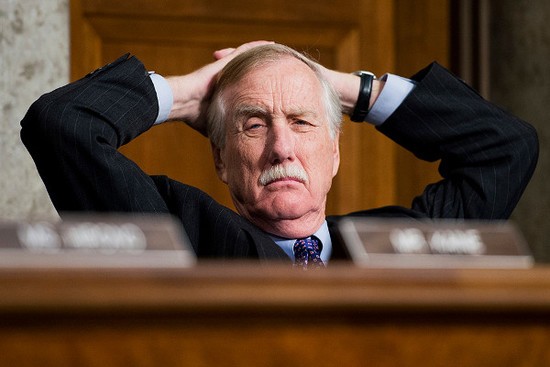
CHEERS to the Maine event. There’s a new poll out on our U.S. Senate race here (mission: replace Olympia Snowe), and it shows extremely soft support for the Republican and the Democratic candidates. Instead, Independent candidate (and former Governor) Angus King is leading the pack with 56 percent of the vote in a three-way matchup. There will, of course, be much vetting of King at the national and state level in the months ahead, including the crucial question of whether he’ll caucus with our side or the other side. Let’s see: he believes climate change is real, was an early cheerleader for GLBT rights, introduced computers to classrooms to enhance educational opportunities, is pro-choice and knows President Obama is an American citizen. Tough call. [4/6/22 Update: Angus, aka “The Mustache of Independence,” handily won his election and is currently in the middle of his second term as a beacon of common sense in the Senate. Our only regret up here: that he didn’t replace Susan Collins instead.]
–
And just one more…
CHEERS to 30 days of tummy growlies. The Islamic holy month of Ramadan started over the weekend (our immigrant neighbors had a big pre-Ramadan bash Saturday—a good time was had by all), and we’d like to give a C&J shoutout to all of our Muslim readers around the world.
According to the mighty Wikipedia, “This annual observance is regarded as one of the Five Pillars of Islam. The month lasts 29–30 days based on the visual sightings of the crescent moon, according to numerous biographical accounts compiled in the hadiths.” It’s also a month of dawn-to-dusk fasting, which is why I’m an Episcopalian—our holidays are marked by dawn-to-dusk pancake suppers with real Maine maple syrup by the gallon. To mark the occasion on behalf of the nation, the Democratic President of the United States wished those who celebrate Ramadan a—spoiler alert—Happy Ramadan!
The Biden-Harris Administration wishes our Muslim communities a blessed and prosperous month of Ramadan. pic.twitter.com/7RiBxc8mQO
His Republican predecessor, who did not do that even once, will be surprised when he finds out his afterlife consists of 72 virgins beating him for eternity with bottles of spray-on tan.
Have a happy humpday. Floor’s open…What are you cheering and jeering about today?
–
Today’s Shameless C&J Testimonial
When many people think of Cheers and Jeers, the taste of Pineapple Kiddie Pool Whip, a soft-serve ice cream comes to mind.