
Independent News
A concerning number of young voters believe trans folks want special treatment, not equal rights
This post was originally published on this site
In an ideal world, we don’t have to poll on human rights issues. We don’t have to fight for basic rights and dignities and we don’t have to worry about elected officials (and election hopefuls) turning diversity into a rallying cry for hate. But as conservatives continue to show, nothing is off-limits when it comes to keeping their voter base enraged, as long as they’re getting to the polls.
Should it matter how the public feels about trans folks receiving gender-affirming health care? On the one hand, it shouldn’t. On the other hand, it clearly does. Or it matters insofar as we need to educate and mobilize voters to get on the right side of history to prevent the party of hate from legislating an already marginalized population out of existence. It’s with this framing in mind that we can dig into some recent public opinion data from Civiqs about some of the most pressing trans rights issues in the United States today.
I won’t sugarcoat this: When it comes to Republican respondents, the numbers are bleak. The disparity between Democrats and Republicans is considerable and, obviously, concerning. But we have to both try to change the minds of conservatives and mobilize progressives to hit the polls every chance we can. Now, let’s look at some specifics on health care, sports, and books.
RELATED: Republicans in this state once again ensure it’s legal to fire LGBT teachers because of who they are
As some background on the polling, this survey was conducted by Daily Kos/Civiqs and included 1,248 registered voters in the United States. It was conducted online from April 23 to April 26, 2022. Results are weighted by factors including region, age, race, gender, political party identification, and education to be representative of the population of registered voters in the U.s. The survey has a margin of error of ± 2.8% at a confidence level of 95%.
While the survey results cover a number of exciting and relevant topics, including Joe Biden’s approval rating, student debt forgiveness, book bans, and Biden’s campaign promises, there are several important questions regarding trans rights specifically.
Let’s start with the foundational: Are issues involving transgender rights important to you? Just over one-quarter of respondents said trans issues are very important to them, while another quarter said they’re “somewhat” important, nearly one-third said they’re not important at all, and 2% said they’re unsure.
Forty-three percent of respondents believe that trans folks face discrimination, harassment, and attacks on their rights in the U.S. today, while a concerning 41% believe trans folks already have equal rights and want “special” treatment. About 13% of respondents said neither statement matches their perception, and about 3% said they are unsure.
In terms of gender-affirming health care, responses are pretty divided. About 35% of respondents believe this anti-trans legislation is actually helping trans youth (it isn’t) while about 48% believe it is hurting them. Just under 10% of respondents feel it’s neither helping nor hurting (which is strange, but I digress), and about 8% of respondents are unsure.
Lastly, we have to talk about trans folks and sports. This is one of the subjects that gets the biggest emotional reactions in general (as well as here on Daily Kos) and the numbers here seem to mirror that range of feelings. The survey asked if legislation being pushed around the nation barring trans youth from participating on teams that align with their gender identity is helping or hurting.
Forty-five percent of respondents said the legislation is helping, 36% said it’s hurting, 9% said neither, and 8% said they’re unsure. The question doesn’t ask if the legislation is helping trans youth versus helping cisgender youth, so the results here are additionally nuanced in that it’s difficult to parse out where people are coming from in their rationale: Are they prioritizing the feelings of cisgender people, or only responding as a means of punishing trans youth? On the one hand it doesn’t matter, but on the other, it can be useful to understand these dimensions when it comes to messaging and advocacy.
It is useful to look at these responses as broken down by political party. For example, just 5% of Republicans believe trans people face discrimination. I’m willing to bet nearly everyone here at Daily Kos is going to find that number as disturbingly (and unrealistically) low as I do, and yet there it is. On the other hand, more than 80% of Democrats believe trans people face discrimination. Less than 15% of Republican respondents believe legislation banning gender-affirming health care hurts trans youth. Meanwhile, more than 80% of Democrats recognize these efforts as harmful.
As some other additional findings, women and people living in urban areas were more likely to say trans issues are very important to them. Men and people in rural areas were more likely to believe trans folks want special treatment. A concerning number of young voters believe trans folks want special treatment, with 39% of voters between 18 and 34 saying so.
More than three-quarters of respondents who frequently watch Fox News believe trans folks want special treatments, whereas just 7% of folks who watch MSNBC frequently believe the same.
Sixty-six percent of Republicans believe anti-trans legislation barring youth from accessing gender-affirming health care is helping, whereas just 7% of Democrats feel that way. Similarly, more than 80% of Republicans believe anti-trans sports legislation is helping whereas just 10% of Democrats think so.
You can check out a more in-depth write-up of this data from my colleague, Carolyn Fiddler.
Ukraine update: Ukraine's well-calculated strikes inside Russia have multiple effects
This post was originally published on this site
On Sunday, a pair of fuel deports in Bryansk, Russia, roughly 100 miles from the border with Ukraine, exploded into flames. As with the fuel depot that “mysteriously” burned in Belgorod, Russia, back on March 31 (after two Ukrainian helicopters were seen zipping past in a daring treetop-level raid), Ukrainian officials are being cagey about the cause of the explosions at Bryansk. But there seems almost no doubt that the fires were started by a carefully targeted Ukrainian assault that avoided hitting civilian targets and went straight for vital military supplies.
Speaking of Belgorod, there was another explosion in Belgorod oblast early on Wednesday morning. In this case, an ammunition storage area in the village of Staraya Nelidovka, barely 10 miles from the Ukrainian border, went up in a series of spectacular explosions.
Belgorod wasn’t the only ammunition storage facility to blow sky high in the last 24 hours. Another mystery fire broke out at a smaller ammunition storage facility in the Russian-occupied area of Luhansk. This time, it was near the town of Pervomaisk. Except this was no mystery at all, since this was close enough that it may have been shelled from Ukrainian forces still struggling to hold the town of Popasna just a handful of miles to the west.
The amount and nature of ammunition lost at Pervomaisk and Staraya Nelidovka is hard to estimate, and it’s not clear that it will have a great impact on Russia’s efforts in the war, except that both these attacks should indicate to Russia that their ammunition storage facilities are vulnerable. That might generate a tendency not to stockpile as much material in a single location. Considering the difficulties that Russia is already having with logistics, making them sweat the placement of materials has some value on its own.
When it comes to the destruction of the fuel supplies at Bryansk, those 1,500 tons represent about 430,000 gallons, or roughly 170,000 miles of travel for T-72 tanks. The earlier strike at the fuel depot in Belgorod generated rationing of fuel across a wide area.
But it’s not just the diesel that’s going missing—it’s the ability to store large amounts of diesel close to the area of combat. The missing tanks at Belgorod and Bryansk may not put any real cap on the fuel available to Russian forces; however, they could definitely mean that fuel tankers hauling supplies to those forces have a much more lengthy round trip. As with the strikes on ammo depots, that’s a direct attack on Russia’s fragile ability to juggle logistics.
One other thing that might shake Russia up just a bit: Bryansk is almost exactly halfway between Kyiv and Moscow.
The Secretary General of the United Nations has arrived in Ukraine.
Transnistria is under the equivalent of martial law following an (odd, and possibly staged) attack on government buildings Tiraspol that took place on Monday.
Elon Musk's Twitter deal offers so many strong arguments for taxing billionaires
This post was originally published on this site
Twitter announced its sale to Elon Musk on Monday, and there’s been at least a week’s worth of drama since. Large numbers of existing users left Twitter, while right-wing accounts gained followers as their supporters apparently joined the site. Tesla’s stock dropped by more than $100 billion—kind of a problem for Musk since he put up Tesla shares as collateral for his Twitter purchase.
The specifics of the deal became public on Tuesday, including a $1 billion termination fee if either party pulls out. If the deal doesn’t close by Oct. 24, both sides can walk away, or, if there’s a regulatory delay, they can extend for six months. But while “It’s actually a pretty plain vanilla merger agreement,” according to an expert quoted in The New York Times, the drama surrounding it is decidedly not vanilla.
RELATED STORY: Twitter announces sale to Elon Musk as his recent tweets show what a bad idea that is
Even without the drop in Tesla’s stock, there was some reason for concern about the financial details of the purchase:
It makes you wonder how Musk plans to make this work. Does he think he’s just getting a $44 billion toy, a piece of conspicuous consumption even more impressive than owning a really big yacht? Or does he have a plan to wring more money out of the platform than its current or past executives have been able to do?
However he plans to make it work on a financial level, Musk is throwing up red flags about how it will work for users and current Twitter employees. On Tuesday, Musk targeted two Twitter executives in his own tweets, in both cases piggybacking on attacks on the executives by right-wing media figures seeking Musk’s attention. As a result of Musk’s criticism of Vijaya Gadde, one of Twitter’s top lawyers in charge of trust and safety and legal and public policy, Gadde’s mentions filled with abuse, including overt racism. Musk also responded to a tweet by Pizzagate conspiracy theorist Mike Cernovich, saying “Sounds pretty bad” in response to Cernovich’s attack on a different Twitter executive.
It didn’t take Musk long to bolster concerns that he would run Twitter in service to the far right, in other words, and enable abuses.
But we already knew that. Popular Info’s Judd Legum has detailed how Musk’s commitment to free speech is situational and self-serving, including Musk’s attacks on journalists who’ve criticized Tesla, Musk’s threats to Tesla workers who’ve discussed unionizing, and Tesla’s ask to the Chinese government to censor criticism of its products. Musk’s idea of free speech is all about punching down and dogpiling, but stops abruptly when his own interests are involved.
About the China thing, too: Another billionaire with too much power weighed in with a concern about Musk’s purchase of Twitter:
No one really knows what the worst-case scenario for an Elon Musk-owned Twitter looks like. But the best-case scenario here may just be that he wreaks havoc with poorly thought-out tweets and ones outright encouraging abuse, then loses interest before the sale ever becomes final. Whatever happens, it’s guaranteed to be a continuing advertisement for taxing the rich a helluva lot more.
RELATED STORIES:
Man who climbed up government-funded ladder endorses burning ladder now that he’s safely at the top
Don’t buy a Tesla unless you’re okay with Black workers being brutalized by racist managers
21 millionaires in Congress have helped 25 billionaires pay almost nothing in taxes
Before the week is out, Jan. 6 committee may have another 'invitation' for Kevin McCarthy
This post was originally published on this site
The Jan. 6 committee is not done with Kevin McCarthy.
The leader of Republicans in the House of Representatives and longtime ally to former President Donald Trump will soon find himself on the receiving end of another request to appear before the panel investigating the attack on the U.S. Capitol.
McCarthy was never formally subpoenaed by the committee, but investigators asked that he cooperate voluntarily this January. His refusal to come forward has simmered as options have been explored by the committee behind the scenes on how to go about navigating the legal thicket that is demanding another member of Congress testify under subpoena.
“We’ve invited him to come earlier before the latest revelation that was reported on tapes. So in all probability, he will be issued another invitation to come just like some other members,” Jan. 6 committee Chairman Bennie Thompson told reporters Tuesday.
That decision will be made “soon,” Thompson added.
RELATED STORY: The Jan. 6 committee wants you, Kevin McCarthy
Audio recordings of McCarthy obtained by The New York Times over this week have exposed the Republican as a leader on edge, fearful, and prepared to call on Trump to resign after Jan. 6 because he believed the president had some responsibility for the attack. McCarthy has denied making the comments.
But in a phone call four days after the insurrection, McCarthy is reportedly heard openly worrying to GOP leadership about the inflammatory remarks pouring out from fellow lawmakers like Reps. Mo Brooks of Alabama and Matt Gaetz of Florida—among others—who supported Trump’s push to overturn the election.
Brooks took the stage at the Ellipse on Jan. 6 and called on the president’s supporters to “fight like hell” before they descended on the Capitol. Gaetz used the aftermath of the attack to lash out at fellow Republicans critical of Trump, including Liz Cheney, who is now the Jan. 6 committee vice chair.
“The other thing I want to bring up and I’m making some phone calls to some members, I just got something sent now about … Matt Gaetz where he’s calling peoples names out … this is serious stuff people are doing that has to stop,” McCarthy said.
“I’m calling Gaetz, I’m explaining to him, I don’t know necessarily what to say but I’m going to have some other people call him too … This is serious shit, to cut this out,” McCarthy said.
When Rep. Steve Scalise of Louisiana pointed out to McCarthy that Gaetz’s remarks bordered on illegality, the House leader acknowledged again the severity of the situation.
“Well, he’s putting people in jeopardy, he doesn’t need to be doing this. we saw what people would do in the Capitol and these people came prepared well with everything else,” McCarthy said.
Gaetz has retreated from McCarthy since the recordings were published. In a statement posted on Twitter, the congressman—who is currently under investigation by the Department of Justice—defended his comments and called McCarthy and Scalise “weak men.”
Gaetz said he was “protecting President Trump from impeachment” while the House GOP leader was defending Rep. Adam Kinzinger and “protecting Liz Cheney from criticism.”
Gaetz has not yet been asked to appear before the Jan. 6 committee thus far—at least not publicly. A spokesman for the committee did not immediately return a request for comment Wednesday. Gaetz also did not immediately return a request for comment to Daily Kos.
Besides McCarthy, the committee has previously issued requests for records and deposition to Reps. Jim Jordan of Ohio and Scott Perry of Pennsylvania. Both Republicans have refused to appear voluntarily.
Details about Jordan and Perry’s conduct in the runup to Jan. 6 have been made more transparent with the recent publication of text messages sent to Trump’s chief of staff at the time, Mark Meadows.
More than a month after the 2020 election, Perry texted Meadows frantically in search of guidance as the administration sought a path to overturn the election results.
“Mark, just checking in as time continues to count down. 11 days to 1/6 and 25 days to inauguration. We gotta get going!” Perry wrote on Dec. 26.
Perry wasn’t just looking for guidance, however—he was also offering some of his own.
It was Perry who spurred Meadows to meet with Jeffrey Clark, an assistant attorney general at the Department of Justice on board with Trump’s claims of rampant election fraud.
According to the testimony that former Acting Attorney General Jeffrey Rosen provided to the Senate Judiciary Committee last year, Trump not only pushed the Department of Justice to discredit the election results, but it was Clark who led a charge to have him ousted so the scheme could be better controlled.
Clark pleaded the Fifth Amendment over 100 times when he finally sat with members of the committee in February following weeks of delays.
The texts show Perrry also spewed conspiracy theories to Meadows about rigged voting machines and accused the CIA of a cover-up.
As for Jordan, White House call logs show the Ohio Republican spoke with Trump for roughly 10 minutes on Jan. 6. A text message obtained by the committee and made public in December also appeared to show Jordan sharing legal arguments in support of an unconstitutional pressure campaign leveled at then-Vice President Mike Pence to stop the count.
Jordan said the text was a forward from former Pentagon Inspector General Joseph Schmitz, but it is not clear whether the text was in fact a forward or why it was sent at all, based on what the committee released.
Jordan has been notoriously inconsistent when fielding questions about his engagement with Trump on Jan. 6.
Both he and Perry voted against the formation of the select committee investigating the attempted overthrow. Both now sit on a shadow committee purporting to analyze the events of Jan. 6.
RELATED STORY: White House Jan. 6 call log confirms what Jim Jordan couldn’t—or wouldn’t
When Thompson told reporters Tuesday that another invitation was due soon for McCarthy, the Mississippi Democrat also did not rule out issuing “invites” to other members of Congress.
“We’ll make a decision on any others before the week is out,” Thompson told The Hill.
When asked if he would skip the second invite for McCarthy and move straight to a subpoena, Thompson said it was “a consideration.”
According to the Times, in the Jan. 10 GOP leadership call where McCarthy lamented the remarks from Gaetz and Brooks, Cheney was on the line too and raised concerns about Rep. Lauren Boebert of Colorado publicly tweeting about the movement of lawmakers as they were under siege.
In other clips, McCarthy is heard asking about whether Rep. Marjorie Taylor Greene of Georgia was involved in any remarks at the Ellipse on Jan. 6. She did not speak at the rally that morning but had spent weeks advocating for Trump and promoting the lie that the election was stolen by Democrats.
McCarthy is gunning to become speaker of the House should Republicans take the majority. It has been a long-awaited goal for the legislator and may explain the increasingly light touch he has employed with some of the most extreme members in the House and in particular those on the uber conservative House Freedom Caucus.
When Rep. Paul Gosar was censured and removed from his committees for posting an animated video depicting the murder of Rep. Alexandria Ocasio-Cortez, McCarthy called it an “abuse of power” inflicted by “one-party rule.”
A month after the insurrection, when Greene posted a sign outside of her Capitol Hill office targeting a fellow lawmaker who is the parent of a transgender child, McCarthy was quiet.
A few months later in May 2021, when Greene was reportedly stalking Ocasio-Cortez through the halls of Congress and harassing her, McCarthy was quiet.
When Greene spewed conspiracy theories on social media about everything from “staged” school shootings to questioning whether a plane actually hit the Pentagon on Sept. 11, 2001 to antisemitic rhetoric, she was booted off her committee assignments.
McCarthy said he was opposed to Greene’s remarks but said in the same breath that her ouster was a Democrat “power grab” and called it “dangerous.”
When both Gosar and Greene attended a conference organized by white nationalists this February, McCarthy said he spoke to both lawmakers but wouldn’t divulge what, if any, the repercussions might be.
According to CNN, during a House GOP conference meeting Wednesday morning, McCarthy said his remarks on the calls were merely him “floating scenarios about Trump’s future after Jan. 6.”
He reportedly received a standing ovation.
McCarthy did not respond to multiple requests for comment by Daily Kos.
From 'critical race theory' to 'grooming,' the real Republican agenda is ending public education
This post was originally published on this site
There’s a common thread in some of the biggest battles of the Republican culture war over the past year and change—beyond the bigotry and dishonesty that is their bedrock. The specific common thread is Christopher Rufo. From critical race theory (CRT) to grooming, math textbooks to Disney, Rufo is on Fox News so often he has his own in-home studio, issuing the talking points of the moment. And all of his talking points are aimed at promoting a vision of the United States based on the cultural politics of the 1950s combined with the rampant privatization and lower taxes on corporations and the wealthy of the 2020s. Rufo wants the racism and gender norms of the 1950s, minus the public schools and government revenue.
Rufo hit big in 2021 with his promotion of a false version of critical race theory as a danger to white children everywhere. Like a Bond villain, he even explained what he was doing as he was doing it. “We have successfully frozen their brand—‘critical race theory’—into the public conversation and are steadily driving up negative perceptions. We will eventually turn it toxic, as we put all of the various cultural insanities under that brand category,” Rufo tweeted in March 2021. “The goal is to have the public read something crazy in the newspaper and immediately think ‘critical race theory.’ We have decodified the term and will recodify it to annex the entire range of cultural constructions that are unpopular with Americans.”
And yet, despite laying out his strategy right there in plain sight, he got many in the traditional media to bite, covering the critical race theory panic that Rufo created as if it were an organic grassroots phenomenon. Now he’s back, leading the charge against Disney and propelling “grooming” as an accusation to be used in a broader attempt to drive LGBTQ people out of public life. That work earned him a puff piece in The New York Times over the weekend, and a spot on the stage as Florida Gov. Ron DeSantis signed the “Stop WOKE Act.”
RELATED STORY: A look inside banned Florida math textbooks suggests Republicans simply lied about what’s in them
After weeks of bashing Disney for “grooming” and highlighting mug shots of past Disney employees who have been charged with child sexual abuse unconnected to their employment at Disney, Rufo told the Times, “It’s wrong, factually and morally, to accuse someone of being a groomer with no basis and evidence.” About that:
But as Moynihan, a political scientist at Georgetown University, wrote at his Substack, it goes deeper. In Rufo’s usage, “this language is largely not about sexual abuse of children. Rufo is much more likely to describe ‘grooming’ in the context of kids being exposed to ideas he dislikes rather than actual sexual abuse. In other words, sharing certain political beliefs — usually centered around recognizing the status of historically marginalized groups — are treated as interchangeable with child abuse, its perpetrators akin to child abusers.”
“The reservoir of sentiment on the sexuality issue is deeper and more explosive than the sentiment on the race issues,” Rufo told the Times. In translation: He thinks he can ride anti-LGBTQ bigotry even further than racism.
Rufo’s overall message that institutions from Disney to the public schools are grooming children by exposing them to ideas he doesn’t like was a major factor in his participation in the banning of math textbooks in Florida because they supposedly contained CRT and other “prohibited topics or unsolicited strategies.” In Times coverage of that episode, Rufo explained his opposition to social-emotional learning, saying, “in practice, SEL serves as a delivery mechanism for radical pedagogies such as critical race theory and gender deconstructionism.”
”The intention of SEL,” according to Rufo, “is to soften children at an emotional level, reinterpret their normative behavior as an expression of ‘repression,’ ‘whiteness,’ or ‘internalized racism,’ and then rewire their behavior according to the dictates of left-wing ideology.”
Don’t teach our kids to be kind. It might make them less racist.
Rufo is part of a broader Republican movement to end public education, something he’s strategically laying the groundwork for with each new campaign he wages. CRT, grooming, social-emotional learning—all of these are buzzwords intended to weaken support for public education. Disney came into it because of the company’s opposition to the Florida Don’t Say Gay law banning the teaching of anything that might imply to children that LGBTQ people are acceptable members of their communities.
Rufo laid out his approach in an April speech at Hillsdale College, titled “Laying Siege to the Institutions.” In it, he called for a “narrative and symbolic war against companies like Disney” in which “You have to be very aggressive. You have to fight on terms that you define.” On schools, he was explicit: “To get to universal school choice, you really need to operate from a premise of universal public school distrust.”
(When American Federation of Teachers President Randi Weingarten slightly mistranscribed some of this, Rufo threatened legal action, so apparently he’s kind of sensitive here.)
Rufo is far from the only prominent conservative openly trying to dismantle public education. There’s Betsy DeVos, of course, the Trump education secretary whose only experience related to education was years of funding efforts to privatize it. Then there’s this:
Make no mistake: Republicans are coming for public education, in many cases looking for the government to provide vouchers that can go to unregulated religious and private schools. What they definitely don’t want is empowered teachers who can speak up for their students—all of them, not just the straight white Christian ones—and teaching that encompasses the racial history of the U.S., exposure to a wide range of experience, and basic social skills alongside of 2+2=4.
RELATED STORIES:
Citing ‘humiliated’ white people, Mississippi governor signs anti-critical race theory law
Forget CRT—new poll shows what Republicans really don’t want taught in schools
Architect of ‘critical race theory’ panic previews the next wave of attacks on public education
Republican governor signs cruel ‘Don’t Say Gay’ bill into law and sets a dangerous precedent
At least three big banks to continue fossil fuel financing as shareholders fight for net-zero goals
This post was originally published on this site
It’s annual shareholders meeting season for banks, many of which face questions over fossil fuel financing. Three big banks—Citigroup, Wells Fargo, and Bank of America—held their meetings on Tuesday and each bank had shareholders vote on climate finance resolutions proposed by groups like the Sierra Club and Harrington Investments. None of the measures passed, though the votes of 12.8% for Citi, 11% for Wells Fargo, and 11% for Bank of America show that shareholders have a vested interest in fighting climate change. Because each proposal crossed the 5% threshold of approval, all three can be refiled next year. “Today’s votes put the question of fossil fuel expansion firmly and irrevocably on the table for three of the world’s top four fossil banks,” Jason Opeña Disterhoft, senior climate and energy campaigner at Rainforest Action Network, said in a statement.
“A critical mass of investors affirmed that business-as-usual expansion of fossil fuels is incompatible with a 1.5 degrees C world and threatens their portfolios overall,” Disterhoft continued. “Ending fossil expansion is a matter of when, not if: Citi, Wells Fargo and Bank of America must recognize this direction of travel and make ending fossil expansion a precondition for financing for all clients.” Statements from other activists and advocates echoed that hopeful sentiment, yet publications like Politico chose to frame the vote as a question of “woke capitalism,” as if earnestly fighting climate change is some type of passing trend. Bloomberg seemed to at least get to the heart of the problem, quoting Citigroup CEO Jane Fraser cautioning against pulling support of fossil fuel companies. “It’s not feasible for the global economy or for human health or livelihoods to shut down the fossil-fuel economy overnight,” Fraser said. “The transition needs to be accelerated, but it also needs to be managed to minimize the shock to our economy and our communities.”
Advocates for substantial change in the banking industry are begging and pleading with banks to do the right thing, but it’s shareholders who have the ability to counteract the Frasers of the sector. And there are indeed some major players who want banks to adopt the right kinds of policies, such as these proposals, which would’ve forced the likes of Citi, Wells Fargo, and Bank of America to take “available actions to help ensure that its financing does not contribute to new fossil fuel supplies that would be inconsistent with the IEA’sNet Zero Emissions by 2050 Scenario.” A group of 32 philanthropists whose asset managers hold stakes in major banks signed a letter in support of the proposals, including John Hunting, Basso Capital Management founder Howard Fischer, and president of the Sagner Family Foundation, Deborah Sagner.
Given the way these initial votes shook out, those same philanthropists are bound to react to their wishes being ignored by the likes of BlackRock, Fidelity, and others. Banks that have yet to hold their annual shareholder meetings include Goldman Sachs, JPMorgan Chase, and Morgan Stanley. The companies face similar pressure to adopt policies that prioritize climate change as well as proposals benefitting marginalized customers like the ones proposed at Citi and Wells Fargo urging the companies to internationally recognize Indigenous communities’ right to Free, Prior, and Informed Consent (FPIC). FPIC policies could potentially prevent banks from sinking money into projects that actively harm Indigenous communities, like Enbridge’s Line 3 pipeline, which was financed by Citi, Wells Fargo, and Bank of America, along with numerous other financial institutions.
Kevin McCarthy is in large trouble with his fellow Republicans after more recordings released
This post was originally published on this site
The Kevin McCarthy tapes just keep coming, and the latest round have the far-far-right annoyed at not just McCarthy and Rep. Liz Cheney but other members of Republican leadership as well. All because in the days after the Jan. 6 attack on the U.S. Capitol, McCarthy and other Republican leaders were a little bit honest, in private, about what had happened and the role of some Republican House members in inciting an insurrection.
New recordings released by The New York Times have McCarthy saying, of comments by Rep. Matt Gaetz about Cheney: “He’s putting people in jeopardy. And he doesn’t need to be doing this. We saw what people would do in the Capitol, you know, and these people came prepared with rope, with everything else.”
RELATED STORY: Awkward recording of Kevin McCarthy emerges hours after his denial. What else do reporters have?
“It’s potentially illegal what he’s doing,” Rep. Steve Scalise, the second-ranking House Republican, said of Gaetz.
In response to their comments about him, Gaetz released a statement saying that McCarthy and Scalise “held views about President Trump and me that they shared on sniveling calls with Liz Cheney, not us. This is the behavior of weak men, not leaders.”
Gaetz … has a point? McCarthy is sniveling and weak and not a leader—but his failure to lead comes in his failure to follow through on his comments in these recordings from January 2021. The collapse of any interest he had in penalizing people like Trump and Gaetz and Brooks for their actions. One interesting question is whether McCarthy did call Gaetz in January 2021 to tell him to “cut this shit out,” as he indicated in that recording he planned to do. But don’t look for McCarthy to rebut Gaetz by proving that he did call him to say that.
House Republican leaders also discussed Rep. Mo Brooks’ rally speech on Jan. 6, in which he said it was “the day American patriots start taking down names and kicking ass.”
”You think the president deserves to be impeached for his comments?” McCarthy responded to that line. “That’s almost something that goes further than what the president said.”
In response to hearing about deleted tweets by Rep. Barry Moore of Alabama—including one saying, “it was a Black police officer who shot the white female veteran”—McCarthy muttered, “Can’t they take their Twitter accounts away, too?”
These and other comments in the recordings have McCarthy and other Republican leaders under fire from more than just Gaetz. Tucker Carlson is big mad. McCarthy “sounds like an MSNBC contributor,” Carlson said, warning that “unless conservatives get their act together right away, Kevin McCarthy or one of his highly liberal allies like Elise Stefanik is very likely to be speaker of the House in January. That would mean we will have a Republican Congress led by a puppet of the Democratic Party.”
Stefanik, mind you, replaced Cheney in Republican leadership because she managed to meet the Trump loyalty test. Apparently that’s no longer good enough.
“Heck, yeah,” he was concerned about McCarthy wanting Republicans kicked off Twitter, Rep. Andy Biggs told CNN. Taking away Twitter accounts is “not something I’m for,” said Rep. Scott Perry, head of the House Freedom Caucus.
The Republican Party is in disarray, but with the extremists and inciters of insurrection poised to come out on top, and McCarthy scrambling to appease them in any way he can, that’s not as much fun as it usually is. These recordings put into stark relief the utter collapse of any significant opposition by Republican leaders to a violent attempt to overturn an election. Less than 18 months after McCarthy was hoping for some of his members of be kicked off Twitter and claiming he was going to tell Gaetz to “cut this shit out” and urge Trump to resign, he has become entirely committed to sucking up to the far right to bolster his hopes of becoming speaker. Those hopes may have taken a hit, but that doesn’t mean anything good for the Republican Party’s support for democracy.
RELATED STORIES:
Trump’s Big Lie rules Republicans, and the traditional media is letting them get away with it
Dear reporters: Please don’t parrot back whatever noted liar Kevin McCarthy says at the border today
Tennessee Republicans already forced hate into law, but they aren't slowing down
This post was originally published on this site
On Monday, April 25, two discriminatory bills passed through legislative chambers in Tennessee. The first bill, House Bill 2633/Senate Bill 277, seeks to give permission to public school teachers (and other school employees) to ignore the correct pronouns of students. In essence, this is giving legal permission to teachers to misgender students who are routinely marginalized in general and already report higher rates of harassment and bullying in school.
The second bill is Senate Bill 2153, which aims to stop trans girls from participating in the sports teams that align with their gender identity at the college level, as reported by local outlet WREG. This bill also adds a cause for athletes to sue if a trans athlete wins a competition.
As is the case with all of these Republican pieces of legislation, conservatives say it’s about fairness in sports and protecting girls and women, but really it’s about signing discrimination into law.
RELATED: Republicans in this state once again ensure it’s legal to fire LGBT teachers because of who they are
House Bill 2633 also protects school employees from any adverse employment actions and civil liabilities if they refuse to use a student’s correct pronouns. As Daily Kos has stressed in the past, pronouns are not optional. Pronouns are not suggestions. Getting someone’s pronouns right is as important, respectful, and frankly, reasonable, as getting someone’s name right. Yes, you might make a mistake. No, that doesn’t make you a monster. But the correct course of action is simply to apologize and make a dedicated effort to get it right next time. Again, it’s about dignity and respect.
Listen and subscribe to Daily Kos Elections’ The Downballot podcast with David Nir and David Beard
Speaking on the house floor Monday, Democratic state Rep. Bob Freeman spoke against the bill while on the House floor on Monday, telling conservative colleagues that if “your religion teaches you to hate kids, I think you need to find a new religion,” according to local outlet FOX 17.
Unfortunately, the bill ultimately passed in the House with a vote of 67 to 25. The bill advanced in the Senate committee on Tuesday.
Now, in terms of the sports issue, you might recall that Republican Gov. Bill Lee actually already signed a piece of anti-trans sports legislation into law. Back in 2021, Lee signed a measure requiring student-athletes to prove their gender identity matched their sex as assigned at birth by using their original birth certificate. (If that birth certificate was unavailable, parents are apparently supposed to bring other forms of proof of the student’s sex as assigned at birth.)
That law is set to go into effect as of July 1, 2022, though it is currently facing a lawsuit.
As of now, lawmakers in Tennessee are pushing legislation to bar trans athletes from participating in girls’ sports at the collegiate level. And that bill is headed to Lee’s desk, where, based on recent history, it’s highly likely it’ll be signed into law as well. Shameful.
If you’d like to learn more about trans rights and advocacy from several experts, please feel free to check out our recent panel. You can also watch the video below.
Ukraine update: What are combined arms, and why are they so hard?
This post was originally published on this site
You’ll hear “combined arms” thrown around a lot by war analysts. It’s the ability to combine infantry, armor, artillery, aviation, engineering, and support units to successfully prosecute a war. You’ll see people like me laugh at Russians for throwing unsupported infantry in this attack, then unsupported armor in that other attack. So in a way, this is easy to explain. But really, no one has done a better job of really driving home the explanation than this guy, a British paratrooper, in this thread.
The thread continues, because we still have air defense, transport aircraft, combat engineers, medical, logistics, mechanics, and so on. Running an army is insanely complex, which is why we’ve long talked about my 15% rule: When looking at the size of the army, only 15% shoot stuff. The other 85% support the people who shoot stuff. This is what the officers’ tent looks like, as the commanders of all these components work together to devise their battle plans:
These disparate components are deadly on their own, but vulnerable. Get them to work together, and you have an effective fighting force. Russia can’t pull it off. Who the hell knows what their officers discuss in meetings like the one above. Ukraine really hasn’t needed combined arms thus far—playing defense is much easier than going on the offensive. Hopefully all that NATO training the last eight years has gotten them ready for the inevitable future counterattacks.
Let’s revisit this story, when 40 American special forces and Marines held off 500 mostly Russian and Syrian Wagner mercenaries somewhere in the Syrian desert. The Russian forces, including 27 armored vehicles and artillery, hit the American outpost at 10 PM with everything in one apparent frontal assault. After 15 minutes of trying to talk the assailants into retreating, the Americans unleashed.
First came waves of Reaper drones, F-22 stealth fighter jets, F-15E Strike Fighters, B-52 bombers, AC-130 gunships, and AH-64 Apache helicopters. The air component. Meanwhile, a 16-person reaction force in armored personnel carriers sped toward the outpost to reinforce the 24 Americans under assault. So 40, facing an enemy 500 strong.
A handful of Marines ran ammunition to machine guns and Javelin missile launchers scattered along the berms and wedged among the trucks. Some of the Green Berets and Marines took aim from exposed hatches. Others remained in their trucks, using a combination of thermal screens and joysticks to control and fire the heavy machine guns affixed on their roofs.
A few of the commandos, including Air Force combat controllers, worked the radios to direct the next fleet of bombers flying toward the battlefield. At least one Marine exposed himself to incoming fire as he used a missile guidance computer to find targets’ locations and pass them on to the commandos calling in the airstrikes.
When the dust settled, 200 to 300 Russians and Syrians lay dead. Not a single American was hurt. Not even one boo-boo! That’s what combined arms is. In this case, light armor, infantry, and air took care of the situation. Had artillery been nearby, they would’ve joined the action, likely shortening the battle significantly.
That’s what wins battles and wars, and Russia simply can’t pull it off. It’s hard, it’s complicated, it requires quality leadership and the resources to practice, evaluate, and practice again, But large training exercises are expensive, no one can grift off them, and a general might look bad if something goes wrong. Meanwhile, American soldiers drill this so extensively, coordinating during the extreme stress of combat was like muscle memory.
The best Russia can do is snatch men off the streets of Donbas, up to the age of 60, and throw them at Ukrainian positions in human waves. More of that in a future update.
Wednesday, Apr 27, 2022 · 1:16:02 PM +00:00
·
Mark Sumner
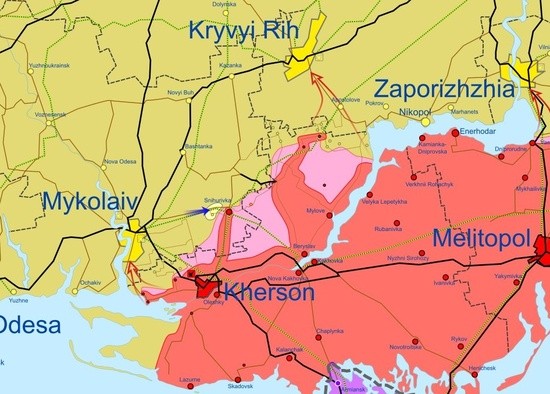
Multiple reports on Wednesday indicate that Russia appears to be serious about making a move toward Kryvyi Rih. Forces are reportedly being massed west of the Dnipro River to the north of Kherson, and villages in the area — some of them only recently retaken by Ukrainian forces — were shelled over the last day.
Notice that, just in this one small area of the war, Russia is also attempting to push toward Mykolaiv from the south, and toward Zaporizhzhia on the north. This is in addition to the multiple attempts to push from the east. Russia appears to be once again attempting to operate a at least a half dozen advances, all at once, and the one on Kryvyi Rih appears to have no good reason other than the fact that it’s Zelenskyy’s home town.
Wednesday, Apr 27, 2022 · 1:46:29 PM +00:00
·
Mark Sumner
Meanwhile, in the area of Izyum, Russia also seems to be launching multiple, narrow assaults.

Some of the difference between this map and yesterday represents genuine Russian gains west of Izyum. Some of it comes from failure to recognize changes that took place in the previous 24 hours. But Russia is currently engaged in an attempt to move west along the road that — assuming they could hold a couple of hundred miles more supply lines — would eventually reach Dnipro. They’re also moving southwest in a route that looks as its designed to cut off the entire oblast by running down to Donetsk. And they’re moving south in a direction that might allow them to surround Kramatorsk. And they’re continuing an attempt to break through the eastern lines at multiple points.
Some intelligence agencies are still reporting that Russia hasn’t launched their “big attack” in the east — but it seems easy to believe that this is it. Just as they’ve done from day one of this invasion, Russia has simply been unable to mass forces and coordinate behind anything that looks like a strong, unified push.
Morning Digest: Trump's man in Georgia keeps flogging election conspiracies as his campaign craters
This post was originally published on this site
The Daily Kos Elections Morning Digest is compiled by David Nir, Jeff Singer, Stephen Wolf, Daniel Donner, and Carolyn Fiddler, with additional contributions from David Jarman, Steve Singiser, James Lambert, David Beard, and Arjun Jaikumar.
Subscribe to our podcast, The Downballot!
Leading Off
● GA-Gov, GA-Sen, GA-SoS: A new survey from the University of Georgia for the Atlanta Journal-Constitution is the latest poll to find Gov. Brian Kemp cruising to renomination in the May 24 GOP primary, with Kemp holding a 53-27 lead over Big Lie proponent David Perdue and earning the majority needed to avoid a June primary runoff against the former senator. This latest survey is one of Kemp’s best results so far from any pollster and marks a significant improvement for him from UGA’s last poll taken in late March and early April, which found Kemp ahead 48-37. Still, every other recent poll here has also found Kemp with a sizable lead.
Perdue has failed to gain traction in the polls despite Donald Trump’s endorsement, but that hasn’t stopped his zealotry for spreading Trump’s 2020 election conspiracy theories from shaping the race. Perdue and his allies have run ad after ad spreading the Big Lie that Trump was cheated in 2020 and chastising Kemp for failing to help Trump steal the contest, and Perdue’s opening statement in Sunday’s debate reiterated his bogus accusation of election theft. Kemp, meanwhile, has focused his campaign message on reminding voters that Perdue’s re-election defeat makes him a proven loser and touting the governor’s record on bread and butter conservative issues such as immigration, crime, and taxes.
In the Senate primary, UGA’s poll does have unambiguously good news for the Trump-backed candidate: Former NFL star Herschel Walker has a 66-7 edge over his closest rival, state Agriculture Commissioner Gary Black, which is little different than his 64-8 lead in their previous poll.
Looking further downballot in the GOP primary for secretary of state, another of Trump’s endorsees running a campaign focused on 2020 election denial has found more success than in the governor’s race, but UGA’s latest poll finds it is no sure thing. Their survey shows incumbent Brad Raffensperger holding a 28-26 lead over Rep. Jody Hice, who has Trump’s backing, which marks an improvement for the incumbent from Hice’s 30-23 advantage in UGA’s prior poll. However, Hice has done significantly better in one of the few other credible polls here from GOP firm Landmark Communications, which had Raffensperger trailing by a wide 35-18 earlier this month.
Trump’s election lies almost certainly aren’t going anywhere as a campaign topic regardless of the outcome of the primaries for secretary of state. One of the leading Democratic contenders, state Rep. Bee Nguyen, has focused her initial ad on her support for protecting voting rights against Trump’s attacks and previews what the general election message may look like.
Senate
● AL-Sen: Alabama Patriots PAC, which is backing Army veteran Mike Durant in the May 24 GOP primary, has reported spending more than $3 million on his behalf thus far.
● FL-Sen: Former Donald Trump operative Roger Stone, whom Trump pardoned in December 2020 after he was convicted on several felony charges of obstructing Congress’ investigation into Russian interference in the 2016 election, said he isn’t ruling out a primary bid against GOP Sen. Marco Rubio over the latter’s vote against overturning the 2020 election outcome. Stone, however, hardly looks like a serious candidate: even he conceded that he wasn’t the ideal challenger and implored someone else to run. Stone had also mulled running for governor as an independent to stymie Republican Gov. Ron DeSantis before acknowledging he was barred from doing so by state law preventing recent party switchers from running for office.
● OH-Sen: Democratic firm Blueprint Polling has released a poll finding that the May 3 GOP primary is still up in the air with 33% undecided and no candidate topping 20%. The pollster, who did not disclose who, if anyone, was their client, shows state Sen. Matt Dolan with a slim 18-17 lead over venture capitalist J.D. Vance, while businessman Mike Gibbons earns 13%, former state Treasurer Josh Mandel takes 12%, and former state party chair Jane Timken wins just 7%.
This is the first survey from any outfit this cycle showing Dolan in first, but with all three other polls disclosed this month from reputable firms each finding three different leaders and many voters still undecided, it’s another sign of just how uncertain the outcome of next week’s vote is.
Governors
● MI-Gov: Republican Rep. Jack Bergman, whose 1st District covers the Upper Peninsula and northernmost portion of the Lower Peninsula, has switched his endorsement in the August GOP primary from former Detroit Police Chief James Craig to self-funding businessman Perry Johnson. In doing so, Bergman complained that Craig ignored “campaigning in Northern Michigan and the U.P. in favor of a self proclaimed Detroit-centric approach.”
● NE-Gov: The Republican firm Data Targeting has conducted a survey of the May 10 GOP primary for Neilan Strategy Group, which says it’s not working on behalf of any candidate or allied group, that shows state Sen. Brett Lindstrom taking a narrow lead for the first time in a very expensive and ugly race where he’d largely been overshadowed.
The firm shows Lindstrom edging out Trump-backed agribusinessman Charles Herbster 28-26, with University of Nebraska Regent Jim Pillen, who is termed-out Gov. Pete Ricketts’ endorsed candidate, just behind with 24%; former state Sen. Theresa Thibodeau lags far behind in fourth with 6%. Back in mid-February, the firm showed Herbster edging out Pillen 27-26, with Lindstrom taking third with 21%.
This new poll is the first we’ve seen conducted since the Nebraska Examiner published an April 14 story where Republican state Sen. Julie Slama and seven other women accused Herbster of groping and other forms of sexual assault; Herbster denied the allegations and soon went up with a commercial claiming “the establishment” was lying about him just like they supposedly did with Trump. Unsurprisingly, Trump himself has stuck behind his man, and he’s scheduled to hold a rally with him on Friday.
While no other polls have found Lindstrom in first place, there were previously signs that his detractors were treating him as a serious threat even though he lacked the money and big-named endorsements that Pillen and Herbster have available. (Lindstrom’s most prominent supporter is arguably Omaha Mayor Jean Stothert.) A group called Restore the Good Life began running ads against the state senator weeks ago that portrayed him as wrong on taxes, while another outfit called Say No to RINOs launched its own spots in mid-April saying, “Liberal Brett Lindstrom is no conservative, he just plays one on TV.”
But perhaps most tellingly, Conservative Nebraska, a super PAC funded in part by Ricketts, recently began running its own spots using similar arguments against Lindstrom after it previously focused on attacking Herbster only. The termed-out governor himself joined in the pile-on, characterizing Lindstrom as “a liberal (who) does not have a conservative voting record in the Legislature.” The state senator, for his part, said last week that he wouldn’t be running negative ads against Pillen and Hebster.
● PA-Gov: State Attorney General Josh Shapiro, who is unopposed in the May 17 Democratic primary, has laid out $950,000 of the $16 million his campaign recently had on hand to air his first two ads. The first commercial is a minute-long spot that devotes its first half to Shapiro’s biography, referencing his Pennsylvania roots, family values, and the importance of his Jewish faith, while the second part highlights his record of keeping taxes low when serving in local office and how he has “taken on powerful institutions” as attorney general.
The second spot expands on the latter theme, featuring a nurse praising Shapiro’s work going after predatory student loan companies like the one that she says tried to rip her off.
● WI-Gov: Wealthy businessman Tim Michels, who announced a sizable ad buy when he joined the GOP primary over the weekend, will spend $980,000 on his initial ads, though no copy of a spot is available yet.
House
● FL-04: Navy veteran Erick Aguilar this week became the first notable Republican to announce a bid for the new 4th District, a Jacksonville area constituency that would be open should incumbent John Rutherford run for the 5th as fellow Republicans expect. The new 4th would have supported Trump 53-46.
Aguilar himself had been waging a second primary bid against Rutherford, who beat him in an 80-20 landslide two years before, before redistricting changed things. But while Aguilar’s doomed first campaign brought in all of $16,000, his second try is a far better-funded affair: Aguilar raised $320,000 during the first quarter of 2022, and he ended March with a hefty $812,000 on hand thanks in part to earlier self-funding.
● FL-23: Republican state Rep. Chip LaMarca has announced that he won’t run to succeed retiring Democratic Rep. Ted Deutch in the new 23rd District, which contains most of Deutch’s existing 22nd District.
● IL-03: SEIU Local 1, which represents maintenance workers, has backed Chicago Alderman Gilbert Villegas in the June Democratic primary.
● IL-17: SEIU Illinois, which represents more than 170,000 public sector employees and workers in private service sectors statewide, has endorsed former state Rep. Litesa Wallace in the June Democratic primary, which has no clear frontrunner yet. Wallace faces a field that includes former TV meteorologist Eric Sorensen, Rockford Alderman Jonathan Logemann, and Rockford Alderwoman Linda McNeely.
● OH-11: Democratic Majority for Israel is airing its first negative spot of the year against former state Sen. Nina Turner ahead of her Democratic primary rematch next week against Rep. Shontel Brown. The narrator faults Turner for not supporting Hillary Clinton over Donald Trump in 2016 before declaring that the challenger “said voting for Biden was like eating ****.” (The screen flashes the words “EATING S**T.”) The super PAC, which recently began running positive commercials for Brown, has spent close to $600,000 so far.
● OR-06: In an effort to unravel why billionaire Sam Bankman-Fried’s super PAC, Protect Our Future, has spent more than $7 million so far boosting first-time candidate Carrick Flynn’s quest for the Democratic nomination in Oregon’s brand-new 6th Congressional District, OPB’s Dirk VanderHart dives deep into the possible ties between the two men.
Most notably, Flynn’s wife, Kathryn Mecrow-Flynn, worked at an organization called the Center for Effective Altruism in 2017—the same time that Bankman-Fried served as the group’s director of development. Flynn has maintained he “has never met or talked to Sam Bankman-Fried”—by law, super PACs are forbidden from coordinating with campaigns they’re seeking to boost—and in response to VanderHart’s reporting, he said of his wife, “If she’s met him she hasn’t said anything. I think she would have said something.”
VanderHart also points out that Bankman-Fried’s younger brother, Gabe Bankman-Fried, runs yet another super PAC called Guarding Against Pandemics that has likewise endorsed Flynn; it so happens that the president of Protect Our Future, Michael Sadowsky, also works for Guarding Against Pandemics. Gabe Bankman-Fried offered effusive praise for Flynn in remarks to VanderHart, though he insisted he “could not comment” on the interest shown in Flynn by his older sibling, who has not said anything about the candidate publicly.
● TX-28: Attorney Jessica Cisneros is focusing on abortion rights in her first spot for the May 24 Democratic primary runoff against conservative Rep. Henry Cuellar, a topic the Texas Tribune says she didn’t run many spots on during the first round. The narrator declares that Cuellar sided with Texas Republicans when they “passed the most extreme abortion ban in the country,” characterizing the incumbent as “the lone Democrat against a woman’s right to make her own decisions, even opposing life-saving care.”
Cuellar’s new ad, meanwhile, features people praising him for having “kept our businesses open during the pandemic and reduced taxes” and funding law enforcement and border security, language that’s usually more at home in GOP ads. The commercial then pivots to the left by commending him as a champion of healthcare and affordable college. One elderly woman goes on to make the case that he’s vital for the district, saying, “Henry helps us with prescriptions and Social Security benefits. If we lose him in Congress, we lose everything.”
Cuellar goes into the final weeks of the runoff with a cash-on-hand lead over Cisneros, but she’s managed to close much of what had been a massive gap. Cuellar ended March with a $1.4 million to $1 million edge, while he enjoyed a $2.3 million to $494,000 advantage three months before.
● TX-30: The cryptocurrency-aligned group Web3 Forward has reported a $250,000 ad buy ahead of the May 24 Democratic primary runoff to support state Rep. Jasmine Crockett, who came just shy of winning the nomination outright last month with a 48-17 lead over party operative Jane Hamilton. Web3 Forward may have more where that came from if the initial primary, where they and another crypto-oriented group had already spent over $2 million aiding Crockett, was any indication.
Attorneys General
● KS-AG: Former Secretary of State Kris Kobach has released a survey from WPA Intelligence arguing that he’s well-positioned to win the August Republican primary for attorney general and revive his career following his disastrous bids for governor and Senate. The firm shows Kobach taking 52% in the race to succeed Derek Schmidt, who is leaving to run for governor, with state Sen. Kellie Warren and former federal prosecutor Tony Mattivi far behind with 12% and 7%, respectively. The Democrats are fielding attorney Chris Mann, a former prosecutor who currently faces no serious intra-party opposition.
Mayors
● Los Angeles, CA Mayor: City Attorney Mike Feuer is spending about $1 million on an opening TV and digital buy for the June nonpartisan primary, which his strategist acknowledges to the Los Angeles Times is “pretty close” to all they have available. The spot features the candidate, who took just 2% in a recent UC Berkeley poll, walking a dachshund (who at one point rides a skateboard while leashed) through the city as a song proclaims him the “underdog.” Feuer tells the audience, “Even with the most experience, being outspent 30 to 1 could make the odds of becoming mayor … well, long. But L.A.’s a city of underdogs.”
Billionaire developer Rick Caruso, who had the airwaves to himself until now, has run numerous ads focused on crime without mentioning any of his rivals, but one of his most prominent allies will soon be going after his main competitor. The Los Angeles Police Protective League, which is the city’s well-funded police union, has so far given $500,000 to a new super PAC opposed to Democratic Rep. Karen Bass.
Prosecutors
● Maricopa County, AZ Attorney: Anni Foster, who is Gov. Doug Ducey’s general counsel, has dropped out of the August special Republican primary and endorsed Rachel Mitchell, who was appointed interim county attorney last week. The nomination contest still includes Gina Godbehere, who recently announced that she was stepping down as prosecutor for the City of Goodyear in order to concentrate on her campaign.
Ad Roundup
Dollar amounts reflect the reported size of ad buys and may be larger.
- CO-Sen: Joe O’Dea (R)
- GA-Sen: Gary Black (R) – anti-Herschel Walker (R), backed by $37,000
- GA-Sen: Latham Sadler (R) – anti-Walker (R)
- OH-Sen: Josh Mandel (R) – anti-J.D. Vance (R)
- AL-Gov: Kay Ivey (R-inc)
- IL-Gov: Darren Bailey (R)
- CO-08: Jan Kulmann (R), backed by $50,000