
Independent News
'Jackson is immensely qualified. What Romney is actually doing is just his job': A word to remember
This post was originally published on this site
In the days leading up to the historic confirmation vote making Judge Ketanji Brown Jackson the first Black woman to sit on the U.S. Supreme Court, there has been so much GOP criticism of the accomplished judge that a casual news observer might be persuaded to question her qualifications. The resounding response to that inclination from many Black women, both in the legal profession and watching from outside of courtroom doors, has been: Don’t. Not with Judge Jackson. Because despite Republican sentiment, this moment is not about them or their beliefs about critical race theory. This moment is about Black women, and one phenomenal one in particular.
Opinion writer Kimberly Atkins Stohr tweeted in response to a Washington Post analysis highlighting Sen. Mitt Romney’s historic flip from voting against Jackson’s nomination to an appeals court last year to announcing his intent to support her confirmation on Monday. “Here’s the problem with framing Romney’s vote as ‘historic’ or whatnot: (1) Romney has made a career of being a careful political tactician, doing what he thinks will serve him best at the time,” Stohr wrote in the tweet. “That’s why he was against Jackson before he was for her.”
RELATED STORY: Senate poised to confirm Ketanji Brown Jackson to the Supreme Court
Stohr continued:
“He was fine with same-sex marriage before he wasn’t. He didn’t oppose abortion until he did. He thought Trump was a fraudulent phony before he tried to be his Secretary of State before he thought he should be removed from office. (…)
Romney knew he’d get praised for doing this now. And the political cost is low. But remember: Jackson is immensely qualified. What Romney is actually doing is just his job. Context, y’all.”
A U.S. circuit judge and former district judge, Jackson graduated cum laude from Harvard Law School in 1996 after earlier graduating magna cum laude from Harvard-Radcliffe College in 1992, according to her circuit court profile. She served as a clerk for both a judge appointed by former president Bill Clinton and another appointed by the late President Ronald Reagan, and Jackson went on to become a public servant in a federal public defender’s office and on the U.S. Sentencing Commission, which aims to underscore disparities in sentencing.
Abigail Hall, who belonged to the Harvard Black Law Students Association that Jackson is an alumna of, told The New York Times Judge Jackson has had to meet every single mark, and was not allowed to “drop the ball.” “And that’s something that’s ingrained in us, in terms of checking every box, in order to be a Black woman and to get to a place like Harvard Law School,” Hall said.
Catherine Crevecoeur, another member of the Harvard association, told the Times she watched with discomfort as lawmakers tried “to plant seeds of distrust” in Jackson during her confirmation hearings. “It’s not new. It’s very common, I think, to a lot of people of color in these spaces,” Crevecoeur said.
Even before Jackson’s confirmation hearings began, Fox News host Tucker Carlson demanded to see her LSAT scores, as if some flaw in the system had propelled her to success instead of the actual years of hard work she invested in her career.
Once the hearings got underway, Sen. Josh Hawley implied that Judge Jackson was too lenient on defendants in child pornography cases, and Sen. Marsha Blackburn accused Jackson of praising critical race theory, both allegations Jackson refuted.
RELATED STORY: GOP attack on Judge Ketanji Brown Jackson with race-baiting could backfire
Still, she faced so much unwarranted criticism that Sen. Cory Booker was moved to passionately defend her during one hearing. “You have earned this spot,” he said. “You are worthy. You are a great American.”
Jackson said in opening remarks and in other remarks during the hearings that rising to the level of success she has achieved has not come without sacrifices. “It’s a lot of early mornings and late nights, and what that means is there will be hearings during your daughters’ recitals,” she said. “There’ll be emergencies on birthdays that you’ll have to (…) handle.”
RELATED STORY: Biden should release Ketanji Brown Jackson’s LSAT score same day Trump releases his academic record
Jackson said she ultimately hopes girls see her and know they don’t have to be perfect.
RELATED STORY: What I see as a Black woman watching Judge Ketanji Brown Jackson’s confirmation hearings
Call her Justice Ketanji Brown Jackson
This post was originally published on this site
In a historic 53-47 vote, the Senate has confirmed Ketanji Brown Jackson to the U.S. Supreme Court. The 51-year old Jackson will take the seat of the justice she once clerked for, Stephen Breyer, when he retires before the October term. Vice President Kamala Harris—who represents two firsts as a woman and person of color to serve in that office—presided, making the moment doubly historic.
Jackson’s impeccable qualifications have been well-documented. Her path to this confirmation was as heinous as Republicans could make it. But to paraphrase Sen. Cory Booker, those Republican senators can’t steal our joy.
“I want to tell you, when I look at you, this is why I get emotional,” Booker said to Jackson on her final day in front of the Senate Judiciary Committee. “I’m sorry, you’re a person that is so much more than your race and gender. You’re a Christian, you’re a mom, you’re an intellect, you love books, but for me, I’m sorry, it’s hard for me not to look at you and see my mom, not to see my cousins—one of them who had to come here and sit behind you. She had to have your back. I see my ancestors and yours. Nobody’s going to steal the joy of that woman in the street or the calls I’m getting or the texts. Nobody’s going to steal that joy. You have earned this spot. You are worthy. You are a great American.”
That is the joy Jackson’s successors, young Black women in the Harvard Black Law Students Association, expressed in this New York Times profile, while at the same time reinforcing how hard it as been to get there, to have to be “near perfect” to do it. Here are a few of their reflections, but it is well worth your time to read the whole article.
Abigail Hall, who is 23, has always wanted to be the first Black woman on the Supreme Court, but says “if I have to be second, I’m fine being second to K.B.J.” “She’s had to meet every single mark and she hasn’t been able to drop the ball,” Hall said. “And that’s something that’s ingrained in us, in terms of checking every box, in order to be a Black woman and to get to a place like Harvard Law School.”
Catherine Crevecoeur, 25, watched the hearings and gave side-eye to Republicans. “They were trying to plant seeds of distrust,” she said. “It’s not new. It’s very common, I think, to a lot of people of color in these spaces.” That makes Jackson’s confirmation all the more important. “That’s why it’s extra imperative for people to be represented and to see ourselves and to know that we belong in these spaces,” she said. Christina Coleburn added that “We’re our ancestors’ wildest dreams, some you’ve never gotten to meet.”
Virginia Thomas (not that Virginia Thomas) is already marking victories. She helped pass New York City’s ban on discrimination over hair, and reveled in the picture of Jackson “with sisterlocks, standing up there in her glory and her professionalism.” “It’s an opportunity for people to really visualize and see Black women doing what they do, which is being unapologetically successful, unapologetically confident in who they are,” Thomas said. She organized screenings of the hearings at Harvard, and said watching the support staff of the school—cafeteria staff, custodians, security guards—was a highlight for her. “Watching with the staff in the morning before students started trickling in after classes and realizing that this moment is bigger than just for law school nerds who love the Supreme Court,” she said. “It also matters for everyday people.” She added, “Everyday people who look at this woman and think to themselves, ‘Wow, she did it.’”
Gwendolyn Gissendanner grew up in working-class Detroit and works at the school’s student-run Legal Aid Bureau. “We always have to think about what we need to do to make my often Black low-income clients appeal to a white judge who doesn’t understand their experience,” she said. “But someone who you don’t have to take the extra leap to prove to them that race interacts with every aspect of your life makes a giant difference in what types of decisions can be made.”
“This is a Black woman who went to Harvard undergrad, who went to Harvard Law School,” Aiyanna Sanders said. “We are literally walking in her shoes as we walk through this hallway. And so it’s so close to home. Wow, these things are attainable. But also dang, why hasn’t it happened yet? Or why is it that in 2022 is the first time this has occurred?”
It won’t be the last time, Ms. Sanders.
RELATED STORIES:
The genius of Rep. Raskin linking Republicans to the 'Trump-Putin axis'
This post was originally published on this site
Shortly after a routine congressional outburst Wednesday from a Trump-aligned Republican, Rep. Jamie Raskin of Maryland uttered a phrase that should quickly become a Democratic staple: the Trump-Putin axis.
The GOP offender was Rep. Marjorie Taylor Greene of Georgia. Who knows exactly what she said—who even cares? It’s Raskin’s response that matters.
“The gentlelady said something about the Russian hoax—I accept the heckling, Mr. Speaker,” Raskin said from the well of the House floor. “If she wants to continue to stand with Vladimir Putin and his brutal, bloody invasion against the people of Ukraine, she is free to do so, and we understand there is a strong Trump-Putin axis in the gentlelady’s party.”
For the past several months, I have been trying to identify attack lines Democrats can leverage against Republicans ahead of the midterms, and this particular phrase accomplishes so much in so few words—it’s just killer.
First, linking Donald Trump and Russian President Vladimir Putin passes the smell test. Every reality-based voter (the only ones we can reach) knows that Trump has been a loyal and dedicated Putin bootlicker for many years, including using his White House perch to do Putin’s bidding on the global stage for four years. What makes Trump’s actions even more grave now is the fact that Putin has turned himself into a global pariah through his butchery in Ukraine.
Second, “axis” is a potent word that Americans immediately get due to its historical underpinnings. From the disgraced Axis powers of World War II to President George W. Bush’s “axis of evil,” Americans inherently know “axis” is a word anchored in ignominy. Regardless of whether one agrees with Bush’s 2002 adaptation of it, his relatively recent usage helps.
Finally, as GOP congressional members and aspiring candidates continue to embrace Trump across the country, frequent reminders of the “Trump-Putin axis” is very simple shorthand for evoking all the turmoil Trump brought into the White House along with the consequences presently playing out in Ukraine. There’s no need to belabor the point, Democratic base voters are crystal clear about Trump’s corrosive effect on international relations, and at least some Trump-Biden voters actually defected in 2020 for that very reason. Trump’s Putin sycophancy may play well to the GOP’s white nationalist base, but it’s pretty cringey to that slice of reality-based Republicans. Some of them even voted for a Democrat in 2020 because of it.
So the term is really a twofer, reminding both the Democratic base why their votes matter and reality-based GOP voters why their party’s continued loyalty to Trump has dangerous and despicable real-world consequences. Perhaps those GOP voters, particularly in swing districts, will defect again if they find their candidate too repulsive, or maybe they’ll just stay home. Either one is a win for Democrats.
So yeah, Democrats should start hitting the term on the regular forthwith.
Ukraine update: The Kherson bulge, the Kramatorsk gap
This post was originally published on this site
There was no doubt at all about Russia’s strategy when its troops rolled across the border on Feb 24: Take it all. Vladimir Putin meant to capture Kyiv, install a puppet government, declare victory, and then watch as the invincible Russian military drove tanks over dispirited Ukrainian holdouts while wearing their dress uniforms and singing the Soviet national anthem. According to Moscow, everything is going according to plan.
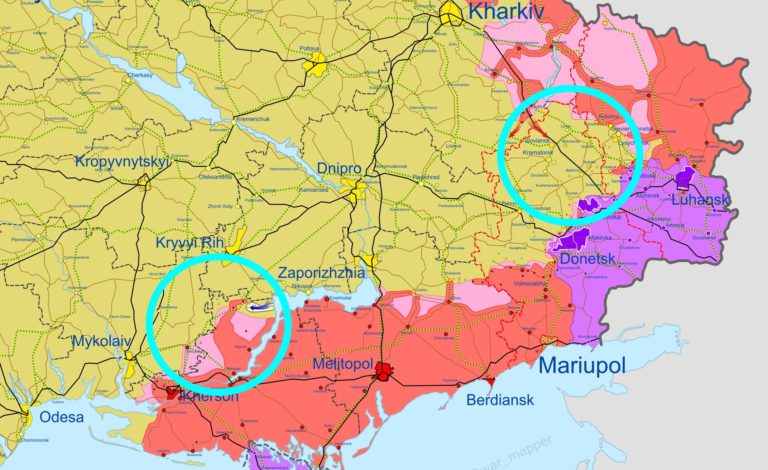
In the real world, Russia is now moving all its forces to the east and south of Ukraine and where a few days ago there were conflicts all over the nation, now there are just two zones that are the absolute focus of both militaries—and could decide the course of the war.
One of these areas is what might be described as “the Kherson bulge.” With the help of local officials who took a bribe, Russian forces managed to capture two intact bridges across the southern Dnieper River: one on the northern edge of Kherson, and another about 40 miles upstream at Nova Kakhovka.
These bridges allowed Russia to take control of the city of Kherson in the first week of the war. With a population just under 300,000, Kherson represents the only large urban center that Russia has been able to capture and hold since the invasion began. Once they had a grip on Kherson, Russian forces were able to achieve one of their key objectives — opening the flow of water to Crimea, without which conditions there were becoming extremely difficult for Russia to maintain.
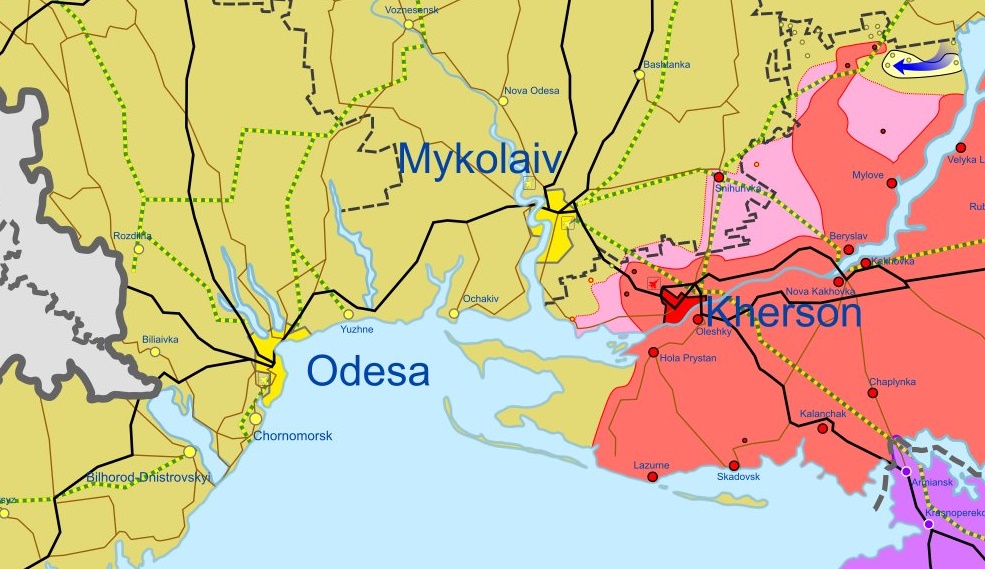
Russian forces would like to achieve their second main objective in the area: capturing Odesa and cutting off Ukraine from the Black Sea. However, attempts to reach the city of Mykolaiv were strongly repulsed (in part by some of the same troops that had originally been in Kherson). Ukraine has been gradually pushing back down the same highway along which Russia advanced, recapturing towns and coming within about 20 miles of Kherson proper. In the past two days, Ukrainian forces have also been recapturing a series of towns and villages in the area of that blue arrow at the top of the map.
There were widespread rumors that Russia was going to retreat across the bridges and hold positions on the east side of the Dnieper, but in the past day Russian troops advanced again to capture the town of Snihurivka (that red dot directly east of Mykolaiv). That seems to indicate they have not given up their ambitions in this area.
A total victory for Ukraine would involve capturing one or more bridges and bagging a large number of Russian troops left trapped on the west side of the river. A more likely scenario is that Russia moves east and takes the bridges with them. But the move to take Snihurivka could signal a new advance on Mykolaiv.
In any case, what happens next here could decide whether Russia gets anywhere close to Odesa, because attempts to capture the city by amphibious landing look like a no-go.
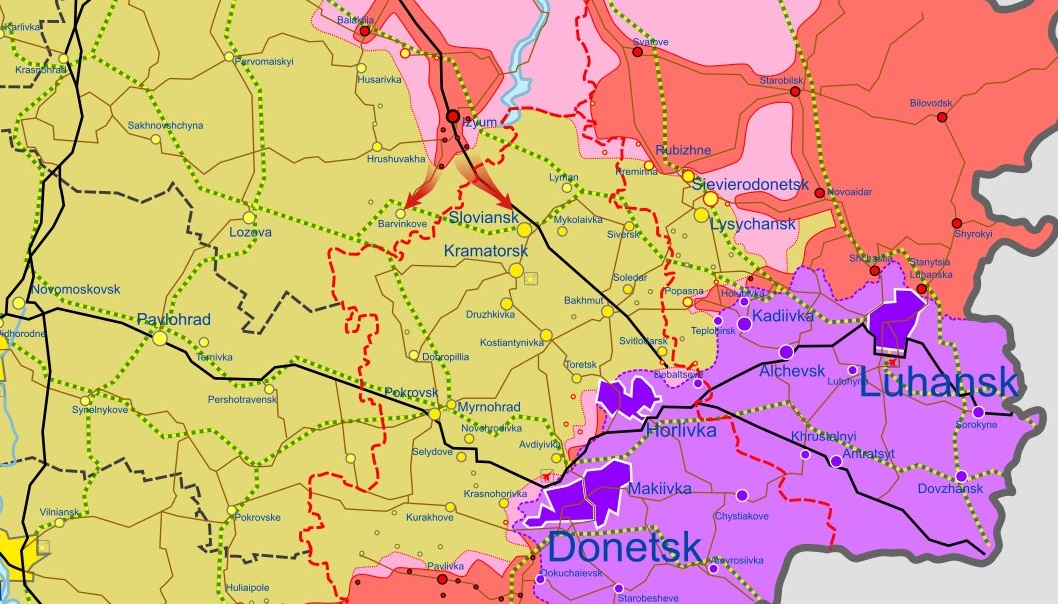
The other area is that “gap” in Russia’s control of the Donbas region south of the town of Isyum. This area is the key to whether or nor Russia can complete its number one goal at this point: capturing all of the Donetsk and Luhansk oblasts.
The east side of the yellow area on this map represents well-established defensive positions where Ukrainian forces are dug in to prevent a direct westward advance by Russia or its supporters. In order to bypass this position and potentially capture a large number of Ukrainian troops along with their equipment, Russia is pushing south from Izyum and north from the Donetsk.
The simple fact that we’re talking about Izyum as a town under Russian control shows that Russian forces have managed to advance in this area over the past week. Once again working with local officials who—due to either threat or bribery—went over to Putin, Russian forces managed to locate an area where they could successfully ford/bridge the small river running through Izyum, circled around the small local garrison from the southeast, and captured the hold-out town. Now those forces are continuing on to the south.
Russia could continue down the M03 highway toward Slovyansk. If Russia took Slovyansk, its troops would have the option of continuing south or of cutting east along another highway to cut off a portion of the Ukrainian troops along the Donbas defensive line. However, there are indications that’s not what Russia intends to do. Troops may swing west around the town of Kramatorsk, putting them closer to the oblast border and allowing the troops to give the recently discovered oil field in the area a warm hug.
Or …
This would be the equivalent of a Hail Mary pass on the part of Russia. Izyum is already at the end of a long and complex salient that is vulnerable to a possible Ukrainian attack from Kharkiv. But an attempt to go all the way out to Pavlohrad (near the left edge of the map of the Kramatorsk area), would put them way-the-hell out on a limb.
If Russia pulled it off, it would be an amazing feat, and could potentially cut off a sizable portion of the whole Ukrainian army. On the other hand … this looks impossible. They would have a salient that, by that point, would be hundreds of miles long, under assault from every direction, and subject to attack at dozens of locations.
Still, Russia has shelled multiple locations west of Kramatorsk on Thursday, including points along the highway leading to Pavlohrad. That could indicate that they are trying to soften up the route in advance of moving that way.
Meanwhile, Ukraine is well aware of Russia’s intentions in the Kramatorsk gap, and has also repositioned forces. On Wednesday several Russian tanks and a helicopter were destroyed by Ukrainian troops moving in southwest of Izyum, and some of those same vehicles that were involved in building the bridge that allowed Russia to cross the river now look like this:
(Bonus points: Can you name all the items Russian troops were trying to steal when these vehicles were destroyed?)
One other zone of major conflict which I failed to circle: Mariupol. While the battle there may seem to have been decided, that’s not how local Ukrainian forces are behaving. On Thursday, at least one Russian ML-TB armored vehicle was destroyed in the city, and Ukrainian forces are still putting up something that’s far greater than token resistance.
All of this is taking place as Russia has also taken away the city’s last hospital staff at gunpoint and continues to relocate thousands of the city’s residents to unknown locations in Russia.
One of those Russian missile strikes west of Slovyansk has blocked efforts to evacuate civilians from the area in anticipation of the coming battle.
'I am disgusted': Amir Locke's mom speaks after prosecutors refuse to charge cop who killed her son
This post was originally published on this site
Prosecutors announced on Wednesday that they are “declining” to file criminal charges in the shooting death of Amir Locke, a Black man who was lying on a couch when police barged into a downtown Minneapolis apartment and killed Locke after he reached for a gun. Authorities were executing a no-knock search warrant just before 7 A.M. on Feb. 2, according to the offices of Minnesota Attorney General Keith Ellison and Hennepin County Attorney Michael Freeman. “Amir Locke was not a suspect in the underlying Saint Paul criminal investigation, nor was he named in the search warrants. Amir Locke is a victim,” prosecutors said in a news release. “This tragedy may not have occurred absent the no-knock warrant used in this case.”
Still, prosecutors said the law prevents them from filing charges against Mark Hanneman, the officer who shot Locke. “After a thorough review of all available evidence, however, there is insufficient admissible evidence to file criminal charges in this case,” prosecutors said in their release. “Specifically, the State would be unable to disprove beyond a reasonable doubt any of the elements of Minnesota’s use-of-deadly-force statute that authorizes the use of force by Officer Hanneman.”
RELATED STORY: Family wants answers after 22-year-old Black man, Amir Locke, shot and killed during no-knock raid
“Nor would the State be able to prove beyond a reasonable doubt a criminal charge against any other officer involved in the decision-making that led to the death of Amir Locke.”
While both offices of the Hennepin County Attorney and Minnesota Attorney General agreed in a joint report that existing policies need “rethinking,” they said as prosecutors, they are limited in their role “to considering only whether criminal charges are warranted against any of the police officers involved in Mr. Locke’s death.”
They wrote in the report:
“To file a criminal charge against any of the police officers, and specifically against Officer Hanneman, the State must possess sufficient admissible evidence to prove every element of the criminal offense and disprove at least one element of any available affirmative defense beyond a reasonable doubt. This is a high burden, and it is one which is not met here.”
Prosecutors also cited the expert report of retired Capt. John Ryan, who concluded that “the use of deadly force by Officer Hanneman was consistent with the Minneapolis Police Department when considered in conjunction with generally accepted practices and training in law enforcement.”
Activist Al Sharpton, civil rights attorney Ben Crump, and Amir Locke’s mother, Karen Wells, made a case during a press conference Wednesday at Sharpton’s National Action Network Convention that those generally accepted standards need to change. ”I’m not gonna give up,” Wells said. “Right now, the Minneapolis police officer that executed my baby boy on 2/2/22, be prepared for this family because every time you take a step we’re going to be right behind you. This is not over.”
She directed her message directly to Hanneman and said, “the spirit of my baby is going to haunt you for the rest of your life.”
“I am not disappointed. I am disgusted with the city of Minneapolis,” Wells said.
Although Minneapolis police promised they wouldn’t use no-knock search warrants some two years ago, they went on to seek some 90 of them between November 2020 and September 2021 alone, according to the journalism nonprofit MinnPost. Following the death of 26-year-old emergency medical technician Breonna Taylor, Minneapolis Mayor Jacob Frey issued a policy in November 2020 requiring officers to identify themselves before executing no-knock warrants. Taylor was killed when police raided her home executing a no-knock warrant on Mar. 13, 2020, in Louisville, Kentucky. She was sleeping when officers smashed through her door.
“Outside of limited, exigent circumstances, like a hostage situation, MPD officers will be required to announce their presence and purpose prior to entry,” Frey’s office said in a 2020 statement the Star Tribune obtained. The city tightened the restriction in March, implementing a new policy prohibiting the application for and execution of all no-knock warrants.
Ellison called for Congress to pass the George Floyd Justice in Policing Act, an endeavor Republicans sabotaged in pandering to special interest groups working to protect the very people targeted with reform measures. The policing act is a comprehensive police reform bill to ban chokeholds and no-knock warrants and require body cameras, among other reform measures.
Crump said on Wednesday that the National Rifle Association should be joining their fight to get rid of no-knock warrants “because if it can happen to Amir, it can happen to Breonna Taylor, it can happen to your children, too.”
RELATED STORY: Shocking! Negotiations on police reform bill hampered by the very people who need to reform
Listen and subscribe to Daily Kos Elections’ The Downballot podcast with David Nir and David Beard
Texas Gov. Greg Abbott peddles horrific plan to kidnap immigrants, then backtracks
This post was originally published on this site
Right-wing Texas Gov. Greg Abbott on Wednesday declared that he would round up and forcibly bus asylum-seekers and other migrants to Washington, D.C., in retaliation for the Biden administration’s just decision to end use of Stephen Miller’s anti-asylum order by end of May.
“To help local officials whose communities are being overwhelmed by hordes of illegal immigrants who are being dropped off by the administration, Texas is providing charter buses to send these illegal immigrants who have been dropped off by the Biden Administration to Washington, D.C.,” Abbott offensively claimed in front of cameras.
But while Abbott puffed up his chest to make the kidnapping threat to the press and cameras, he was notably sedate in the state’s official release, which stated that the busing would actually be completely voluntary. Yes: Providing asylum-seeking families and individuals with Texas taxpayer-funded transportation to a region heavy with pro-immigrant advocacy groups to own the libs.
RELATED STORY: Border state advocates say they’re ready to welcome asylum-seekers following Title 42 announcement
The response to the initial reporting of Abbott’s plan was obviously abject horror. “This is literally kidnapping, right?” tweeted American Immigration Council senior policy counsel Aaron Reichlin-Melnick. “It’s not just me. You can’t just ‘send people’ places against their will. That’s a crime.” It would seem that way. “Any forcible busing of migrants across the country would be outrageous and blatantly unconstitutional,” ACLU of Texas staff attorney Kate Huddleston said in a statement reported by The Texas Tribune.
Did Abbott then backtrack on his threat because “someone mentioned to him that busing people across state lines against their will is felony kidnapping,” as posited by Texas Monthly senior editor Jack Herrera? Or was this the plan all along, because he has a reelection campaign to win and knew it would be breathlessly reported by mainstream outlets and right-wing propagandists?
Then, possibly in response to backlash from racists really angry that it’s all voluntary, Abbott on Fox News refused to say if it was all voluntary:
We know Abbott’s reelection has been heavy on the anti-immigrant stunts. While he’s touted the multibillion dollar Operation Lone Star scheme as a success story, he refuses to be transparent about the data that would back up that lie.
“In the fight against fentanyl, DPS has seized over 288 million lethal doses throughout the state,” Abbott’s office has claimed. But a recent joint investigation from Marshall Project, ProPublica, and The Texas Tribune found that Texas has been citing drug seizures from areas that included “counties that did not receive additional resources from the operation, and some of the newly credited actions included work already conducted by troopers stationed there before the governor’s initiative began.” The report said that his office has fought dozens of public records requests.
The stunt this week drew support from Ted Cruz, who endorsed Abbott for reelection to boos last summer. Cruz, who last year was caught infamously vacationing in beautiful Cancún while Texans froze, said he supported sending migrants to regions including California, Connecticut, Massachusetts, and Rhode Island. Maybe Ted is unaware, but all have immigrant-rich communities where families would assuredly be welcome. Once again, Texas taxpayer-funded rides to own the libs.
Greg Abbott is a fucking jackass but it doesn’t change the fact that his rhetoric is disgusting—and dangerous. “I see Greg Abbott wants to smuggle migrants,” America’s Voice campaign director Mario Carrillo initially tweeted in response to Abbott’s claim. “All jokes aside, just a truly despicable act by a nasty person who will stop at nothing to dehumanize migrants to score political points. He’s learned nothing from the attack in El Paso in 2019 and doesn’t care if it happens again.”
RELATED STORIES:
GOP states waste no time suing over Biden admin’s termination of anti-asylum Title 42 policy
Texas refuses to be transparent about Operation Lone Star. Probably because it’s all a scheme
Texas’ corrupt attorney general is using the courts to sabotage Biden’s immigration agenda
Tribal and state waterways once again threatened by Trump-era water regulation
This post was originally published on this site
The Supreme Court’s “shadow docket” was in full effect on Wednesday when Justices chose to reinstate a Trump-era water rule that threatens waterways on state and tribal land. In a 5-4 ruling in which all three Trump-appointed Justices were part of the majority, the nation’s highest court chose to allow the 2020 Rule created by the Trump administration to take effect temporarily. The rule concerns Section 401 of the Clean Water Act and limits states’ and tribes’ abilities to review projects like pipelines, from shortening the review period to allowing federal oversight that could overturn a state and tribe’s findings. It is also on states and tribes to prove that projects will harm water quality. Polluters cheered the ruling, while environmental groups and even states themselves sued over what was effectively a gutting of the Clean Water Act.
This led to a federal judge in 2021 rejecting the EPA’s request to keep the rule on the books. An appeal failed, but oil and gas groups and fossil fuel-loving states stayed persistent, filing a request to the Supreme Court to get the rule reinstated, which leads us to Wednesday’s order in the case of Louisiana v. American Rivers. Unsurprisingly, the states interested in keeping antiquated oil and gas ventures in existence included the usual suspects, like Louisiana, Texas, and West Virginia. The groups joining them in the lawsuit include the American Petroleum Institute and Interstate Natural Gas Association of America. It was Justice Elena Kagan who issued the dissenting opinion. She was joined by Chief Justice John Roberts Jr. and Justices Stephen Breyer and Sonia Sotomayor. The final paragraphs are damning.
“The applicants… have failed to meet that burden.They claim that the vacated rule gave them ‘protections’ against States that previously ‘abuse[d]’ their statutory authority to review infrastructure projects for compliance with water-quality standards. But the applicants have not identified a single project that a State has obstructed in the five months since the District Court’s decision. Still more, they have not cited a single project that the court’s ruling threatens, or is likely to threaten, in the time before the appellate process concludes. The request dissenting for a stay rests on simple assertions—on conjectures, unsupported by any present-day evidence, about what States will now feel free to do. And the application fails to show that proper implementation of the reinstated regulatory regime—which existed for 50 years before the vacated rule came into effect—is incapable of countering whatever state overreach may (but may not) occur. Even the applicants’ own actions belie the need for a stay… The applicants have given us no good reason to think that in the remaining time needed to decide the appeal, they will suffer irreparable harm. By nonetheless granting relief, the Court goes astray.”
The Sierra Club issued a statement urging the EPA to act quickly to right this wrong. The Biden administration promised that a new draft rule would be issued this spring, with a final rule issued next spring. But even a smidgen of time in which oil and gas companies can threaten states and tribes and worsen climate change conditions is a moment too long. EarthJustice, which filed a lawsuit against the Trump-era rule, similarly demanded action from the EPA and called out the Supreme Court. “The Court’s decision to reinstate the Trump administration rule shows disregard for the integrity of the Clean Water Act and undermines the rights of tribes and states to review and reject dirty fossil fuel projects that threaten their water,” Senior Attorney Moneen Nasmith said in a statement. “The EPA must ensure that its revised rule recognizes the authority of states and tribes to protect their vital water resources in its ongoing rule-making under Section 401.”
Senate poised to confirm Ketanji Brown Jackson to the Supreme Court
This post was originally published on this site
Judge Ketanji Brown Jackson will become U.S. Supreme Court Justice Ketanji Brown Jackson, the first Black woman to sit on the nation’s highest court, Thursday afternoon. The Senate will vote to confirm her for the seat that Justice Stephen Breyer will vacate before the October term begins, after finishing out the spring term.
She will be the first Black woman on the Supreme Court, fulfilling President Joe Biden’s promise as a candidate back in 2020. She will be the first justice who has experience as a public defender. She is the first justice since Thurgood Marshall to have substantial criminal defense experience. She will be just the second justice in history to have served on all three levels of the federal judiciary—District, Circuit, and the Supreme Court. She has spent more time on the bench as a trial court judge than any nominee since 1923.
In fact, she has more experience on the bench than Justices Thomas, Roberts, Kagan, and Barrett combined had before their confirmations.
Thursday, Apr 7, 2022 · 3:17:31 PM +00:00
·
Joan McCarter
It’s a good day. The Senate is about to have the cloture vote on her confirmation, which will be followed by “debate” and then the final vote this afternoon, possibly evening. Hopefully the worst of the worst of Republicans got it out of their systems already, and don’t bother to show up for debate. But we should be so lucky.
Thursday, Apr 7, 2022 · 3:40:26 PM +00:00
·
Joan McCarter
Cloture vote begins and, wonderfully, Sen. Cory Booker is in the presiding chair. He’s always the best in the chair, and is so excited this morning he’s nearly vibrating.
Judge Jackson has the quintessential biography for an American success story in public service. She was born in Washington, D.C., in 1970 to two public school teachers. After her birth, the family moved to Miami, Florida, where her father went to law school. She would sit at the kitchen table with him, with her coloring books, while he studied. That, she says, is where her interest in the law was born.
At Miami Palmetto Senior High School, Judge Jackson was a star, but nonetheless, when she told her guidance counselor that she wanted to go to Harvard, she should not set her “sights so high.” She went to Harvard, where she graduated magna cum laude. She then graduated cum laude from Harvard Law School, where she also served as an editor of the Harvard Law Review.
Judge Jackson’s career has been absolutely impeccable. That, of course, did not stop Republicans from wallowing in the gutter with baseless and vile racist and sexist attacks on her record, a tactic blessed by Minority Leader Mitch McConnell.
The spectacle was so extreme that a majority of Americans polled right after the hearings by Quinnipiac University were appalled by it.
Nonetheless, Judge Jackson will prevail. Justice, just this once, will prevail.
Washington Post provides a vivid picture of Trump, sitting at Mar-a-Lago and lying. But why?
This post was originally published on this site
Donald Trump’s influence is fading in the Republican Party and everyone outside of his die-hard supporters realizes that nothing he says can be trusted or believed, but The Washington Post is trumpeting an exclusive interview with him, giving Trump space to lie some more. Apparently it’s really newsworthy to hear that Trump still blames everyone else for his supporters attacking the U.S Capitol and still insists he didn’t lose fair and square in 2020.
The Post does offer context for some of what Trump lied about and omitted from his accounts, and notes that he “meandered during the interview and stonewalled questions with long answers.” But nothing here is newsworthy. “Liar continues to lie. Man who never admits error continues to insist he was right about everything.”
RELATED STORY: Rep. Mo Brooks says Donald Trump demanded he take part in a coup well after Jan. 6
Trump’s nonsense included insisting that he was just waiting for Speaker Nancy Pelosi to put a stop to the attack on the Capitol by a mob of thousands of his supporters: “I thought it was a shame, and I kept asking why isn’t she doing something about it? Why isn’t Nancy Pelosi doing something about it? And the mayor of D.C. also. The mayor of D.C. and Nancy Pelosi are in charge,” he told the Post. “I hated seeing it. I hated seeing it. And I said, ‘It’s got to be taken care of,’ and I assumed they were taking care of it.”
While the Post notes that responsibility for the Capitol does not lie solely with the speaker of the House and that the Washington, D.C., mayor’s office repeatedly tried and failed to get through to Trump during the attack, it doesn’t mention the phone call that afternoon in which Trump responded to House Minority Leader Kevin McCarthy’s plea for Trump to tell the mob to stop attacking by saying, “Well, Kevin, I guess these people are more upset about the election than you are.”
Trump also told the Post he really had wanted to march to the Capitol himself on January 6, but was prevented by the Secret Service. That would have been something else—a violent attack on Congress that the sitting president didn’t just incite through words but physically led to the scene. Of course, since Trump lies, it remains equally likely that he had no desire to do anything more strenuous than he had already done and preferred to go relax at the White House while watching what he’d unleashed from a comfortable seat in a heated room.
He bragged at some length about the size of the crowd at the rally on the Ellipse—the crowd from which the mob of attackers peeled off beginning while he was speaking. “The crowd was far bigger than I even thought. I believe it was the largest crowd I’ve ever spoken to. I don’t know what that means, but you see very few pictures. They don’t want to show pictures, the fake news doesn’t want to show pictures.”
A bigger crowd even than the “million, million and a half people” at the 2017 inauguration? Big, if true.
It was a “tremendous crowd” which he really wanted to lead straight to the Capitol, but once it arrived there, someone else should have stopped it from battering down the doors and windows and assaulting the police officers defending the building and the Congress inside.
On the subject of the 2020 election, which the mob was attempting to overturn on January 6, Trump continues to insist that he was robbed by massive voter fraud. (Again, this is news?) In a masterpiece of admitting something in the midst of denying it, he said of Rep. Mo Brooks’ allegations that he has asked Brooks to help him overturn the election since the inauguration of President Joe Biden, “I didn’t ask [Brooks] to do it. He’s in no position to do it. I certainly didn’t ask him to do it. But I believe when you see massive election fraud, I can’t imagine that somebody who won the election based on fraud, that something doesn’t happen? How has it not happened? If you are a bank robber, or you’re a jewelry store robber, and you go into Tiffany’s and you steal their diamonds and get caught, you have to give the diamonds back.”
I didn’t ask him to do a perfectly reasonable, even just, thing that someone should definitely do. Uh huh.
Nothing about Donald Trump has changed over the past 15 months except his position in the world. And his current position means that the media should not be trotting down to Mar-a-Lago to seek out more lies from him. When he speaks at a rally or endorses a candidate? Sure, that’s news—as much as we might look forward to the day when basically nothing he does is worth our attention. But Trump, sitting at Mar-a-Lago drinking a Diet Coke? Let that guy tell his lies to the people wandering the grounds eager for the chance to suck up to him. Let him rant to the guests of weddings held at the property. It’s not worth making an effort to hear what he has to say.
RELATED STORIES:
It’s a family affair: Ivanka Trump appears before Jan. 6 probe
Let’s talk about the Trump White House call logs from Jan. 6
Ukraine update: 'Looking behind us now, into history back'
This post was originally published on this site
Here’s a bit of lovely speechifying from one of my favorite film characters, “I’s looking behind us now into history back.” But “time counts, and it keeps counting” and there “ain’t nobody how knows where it’s gonna lead.”
While you’re skimming Google to find Savannah Nix, all of this is just an elaborate way of saying that this morning—43 days into Russia’s unprovoked invasion of Ukraine—I’m looking “into history back.” As in, checking out the predictions that media outlets and columnists made before the tanks started to roll. But before we get to the point where Vladimir Putin began to gather forces around Ukraine last fall, here’s a thumbnail sketch of where things have gone over the last couple of decades.
Following the collapse of the Soviet Union, Ukraine learned quickly that Russia was far too busy dealing with its own internal issues and structural collapse to lend anything like assistance to former Soviet member states. That was underscored in 1995 when Kharkiv was left without drinking water for months after the literal collapse of Soviet-era infrastructure. Both desperate for assistance, and anxious to put some distance between Kyiv and Moscow, Ukraine looked to the West for assistance.
But almost as soon as Vladimir Putin rose to power, he saw that Ukraine was a threat. It wasn’t so much having NATO on the doorstep that bothered the Russian dictator, it was the idea of a functioning democracy with a growing economy that bothered him. After all, many Russians and Ukrainians have close personal and familial links. How was Putin going to keep everyone in Moscow happy with an economy slogging forward under the burden of an authoritarian kleptocracy, if they were always comparing their lives to cousin Sasha’s thriving democracy?
So Putin set out to end that. He launched a series of programs to bribe Ukrainian officials, promote their own oligarchs, and ensure that levels of corruption pegged the dial. When Ukraine still seemed to be looking West, Putin brought in an expert on destroying democracies around the world, Paul Manafort, and set him loose to create chaos, break agreements with the West, and ink deals that bound Kyiv and Moscow. That included destroying deals that were easing Ukraine toward both the EU and NATO.
By 2014, Ukrainians answered Putin with a resounding “no,” ousting pro-Russian officials in the Maidan Revolution, which is also known inside Ukraine as “the Revolution of Dignity.” Once again Ukraine turned to the West, and overthrew the Yanukovych government promoted by Manafort & Putin, Inc.
Then Putin replied by invading Crimea and bolstering pro-Russian separatists—many of which were so pro-Russian that they were actually Russian soldiers or members of the FSB—in the Donbas.
That Russia was able to so easily take Crimea and seize areas of eastern Ukraine wasn’t a signal that Russian soldiers were great and Ukrainian soldiers were terrible. It was a result of Russia acting while a political revolution and reformation in Ukraine was still underway. The capture of Crimea was as much about the internal disruption Putin has spent over a decade building, than it was “Little Green Men” dropping in to secure the borders.
Putin was convinced that this action would teach Ukraine a lesson, reverse the Maidan Revolution, and convince Kyiv to beg to be let back into the Russia club. Instead, the 2014 invasion generated a new unity within Ukraine and increased their determination to rebuild connections with the West. Putin responded to this by sending ever more military equipment to the Donbas (if your internal rebels are driving around in tanks provided by your neighbor, are they really your rebels?) and continuing its efforts to fund corruption in Kyiv — efforts that Republicans from Donald Trump to Rudy Giuliani were all to happy to boost. Russia also took a number of provocative steps like seizing the Kerch Strait that were likely designed to test whether the West was still snoozing when it came to mounting a response (Answer: Yes).
Still, the election of Volodomyr Zelenskyy was seen as a big repudiation of any remaining pro-Russia sentiment and a solid middle-finger to Moscow. Efforts to drag Ukraine out of Putin’s corruption and disruption shadow accelerated.
And that … is why is I’m no good at writing a brief thumbnail version of history. Anyway, Ukraine looked West. Putin spent twenty years trying to prevent Ukraine from evolving a functional democracy. Ukraine shrugged off the efforts. Putin invaded. Ukraine resisted. Putin fumed. Fuck you, Vlad.
There.
Since 2014, Russia has teased a second invasion many times when Putin believed that Ukraine’s progress needed to be checked. So when all those Russian forces began gathering around Ukraine in the fall of 2021, it’s understandable that a lot of people seem to have responded with an eye-roll and a “here we go again.” As Foreign Policy explained, Russia wasn’t actually going to invade. It just wanted a better bargaining position.
Except U.S. intelligence was getting serious signals that this time was different. Unable to cripple Ukraine sufficiently to keep them from evolving into a threat, Putin was going to do the other thing. Crush them.
How did all the experts and analysts respond? It’s not hard to find predictions that Russia would simply roll over Ukraine in The New York Times and other major outlets, or that the West would step back and do nothing. In fact, many of the media forecasts bear an uncanny resemblance to exactly what Moscow was saying. Because transcribing Putin was probably a lot easier than doing any actual analysis.
But there are some surprising nuanced prediction out there that don’t look half bad “in history back.” For example, Defense News didn’t think that Russia was going to go for a full-scale invasion of Ukraine, but there reasoning for this was pretty much—because Putin would be making a huge mistake.
“… it would be very risky diplomatically and expensive militarily for Moscow. Russia could lose. … The Western response to an all-out invasion could be fierce, including possibly providing airpower to Ukraine to defend Kyiv should Ukraine be losing the battle. It could result in escalation and a major war despite lack of an Article 5 commitment. Putin likely knows this. Therefore, he is probably—hopefully—deterred here.”
He wasn’t. Defense News actually expected Putin to go for something more modest and achievable, like just grabbing a land bridge from Donbas to Crimea through Mariupol, but they get points for the clear signal that a full scale of invasion was simply beyond the limits of what the Russian military could achieve.
There’s also this piece, from The Wall Street Journal, that calls a Ukraine invasion “a trap” for Putin.
“If Russian aggression toward Ukraine does expand militarily, however, it could spell the end of the authoritarian experiment that Vladimir Putin has fostered for the past two decades. In any scenario, it will also result in a much-diminished Russia.”
That’s a remarkably good call, in an article that also recognizes Putin’s capture of Crimea was done “from a position of weakness” and ties Putin’s threats to Ukraine toward how his own popularity had crashed following the mishandling of the COVID-19 crisis.
There’s also this analysis from Reuters, that predicts a Russian invasion of Ukraine would be “no walkover.” For the same reasons as the Defense News analysis, this leads to the conclusion that it would be “highly unlikely that Putin would contemplate an outright conquest of Ukraine.”
Honestly, while the biggest media outlets were running a lot of news stories that took Russia marching into Kyiv in their parade best as a given, there were no end of sources with analysis that showed exactly why that was unlikely. But there were far more predictions that treated Russia’s ability to invade and conquer Ukraine as a given, but simply didn’t think Putin would do it, because the cost would be so high, and any attempt to take the whole of the country would turn into a long term slog.
“The invasion would not lead to the kind of swift victory Russia won in Georgia in 2008, or could have won over Ukraine in 2014. This would give the West time to react in whatever manner it chose – which, in turn, would make the outcome of the war less predictable and controllable for Russia. However, one can only guess whether Putin believes there is a credible chance of a substantive Western reaction.”
And that’s the point where most of these predictions failed—not in pointing out that Ukraine’s military had vastly improved over 2014, or that Russia’s ability to wage full scale conquest was questionable at best. They failed on the Putin question.
They failed to predict that despite the high probability of failure, despite the enormous cost in men and materiel, and in spite of a staggering long term cost of isolation and sanctions, Putin would push that button. The biggest errors people made weren’t in overestimating the power of the Russian military, it was in underestimating the size of Putin’s ego.