
Asylum-seekers have been waiting years for an interview because of a Trump-era processing system
This post was originally published on this site
This article was originally published at Prism.
Over 430,000 affirmative asylum-seekers have been subject to a processing policy referred to as “Last In, First Out” (LIFO) that prioritizes recently submitted applications over older cases. A person who applies for affirmative asylum this year should have their interview within 45 days, but the wait is averaging 1,621 days. For those who applied in 2015, 2016, or 2017 when the backlog began, the delay has lasted seven years.
Former President Donald Trump ordered the U.S. Citizenship and Immigration Services (USCIS), the agency responsible for processing affirmative asylum applications, to reinstate the LIFO system in 2018. According to USCIS, the policy was originally introduced in 1995 by then-President Bill Clinton to reduce the backlog and deter asylum-seekers who apply as a means to obtain work authorization. LIFO was in place for 20 years until December 2014, when then-President Barack Obama’s administration temporarily adopted a “First In, First Out” (FIFO) scheduling system, processing applications as they arrived. However, according to immigration advocates, the policy has failed to reduce the backlog, with the backlog increasing by 450,000 cases from 163,000 in 2017, which was right before LIFO was reinstated, to 614,000 in 2020.
The wait has also forced thousands of asylum-seekers to live in constant uncertainty about their status.
Erez, a Kurdish asylum-seeker from Turkey, applied in 2016 and has been waiting for an interview ever since. Erez was a college student at the time, and police were attacking Kurdish students. Erez fled Turkey and came to the U.S. to find safety. Erez said he has had to reapply for a work permit every two years but has yet to receive his most recent work authorization card because of the backlog. On March 29, Biden announced actions to address the work permit backlog and immigration applications, but the measures do not apply directly to processing affirmative asylum cases.
“There’s uncertainty,” Erez said. “I’m not sure when they will address my application; after all this time, I’m just waiting.”
Andrea Barron, the advocacy program manager for Torture Abolition and Survivors Support Coalition, said asylum-seekers and torture survivors are suffering the most from LIFO. Many applicants are separated from family members who are still in their home countries. According to Barron, applicants report that their children experience ongoing violence and are punished for their parents being known as dissidents. One applicant was a mother with a 14-year-old daughter in Ethiopia. Her daughter was raped as punishment for her mother being a known dissident. According to Barron, had her mother gotten an interview, she could have brought her daughter to the U.S. and prevented the attack.
“Torture survivors have experienced significant trauma and are left in limbo, often separated from their families, and this exacerbates the trauma,” Barron said. “These tragic outcomes could have been avoided had their applications been processed promptly.”
Barron has been advocating for a concrete solution to the problem. She suggests that USCIS hire asylum officers designated to address asylum applications that were filed five or more years ago. While USCIS says they have increased the number of authorized asylum officers from 273 in 2013 to 771 in 2019, Barron said this increase has had hardly any effect on increasing the number of interviews for torture survivors and other asylum-seekers waiting more than five years for an interview.
“The big question is, how are you going to use those asylum officers?” Barron said. “Are any of them going to be able to interview the people who are waiting five years for their interview?
Barron suggests a portion of asylum officers should work back to front. Her suggestion was supported by Rep. Jerry Nadler and 39 other members of Congress, including Rep. Alexandria Ocasio-Cortez, in a letter they sent to Homeland Security Secretary Alejandro Mayorkas and USCIS Director Ur Jaddou on Sept. 9, 2021.
“USCIS wants to make it look like they’re trying to solve the problem,” Barron said. “It will not solve the problem, the problem will be solved only when there is a designated number of asylum officers to work on these long-term cases.”
Prism is a BIPOC-led nonprofit news outlet that centers the people, places, and issues currently underreported by national media. We’re committed to producing the kind of journalism that treats Black, Indigenous, and people of color, women, the LGBTQ+ community, and other invisibilized groups as the experts on our own lived experiences, our resilience, and our fights for justice. Sign up for our email list to get our stories in your inbox, and follow us on Twitter, Facebook, and Instagram.
Paul Gosar explains yet another appearance at a white nationalist conference by blaming his staff
This post was originally published on this site
Arizona Rep. Paul Gosar, whom God created to conclusively disprove white supremacy, is trying to explain away his video appearance at shrieking anti-Semite Nick Fuentes’ white power-palooza carnival in February, and that explanation is just as craven as you might imagine.
Gosar, who has the intellectual heft of chilled monkey brains and looks like he cuts his own hair with an intermittent series of controlled burns, seems to think white people are superior to other races. Now, that’s an assertion that might seem slanderous if not for his repeated participation in white supremacist events. And now, more than a month after appearing via video at Fuentes’ America First Political Action Conference, Gosar is addressing the controversy—by blaming his staff. What a standup fella, huh?
What’s the old saying? Fool me once, shame on you. Fool me twice, shame on my underpaid, overworked staff, who should have recalled from my appearance last year that this was a white nationalist event.
Gosar’s denial — among the first public remarks he’s given on the matter — comes nearly a month after the furor over his appearance at Fuentes’ event consumed the House GOP. Rep. Marjorie Taylor Greene (R-Ga.) and Gosar both appeared at Fuentes’ America First Political Action Conference. Greene spoke in person, while Gosar’s office sent in a video.
What he’s saying: “It wasn’t supposed to go to Nick’s group,” Gosar told POLITICO, noting that a staffer “misconstrued” directions from his chief of staff. The tape was intended to go to other groups as a general “welcome video,” he added.
According to Gosar, his staff is currently shorthanded, and “there was a miscommunication.” Which is odd, because after he spoke in person at the same conference in 2021, you’d think he might have put his foot down and removed the white nationalist group from his iPhone or Rolodex or fish pail full of Post-It Notes or whatever the disgraced dentist uses to organize his contact list.
Famously, Gosar claims he “didn’t know anything about the group” before speaking at the event last year; Rep. Greene made a similar comment following her appearance at the conference this year. That might pass as an explanation if not for this:
The first results when you Google Fuentes’ name identify him as a white nationalist who has compared baking cookies to the Holocaust’s mass murder of Jews, among other incendiary and discriminatory statements.
And Fuentes isn’t just content to marginalize the vast majority of humans. He also managed to slip in some Putin praise at the AFPAC as Greene awaited her turn to speak. Remember, this came shortly after Vladimir Putin launched his unprovoked invasion of Ukraine.
Transcript!
FUENTES: “You know they say about America, they say diversity is our strength. And I look at China, I look at Russia. Can we give a round of applause for Russia? [Crowd cheers and chants ‘Putin, Putin, Putin!’] Absolutely, absolutely.”
And as Tim Wise notes, Greene still came on out.
While House Minority Leader Kevin McCarthy has vowed to give both Greene and Gosar (another) stern talking-to, the Republican Party appears unwilling to expose them to censure—an extraordinary disciplinary measure they appear to reserve solely for members who investigate coups against the legitimate government of the United States.
Listen and subscribe to Daily Kos’ The Brief podcast with Markos Moulitsas and Kerry Eleveld
Meanwhile, according to POLITICO, both Gosar and Greene have apparently lost the benefit of the doubt among most congressional Republicans, who would likely prefer they keep their racism cloaked behind a thin veneer of respectability.
And, of course, Gosar and Greene were among the 63 House members (all Republicans) who on Tuesday voted against a resolution supporting NATO—which is likely the biggest gift they can get away with giving Putin at the moment.
Yes, the GOP is indeed the party of Putin and white nationalism. It’s past time we hang those moldering albatrosses around their treacherous necks, don’t you think?
It made comedian Sarah Silverman say, “THIS IS FUCKING BRILLIANT,” and prompted author Stephen King to shout “Pulitzer Prize!!!” (on Twitter, that is). What is it? The viral letter that launched four hilarious Trump-trolling books. Get them all, including the finale, Goodbye, Asshat: 101 Farewell Letters to Donald Trump, at this link. Or, if you prefer a test drive, you can download the epilogue to Goodbye, Asshat for the low, low price of FREE.
Well, you can take the white supremacist out of the white supremacy event, but you can’t take the white supremacy out of the white supremacist. Or something like that.
A new development from The Arizona Mirror:
Prescott Republican Congressman Paul Gosar is set to be a “special guest” with the white nationalist American Populist Union at an event that will be on a date popular among white nationalists and Neo-Nazis: Hitler’s birthday.
The American Populist Social will be held in Tempe on April 20, a date revered by white supremacists and Neo-Nazis.
The American Populist Union is closely aligned with groypers, a group of white nationalists who strive for their ideas to become a part of the Republican mainstream and are largely followers of 23-year-old white nationalist Nick Fuentes.
D’oh!
Trans rights: How to center trans voices and tips for allies (VIDEO)
This post was originally published on this site
Transgender rights are consistently being threatened, with a record number of anti-trans bill being filed in just the first few months of this year alone. According to NBC News, nearly 240 such pieces of legislation have been filed, ranging from bills that target trans athletes and youth to restricting health care access and barring students from learning about LGBTQ issues. As part of Daily Kos’ commitment to better covering trans issues and uplifting the trans experience, the Daily Kos Equity Council on Thursday facilitated a discussion with three panelists about trans rights. Hosted by Trending News writer Marissa Higgins (she/her), staff heard from KB Brookins (they/them), Holiday Simmons (he/him), and S. Leigh Thompson (he/they).
Brookins, whose book of poetry How to Identify Yourself With a Wound delves into intersectional inquiry, expertly answered questions about the trans experience and offered fantastic advice for those looking to be better allies. When the subject of health care arose, Brookins was able to connect the medical system that fails us all with trans-specific issues in that space. Brookins discussed a piece they wrote for the Huffington Post about their experience seeking care from a gynecologist as a Black trans man in Texas and the power imbalance between providers and patients. “If you have someone in front of you who has the power to alter the experience of your body or your mind, that is a large responsibility and I think it’s super important that people are competent around giving health care to trans folks,” Brookins said. “This is a thing that absolutely everybody should care about, because having legislation that hinders how you can support your child is an issue that everyone should care about. And the misconception is, I think, that people think it’s a trans issue. I think it’s a human rights issue.”
RELATED STORY: Daily Kos Equity Council presents a panel on trans rights
Thompson, a consultant and facilitator whose creative work offers an inspiring chance for intersectional dialog, was well-equipped to provide a thoughtful answer about trans health care issues. They briefly brought up the trauma of their first OB/GYN visit, further highlighting the fact that seeking out gender-affirming care should only strengthen the argument that trans rights are human rights. “This just underpins that health care for anybody is hard in the United States, right? It’s already hard,” Thompson said. “So, like, who actively desires to engage more in the health care system just for funsies? It’s so, so rare that that happens. People are struggling to actually get any care whatsoever, and so for trans people to take the extra effort to seek out actual care […] to affirm and to support their experience and their identity in the world, that’s not something that just happens on accident. It’s through great consideration and great deliberation.”
That certainty is something cisgender folks rarely are forced to reckon with, even when those folks choose to seek care that is itself gender-affirming. Both Brookins and Simmons brought up the fact that hormones are prescribed for a variety of reasons for folks across the gender spectrum. “We’re all transitioning, throughout life,” Simmons explained. “A personal story is when I was earlier on in my medical transition, I was not seeing some of the physical changes that I wanted and I asked my doctor, ‘Should I get a higher dose?’ And I go to a queer medical place,” Simmons said. “He’s like, ‘I got big burly bears who have low testosterone levels and little skinny twinks with testosterone through the roof.’ It’s really not correlated, and also, maybe let’s interrogate this.”
Simmons’ work as the Resident in Resilience and Healing at the Campaign for Southern Equality is pivotal in helping LGBTQ+ folks get the medical care they need. The Campaign for Southern Equality maintains a provider directory so those seeking care can do so in a respectful environment that doesn’t pose a danger to them—a very pressing concern Simmons noted in his experience of, say, simply going to urgent care for a COVID test. “Even if it’s the most affirming urgent care place, I still have to do that work to figure out if it’s safe to [out myself] and if I want to do that labor,” Simmons said. “Even if we create the best systems, this is still something trans people have to navigate.”
An unwelcoming environment isn’t just at the doctor’s office, unfortunately, but rather can be felt across many interactions. Panelists provided tips for those who may struggle with misgendering trans and nonbinary folks. Perhaps one of the easiest ways to get better with using different pronouns is a tool any language learner is familiar with: practice. Brookins describes giving one of their plants ze/hir pronouns, while Thompson gave their cat they/them pronouns to not only help them practice but teach their child about pronoun usage. Brookins also brought up mypronouns.org, which offers a collection of resources in one place.
Perhaps the best tools for honoring trans folks and combatting transphobia are cold, hard facts. All three panelists easily tore apart made-up scenarios about one of the most pressing issues trans folks face today: discrimination in sports and through legislative actions. Thompson suggested that, for those who engage in a lot of “what if” questions, it’s about finding out what information that person is truly seeking and helping them get to the heart of why they may have some confusion around trans athlete issues.
“We can ‘what if’ any scenario,” Thompson said. “And, for some people, it’s a helpful thing for them to start to learn the boundaries of an idea or of an issue, and so they’re trying to figure out, ‘What are the edges of this conversation?’ As a person who trains on these issues, I approach it a little bit differently at times. Which is just to remind people, to really help folks understand that, often if people are trying to ‘what if,’ they really are trying to learn where the extremities are of this thing.” Thompson continued:
“Some people are literally trying to ‘what if’ in order to tank the issue. And so trying to lean into the ally space of people who actually really want to support and health. And if that’s really what you want to do, I try to get to what’s at the core of the ‘what if.’ Like, are you really trying to understand this issue more? Because we can come up with a scenario, anybody can actually pretend to be anyone else in order to defraud a sports team. Anybody can pretend to be somebody else in order to do harm, or because they have a whim, or because they have an issue and they really hate all girls in sports and want to screw them over. There are so many possibilities. Those are possible. They’re not likely. We don’t have any experiences of them actually happening. Let’s actually instead of focusing on the one maybe, let’s focus on all of the thousands and thousands of trans young people who are trying to engage in sports and need to do so in a supportive way. […] And so really supporting people and saying, ‘This is the pathway that can actually get to the place that we want to go.’”
A helpful list of resources is below for those interested in learning more about accessible health care for trans folks, pronouns, and more about the panelists themselves.
- KB Brookins’ website
- S. Leigh Thompson’s website
- Holiday Simmons’ website
- mypronouns.org
- How to add your pronouns to Zoom
- Brookins’ article on seeking health care as a Black trans man in Texas
- World Professional Association for Transgender Healthcare
- A trans athlete’s guide to writing about trans athletes
- National Center for Transgender Equality ally guide
NLRB official moves to ban captive audience meetings, this week in the war on workers
This post was originally published on this site
Captive audience meetings are one of the major tools of corporate union-busting efforts, in which management intimidates workers in person, on the clock, with the knowledge that their responses are being watched. Now, Jennifer Abruzzo, the general counsel of the National Labor Relations Board, is asking the board to classify most captive audience meetings as an unfair labor practice based on coercion in violation of workers’ rights.
“I will urge the Board to correct that anomaly and hold that, in two circumstances, employees will understand their presence and attention to employer speech concerning their exercise of Section 7 rights to be required: when employees are (1) forced to convene on paid time or (2) cornered by management while performing their job duties,” Abruzzo wrote in a memo this week. “In both cases, employees constitute a captive audience deprived of their statutory right to refrain, and instead are compelled to listen by threat of discipline, discharge, or other reprisal—a threat that employees will reasonably perceive even if it is not stated explicitly.”
Workers seeking to unionize are subjected to captive audience meetings in 90% of all organizing drives, according to studies. In recent high-profile cases, that’s included workers at Starbucks and Amazon. And while those union efforts have been successful, it doesn’t mean that the workers don’t feel the effects of the intimidation. Taking away this tool in the union-busting arsenal would be a very big deal.
● More than 50 gig workers have been killed on the job since 2017, according to a report from Gig Workers Rising, and more than 60% of those killed were people of color.
● This is a beautiful video:
● MIT graduate students voted to unionize, 1785 to 912.
● A grocery worker strike was imminent. Then came a 30-hour bargaining marathon.
●
● Jaya Saxena reports on what Amy’s Kitchen workers are fighting for:
“The primary issue for every worker is workplace injuries,” says Ricardo Hidalgo, the Western Region organizing coordinator for the Teamsters, which is behind the union effort at the Santa Rosa facility. According to the Cal/OSHA complaint, Amy’s employs around 2,000 people at its four production facilities, which, according to the company’s 2019 fact sheet, cook up to 1 million meals a day (160,000 hand-rolled burritos among them). The complaint also says around 550 employees work at its Santa Rosa plant — the company’s first, opened in 1987 — though Hidalgo says the number is now around 700, making it the one of the town’s largest and most reliable employers. “I have never, in my career, seen the level of workplace injuries that I’m seeing now,” Hidalgo says.
Ukraine Update: The challenges of sifting through the fog of war
This post was originally published on this site
In an earlier update by Mark Sumner, a commenter noted, “I do hope you are successful in sussing out the accurate stuff from the propaganda and bot work.” Mark responded:
In spite of attempts to limit the numbers, about half of all the information on Ukraine out there still comes from pro-Russian bots, fake accounts, and propaganda units. There is never a shortage of “Russia is winning!” and “Ukrainian forces have been destroyed!” tweets out there. There seem to be no shortage of Western accounts ready to repeat these statements.
At the other end, there are no end of click-bait accounts trying to draw eyeballs by claiming to have knowledge of troop movements, or breaking news on the next Big Ukrainian Victory! These, of course, can generate hopeful attention from people who definitely want to just see Ukraine roll to Moscow.
To avoid both, we rarely post anything on the basis of a single source, and usually track back along the path to make sure that what appears to be multiple sources are not just quoting the same questionable origin story. We’re rarely first up with Breaking News, but also have to write a lot fewer retractions.
I added my own thoughts in that comment thread, but I’m going to use this opportunity to expand on them, because it can hopefully provide lessons to others as they work to navigate the confusing world of war coverage.
As Mark notes, there are several kinds of misinformation:
- Hostile mis- and disinformation (Russian trolls, bots, etc, Scott Ritter and the tankies)
- Friendly mis- and disinformation (Ukrainian “information warfare” efforts to shape the world community’s perception of the war)
- Click-bait confirmation bias material (Example below)
- Honest mistakes (e.g. calling artillery gun a “tank”)
- War-splainin’ bloviating (You know, the pundits who have all the answers)
The truth is out there, but in the fog of war, it drips out in bits and pieces, all the while all the crap above muddies the water. Our job is to piece together all confirmed facts to try and paint a picture of what is actually happening on the ground, all the while acknowledging holes in our knowledge. For example, we can take what we know to be a credible on-the-ground source, this Canadian volunteer fighting in the Ukrainian foreign legion, and understand what even he admits—that his own operational security (OpSec) means he can’t be too detailed in his information:
Yet he notes that he’s near Kherson, and occasionally mentions town names, so we can get an idea of how far Ukrainians have advanced. That gives us something to work on, that Ukraine is on the attack, but that the exposed, desert-like open terrain prevents them from holding some of that territory, and thus they are being strategic and fluid in where they move. (Note, careful of clicking on his Twitter timeline. He posts graphic war dead photos that are literally some of the worst shit I’ve seen and I wish I never had.)
Still, we would never use one random guy who seems to be in Ukraine, but could be a big scam, as our source. It’s always cross checked with other information from the area, culled from Twitter, Telegram, and Ukraine’s Facebook pages (where its military general staff release regular war updates). We’ve sat on a lot of really exciting information because we couldn’t get multiple credible confirmation, and we didn’t want to fall into the “confirmation bias” trap—believing something simply because it’s something we want to believe.
The opposite is true, we don’t reject information because we don’t want to believe it. It was okay to be skeptical of Russian reports that several hundred Ukrainian marines had surrendered in Mariupol. There was a big effort to “debunk” the video evidence, some of it which was genuinely intriguing. Ukraine general staff contributed to the confusion by denying it was true. But real confirmation soon came from other Ukrainian soldiers on the ground, saying “yup, that’s some of ours.” We didn’t want to believe it was true, but unfortunately, it was.
Here’s another example of confirmation bias:
We all want to see the Russian Black Sea Fleet on the ocean floor, so exciting! Nearly 11,000 people liked that tweet! But digging in, it was clear that there was zero evidence to support it. For one, no credible Twitter accounts reported it. This one is a British photographer with like 700 followers. And not to say the number of followers is everything, but “photographer” isn’t the kind of person that would have insight into, well, the covert shipment of a major offensive weapon, already deployed to Odesa.
So we dug deeper, looking for credible media reports, and nothing. This tweet and photo made the rounds, reposted by many over-eager excited Ukraine boosters, but there was no credible source at the end of the line. Now, that doesn’t mean the tweet is wrong! It just means there is no evidence, and so we couldn’t report on it, or build entire narratives around its presence. Quite the opposite, in fact: The Harpoon has a 75-mile range. If Ukrainians had it, they could deploy the missile at Zaporizhia, and hit Russian ships at Berdiansk (where that landing ship was sunk, either by missile attack or accident). If Ukrainians had those missiles, they could deploy at Odesa and have sunk the Russian ships that were shelling the city just two days ago.
Today, the UK announced that they were, indeed, delivering anti-ship missiles to Ukraine. However, they haven’t said which ones. Everyone assumes Harpoons, but the only country with shore-fired Harpoons are Taiwan, and they’re the other country in the world that most needs them. They ain’t giving those launchers up. The UK has a helicopter version, the Sea Venom, but that’s also a no-go, as Ukraine doesn’t have the right kind of helicopters specially outfitted to carry the missile.
After more digging, we found that the UK actually has three “land-based reference systems” of Harpoons, so is that it? While we haven’t confirmed, those appear to be launchers used to develop and test the Harpoons, and are around 30-40 years old. Do they even work, as they’re not fielded? Maybe! But again, we don’t know. A Politico writer “confirmed” that Britain was sending Harpoons, but we still don’t consider it confirmed, because reporters make mistakes and misunderstand things. What would make most sense would be short-range anti-ship missiles that Odesa could use against an amphibious assault that will never come (as I’ve been saying since the first week). That would be defensive, which is a thing that NATO is still seemingly hung up on. Harpoon’s range and punch makes it a potent offensive weapon.
At some point, a British Ministry of Defence official will confirm Harpoon, or we will see pictures of one in Ukraine, but until then, we consider that bit of information “rumor,” and will treat it as such if and when we write about it. The amount of time we’ve spent on this Harpoon issue the last several days is … more than I’d like to admit. But it’s important that the information you guys get is as reality-based as possible. No one is served by simply regurgitating information that makes us feel better.
The best information is objective information, like the NASA FIRMS satellite imagery. Next up is commercial satellite imagery, like the stuff that confirmed that the dead civilians lying in the street had been there before the Russians retreated from Bucha. Next up is geolocated video from Twitter and Telegram. That is, Ukrainian and Russians post video of their attacks, and an army of volunteers in the Open Source Intelligence (OSINT) community use satellite and Google maps imagery to find the precise location.
Then there’s on-the-ground sources, but only when multiple individual accounts corroborate the information. Ukrainian Ministry of Defence is actually shockingly reliable when it comes to who holds what territory (oftentimes a day late, presumably for confirmation or OPSEC), but terrible when it comes to the number of tanks, aircraft, etc destroyed. (And I know there have been efforts to demonstrate how their numbers might not be so far off, but the counter evidence is stronger.) The Russian Ministry of Defense lies, but at least it gives us an idea of where Russia intends to go. If they claim they’ve captured Mariupol’s port areas in the southwest, then that’s where they’re currently focused in the fight.
The Pentagon, UK, and French ministries of defense are sparse in details, and oftentimes a day or two late, but they’re nice to confirm some details. But when the Pentagon says things like “29 Russian BTGs are combat ineffective,” we understand that those are general estimates, and no one knows the real truth, not even Russia. (You think commanders are sending accurate reports up their chain of command? That’d be one way to get shot. Better to say all is great!)
Finally, we rely on or experiences and expertise. Remember when everyone was screaming that Belarus was going to directly enter the war? It was obvious from the beginning, given my knowledge of military logistics, that it was literally impossible for Belarus to open up a new front all the way out in Western Ukraine. There was no way it was ever going to happen. So while Ukraine, the Pentagon, and everyone with satellite pictures of Belarusian forces gathered in Western Belarus were convinced it would happen, I was confident it never would. Same thing with an amphibious assault of Odesa. How was a couple of thousand Russian naval infantry going to make a contested amphibious assault against a well-defended city of 1 million? Yes, Russia has been stupid. Suicidal at times. But amphibious landings are some of the most difficult military maneuvers to pull off, and Russia has never pulled one off in its history. The loss of men? Russia doesn’t care. The loss of a big chunk of its navy, which would’ve inevitably happened? Russia cares about that.
That doesn’t mean we can’t be wrong, but understanding the logistical (always first!), strategic and tactical pictures is key to properly covering the war. Understanding how weapons systems work (a Mark Sumner specialty), how they are supplied and maintained and operated, and their operational details, further inform the situation on the ground.
Anyway, I write this not out of defensiveness. The community has been incredibly appreciative of our war coverage, and we truly appreciate all the sincere and warm thanks. My favorite part is how so many great, smart commenters add rich details, historical context, and other great information to the topics at hand. I write this to confirm that yes, we take our jobs seriously, and work really hard to ensure no one is misled, and that we are always 100% reality based. And just as importantly, I write this to remind all of you to consume war information (and all information, really) responsibly. Always check sourcing and your own propensity for confirmation bias. If something is too good to be true, spend extra time trying to confirm it. And never be afraid to wait for more official confirmation (if it is, indeed, true).
And lastly, I’ll just say that I love you guys. All of you. I’m tired, emotionally drained, and often triggered given my own personal story (as a war refugee from El Salvador). But your warm embrace of our work gives me energy and motivation when it otherwise might flag. So I appreciate you all.
WTF Fox News roundup: Bigotry, conspiracy, and smug lying … and again with the sex parties
This post was originally published on this site
What is there to say about Fox News and the right-wing-o-sphere that hasn’t been scratched by the nails of demons into the toilet stall walls of hell? Every day, every hour, every minute, Fox News and the propaganda machines it has birthed are either selling their audience lies, misinformation, and disinformation about the world, or selling them pillows, telling them to sell their gold, and saying that the way out of debt is to give Magnum P.I. your home in a reverse mortgage.
These days it is hard to keep up with the avalanche (maybe tidal wave as we go into the warmer months?) of right-wing “news” media hooey. Grabbing every single moment of misinformation or disinformation off of just Tucker Carlson’s show would be a full-time job for three well-paid masochists. But there are a few conservative tropes that perennially emanate from the putrid hate stew of right-wing media.
You know what “perennially” means, right?
Fox News spends most of its resources sifting through a decades-old, burnt-out box of ideas, repackaging them, and throwing them against the wall to see what sticks. Racism by way of South American immigration? Check.
Of course, in the face of the conservative movement to condone-while-not-condoning Russian dictator Vladimir Putin’s invasion of Ukraine, the conservative media-sphere keeps having to eat this kind of crow.
On top of that, while the new “go low” rallying cry of conservatives is that everybody is a pedophile with loose sexual boundaries, the harsh reality is that the only proof of any of these accusations seem to involve GOP operatives and Republican officials. So, if you guys had plans in the D.C. area that included partying with the GOP…
Don’t believe me? Here’s how that Eyes Wide Shut/QAnon world Venn-diagram has begun to eclipse the entire Grand Old Party.
[Note to self: Spray eyes and ears with Windex]
How’s Fox & Friends and Tuckey doing with all of the Ukraine and Russia blowback?
One way to squash dissent is kill your audience. If they’re dead they cannot complain, amiright? But Tucker and Laura Ingraham haven’t had the easiest time making conspiracies of Muslim Socialism stick to Biden as easily as some others, so it’s time to begin manufacturing video of the previous, darker-skinned president, that they were able to direct their audience’s “anxiety” towards.
And just because I’m 100% willing to “go low” with some facts. Here’s a reminder of how Tucker Carlson has always been, and will always be, a truly mediocre intellect, with the moral compass of a gold bar.
But let us all remember that Tucker and the rest of these Christian conservatives are just doing God’s work.
But no worries, Sean Hannity is here to clean everything up by projecting it all away.
Listen and subscribe to Daily Kos’ The Brief podcast with Markos Moulitsas and Kerry Eleveld
Workers at Amy’s Kitchen are organizing after years of unsafe working conditions
This post was originally published on this site
This article was originally published at Prism.
Janet Barcenas has been working at Amy’s Kitchen in Santa Rosa, California, since 1993. She’s worked in the food production line, packaging, and as a team leader, now she has joined a group of workers from the organic frozen food company calling for safe working conditions, higher pay, and a union.
“No matter how much we talk to the supervisors, to the managers, accidents keep happening,” Barcenas said. “They don’t take our opinions into account.”
Amy’s Kitchen, which has been in business for 35 years, has long held a reputation for being a socially responsible brand that uses organic ingredients and has said they “always cook [their] food with love.” But over the last decade, the Department of Labor’s Office of Safety and Health Administration (OSHA) has fined the company more than $100,000 to settle federal health and safety violations at the California location, with additional incidents at the Oregon and Idaho locations. Complaints have detailed workers getting their fingers or pieces of their fingers amputated by machinery, and others detail an employee fracturing their hip while tripping over a forklift. Most recently, workers filed a safety complaint that was opened by Cal/OSHA on Jan. 26 of this year saying they have not been given access to the bathroom or drinking water during shifts. After multiple attempts at asking their managers for better working conditions went unheeded, they filed the complaint.
“You get tired of asking for changes when they don’t pay attention to you,” Barcenas said. “We have continued in this struggle even though they don’t want to pay attention to us.”
Barcenas, who is 54, was diagnosed with cancer in 2005. At the time, she was a team leader in the packaging line. She was allowed four months off for rest, but after six rounds of chemotherapy and 33 rounds of radiation, she had to take off a total of seven months. When she returned, her body was not the same and could not stand for the eight-to-nine-hour days. Her manager refused to let her maintain her position as team leader since she was no longer physically able to stand all day. She had to return to her previous position as a line worker in packaging, making less money than she did before.
“I liked being the team leader very much,” Barcenas said.
Barcenas wrote a detailed letter to her manager expressing her interest in returning to the team leader position. She explained that she was still a detail-oriented person who liked to help her team workers. But she was still denied because of her disability.
“I felt very bad, I felt discriminated against,” Barcenas said. “They didn’t want to give me the position because I really couldn’t do it anymore. Now, I make less money.”
It was not until 2020 that Barcenas’ doctor eventually wrote a note asking to allow her to use a chair while on the line. Her supervisor rejected the request, but after a second request they allowed the chair, and added more for other workers. But there are never enough chairs for the 600 workers. Last year, Barcenas also successfully organized with her colleagues for a salary raise. Barcenas and some other workers previously made $20 an hour, but after a brief labor stoppage, it was raised to $22 an hour. However, immediately after the raise was granted, their health insurance premiums increased, canceling out any salary increase.
According to a statement from Amy’s Kitchen spokesperson Paul Schiefer, they spend $17,500 per employee per year in health care benefits, which is $45 million a year. Amy’s Kitchen did not confirm or deny that insurance premiums were raised in 2021.
“Every year, they are changing the insurance,” Barcenas said. “That is why we need them to value our work. We want good salaries and good insurance. We also want them to be respectful of us. We do our work with so much effort, dedication, and responsibility, but they still do not want to pay attention to us.”
Ever since the January 2022 OSHA complaint was filed and workers began sharing their concerns publicly, Amy’s Kitchen has brought in union-busters in an attempt to scare the workers away from unionizing. Outside the plant, anti-union protestors have been seen chanting against forming a union. Inside, union-busters have given meetings on the “dangers” of unions, and they lurk around the production line and in the break rooms. According to Barcenas, the union-busters have created a misinformation campaign to scare workers away from organizing.
“They just come to intimidate people,” Barcenas said. “But, I’m not scared. I know what the truth is.”
Amy’s Kitchen has denied all allegations. According to spokesperson Schiefer, Amy’s Kitchen reviewed the allegations, reached out to Cal/OSHA, and fully cooperated in the audit process. They say they have a good working relationship with Cal/OSHA, conducted their own internal audit, and completed a three-day audit by an outside firm that analyzed the safety record, disability programs, and employee experience. They say the results show the allegations are false.
“We respect our employees’ choice in a free and fair secret election,” Schiefer said in a statement. “However, this union is not the chosen voice of our employees. Amy’s respects our employees’ rights to vote for or against union representation through a free and fair secret election.”
Since filing the complaint, the Teamsters Local 665 union has been helping the workers with unionization efforts. According to Barcenas, the pressure to maintain line speed has gone down slightly since filing the complaint in January, but that’s not enough. They want a guarantee of safe conditions and comparable pay.
Grocers and co-ops have been showing solidarity with the workers and are boycotting Amy’s Kitchen products. Barcenas said her manager has since held meetings intimidating the workers, saying that if nobody is buying Amy’s products, then there will be no more work for them.
“He put that fear into them,” Barcenas said. “It made me very angry because we are there listening to everything he is talking about, and you feel like, ‘How come we can’t have an opinion on anything? How come we can’t say anything?’”
Lauren Ornelas, the founder and president of the board for Food Empowerment Project, said it is important that vegans, to whom the company caters, stand in solidarity with Amy’s Kitchen workers. Food Empowerment Project, along with Veggie Mijas, amplified the workers’ call for a boycott on Amy’s Kitchen products.
“If they’re doing what they do for the sake of non-human animals, they certainly aren’t treating the women who work for their company with any amount of decency or respect,” Ornelas said. “Amy’s Kitchen is a symbol of suffering right now.”
Ornelas says that customers should continue to boycott their products and, more importantly, reach out to the company and let the company know via email, phone calls, and social media that they aren’t going to buy their products until the workers get the respect, pay, and protection that they deserve. Barcenas says they will continue with their organizing efforts until an agreement is reached.
Prism is a BIPOC-led nonprofit news outlet that centers the people, places, and issues currently underreported by national media. We’re committed to producing the kind of journalism that treats Black, Indigenous, and people of color, women, the LGBTQ+ community, and other invisibilized groups as the experts on our own lived experiences, our resilience, and our fights for justice. Sign up for our email list to get our stories in your inbox, and follow us on Twitter, Facebook, and Instagram.
Daily Kos Turns 20: Let's showcase our best work! Up next: The man who started it all—Kos himself

This post was originally published on this site
The internet—and the world—was a very different place on May 26, 2002, when Markos Moulitsas dashed off seven sentences and hit PUBLISH on the first-ever post on Daily Kos. Moulitsas—better known as the Kos in Daily Kos and Kos Media, LLC—will be the first to tell you that he never anticipated what was to come.
And now, we’re just weeks from the 20th anniversary of that iconic handful of sentences. In case you haven’t noticed, we kinda can’t stop talking about it or coming up with ways to celebrate. There are the Koscars and my fun little project—This is My Best—and so much more to come!
Some years ago, I’m told, there was a wonderful series called This Is My Best (TIMB), which encouraged Community members to share one piece of their own writing that they were most proud of, rather than the writing of others. One part self-promotion, one part self-confidence, all parts awesome, TIMB encourages writers to press pause on their roles as their own worst critics and take some time to toot their own horns.
I’m so excited to bring TIMB back for this amazing milestone, and it’s been a blast collecting submissions from the CC Team, our Daily Kos staffers, and you, dear Community.
This week we’re highlighting the writing of our fearless site founder. Since the site, you know, has his name on it and stuff, and he’s written nearly 15,000 posts since that first one, I decided he didn’t have to pick just one story.
As I noted in the first installment of TIMB, which showcased the Community Contributors, we’re challenging you to reflect on your own writing at Daily Kos and choose your own “best” story.
In the comments, sound off with your own This Is My Best submissions. We’ll be watching and taking note—and using your favorites to create new collections.
Be sure to include a link to your chosen best story and a sentence or two about why you think it’s great. Keep in mind that your “best” story doesn’t need to be your most recommended or the one that got the most comments.
You can read the second installment—which featured Daily Kos Staff and includes my own submission, toot toot!—right here. So far, we’ve got over 60 of your TIMB submissions, and we’ll be using them to keep the party going right up until our joyful 20th anniversary on May 26!
But right now, it’s time to see what stories Kos thinks are his best. He selected eight awesome stories that span both decades of Daily Kos, and deserves a round of applause just for taking on that Herculean task. He didn’t even complain about it when I asked … not too much, anyway.
Let’s go!
***
Day 1 (2002)
I hate this post. Had I known at the time that Daily Kos would become what it became, I would’ve given it more thought. But it is what it is, and it launched this amazing place.
The secret of [Howard] Dean’s success (2003)
“The formula to Dean’s success is simple: He speaks like a Democrat, particularly the part about opposing Republicans. That resonates with those of us who saw DLC-types lead our party to disaster in 2002.”
People today really don’t get just how far we’ve come as a party in the last (nearly) 20 years. It was radical for a Democrat to sound like a Democrat.

Watch Obama (2004)
I was at the DNC convention in Boston, and watched Barack Obama—then running for U.S. Senate—give his famous speech that catapulted him to national prominence. What a mess of a story—no first names or titles; I talk about Obama having his race “in the bag,” without saying what race that was. I assumed everyone reading was as much of a plugged-in nerd as I was. It was also the first time I wrote about Obama being on track to be “the first Black president.”
Saturday hate mail-a-palooza (“Dear Socialist Fuckstick” edition) 2009
Before Twitter, Facebook, and other social media, the only way for conservatives to express their hatred for me and Daily Kos was through email, which I would then publish as a weekend feature. This is the most classic of those classics.
Comedian David Cross and our own Joan McCarter read some of that hate mail for a YearlyKos feature.
Yes, I’m angry. Pissed. Livid. And yes, at pretty much everyone (2016)
The results of the 2016 election were brutal. Here’s where I lashed out.
Robert Kennedy Jr. cavorts with Nazis, and suing Daily Kos won’t make that any less true (2021)
We fight for our community, even if it means expensive litigation against a Kennedy family scion.
Anti-vaxx chronicles: Another senseless death by QAnon stupidity (2021)
Nothing particularly special about this story, except that it launched a six-month daily series that was only supplanted by the Russian invasion of Ukraine.
Ukraine update: Most Russian troops are support, not fighters, and they are stretched too thin (2022)
I’m really proud of my Russian war coverage, and this piece specifically really gets at something I’ve seen discussed very rarely in any media outlet—just how few soldiers in any army are actually combat arms.
Now it’s your turn! To make my job easier (and data entry much faster), please use this format for your submission:
Linked title of story (year published)
A sentence or two in your own words—not an excerpt—about why it’s your “best.”
See you in the comments! Remember: If you’ve already submitted, there’s no need to do it again, and we are only accepting one story per person. And if you can’t narrow down your choice before comments close, we’ll be back with another installment (and opportunity to submit) next week!
Ukraine update: 'There just isn’t enough space for the amount of death'

This post was originally published on this site
On Saturday, Rolling Stone writer Mac William Bishop published an account of a visit he made to Ukrainian forces fighting in the east of the country along the Donetsk and Luhansk oblasts.
That area around the “Kramatorsk gap” represents the defensive line between Ukrainian forces and the territories that Russia, along with their separatist allies, has occupied since 2014. Since the invasion began, Russia has almost continuously attempted to push through this line from the east, making dozens of temporary breakthroughs. Day after day they’ve been pushed back. That conflict has been one of the least talked about parts of the entire invasion, but it’s been one of the most costly in terms of the lives of Ukrainian soldiers.
The Ukrainians fighting in the area include regular members of the military, reservists called up during the conflict, and volunteers who have left their day to day jobs behind to join the fight. Bishop’s visit to the area took him to an abandoned school building near Donetsk, a few miles from the front line, where a mixed group of soldiers is fighting every day at the limits of their training, equipment, and strength.
There’s a fifty-something chef who has become famous in Ukraine for walking away from his home to take the lowest rank as a volunteer among a squad of much younger marines. There are long term members of the service. There’s a grizzled guy who claims to have killed two Russians with a knife. There’s an IT manager who used to troubleshoot networks, and who asks Bishop if he can instruct him on how to fire a Javelin. Every one of these people is an individual. They are all at the center of their own story. They are all making the most terrible of sacrifices.
Olena is from Mariupol. She’s shy and diminutive, thirtysomething, with a long black ponytail. She has a fearsome reputation as a sniper. Even as her unit was sacrificing lives to stop the tide of Russian armor pushing into Donetsk, her daughter was trying to flee Mariupol. Olena could do nothing to help her daughter. Her duty was with her unit.
That sacrificing lives part is the key to this whole story. These people are tired. They’re not just tired of seeing their companions cut down—and they are getting cut down, in numbers large enough that Ukraine hasn’t given official casualty numbers in weeks—they’re tired of killing. They want to go home. They want to resume the lives they walked away from to enter this horror.
“I had a video chat with my son today for the first time in a while,” Oleksiy says happily. Then a brief flash of emotion creases his face. “He told me to make sure I didn’t die. What am I supposed to say to that?”
It’s very easy when looking at the maps and collecting images of tanks and talking about the various models of drones, to forget that at the center of this story people are being ripped apart. Sometimes metaphorically. Often literally. Those individual stories are getting shredded every day, in large numbers.
That eastern line doesn’t end where the Izyum salient extends out to the M03 highway and hooks south toward Slavyansk and Kramatorsk. It extends up to and past hard-hit Kharkiv, where Russia continues to deliver a withering daily attack from their base across the border at Belgorod. While areas around Sumy, Chernihiv, and Kyiv may now be clear of Russian troops, the same can’t be said for Kharkiv. Despite how long and how hard that city has held out, Russia is still ramping up pressure in the area.
U.S. defense officials have also reported more forces moving into the Donbas. Those officials also indicate that the roughly 1,000 troops of the mercenary Wegner Group have been moved to the Donbas. The goal of all those movements remains what is has been since the start of the invasion, and forms one of Russia’s key strategic objectives.
“We still believe that one of their objectives is to fix Ukrainian Armed Forces in the Donbas and then engage them in combat to occupy the Donbas completely.”
When they “fix,” what they mean is “pin down” or “trap.” The Russian military means to push down from the north and up from the south, isolate the Ukrainian forces fighting along the defensive lines in the Donbas, eliminate those forces and capture the whole of Donetsk and Luhansk oblast. But the constant pressure all up and down the line means it’s difficult for Ukraine to peel away any forces to meet the north-south thrust.
If Putin can do this one thing, he can claim a kind of victory. Not only would he have expanded the scope of the “breakaway republics” that he intends to immediately make a part of Russia, it would give him control of the area around Kramatorsk, which has been identified as a possible source of oil and gas that might compete with Russian fields.
With the relief of pressure on Kyiv and Chernihiv, Ukraine can also shift some forces east. If the fight at Kherson draws to some good intermediate position—like Russia retreating across the Dnipro and blowing the bridges behind them—Ukraine might be able to shift even more. And they need more. Because while their resistance to the Russian invasion has become legendary, they’re not superheroes. Their losses are terrible
On the way back to Kyiv, Bishop stops at a graveyard where the friend of one of the men he’s met is being buried.
The gravediggers are using a backhoe to cut into the asphalt of the parking lot to make room for more. They want to keep all of the fallen soldiers together in one area, and there just isn’t enough space for the amount of death.
The Russian invasion of Ukraine isn’t swatches of color on a map, or pictures of tractors pulling tanks. It’s people genuinely dying for their country, in large numbers, every day.
That territorial guardsman in the picture at the top of the page is in Barvinkove, northwest of Kramatorsk. Russian forces in tanks pushing southwest from Izyum tried to get into that man’s small town on Wednesday. They were repulsed. An air strike hit the town on Thursday. On Saturday evening, Russian forces are reported to be massing in the area for another push through this town.
The Ukrainians will be waiting.
How Ukraine transformed its military with the help of U.S. Army advisers at a former Soviet base
This post was originally published on this site
Ukraine’s military was unprepared and caught off guard when Russia seized control of Crimea with only token resistance in 2014. If Vladimir Putin had launched an invasion back then, Russian forces quite likely would have taken Kyiv within a few days.
In 2014, Ukraine’s Chief of the General Staff, Viktor Muzhenko, described the situation as “an army literally in ruins.” The Ukrainian army was totally demoralized. Around 70% of the Ukrainian forces stationed in Crimea swore allegiance to Moscow after Russia annexed the peninsula, whose population was primarily ethnic Russian.
Perhaps that explains why Putin was overconfident that Russian forces would quickly overwhelm Ukraine’s military in 2022. Maybe that’s why Russian troops brought their dress uniforms for a victory parade in Kyiv. Putin overlooked that Ukraine had spent the past eight years reforming its military and preparing for the day when Russia might launch a full-scale invasion.
And a key role in transforming Ukraine’s military into a modern fighting force was played by U.S. Army advisers at a former Soviet base near Lviv in western Ukraine. Here’s an overview of the training facilities available at the Yavoriv Combat Training Center—International Center for Peacekeeping and Security:
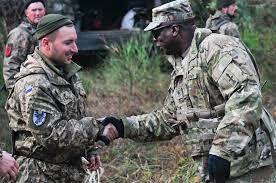
Starting in April 2015, U.S. soldiers deployed to the Joint Multinational Training Group-Ukraine mission trained up to five battalions of Ukrainian troops per year at the Yavoriv base. In Yavoriv, U.S. military advisers, including Army Green Berets and National Guard troops from various states, trained more than 27,000 Ukrainian soldiers. The top Ukrainian trainees were then deployed to serve as instructors within other Ukrainian units.
But the training was not just about teaching battlefield tactics and techniques to Ukrainian troops. “The American mission in Yavoriv is focused on the professional transformation of Ukraine’s armed forces; specifically, helping the Ukrainians ditch the rigid, hierarchical chain of command traditions they inherited from the Soviet Union,” wrote a correspondent for the veterans’ website Coffee or Die, who visited Yavoriv in June 2021.
In the past, the role of noncommissioned officers in the Ukrainian military in battlefield decision-making had been virtually nonexistent. The Coffee or Die correspondent, Nolan Peterson, wrote that the training model was the U.S. military chain of command that “decentralizes decision-making from the upper ranks, teaching junior officers and non-commissioned officers to take the initiative and make tactical decisions based on battlefield realities.”
“It takes time because it’s actually an entire cultural shift. It’s a completely different way of thinking. … They’re surprised when they find out how far down we push those decision-making abilities, and how we maneuver those below the platoon-leader level,” said Capt. Sean Kelsey of the Washington (State) Army National Guard, whose Stryker armored fighting vehicle combat team was deployed to Yavoriv at the time.
“The overall mission is for Ukraine to be interoperable with NATO partners and NATO nations. And (to be) independent,” Kelsey added in the interview for Coffee or Die.
As late as Feb. 2022, about 150 members of Florida’s Army National Guard—Task Force Gator—were at Yavoriv training Ukrainian forces in reconnaissance, on using newly acquired shoulder-fired weapons systems, and on how to prepare their less experienced fighters who had never handled a rifle before.
One training exercise involved the use of M141 bunker-buster weapons which the Biden administration had provided to Ukraine just a month earlier. One Task Force Gator soldier, who took part in the M141 exercise but was not authorized to speak to the press, commented on Facebook that the Ukrainians were “tough and skilled hombres. The Armed Forces of Ukraine get a vote in the direction of their future.”
An unspecified number of special forces with Special Operations Command Europe were also training their Ukrainian counterparts. The Defense Department ordered the U.S. troops to leave Ukraine on Feb. 12, less than two weeks before Russia launched its invasion.
On March 13, Russian forces fired several dozen cruise missiles at the Yavoriv base, killing at least 35 people. Ukraine was using the base to train foreign volunteer fighters.
UkraineWorld, an English-language Ukraine-based multimedia project, in an analysis on the one-month anniversary of the Russian invasion, said that among Putin’s “deadly mistakes” was underestimating the Ukrainian armed forces.
The successful occupation of Crimea played a nasty trick on the Kremlin. Its leaders sincerely believed that the Ukrainian army was not combat-effective, was poorly equipped and commanded, and was poised to fall to pieces after just one serious blow. … This false perception resulted in truly suicidal tactics by Russia’s invading forces: narrow tank columns rolling over long distances with no support. Why bother with air and infantry escorts if no resistance was expected? …
The Ukrainian Armed Forces have not simply retreated or resisted passively, but have shown that they are more than a match for the Russians, capable of active mobile tactical defense and sound strategic planning. They have also demonstrated unsurpassed capacity for combined-arms warfare, coordinating of unmanned combat aircraft, artillery, and infantry.
UKRAINE’S PRO-RUSSIAN PRESIDENT LEFT THE COUNTRY DEFENSELESS
The pro-Russian Viktor Yanukovych won Ukraine’s presidency in a disputed election in 2010—with the help of U.S. political consultant Paul Manafort. Yanukovych strengthened and boosted pay for the elite riot police force, the Berkut, who brutally suppressed internal dissent. Its members were accused of killing more than 100 protesters during the Euromaidan Revolution in February 2014 that ousted Yanukovych from power.
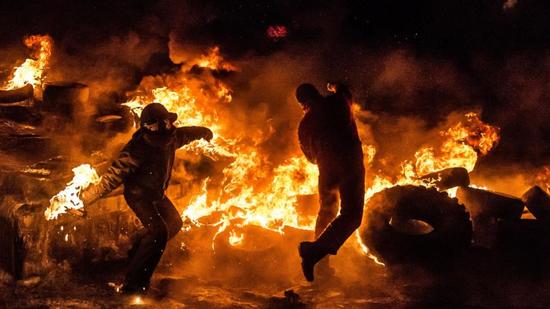
But Putin’s puppet hollowed out Ukraine’s military, turning it into “a depleted, neglected and underfunded force.” He ended military conscription in 2013—Ukraine had 184,000 troops in 2012, but two years later, that number had dropped to 130,000, and Yanukovych’s plans called for reducing the military to half that size. Ukraine’s defense minister estimated that only about 6,000 of those troops from a rapid reaction unit were actually prepared for combat in 2014, according to a New York Times story.
The Times reported:
The Ukrainian Army was all but worthless—rife with corruption and Russian spies, and made up largely of “skeleton” battalions of officers with just a few men. About 1% of the equipment was manufactured in the past decade.
Muzhenko said that 75% of all equipment being used by the Ukrainian armed forces was more than 20 years old and had grown obsolete.
A Ukrainian Marine officer, Lt. Yevgen Zabrodsky, who had been serving at the Naval Headquarters in Sevastopol in 2014, described the humiliating fall of Crimea in a Jan. 2015 article published on a U.S. Army website. Among his duties was helping calculate precautionary measures against a possible incursion by Russia. But after Yanukovych took office, Zabrodsky said the Russian defense plans were scrapped as part of “military reforms.”
“When Yakukovych came to the president’s post, he started to say, ‘No, no, no guys,'” Zabrodsky recalled. “’Russia’s our friends, don’t even think about that, stop doing this.’”
UKRAINE’S NEW GOVERNMENT INTRODUCES WIDESPREAD DEFENSE REFORMS
When Ukraine’s newly elected president, Petro Poroshenko, took office in June 2014, Crimea had already been annexed and the Ukrainian military was barely holding on against Russian-backed separatists in the eastern Donbas region. At the time, Ukraine’s armed forces had many of the same problems that plague today’s Russian invaders, said Liam Collins, founding director of the Modern War Institute at the United States Military Academy, West Point. From 2016-2018, he helped Ukraine reform its defense establishment.
Collins wrote on The Conversation website, a nonprofit, independent news organization: “Corruption was rampant, troops were not getting paid and basic supplies always ran low. Overall logistics and command were also inefficient.”
There were certain steps that Ukraine took to upgrade its military. Within months, Poroshenko had reintroduced military conscription. Ukraine raised its defense budget by almost 25% in 2018. And by 2018, Ukraine’s armed forces were larger and better equipped than ever before, numbering 200,000 active duty military personnel, according to a report by the Carnegie Endowment for International Peace.
Ukraine had inherited about 30% of the Soviet Union’s defense industry when it became independent following the dissolution of the USSR., but only about 30% of that production was earmarked for the Ukrainian military. In 2009-2013, Ukraine was the world’s eighth-largest arms exporter in the world. And Russia was its third-largest customer, after China and Pakistan, according to a 2014 Carnegie Endowment report.
Russia was reliant on Ukraine for helicopter engines, transport planes, and half of the components for Russia’s ground-based ICBMs. But after the annexation of Crimea, Poroshenko imposed a ban on all military-technological cooperation with Russia, halting nearly all exports of weaponry and military equipment.
Although the procurement system for Ukraine’s state-owned defense conglomerate Ukroboronprom remained rife with corruption, Ukraine began earmarking an increased percentage of its defense production to its own military, and by 2019, Ukraine was only 12th among global arms exporters. Ukraine also started purchasing and importing weapons from other countries, including dozens of Turkish-made Bayraktar TB2 armed drones, which played a key defensive role in the first phase of the current war.
U.S. MILITARY INSTRUCTORS BEGIN TRAINING UKRAINIAN TROOPS AT YAVORIV
Ukraine’s own efforts were not enough. The Ukrainian government had revised its strategic military doctrine to identify Russia as the country’s top security threat and needed to transform its military with the objective of being able to defend against a full-scale Russian invasion, according to the Coffee or Die feature.
Poroshenko had set an ambitious goal of modernizing Ukraine’s armed forces to reach NATO standards by 2020. The ultimate goal was to prepare Ukraine for NATO membership. The Obama-Biden administration responded to Poroshenko’s request for help in training and modernizing Ukraine’s military. On April 20, 2015, 300 paratroopers from the 173rd Airborne Brigade began training members of the Ukrainian National Guard at the Yavoriv Training Center, which was once a meeting place for military leaders of the Warsaw Pact, the Soviet-led counterpart to NATO.
The training center was the responsibility of the U.S. 7th Army Training Command, based in Grafenwoehr, Germany. Poroshenko thanked the U.S. paratroopers in a speech at the opening ceremony: “Dear generals, officers, sergeants, and American Soldiers, [a] combined exercise of such scale and content is being held, probably, for the first time,” the Ukrainian president said. “Our meeting today is a symbol of our new partnership and a new future.”
Initially, the U.S. trainers conducted what amounted to advanced basic training classes to prepare Ukrainian troops for combat against Russian-backed separatists in the Donbas region. The fighting had devolved into static World War I-style trench warfare with artillery and rocket attacks, tank skirmishes, and snipers targeting soldiers.
So the exercises involved teaching such basic skills as cutting through coils of concertina wire, using encrypted walkie-talkies, searching for improvised explosive devices, building tank defenses, and saving the lives of wounded soldiers. In the ensuing years, the training exercises got more complex. Here are Ukrainian soldiers conducting a Nov. 2016 exercise in carrying out an air assault:
In 2020, Ukrainian troops honed their urban warfare skills with the help of advisers from the Illinois Army National Guard. The exercises included fighting block-to-block in a large population center, tactically entering residences and buildings, and conducting house-to-house searches.
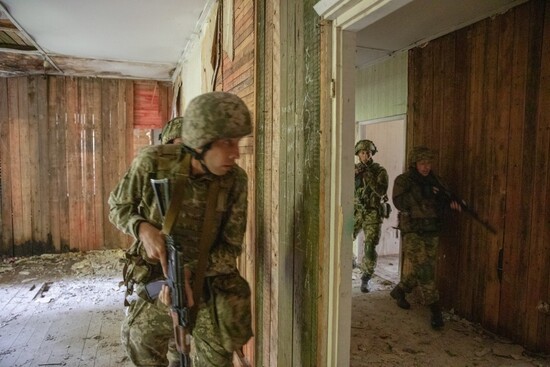
U.S. Army Sgt. 1st Class Joshua Nickels, who had extensive experience in urban missions in the Iraq war, said in an interview on a U.S. Army website that the Ukrainian soldiers were making “quick progress.” And prophetically he added: “From my conversations with Armed Forces Ukraine Soldiers, urban operations have been a big part of their current conflict in the past and may be again in the future.”
Ukraine was not a member of NATO, but Yavoriv, in effect, became the equivalent of a NATO training base.
UKRAINE’S MILITARY GETS TRAINED TO DEFEND AGAINST A RUSSIAN INVASION
Military personnel from the U.S., Britain, Canada, Poland, and several other NATO members eventually broadened the original mission at Yavoriv to prepare Ukraine’s armed forces “to employ maneuver warfare as a defense against an outright Russian invasion,” according to a Coffee or Die reporter who visited the base in June 2021.
A cadre of 300 Ukrainian instructors took over the role of training recruits in basic combat skills. The U.S. troops transformed from trainers to advisers during combat drills. As tensions with Russia increased, Yavoriv was the site of a multinational two-week training exercise in July 2021, dubbed Three Swords-2021, involving more than 1,200 troops and more than 200 combat vehicles.
Here’s how Reuters described it: “Helicopters provided air support, armored personnel carriers rolled through fields, and soldiers fired at enemy targets … as part of a large military exercise hosted by Ukraine and also involving the United States, Poland, and Lithuania.”
U.S. Green Berets and members of the Europe-based 10th Special Forces Group stationed at Yavoriv worked with the Ukrainian military to set up and train commando units to carry out unconventional warfare and guerrilla tactics against Russian invaders. And Ukrainian troops were regularly participating in even larger NATO training exercises in Germany, with the most recent one taking place in Dec. 2021.
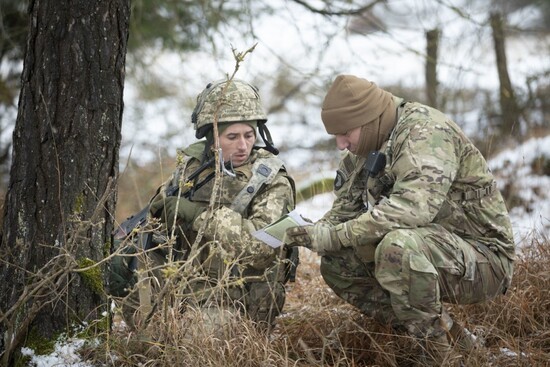
That exercise, known as Combined Resolve XVI included approximately 4,600 soldiers from NATO and non-NATO countries—Bulgaria, Georgia, Greece, Italy, Lithuania, Poland, Serbia, Slovakia, Slovenia, Ukraine, United Kingdom, and the United States.
And in June-July 2021, the Ukrainian Navy and the U.S. Sixth Fleet co-hosted the annual Sea Breeze exercise on the Black Sea, operating out of the port city of Odesa.
The exercise focused on amphibious and land maneuver warfare, diving operations, maritime interdiction operations, air defense, search and rescue missions, and anti-submarine warfare, according to a U.S. Navy press release.
The Navy said it involved the largest number of participating nations in the exercise’s history, with 32 countries from six continents providing 5,000 troops, 32 ships, 40 aircraft, and 18 special operations and dive teams.
And finally, there was the joint exercise that so many of us wish could become reality today, but the risks are considered too high. In Oct. 2018, Operation Clear Sky was held at the Starokostiantyniv Air Base in western Ukraine in which F-15 Eagles from the California Air National Guard flew sorties with Ukrainian Air Force MiG29 and SU-24, 25, and 27 warplanes. Pilots from seven other NATO members also participated.
”The purpose of the exercises is to increase the level of interoperability of our combat aircraft with the air forces of the United States and other member states of the alliance,” said Poroshenko, the Ukrainian president, who attended the exercise.
ZELENSKYY: “RUSSIA DIDN’T KNOW WHAT WE HAD PREPARED TO DEFEND OURSELVES”
Over the past eight years, Russia retained the Soviet chain-of-command model. Corrupt oligarchs and politicians lined their pockets with money intended for defense procurement. Ordinary soldiers pilfered gasoline to the extent that fuel was referred to as the Russian military’s “second currency,” according to a story in Politico.
The invaders found themselves battling a Ukrainian military with high morale and strong motivation to defend against an existential threat to their country. Many of the Ukrainian troops had combat experience from the war in the Donbas. And they were well-equipped and well-trained.
It seems like it was a colossal failure of Russian intelligence to overlook this. Or maybe Russian military intelligence was afraid to deliver bad news to their leader, or Putin chose to ignore reports because he was so arrogant and overconfident.
In a March 18, 2022, video address, President Volodymyr Zelenskyy expressed his gratitude to U.S. President Joe Biden for his “new and effective support” for Ukraine. Zelenskyy added that he couldn’t reveal all the details of the support packages received from the U.S. and other countries. He said:
“This is our tactic. It is our defense. Our adversary shouldn’t know what to expect from us. The same way they did not know what would be waiting for them after February 24. They didn’t know what we had prepared to defend ourselves and how ready we were to take the heat.
“The invaders thought they were going to Ukraine, which they had seen before, back in 2014 and 2015. The country they constantly corrupted and the one they were not afraid of. However, we are different.”