
Starbucks workers are racking up win after win after win, despite vicious anti-union campaign
This post was originally published on this site
The union effort at Starbucks went three for three in vote counts held on Thursday, at one store in Buffalo and two in Rochester. That’s pretty damn good. But on Friday, it appears to have gone four for four, with workers voting to unionize at three Ithaca stores with a combined vote of 47 to three, and the union leading six to one at a store in Overland Park, Kansas. In that case, there are seven challenged ballots—because the company challenged ballots of union supporters to drag things out.
If or when that result holds, it brings the tally to 17 union wins out of 18 votes held at Starbucks stores, with the anti-union practices employed in the 18th under National Labor Relations Board investigation, according to the union. The wins have come in multiple cities in New York; Seattle, Washington; Mesa, Arizona; and now all but certainly Kansas. But workers are organizing across the country, having filed for union representations in Ohio, Oklahoma, Colorado, Florida, Illinois, Virginia, Hawai’i, Pennsylvania, Oregon, Michigan, Missouri, and more.
Starbucks remains committed to its union-busting campaign. In March, the NLRB issued a complaint against the company for retaliating against two Phoenix, Arizona, workers for their activism. But Starbucks actually went on to fire one of those workers after the retaliation complaint. Now, the NLRB is preparing to issue another complaint against Starbucks for retaliation, this time for its firing of seven union leaders in a Memphis store.
All of this looks pretty bad, so Starbucks is going on a PR offensive. Interim CEO Howard Schultz, the company’s founder, is out here warning that “We can’t ignore what is happening in the country as it relates to companies throughout the country being assaulted in many ways, by the threat of unionization,” even as the company bullies and illegally fires teenagers for daring to speak up. In case Schultz isn’t winning over the public with that rhetoric, the company is trying to hire a crisis communications/brand reputation manager.
The alternative, of course, would be … not behaving in a way that leads you to need a crisis communications/brand reputation manager. Stop bullying teenagers. Stop illegally firing workers for exercising their right to speak out and organize. The results are clear: The anti-union campaign is not working, even though it is traumatizing workers.
Without additional support, families of preemies can fall through the cracks
This post was originally published on this site
by Pamela Appea
This article was originally published at Prism.
Brooke Jones was in her late 20s when she became pregnant with her first child. Employed full time as a medical assistant in Connecticut, Jones fully expected to work right up until her due date. Jones described her pregnancy as “normal” and didn’t believe she had any symptoms that were significantly worrisome. But that changed when a routine ultrasound at 25 weeks revealed that her amniotic fluid levels were dangerously low. Shortly after, medical professionals realized Jones’ blood pressure had spiked “through the roof,” she told Prism. She was diagnosed with preeclampsia and was admitted to the closest hospital for immediate treatment.
“They told me I might give birth that day,” Jones said. She was subsequently transferred to Yale New Haven Children’s Hospital, where she was treated for a host of other complications including fluid buildup in her lungs, which meant Jones had to go on medical leave immediately. “I was on autopilot,” she said.
After two weeks of strict hospital bedrest, Jones gave birth to her baby boy at 27 weeks via an emergency C-section. A micro preemie, he weighed only 1 pound, 8 ounces at birth. Earlier in her pregnancy, Jones had carefully thought about her maternity leave schedule, finances, child care logistics and more, but suddenly she needed a whole new plan.
As Jones discovered, balancing medical care, a lack of work leave, and the need for aftercare support and mental health counseling as a caregiver often proves challenging for families with preemies. Jones’ son spent four months in the neonatal intensive care unit (NICU) where doctors treat sick and premature newborns, but her maternity leave only lasted six weeks after he was born, so she had to go back to work long before he was released from the hospital.
In search of emotional and mental health support
Women of color like Jones, who is Black, comprise a significant number of parents who give birth prematurely. According to the March of Dimes, over 380,000 babies are born preterm every year in the U.S.—about one in 10 babies of every live birth. Black and Indigenous women are 60% more likely to give birth preterm than white women.
For the families of preemies, the whole birth experience can be fraught. Often, preemie caregivers aren’t given a lot of time to process that their baby may have short- and long-term medical, developmental, and other complications that require a NICU stay, high-risk surgeries, and other medical procedures.
Additionally, caregivers can feel overwhelmed and experience a wide range of postnatal mental health issues, including depression, anxiety, guilt, and NICU-specific post-traumatic stress disorder.
“The caregivers’ primary need is emotional support. Prematurity is something that is a surprise, and it has a very traumatic effect on the family,” said Tina Tison, executive director of the Tiny Miracles Foundation. The Connecticut-based nonprofit partners with several hospital NICUs in the area to provide counseling, mentoring, and socioemotional support to preemie caregivers. Jones received peer mentor support and financial assistance from The Tiny Miracles Foundation after the birth of her son, including during his lengthy four-month hospitalization in the NICU.
“Any caregiver takes comfort in knowing that they are not alone,” said Tison.
Aftershocks of the pandemic continue to impact caregivers well after their baby has been discharged from the NICU, according to Dr. Angelica Moreyra, an expert in perinatal mental health at the Children’s Hospital in Los Angeles.
“There is currently an enhanced need for advocacy for our families that we serve due to environmental stressors that create barriers for caregiver presence in the unit such as public transit … changes in school and child care options, increased financial, occupational, and housing instability, and more,” Moreya told Prism. “When caregivers encounter barriers in being able to present in the unit, it impacts the nature of our services, as we are focused on supporting bonding/attachment between caregivers.”
Balancing work and care
Apart from the mental and emotional strain, the economic impact of having a preemie can also be significant. According to the March of Dimes, the average NICU bill starts at $65,000. But depending on surgeries, medical procedures, and other complications, many families are expected to pay hospital bills that are hundreds of thousands of dollars or higher. For many, access to health insurance or emergency state health insurance for preemies is crucial. However, more than 2.2 million women in the U.S. live in “maternity care deserts” where families often lack access to necessary prenatal care or don’t have health insurance to cover the costs.
Prematurely born babies are eligible to receive Medicaid and Supplemental Security Income through Social Security. Regardless of a parent’s income level, state insurance typically covers nearly all of the child’s NICU hospital bills, surgeries, post-discharge medical treatment, and other medical and mental health services for both the caregiver and the baby during their first year. Speech, occupational therapy, physical therapy, and other rehabilitative services are typically covered through insurance, early intervention, and occasionally through Department of Education public education services after the age of 3 to 5, depending on the state. However, the process for access to these services is fraught with governmental red tape, making it difficult for caregivers to access.
Even as families face mounting expenses, without extra paid leave caregivers of preemies can find it difficult to hold onto a full-time job given the need for medical appointments, early intervention services, special education services, evaluations, operations, and other treatments for medical issues preemies may struggle with even after “graduating” from the NICU. While Jones’ son’s medical bills and her mental health care were covered by state insurance, her husband ultimately left his job to manage their son’s care and medical appointments.
Working toward policy shifts
As Jones and her husband have looked toward the future and considered having another baby, they’ve become doubtful about the financial feasibility. Without the same state Medicaid services, more paid family leave, and the ability to take time off work for medical appointments, Jones said she was unsure they could afford another child. Her family is far from alone, and advocates for families of preemies argue that a number of policy changes need to be put in place to provide caregivers the support they need, including ensuring universal access to public health insurance programs and a minimum of 12 weeks of paid family leave, with more for families of babies with more significant health and developmental needs. March of Dimes is also pushing for the elimination of racial and geographic disparities in prenatal care and expanded access to coverage for doula and midwifery support to offer caregivers more options both during and after birth.
If she could wave a magic wand around government policy changes for family caregivers, Jones told Prism: “Let us have our time as caregivers with our children. For me, I only got six weeks. Some people are allowed more time. But as a law, I wish it was implemented to give mothers and fathers the [paid] time we need with our kids.”
Pamela Appea (she/her) is a New York City-based independent journalist. She is a contributing writer for Prism where she covers caregiving. Her work has appeared in Glamour, Salon, Wired, The Root, Newsweek, Parents.com (Kindred) and elsewhere. She received her B.A. Degree in English Literature from the University of Chicago.
Follow Pamela on Twitter at @pamelawritesnyc
Prism is a BIPOC-led nonprofit news outlet that centers the people, places, and issues currently underreported by national media. We’re committed to producing the kind of journalism that treats Black, Indigenous, and people of color, women, the LGBTQ+ community, and other invisibilized groups as the experts on our own lived experiences, our resilience, and our fights for justice. Sign up for our email list to get our stories in your inbox, and follow us on Twitter, Facebook, and Instagram.
Ukraine update: Gearing up for a showdown in Kherson
This post was originally published on this site
In the first few days after Russia’s invasion, the bridge on the north side of Kherson became famous as a sign of Ukrainian resistance. Recognizing the importance of that bridge to one of Russia’s strategic objectives—capturing Mykolaiv and Odesa—Russian forces had moved quickly to take the bridge in the first two days of fighting. But then Ukrainian forces took it back. Then Russia seemed to have control. Then Ukraine took it again.
It started to look as if Kherson might use the natural defense of the wide Dnieper River to hold out indefinitely. If things got tough, they could always blow up the critical bridge, greatly complicating Russia’s advance and forcing them to move north to fight again for the bridge at Nova Kakhovka.
Then, suddenly, Ukrainian forces were gone. Russia rolled into Kherson, bridge intact, while the troops that had fought over, and twice retaken, that bridge moved completely out of the city and hurried up the M14 highway to Mykolaiv. Russia had the city. And the bridge. One day later, they also had the Nova Kakhova bridge 40 miles upstream.
With these two wide crossings in hand, Russia was ready to move westward and complete the task of cutting off Ukraine from the Black Sea. In Odesa, mass evacuations began as citizens feared the Russians would roll into the city in a matter of days.
Exactly what happened in Kherson still isn’t clear. How did the Russian military suddenly gain such a decisive upper hand, and why did forces that had been fighting them so successfully suddenly abandon not just the bridge, but the entire city? The answer seems to be: Treason. Officials there were apparently on the Russian bribery dole for years, and unlike officials in other areas of Ukraine, they stayed bribed even after the tanks rolled. As a result, those officials systematically undermined the local territorial defense and refused to provide assistance to troops fighting to hold the city. Those officials ultimately fled the city—possibly running into the open arms of the Russian forces to hand them more information. The details won’t be known until the conflict is over, but betrayal certainly seems to be at the core of how Russia established a beachhead on the west side of the Dnieper.
In the days after Russia took Kherson, the fears of citizens in Odesa seemed justified. Russian troops consolidated their position, captured an 80 mile long swath of territory on the western bank, and began to move toward Mykolaiv from two directions—directly up the M14 from Kherson, and from the east along a smaller highway from Snihurivka.
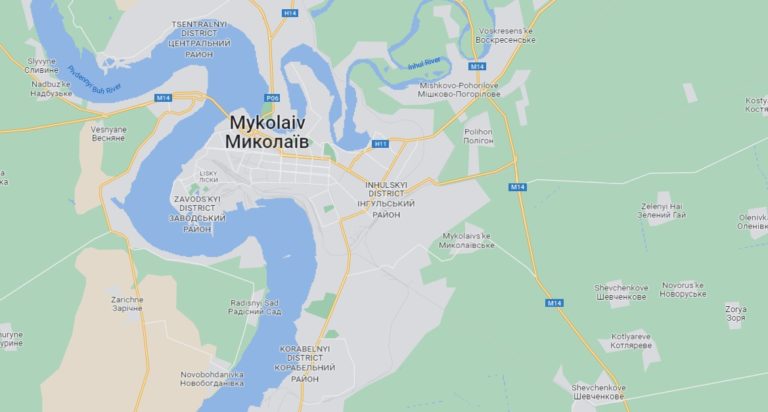
And that’s where things got less happy for Team Russia. Having fallen back on Mykolaiv, Ukrainian troops joined up with other forces and territorial defenses that were already in place in that city. They repulsed repeated attempts by Russia to capture Mykolaiv. When Russia attempted to set up artillery positions around the city, Ukrainian forces managed to sally out and attack those positions, preventing Mykolaiv from becoming besieged. It didn’t hurt that Mykolaiv sits on a peninsula jutting far out into the wide-as-hell Southern Bug River. That essentially means it can only be attacked from one side. If you were going to design a fortress town to withstand an assault, it would be hard to do better than Mykolaiv.
Here, take a look.
Getting a force into Mykolaiv and across it’s crucial bridge means moving through that narrow choke point on the city’s eastern side, then pushing through the entire city center, to reach the possibly still intact bridge. Russia didn’t come close to making it. Instead, it exhausted its forces in one attempt after another to approach the city from the south or east. Russia brought in large numbers of helicopters and planes, positioning them at the Kherson airport just 20 miles to the south. If there was anywhere that Russia had something like decent air support, this was the place.
It still did not allow them to advance through Mykolaiv’s defenses. It’s also likely that those hold-out forces at Mariupol prevented Russia from moving all the forces they wanted to place on the western edge of the advance.
Instead, only a week after being pushed back, Ukrainian forces had begun to range out of Mykolaiv and take back towns and villages along the roads south and southeast of the city. Gradually, they rolled back Russia’s hard-won advances. On March 15, they had advanced far enough to land an artillery barrage on Kherson airport. That not only destroyed a large number of Russian helicopters in place, it forced Russia to move the remainder to a more distant location.
From that moment, Russia’s attempt to capture Odesa by land was likely done. And since multiple attempts to conduct an amphibious landing had already proved futile, the push back from Mykolaiv likely ended any chance of Russia achieving one of its primary strategic objectives. At least in this round.
Since then, Ukrainian forces have been moving from place to place in the area. On Tuesday of last week, Ukraine managed to retake a number of locations at the northeast side of the area Russia had occupied above the Nova Kakhovka bridge. Surprisingly, Russian forces responded by moving back into Snihurivka, which gave the appearance of a fresh advance on Mykolaiv, but may have actually been Russian troops falling back from positions to the north.
For a few days, things seemed to go quiet. That was until Friday, when there were signs of fighting on the south side of Kherson proper. Civilians in the center of the city reported that they could clearly hear explosions and gunfire. There have also been widespread reports of Russians looting and loading up vehicles with consumer goods, which many see as a sign they are about to get the hell outta Dodge.
Before dawn on Saturday in Ukraine, rumors began to circulate that a big action is about to take place. The suggestion here is that the battle in the south isn’t over after all. Ukrainian forces may be more focused on taking Kherson—which remains the only large urban area captured by Russia since the war began, and where over 250,000 Ukrainian citizens are thought to remain — but Russia may have another goal.
Russia may respond by blowing the bridge at Kherson (there have been images showing that Russia has mined the bridge in preparation for taking it down). This would limit any effort to pursue Russian forces across the Dnieper, because this, like the Bug, is a very wide river at the southern end.
That would leave the bridge at Nova Kakhovka. If Ukraine could move quickly toward that bridge from north and south, they could potentially cut off a large Russian force, stranding them on the west side of the river. On the other hand, there are suggestions that Russia intends to press more troops across the river at that point, resuming the attempt on Mykolaiv from the east. Which … good luck on that. See map above.
As of early on Saturday, the battle for Kherson appears to be underway with Ukrainian forces moving toward the southern part of the city both along the M14 from Mykolaiv, and by pushing along the river bank up the narrower T1501.
This still places a significant distance (about 15 miles, depending on the route) between Ukrainian forces and the Kherson bridge. In between, the Ukrainians have to do what Russia has found so difficult—capture a city center. And Ukraine will likely make this attempt without even thoughts of using artillery or MLRS systems that would have to be aimed into their own city. If Russia contests Kherson, the fight could get extremely difficult, and the city could face a level of destruction that has so far been avoided, with fighting vehicles and tanks duking it out in the streets.
But it’s not clear Russia will contest the city. The Ukrainian military has stated they expect the city to be captured “within days,” so expect an advance, but don’t expect a lightning advance. The presence of those Russian troops around Snihurivka and the suggestion that more forces could move across the Nova Kakhovka bridge to join them, certainly means that some Ukrainian forces are still in place around Mykolaiv to guard against a move on the city. There hasn’t been any news over the last few days about Ukraine recapturing more towns or villages on the north of the western bank “bulge,” so those troops may have moved into defensive positions. Or they could be preparing an advance to the south. We don’t know.
But if Ukraine can recapture Kherson, it will mean that Russia has lost the only city it managed to take, and that one came more through treachery than military prowess. If Russia blows the bridge, those forces at Kherson won’t be able to cross to attack forces north of the Crimea, and they won’t be able to restore the lock and dam that could limit water to the Crimea, which has been critical in restricting Russian development there. But if Russia blows that bridge, the Ukrainian forces in Kherson simply won’t stay in Kherson, because there will be no point.
They’ll move somewhere else, and continue the fight.
An NBC News investigation of the company that refinanced Trump Tower turns up a whole lot of weird
This post was originally published on this site
In the long grind of sketchy political stories, we’ve now got enough straight-up corruption news piled up to last the rest of Donald Trump’s remaining life. It’s still not clear anything will actually come of it, because it’s also been demonstrated that you can do ab-so-lute-ly anything, so long as you are willing to pay for more lawyers than state or federal governments are willing to pay for theirs—but we have a general picture. The citrus-tinted blowhard has for decades been part of an American subclass that dabbles in everything from money laundering to tax cheating to boosting international oligarchies to sex trafficking to immigration fraud to take-your-pick, all of it backed by banks whose bottom lines depend on looking the other way and an American political class that will write new laws faux-legalizing pretty much anything you ask them to in exchange for a handshake and a four-figure check.
Then there’s the stories that are just … odd. Maybe there’s something crooked afoot, maybe there’s not, but there’s an inherent weirdness to them that can’t easily be explained away. So, for example, we’ve got this weird, weird NBC News story about the company that refinanced Trump’s flagship Trump Tower.
Trump Tower’s $100 million mortgage was the subject of some heated speculation after Trump launched a coup against the U.S. government that left people dead in the U.S. Capitol building, with some innocent souls wondering if Trump could ever find a bank sleazy enough to work with a seditionist. Things looked grimmer still when, at the beginning of the year, Donald Trump’s longtime auditors severed all ties with Trump and announced that they were no longer standing by the Trump Organization’s last 10 years of financial statements—the Wall Street way of announcing that they found something going on so sketchy that they absolutely do not want any part of it, whether Trump’s checks are clearing or not, and that they don’t intend to go to jail over it.
Listen and subscribe to Daily Kos’ The Brief podcast with Markos Moulitsas and Kerry Eleveld
But the Trump Tower’s mortgage, as it turned out, was a non-issue for Trump. Mere days after Trump’s auditors cut him loose and announced that his company’s financial statements were, screaming-between-the-lines, “Extremely Likely To Be Crooked,” Trump Tower got a $100 million refinance inked with Axos, a smallish bank previously known as the “Bank of Internet USA” and which is currently headed by an ex-Indymac executive who migrated to the company just before the whole “we nearly broke the entire world economy” Wall Street debacle of 2008.
Okay, fine, it’s a little weird that the mortgage for Trump Tower was taken on by a bank with an internet presence but no actual branches, one headed by an executive that managed to land on his feet despite his prior institution not just collapsing, but cratering so spectacularly that its failures will be a permanent mention in new U.S. history textbooks. But what we can glean from this, probably, is that none of the banks Trump had previous relations with wanted to deal with him despite the pile of money involved, while the new company figured he’d still be worth that extra risk.
But the NBC News investigation also revealed some other weird things at play here. Things that all look a bit sketchy to us laypeople, but which may also plausibly be just the way everything in Wall Street tends to roll these days—at least, that’s how the company is trying to sell it.
Weird things ranging, for example, from the two ex-employees suing the company after they were fired for flagging sketchy behavior ranging from allegedly hiding problems with shaky loans …
… to offering “cash recapture” loans of a sort that can facilitate international money laundering …
… to joining up with other companies to offer the small business equivalent of “payday loans,” loans that evade typical regulations limiting how much interest those companies can charge.
Which, okay, sounds a bit weird! The ‘hiding problems with shaky loans’ bit is straight out of the 2008 financial crisis, but I imagine none of us are really expecting that banks are not diving right back into the break-the-economy behaviors that gets the breakers big bonuses before everything goes to hell.
It’s a bit weird that the company has been accused of making things too easy for money launderers, given that Trump Tower and Trump’s other real estate ventures have been noted for decades to be hubs of Russian money laundering. But again, real estate laws have been very carefully crafted to facilitate money laundering, so can we even count it as “weird” anymore? Or is it just business as usual?
And the last one, the charging grotesque interest rates through loopholes in laws barring such things, which NBC refers to as an alleged “rent-a-bank scheme,” is a bit weird only because it turns out it was the Trump administration that put the rule allowing it in place, and it’s already being rescinded by the Biden administration for being obviously sketchy. So, um, extra points to them for managing to squeeze some profit out of a fleeting rule change that was pretty much destined to be yanked back again the second a non-sketchy administration took charge. I guess.
But it doesn’t even end there. NBC News also notes that the company has a history of going after anonymous bloggers who call attention to their weirdness and that the company head responded to an auditor’s whistleblowing by suing him and the auditor’s mother for taking “confidential” information, which, ok, bringing in the guy’s mom definitely ranks high on the old financial company weird-o-meter but in a world with Elon Musk, Peter Lawsuitguy, and a man who hand-stuffs each of his famously crappy pillows with sedition-promoting conspiracy theories, it barely rates. We just have to live with the knowledge that our rich betters are super, super not-pleased with our common rabble opinions these days.
The question NBC News is raising with all of this is what the hell we outsiders are supposed to be making of all of it. Donald Trump had his bacon saved mere days after his company’s auditing firm publicly told the world that there was Something Extremely Sketchy Going On with his bookkeeping, and a look at the low-profile company that bailed him out suggests both that they’re a company that specializes in loans that are a little sketch and has ex-employees who claim that they got fired for pointing out the sketch, which makes the company sound like it went to prep school with Eric Trump or something.
The company’s defense to ex-employee charges that it’s being too permissive with potential money-laundering behavior, by the way, is an assertion to NBC News that such loans are subject to “a full, know-your-customer investigation” before approval, which … okay. Sure, that would be responsible behavior. It’s difficult to imagine a company staying in business very long if they didn’t do such things.
I’m not sure how a company like that would miss a red flag as big as “mere days before we signed this paper, the company we provided a loan to was fired by its own auditors for up to ten years of misleading or fraudulent financial statements” but none of us here are bankers, and we don’t know how this stuff works. It’s all just a bit weird.
It’s gonna be even weirder if some company that once called itself “Bank of Internet” ends up foreclosing on Trump Tower if and when Donald Trump’s finances collapse yet again, but we’re not going to put odds down on that one, either.
McConnell, master of red-line drawing, draws the line at morality
This post was originally published on this site
Whenever someone starts asking Minority Leader Mitch McConnell about morality, it’s bound to get uncomfortable. Over the years, McConnell has made it perfectly clear that his world is singularly ordered around the pursuit of power—a scheme in which morality has found no audience.
Luckily for McConnell, nearly every Capitol Hill reporter has given up on trying to figure out where the longtime GOP leader might draw the line on the path to his Holy Grail—what might be a bridge too far. Instead, D.C. reporters uniquely obsess over the strategic considerations of the supposed mastermind—who incidentally whiffed on his golden opportunity to sideline Donald Trump forever electorally during his second impeachment.
McConnell is, in fact, an avid purveyor of red lines. Increasing taxes on wealthy individuals and corporations is a red line for him, as was supporting a pandemic relief package that didn’t include liability protections for companies that put their workers lives at risk. Indeed, McConnell’s pronouncements over the years have been riddled with so-called red lines.
That’s what made a line of questioning this week by Axios’ Jonathan Swan about McConnell’s “moral red line” so entertaining.
Initially, McConnell thought he could slide right past the query without too much scrutiny. In response to Swan’s description of him as politically “ruthless,” McConnell joked that his wife thinks he’s nice, his kids like him, and then further ribbed that he was “shocked to hear such a comment.”
But Swan wasn’t playing McConnell’s game. “So moral red lines, where do you draw them?” Swan repeated.
McConnell, treading water, actually asked Swan to repeat the term, as if the concept was so foreign, it didn’t quite compute.
Finally, McConnell offered, “I’m very comfortable with my moral red line.”
After Swan asked the question, lingered on it, and then dug a little deeper, McConnell finally said, “You want to spend some more time on this?”
“I actually do,” replied Swan.
Of course, he did. It was a sit-down interview in front of a live audience. McConnell was captive, without the ability to simply walk away from the mic the way he routinely does at press conferences. The whole exchange was so cringey, it was delightful.
Then Swan invoked Liz Cheney, noting that she had the same view as McConnell about Trump being culpable for Jan. 6. But while McConnell has said he would vote for Trump if he were the 2024 nominee, Cheney has made perfectly clear that Trump must be destroyed.
“I’m just actually trying to understand,” Swan offered, “Is there any threshold for you—”
“You know, I say many things I’m sure people don’t understand.”
In short, no.
Watch it:
Proud Boys fold like a cheap suit, Oath Keepers raked by judge on way to trial
This post was originally published on this site
In one courtroom in Washington, D.C., on Friday, a leader of the neofascist, pro-Trump Proud Boys, Charles Donohoe, pleaded guilty to conspiracy to obstruct the 2020 election and assaulting a police officer during the melee at the U.S. Capitol on Jan. 6, 2021.
In another courtroom just nearby, nearly a dozen members of the Oath Keepers listened in as a federal judge gave the extremist group’s defense attorneys a heaping dose of reality as they—and the nation—careen toward a historic seditious conspiracy trial later this year.
Proud Boy enters guilty plea, others follow
Donohoe, 34, is just the latest member of the Proud Boys to flip on his friends in the face of jail time. Once the leader of the network’s North Carolina chapter, Donohoe could receive up to seven years at sentencing. As a part of his plea agreement, he must cooperate with the Justice Department’s massive probe of Jan. 6 on their command.
Charles Donohoe Plea Agreement by Daily Kos on Scribd
According to court records, Donohoe admitted that around Dec. 19, 2020, Proud Boys leader Henry “Enrique” Tarrio enlisted him into a special division of the group known as the Ministry of Self Defense.
It would focus on planning and executing national rallies, and communication was hot and heavy through messaging apps like Telegram.
Donohoe said that under Tarrio’s leadership, he and co-defendants Ethan Nordean, Joseph Biggs, and Zachary Rehl were given a series of tasks aimed at stopping the certification of the election by Congress on Jan. 6.
Tarrio, Nordean, Biggs, and Rehl vow they are not guilty.
But according to Donohoe, it was up to him to recruit new members for the Proud Boys’ Jan. 6 mission, and just after Christmas, it was Tarrio’s warnings about the “D.C. government” that he reposted in their group chat.
The message suggested Congress was preparing to “limit access to Washington on Jan. 6” in order to “deny [that] Trump has the people’s support,” court records show.
“We can’t let them succeed. This government is run FOR the people, BY the people… Congress needs a reintroduction to that fact,” Donohoe wrote on Dec. 27.
By Jan. 4, Donohoe knew the Proud Boys were discussing storming the Capitol though he had yet to make a decision about whether he would come to D.C. to help.
US v Donohoe Statement of Offense by Daily Kos on Scribd
But when he learned Tarrio had been arrested, that sealed it.
Tarrio had an outstanding warrant following his Dec. 12, 2020, theft and burning of a Black Lives Matter banner from a D.C. church. He told police he was in town to sell a Jan. 6 rally-goer a pair of empty magazines for high-capacity firearms.
RELATED STORY: Feds indict Proud Boys leader Henry Tarrio—finally
Donohoe created a “New MOSD Leaders Group” after the ringleader’s arrest and told other Proud Boy leaders to clear their chat history and hide any trace of plans to stop the count. Shortly after, he “nuked” that messaging group and created another.
In the new group, Donohoe wrote he was worried “gang charges” could be brought against them all after Tarrio was picked up. He texted members to “stop everything immediately.”
“This comes from the top,” Donohoe wrote.
But by 9:17 P.M. on Jan. 5, prosecutors say fellow Proud Boy Biggs posted to the group telling Donohoe and others there was a meeting with “a lot of guys” and “info should be coming out.”
Tarrio had been released just four hours before that message was sent on Jan. 5.
According to Tarrio’s indictment, he went straight from his release to a meeting with Elmer Rhodes, leader of the Oath Keepers, in an underground parking garage in D.C. Their meeting lasted 30 minutes.
By 9:20 P.M., Tarrio was added to the new MOSD chat, a statement of Donohoe’s offense notes. By midnight—now Jan. 6—Tarrio was allegedly posting in the group again giving instructions to meet at the Washington Monument by 10 A.M.
Donohoe was in D.C. by 6 A.M., and within a few short hours, prosecutors say he, Nordean, and Biggs led a group of more than 100 Proud Boys in a march to the Capitol.
They knew the crowd had grown aggressive and they knew Capitol Police were severely outnumbered, prosecutors say. Donohoe knew his actions were illegal when he followed Nordean and Biggs over police barricades to go inside.
Once in, Donohoe fielded more texts. One asked him if anyone had deployed mace yet.
“We are trying,” Donohoe responded before throwing water bottles at a line of police.
Donohoe eventually ran into Dominic Pezzola—another fellow Proud Boy, though Pezzola has pleaded not guilty.
Pezzola, also known as “Spaz” was carrying a riot shield he allegedly wrestled from a police officer. Donohoe took it and led Pezzola to the Capitol’s west plaza. He snapped a picture of the shield and sent a text to leadership.
“Got a riot shield,” Donohoe wrote.
Working his way back around to the rear of the Capitol, Donohoe recognized another Proud Boy, Daniel “Milkshake” Scott. Scott—who has pleaded not guilty—was in an altercation at the front of a crowd, prosecutors say, near concrete steps.
The steps were the pathway Donohoe used to push through police trying to stop their advance. He was hit with pepper balls and eventually left. Around 7 P.M., Donohoe boasted to leadership about “storming the capitol unarmed.”
In a statement Friday, Donohoe’s attorney said his client “regrets his actions and is remorseful for the conduct that led to these charges.
“He accepts responsibility for his wrongs and is prepared to accept the consequences,” public defender Ira Knight said.
He will remain in jail until sentencing which is expected sometime after July 8.
Meanwhile, other Proud Boys, including West Virginia chapter leader Jeffrey Finley and California Proud Boys member Ricky Willden have entered guilty pleas, too.
Neither Finley nor Wilden faced conspiracy charges tied to stopping the election certification by Congress on Jan. 6, but Finley, 29, faces up to a year in prison for illegally entering the Capitol. Prosecutors say he appeared in photographs standing beside leaders of the Proud Boys as they breached the Capitol.
He also donned an earpiece and engaged with Proud Boys in a Telegram chat group called “Boots on the Ground.” Prosecutors said Finley also tried to obscure his involvement, telling members to delete photos and videos.
“No talks about D.C. on Telegram whatsoever and gathering [numbers] as we speak,” Finley wrote.
Finley Plea Agreement by Daily Kos on Scribd
As for Ricky Willden, the 40-year-old self-proclaimed member of the Proud Boys pleaded guilty to one count of assaulting, resisting, or impeding officers on Jan. 6. The California resident admitted to attacking police with chemical sprays and then chucking the canister at police when it was empty.
Willden faces up to eight years in prison, but now that he has agreed to cooperate, he will likely see that shaved down. He will remain detained until his sentencing in August.
Ricky Wilden Plea Agreement Jan 6 by Daily Kos on Scribd
Jeremy Grace, another Proud Boy, also copped a deal Friday. The Battle Ground, Washington, resident flew to D.C. for the Jan. 6 rally with his father, Jeffrey Grace, on Jan. 4. They attended Trump’s speech at the Ellipse and headed toward the U.S. Capitol.
According to Grace’s statement of offense, he was behind the front line of individuals crossing barricades and eventually made his way into the Senate through a door on the northwest side. Together, Grace walked with his father to the Capitol Rotunda before climbing out of a broken window.
They took selfies and shot video as they chanted, “Our house!”
Grace’s father has pleaded not guilty.
Jeremy Grace Proud Boy Plea Ag by Daily Kos on Scribd
Tough day in court for Oath Keepers
Meanwhile Friday, defense attorneys for the Oath Keepers were put to the task by U.S. District Judge Amit Mehta.
Discovery in the sprawling and historic seditious conspiracy case is massive and in the run-up to trial, defense counsel for Rhodes has argued there hasn’t been enough time to prepare, pointing to the voluminous amounts of video footage they must comb through to make their case. They have also complained about incomplete records of evidence provided by the prosecution to the defense.
But that’s just not so, according to Judge Mehta.
He emphasized that defense attorneys have had several months to hone their case and sort out what will be relevant in the heap of evidence they have had access to.
To that point, he said, it won’t be video footage of Rhodes or some other Oath Keepers charged with conspiracy breaking a window that will make or break the defense, for example.
“What’s in the videos is not going to reveal what’s in the defendant’s state of mind,” Mehta said Friday. “What will matter is what is in these chats, what is in their social media, what is in the witness interviews. It will matter what they said to each other, what people overheard.”
There are some 45,000 text messages the government deemed important evidence to bring to the impending trial. Mehta sharply told Rhodes’s defense attorney Phillip Linder, he may want to start digging in there.
“Focus on what matters,” the exasperated judge said Friday.
The government has turned over the lion’s share of its evidence available for discovery, including 10,500 videos it seized off Oath Keeper devices alone, grand jury transcripts, and more.
There were also at least 15 Signal group chats on devices that the government found relevant to the seditious conspiracy charges.
All of this was provided to defense attorneys in October.
“Unlike a lot of other defendants, most Jan. 6 cases genuinely are primarily about what the people did at the Capitol that day. This case has to do with that, undoubtedly true, but this is much more about what was said before Jan. 6, what was done in the days leading up to it and what was done on that day and important what was done after, OK? So, I don’t think anything that was done before Jan. 6, nothing after Jan. 6 was captured in video. It’s all in the chats, in their social media. That’s where you need to be looking,” Mehta said. “That’s whats going to tell a jury, not me, a jury, whether these folks engaged in a conspiracy to interfere with Congress.”
Beyond the scope of discovery, there’s also the sheer size of the trial causing much consternation for Judge Mehta.
Much of Friday’s conference was devoted to figuring out how to best run the trials once they kick off. There are 10 total defendants, plus attorneys for each defendant, a jury, court clerks and officers, and press that would need to squeeze into a single room.
Even the large ceremonial courtroom at the federal courthouse wouldn’t suffice. If the trial is moved offsite, then questions about how to properly detain defendants during breaks arise. The same issues plague the Proud Boys conspiracy case.
Defense attorneys have pushed to keep the Oath Keepers together for trial, arguing that splitting them apart would be unfair. Mehta disagreed and proposed that the first batch of Oath Keepers— Jessica Watkins, Joseph Hackett, Kenneth Harrelson, David Moerschel, and Thomas Caldwell—go to trial this July.
Elmer Rhodes, Roberto Minuta, Brian Ulrich, Edward Vallejo, and Kelly Meggs would go to trial in September.
This spurred defense attorneys to pose an interesting proposition: If three other Oath Keepers strike a plea deal—bringing the total group to be tried down to just eight Oath Keepers instead of 10—would that mean Mehta would consider trying them at once?
The judge was careful not to appear with his thumb on the scale; he told attorneys what they decided to do with plea agreements was their decision.
Judge Mehta also informed defendant Kelly Meggs during Friday’s hearing that his attorney, Jonathon Moseley, would not be able to defend him after the commonwealth of Virginia disbarred him last week for disciplinary reasons.
Meggs, who leads the Florida Oath Keepers division, said he has had significant difficulty obtaining a new lawyer because of restrictions placed on him at the D.C. jail.
Mehta said he would contact the jail to ensure he had access and, in the meantime, encouraged Meggs to ask his wife, Connie Meggs, for help. Meggs has claimed he is innocent. He has said in court that he was trying to help U.S. Capitol Police Officer Harry Dunn during the chaos, not hurt him.
Mark Zaid, an attorney for Dunn, told Daily Kos the suggestion was purely laughable.
“It is ludicrous to assert any of the Jan. 6 seditionists in any way came to the defense or provided assistance to Officer Dunn. Nor, as the judge noted, would it be relevant to the culpability of their actions that day,” Zaid said.
And defense could comb through as much video footage of the day as they like, including any body cam footage they claim exists, Zaid said.
Meggs would be searching for something that doesn’t exist. USCP officers do not wear body cameras.
The next status hearing in the seditious conspiracy case is slated for May 6.
Saturday, Apr 9, 2022 · 10:26:56 AM +00:00
·
Brandi Buchman
An earlier version of this story omitted defendant Joseph Hackett.
Ukraine update: Russia has their own 'Switchblade.' It just doesn't seem to work
This post was originally published on this site
We’re currently putting together a look at some movements going on in the area of Kherson, as well as what’s going on in the east. In the meantime, here’s a smorgasbord of smaller items from around Ukraine this morning.
After Friday’s missile attack on a crowded railway station in Kramatorsk, in which at least 50 people, including 5 children, died, attempts to evacuate civilians from the area are continuing. But on Saturday, air raid sirens are again sounding in towns across eastern Ukraine and there is word that Russia is specifically targeting the rail system. There are multiple evacuation trains scheduled for today in Slavyansk, a large town directly adjacent to Kramatorsk. So far, those trains seem to be getting away safely, but this is certainly a tense situation.
The EU is continuing to fast track the admission of Ukraine. Though emergency measures have temporarily simplified processing of those seeking to cross the border into Poland and Slovakia, and reduced or eliminated tariffs on goods, actual EU membership should help ensure that the flow of goods and people between Ukraine and the rest of Europe has fewer restrictions. The economic ties should also make Europe more invested in the success of Ukraine in holding off the Russian invasion. At present, there is no “EU military” and no mutual promise of protection built into this membership. Both things have been proposed, but are unlikely to be in place within the next few years.
The first Switchblade systems, from U.S. manufacturer AeroVironment, are now in Ukraine, but so far there has been no announcement of their use. However, there is a reminder this morning that Russia also has a “loitering munition” or “kamikaze drone” in the form of the ZALA KYB-UAV.
And, of course, this being 2022, there is also a page from the manufacturer, Zala Aero Group, to explain and market this weapon. Though the fact that their video shows nothing but repeated footage of a single Zala apparently missing a target (but hey, it gets close) doesn’t seem all that big a sales pitch.
In theory, the ZALA drone falls in between the Switchblade 300, which targets either lightly armored vehicles or people, and the considerably larger Switchblade 600, which carries a much more significant explosive capable of taking out armored systems. With a 3Kg (6.6 lb.) warhead, the Zala should be able to deliver a decent punch, possibly taking down an armored target or a group of infantry.
There have been at least two previous claims that the Russian military had deployed a ZALA drone. However, the precision loitering munition seems to be a bit … imprecise. In one case, it was found on the ground unexploded, and this time it seems to have missed the target.
Yet another of those translations from @Dmitri of Russian soldiers placing calls to their families back home.
Soldier: “I didn’t tell you yesterday.”
Wife: “What?”
Soldier: “Our whole company is f*cking gone.”
The ZALA is far from the only Russian drone flying. They also have their equivalent of the Turkish Bayraktar in the form of the Kronshtadt Orion-E. (Yes, there’s a promotional video). How many of these drones have been used in Ukraine isn’t clear, but this one is done.
Abbreviated Pundit Roundup: Zeroing in on the Jan 6 conspiracy
This post was originally published on this site
Hugo Lowell/Guardian:
Capitol attack investigators zero in on far-right Oath Keepers and Proud Boys
Panel appears to believe militias coordinated to physically stop certification of Joe Biden’s election victory on 6 January last year
The panel’s working theory – which has not been previously reported though the justice department has indicted some militia group leaders – crystallized this week after obtaining evidence of the coordination in testimony and non-public video, according to two sources familiar with the matter.
Counsel on the select committee’s “gold team” examining Donald Trump, the “red team” examining January 6 rally organizers, and the “purple team” examining the militia groups, are now expected to use the findings to inform the direction for the remainder of the investigation, the sources said.
For more of what these groups were up to, see Daily Kos reporting from Brandi Buchman.
Ukraine’s ‘iron general’ is a hero, but he’s no star
Meet Valeriy Zaluzhnyy, the commander in chief of the Ukrainian Armed Forces, who’s quietly leading the fight against Russia’s invaders.
If a single person can be credited with Ukraine’s surprising military successes so far — protecting Kyiv, the capital, and holding most other major cities amid an onslaught — it is Zaluzhnyy, a round-faced 48-year-old general who was born into a military family, and appointed as his country’s top uniformed commander by President Volodymyr Zelenskyy in July 2021. Zaluzhnny and other Ukrainian commanders had been preparing for a full-on war with Russia since 2014.
Unlike, say, “Stormin’” Norman Schwarzkopf, who led U.S. troops in the first Persian Gulf War, or David Petraeus, who presided over the Iraq war and was nicknamed “King David,” Zaluzhnyy has largely avoided the spectacle of a celebrity commander — deferring that role to Zelenskyy, a former actor and comedian who has captured the public’s imagination.
Phillips P. O’Brien/Atlantic:
Why Ukraine Is Winning
Ukraine’s success illuminates a strategy that has allowed a smaller state to—so far—outlast a larger and much more powerful one.
The Ukrainian way of war is a coherent, intelligent, and well-conceived strategy to fight the Russians, one well calibrated to take advantage of specific Russian weaknesses. It has allowed the Ukrainians to maintain mobility, helped force the Russians into static positions for long periods by fouling up their logistics, opened up the Russians to high losses from attrition, and, in the Battle of Kyiv, led to a victory that has completely recast the political endgame of the Russian invasion. The original maximalist Russian attempt to seize all of Ukraine has been drastically scaled back to a far more limited effort aimed at seizing territory in the east and south of the country.
The Ukrainian way of war has a few foundational elements that we have seen in operation around Kyiv and across the country. They are:
- Contesting air supremacy over the area of battle;
- Denying Russia control of cities, complicating the Russian military’s communications and logistics;
- Allowing Russian forces to get strung out along roads in difficult-to-support columns; and
- Attacking those columns from all sides.
Yair Rosenberg/Atlantic:
Is Israel’s Government on the Brink of Collapse?
Reports of the Israeli coalition’s demise and Netanyahu’s comeback are greatly exaggerated. For now.
On Wednesday morning, Israel was rocked by a revolt that appeared to reshuffle its political map. A single lawmaker from the governing coalition, Idit Silman, dramatically announced that she would be defecting to the opposition. Why does this move by someone most people have never heard of matter? It’s math. The Israeli parliament, or Knesset, has 120 seats. With Silman’s switch, it is now split 60–60 between coalition and opposition. The anti-Netanyahu government that took office in June 2021 no longer has a majority.
Is this the end of the new Israeli government? Will Netanyahu return to power? How exactly did this happen, and what comes next? Here are five insights that help untangle these questions and explain where Israel is heading.
Jonathan V Last/Bulwark:
Democrats Are Screwed No Matter What They Do
There is no world in which Democrats could have won in 2022 by being more moderate and working-class friendly.
The child tax credit was the ultimate kitchen-table issue. Then Republicans killed it. They own—lock, stock, and two smoking barrels—the act of taking this money away from working families.
And yet the same voters who benefitted from this program are basically ¯_(ツ)_/¯
So maybe this political moment isn’t actually about kitchen-table issues? Or about Democrats not being friendly to moderate, working-class voters? Maybe outcomes are being wildly overdetermined by environmental factors beyond the control of either party?
Maybe—and I’m just thinking out loud here—Republicans could run a bunch of crazy, violent extremists whose platforms are entirely backward-looking and still do very well in the midterms.
Maybe Democrats could do everything perfecto—could run the administration of Mitt Romney’s moderate, working-class dreams—and still lose both the House and Senate.
Greg Sargent/WaPo:
A Democrat erupts at Josh Hawley, and a ‘loudness’ gap is revealed
“Democrats need to make more noise,” Sen. Brian Schatz told me. “We have to scream from the rooftops, because this is a battle for the free world now.”
I contacted the Hawaii Democrat to talk about his extraordinary eruption at Sen. Josh Hawley on the Senate floor Thursday. Schatz ripped his Missouri Republican colleague over his hold on a senior staffing nominee to the Defense Department, even as the United States is calibrating its response to the Russian invasion of Ukraine.
But that was the superficial cause of the eruption. The deeper catalyst was how Hawley is doing this — that his arguments are saturated in almost bottomless levels of bad faith. That’s the real topic of Schatz’s tirade, and you should watch all of it…
This raises some questions: Why don’t Democrats create moments like this more often? Are there other ways of getting loud, as Schatz did here, that don’t degrade our politics and are substantively and politically productive?
Aaron Blake/WaPo:
LGBTQ issues are at center stage. What does the public think?
What polls say on Florida’s ’Don’t Say Gay’ law, transgender athletes and other issues
We have had a very limited — and often unclear and even contradictory — picture of where Americans stand on these issues, thanks to a paucity of public polling. That is beginning to change, though. Below are some takeaways from, and analysis of, the recent polling.
News Roundup: A moment of true history worth being alive for

This post was originally published on this site
Hello, Friday folks! It was a week that continued to stress us out, but also one filled with the kinds of moments that remind us all of how far we have come toward achieving a greater union. It is a reminder of what can be achieved in our country, and why we must all continue to be dedicated to the unfinished work.
Will Donald Trump ever go away? Probably not as soon as most of us would like, which would have been about seven decades ago. Right now, hearing Donald Trump’s name almost exclusively tied to legal actions doesn’t bug one nearly as much as hearing the droning dirge of bigotries from people like Marjorie Taylor Greene or Paul Gosar. And there is good news this week, as Judge Ketanji Brown Jackson was confirmed and becomes the first Black woman on the Supreme Court in the history of our country. That is a historic moment worth being alive for.
Here is some of what you might have missed.
- The rejoicing for Justice Ketanji Brown Jackson continues
- One Democratic senator has had enough of Josh Hawley’s attacks on democracy
- New York AG Letitia James asks judge to hold Donald Trump in contempt of court
- The horror of Bucha finally shakes Russia trade bill loose from Senate Republicans
- Former Republican staffer sentenced to 12 years in prison for operating child pornography ring
- ‘Surely we are better than this’: Famed civil rights activist Ruby Bridges speaks out on book bans
- Chris Murphy just showed every progressive how to call out transphobes like Marjorie Taylor Greene
- Cheney impugns her ‘sad’ and ‘tragic’ GOP colleagues’ continued complicity in Trump’s crimes
- Peter Thiel lashes out, seems to indicate we need massive taxes and regulations on wealthy investors
- Trump’s Mar-a-Lago document stash has drawn FBI attention
- Mike Lindell boasts spending $800K on MAGA-supporting election official’s defense—which isn’t legal
- Biden’s handling of Ukraine appears to be breaking the fever of negativity around his approvals
- Brian Kolfage, the guy who raised millions to build a wall, pleads guilty to fraud charges
And from the community:
Rep. Ronny Jackson, the ex-White House doc who praised Trump's 'good genes,' is under investigation
This post was originally published on this site
The GOP’s crack team of doctors (sorry, “quack” team—damn you, spellcheck!) includes such luminaries as Mehmet Oz, Ben Carson, Scott Atlas, and Ronny Jackson, the dude who turned a slovenly heap of fly-pocked Crisco into a Greek Adonis through the magic of barmy bullsh*t.
Now Jackson, who leveraged his unique proximity to Donald Trump’s eminently unkissable bum into a congressional seat, is under investigation by the House Ethics Committee. We don’t exactly know why yet, but if his past assessments of Trump’s “health” are any indication, it likely has to do with rank dishonesty.
The committee’s chairman, Rep. Ted Deutch (D-Fla.), and top Republican, Rep. Jackie Walorski (Ind.), said in a statement that the panel has extended its review of Jackson after receiving a referral from the Office of Congressional Ethics (OCE), an independent watchdog, in late December.
The statement from the House Ethics Committee did not detail the allegations against Jackson.
But a spokesperson for Jackson said that the review concerns his campaign finance activities and that the former White House physician-turned-lawmaker has cooperated with the investigation.
You’ll recall Jackson’s North Korean-like spin from his days as Trump’s personal physician, when he issued a bizarre, fawning report on his health—saying, among other things, “He has incredibly good genes, and it’s just the way God made him. … I told the President that if he had a healthier diet over the last 20 years he might live to be 200 years old.”
Listen and subscribe to Daily Kos’ The Brief podcast with Markos Moulitsas and Kerry Eleveld
Okay, the only way Trump lives to be 200 is if he’s literally sucking the life energy out of me, instead of—as I’ve assumed all along—merely sapping my will to live. The guy is more milkshake than man, for fuck’s sake. My intestinal fluke, Skippy, has a more refined palate. I’m actually a little surprised Trump never gave the Presidential Medal of Freedom to Mayor McCheese.
But there Jackson was, spewing a hagiographic profile of Trump that likely bore little relation to reality. And “good genes”? I did Nazi that coming.
Of course, this isn’t the first time Jackson has been accused of sketchy behavior. A March 2021 Department of Defense inspector general report raised red flags about the rear admiral’s (RDML) conduct while he served as White House physician.
Allegations about his explosive temper and creating a hostile work environment are consistent throughout his time in both the Obama and Trump administrations as an “overwhelming majority of witnesses (56) … who worked with RDML Jackson from 2012 through 2018 told us they personally experienced, saw, or heard about him yelling, screaming, cursing, or belittling subordinates,” the report says.
“Many of these witnesses described RDML Jackson’s behavior with words and phrases such as ‘meltdowns,’ ‘yells’ for no reason,’ ‘rages,’ ‘tantrums,’ ‘lashes out,’ and ‘aggressive.’ These witnesses also described RDML Jackson’s leadership style with terms such as ‘tyrant,’ ‘dictator,’ ‘control freak,’ ‘hallmarks of fear and intimidation,’ ‘crappy manager,’ and ‘not a leader at all,'” it adds.
On a presidential trip to Manila from April 22, 2014, to April 29, 2014, four witnesses who traveled with then-President Barack Obama and Jackson said that Jackson became intoxicated and made inappropriate comments about a female medical subordinate.
Gee, is it any wonder why Jackson loves Trump so much?
Meanwhile, Pete Souza, a very public Jackson detractor (and former Jackson colleague) who’s devoted his Twitter feed almost exclusively to mocking the disgraced doc—including the frequent posting of upside-down screenshots of the Texas rep’s more irreverent tweets—had a few thoughts of his own on this latest development.
We’ll see where this goes, but this investigation couldn’t happen to a nicer guy. As The Independent notes, “Mr. Jackson frequently alleges without evidence that [President Biden] is ‘senile’ and has accused Democrats of weaponising new variants of the coronavirus to assist in this year’s midterm elections.”
In other words, Jackson’s gone full MAGA—he’s dishonest and corrupt to the core. Godspeed, investigators. Godspeed.
It made comedian Sarah Silverman say, “THIS IS FUCKING BRILLIANT,” and prompted author Stephen King to shout “Pulitzer Prize!!!” (on Twitter, that is). What is it? The viral letter that launched four hilarious Trump-trolling books. Get them all, including the finale, Goodbye, Asshat: 101 Farewell Letters to Donald Trump, at this link. Or, if you prefer a test drive, you can download the epilogue to Goodbye, Asshat for the low, low price of FREE.